
Sponsored

Hot charger.

Rade

Well-Known Member
First Name
Rade
Joined
Sep 19, 2024
Threads
36
Messages
601
Reaction score
768
Location
US - Rhode Island
Website
radmorningcoffee.blogspot.com
Vehicles
2025 Rivian R1T - Large. Delivered on November 23, 2024.
Occupation
Retired
I routinely inspect our chargers. We use the Rivian and Tesla supplied L2 chargers plugged into a NEMA14-50 splitter. The Rivian unit works well, but the Tesla supplied NACS charger periodically comes loose, both at the plug going into the splitter and where the L2 adapter plugs into the Tesla charging transformer. I check to make sure everything is tight.

Inspected the chargers last night (the Tesla was an hour into charging). The cables were okay, but the entire unit from the NEMA plug through the charging transformer to the cable to the car were warm to hot. I found it... disquieting.

Wondering is this was normal of if I should invest in a better NACS charger for at-home / daily use?

I never had an issue like this with the Rivian charger.

Thoughts / suggestions?

Thanks!
Sponsored

 

Zoidz

Well-Known Member
First Name
Gil
Joined
Feb 28, 2021
Threads
226
Messages
5,184
Reaction score
11,685
Location
PA
Vehicles
23 R1S Adv, Avalanche, BMWs-X3,330cic,K1200RS bike
Occupation
Engineer
Has it warmed up environmentally, contributing to the heat retention in the cable?

Is the Tesla charging at a higher rate? Higher rate, more heat.

All electrical wiring is rated at a minimum of 60C / 140F operating temperature. If you are charging at 40A+ it's not unusual for the wiring to get warm to the touch. A good reference is compared to hot water. Most water heaters are set to heat water to around 125F. If it feel about like hot water, it's probably ok. If you really want to know, tape a thermometer to the wiring and wrap with some insulation or even a towel and take the reading after a few minutes when it stabilizes. But don't wrap it and wait two hours, more heat will build up.
 

Thebandit

Well-Known Member
Joined
Jul 14, 2025
Threads
0
Messages
73
Reaction score
95
Location
NY
Vehicles
Subaru Crosstrek, Ascent
My concern is a loose connection at the outlet is causing excessive heat. The heat is then just radiating down the wires causing the warmth to be felt far away.

This is how EV charger fires start. Most of them are due to poor outlet connections causing excessive heat.

I suggest replacing the outlet, at least. Hardwiring a charger would be much better and safer if you can manage it.
 

jrmbadger

Well-Known Member
Joined
Jul 16, 2025
Threads
7
Messages
153
Reaction score
258
Location
USA
Vehicles
R1S (Gen 1)
My concern is a loose connection at the outlet is causing excessive heat. The heat is then just radiating down the wires causing the warmth to be felt far away.

This is how EV charger fires start. Most of them are due to poor outlet connections causing excessive heat.

I suggest replacing the outlet, at least. Hardwiring a charger would be much better and safer if you can manage it.
Adding to this - is the 14-50 an EV rated outlet like a Bryant or Hubbell? The cheapest Levitons (non-ev rated) at Home Depot are more for cyclic loads like an oven and have been known to melt under the strain of continuous EV charging loads.
 

Sponsored

mkg3

Well-Known Member
Joined
Nov 19, 2021
Threads
90
Messages
2,787
Reaction score
3,701
Location
SoCal
Vehicles
R1S, Model 3, Outback, Artura
Clubs
 
I routinely inspect our chargers. We use the Rivian and Tesla supplied L2 chargers plugged into a NEMA14-50 splitter....
There are two source points for potential cause.

As already mentioned, NEMA 14-50 plug itself. I had a similar problem where the plug had melted inside the housing - not visible from the plug itself. It was Hubbell plug installed by an electrician when we originally ran a dedicated line from the circuit panel to a dedicated 14-50 EV plug. I replaced it with Hubbell EV rated 14-50 plug and have not had any issue since.

The other is the splitter itself. It can be increasing the resistance and be the cause of the excessive heat generation. Try plugging the Tesla charger directly into the 14-50 plug and see if the similar issue persists.

Since you probably don't charge both vehicles at the same time, why do you need to use both? We own a Model 3 and a R1S, and use the Rivian portable charger for both vehicles. When charging the Tesla, we use the J1772 to NACS adapter (we do this versus Tesla charger to charge Rivian because I already had the J1772 adapter).
 

Dave Cundiff

Well-Known Member
First Name
Dave
Joined
Feb 28, 2024
Threads
4
Messages
1,169
Reaction score
1,581
Location
Pacific County, Washington
Vehicles
'23 R1S (DM,Max); '23 R1T (QM,Lg); '23 Chevy Bolt
Has it warmed up environmentally, contributing to the heat retention in the cable?

Is the Tesla charging at a higher rate? Higher rate, more heat.

All electrical wiring is rated at a minimum of 60C / 140F operating temperature. If you are charging at 40A+ it's not unusual for the wiring to get warm to the touch. A good reference is compared to hot water. Most water heaters are set to heat water to around 125F. If it feel about like hot water, it's probably ok. If you really want to know, tape a thermometer to the wiring and wrap with some insulation or even a towel and take the reading after a few minutes when it stabilizes. But don't wrap it and wait two hours, more heat will build up.
If a wire or connector is uncomfortable to hold, I figure I'm closer to the safety margin than I want to be.

I'm sure that works better in our mild coastal climate than it would in many parts of the country.

Best wishes!
 

JacobAZ

Well-Known Member
Joined
May 13, 2025
Threads
1
Messages
93
Reaction score
103
Location
Heber, AZ
Vehicles
2025 R1T dual large
Heat in electrical circuits is the result of resistance. The hottest point will always be the point of highest resistance. So if the NEMA plug was the hottest point, that is where the issue resides. IT may get warm (100 degrees?), but should not be hot (burn my hand if I hold it hot). The resistance creating the heat will come from a poor connection (trying to push too much current through a small connection), usually the issue ... or trying to push too much current through a good connection. You can try stepping down the charge from 40 to 32 amps or lower to see if it runs cooler. It should if it's a poor connection.
 
OP
OP
Rade

Rade

Well-Known Member
First Name
Rade
Joined
Sep 19, 2024
Threads
36
Messages
601
Reaction score
768
Location
US - Rhode Island
Website
radmorningcoffee.blogspot.com
Vehicles
2025 Rivian R1T - Large. Delivered on November 23, 2024.
Occupation
Retired
Hello!

Answers to the above questions.

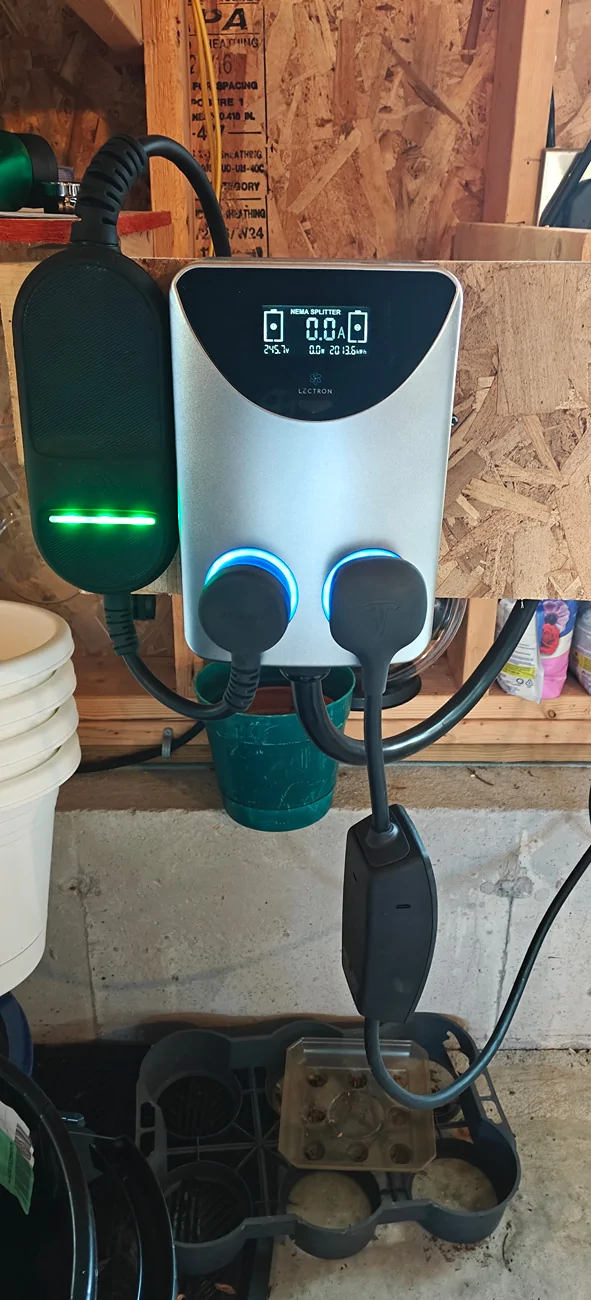
This is a photo the NEMA splitter I am using with the Rivian L2 on the A side and the Tesla L2 on the B side. The splitter plugs into the NEMA 14-50 socket on the wall behind. This wiring (splitter to outlet) never gets hot, nor does the Rivian A side when in use.

The NEMA 14-50 plug was selected and installed by an electician based on the Rivian L2 home charging requirements guide (attached).

I bought this particular splitter because it has an overload circuit breaker built into it.

The heat comes from the plug going from the splitter to the Tesla L2 charger, the charger, of itself, and the cable going from the charger to the car when plugged in. Very warm to the touch; more so than I was expecting. Consistent heat through the whole Tesla charging assembly.

The maximum amperage is 32amps. Both vehicles are set to 32amps through their respective charging settings. Only one circuit can charge at any given time; the splitter will not allow for both to charge at once.

The garage is not heated / cooled and the ambient temperature is around 80 degrees at the moment.

So... is it that the Tesla L2 charger is just... getting overworked? The Rivian unit never gets warm.

Thanks!
Rade

Rivian R1T R1S Hot charger. IMG20260519141323
 

Attachments

Dark-Fx

Well-Known Member
First Name
Brian
Joined
Jul 15, 2020
Threads
147
Messages
13,512
Reaction score
27,264
Location
Michigan
Vehicles
R1T, R1S, Livewire One, Sierra EV, R1S
Occupation
Engineering
Clubs
 
IIRC Tesla uses higher temperature rated cabling than is typical, and takes advantage of it based on wire size. It will run hotter in identical situations. As long as it's not so hot that you can't handle the cable anymore, you're probably okay.
 

Sponsored

Thebandit

Well-Known Member
Joined
Jul 14, 2025
Threads
0
Messages
73
Reaction score
95
Location
NY
Vehicles
Subaru Crosstrek, Ascent
Honestly I'd say ditch the whole contraption and hardwire a Tesla Universal Wall Connector. It has both NACS and J1772 built in. It'll be safer and simpler.
 

jrmbadger

Well-Known Member
Joined
Jul 16, 2025
Threads
7
Messages
153
Reaction score
258
Location
USA
Vehicles
R1S (Gen 1)
Two issues that i see. First, the tesla charger is dangling from the plug. If that's the normal position, the connection with the plug will loosen over time as you've reported. I recommend going on amazon and getting a holder for it so the plug is not supporting the weight of the unit.

Second, the rivian unit is right next to the splitter. Is there heat coming from the splitter that warms up the Rivian unit? I'd also be concerned that the bend angle of those wires going into the Rivian was too extreme. Over time that can cause wires to loosen even though there is strain relief there. Loose wires = heat.

Last time I used my Rivian unit it was in the winter, but it was cold to the touch even after charging for several hours.

Are you getting errors or reduced charging? What is the actual temperature taken with a laser thermometer?

If you do decide to change things, you could get something like this: grizzl-e-duo - it's basically plug-n-play (other than you'd need an adapter possibly for your tesla).
 

JacobAZ

Well-Known Member
Joined
May 13, 2025
Threads
1
Messages
93
Reaction score
103
Location
Heber, AZ
Vehicles
2025 R1T dual large
Your setup looks fine. As another person said, supporting the Tesla charger would be good to keep pigtail from coming loose (although they fit pretty tight), but it's not an issue as is. The Rivian cable is cooler than Tesla because Rivian has 8 guage wire, while Tesla uses 10 guage (Less resistance) which is the minimum size for 32 amps and will warm up as it runs for a few hours. What you describe sounds normal, but the question is how warm is warm for Tesla. Do you have a way to check the temperature of the components? 100 degrees is fine. 120 degrees maybe hotter than it should be. Since the entire Tesla system is warm, my guess is its normal heat and you are pushing the components at their high end. Drop the Tesla side to 24 amps and it should be a lot cooler.
 

mkg3

Well-Known Member
Joined
Nov 19, 2021
Threads
90
Messages
2,787
Reaction score
3,701
Location
SoCal
Vehicles
R1S, Model 3, Outback, Artura
Clubs
 
...NEMA splitter I am using with the Rivian L2 on the A side and the Tesla L2 on the B side. The splitter plugs into the NEMA 14-50 socket on the wall behind. This wiring (splitter to outlet) never gets hot, nor does the Rivian A side when in use.
Have you tried swapping A and B plug between the Rivian and Tesla chargers? If A gets warm still with the Tesla charger, then you know for sure that it's the charger, and not the splitter B problem. Conversely, if the Rivian charger gets hot plugged into B, then you know its the splitter B issue.
 

Time2Roll

Well-Known Member
Joined
Jul 10, 2025
Threads
2
Messages
770
Reaction score
659
Location
SoCal
Vehicles
2026 R1S Quad - 2001 F150
Honestly I'd say ditch the whole contraption and hardwire a Tesla Universal Wall Connector. It has both NACS and J1772 built in. It'll be safer and simpler.
Even get two of the Tesla Wall units and network them to dynamically share power of the limited single circuit.
Sponsored


Top