JamuJoe
Well-Known Member
- First Name
- Joseph
- Joined
- Nov 19, 2020
- Threads
- 20
- Messages
- 207
- Reaction score
- 494
- Location
- Hesperus, CO
- Vehicles
- RAM 2500, Polestar 2, R1T Max Pack Performance
- Occupation
- Retired Petroleum Engineer
- Thread starter
- #1
R1T and Pebble Flow - First Journey
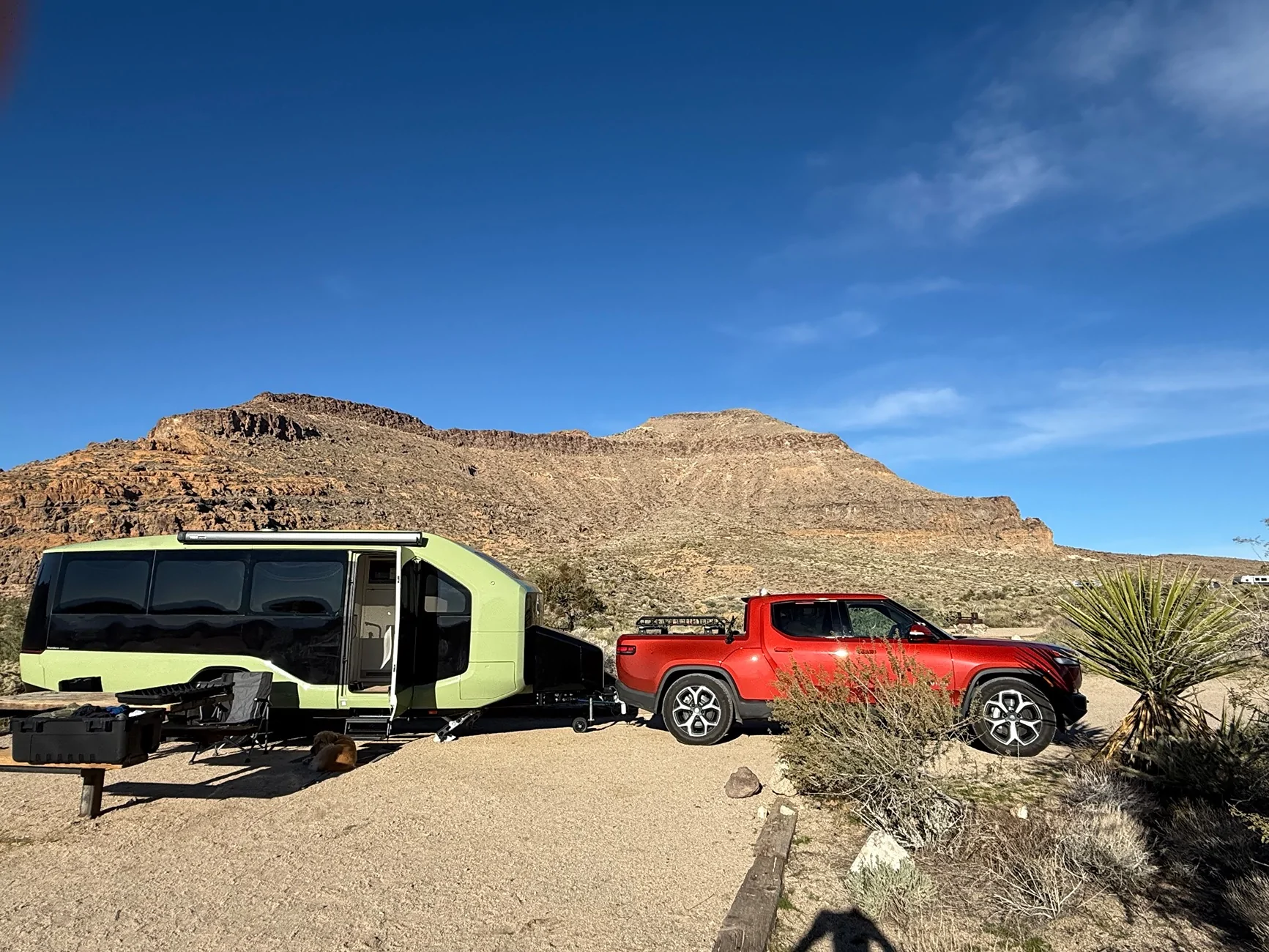
We picked up our new Pebble Flow Founders Edition at Pebble HQ in Fremont CA on 11/19/25 and began our indirect journey home to Durango CO. We’re towing with our R1T, dual motor, performance, max pack on 21” Michelin Defender LTX M/S2 tires. This same truck towed our 28’ Airstream for over 14K miles. The single axle Pebble is 24’ 8” LOA, 7’6” width, 6800 lbs GVWR and is equipped with dual electic motors and a 45kWh LFP battery pack. All utilities are electric - no propane. It rolls on 275/70R18 Goodyear Wrangler Workhorse All-season tires. The Pebble requires no WDH or sway bars, and tracked very well in all conditions thus far. A full description can be found at pebblelife.com.
One unique feature of the Pebble is Tow Assist, whereby the motors engage to offset trailer drag. These motors, remotely controlled via the iPad mini, also provide maneuverability around a camp site, driveway etc.
Tow Assist is seamless, switched on and off from the iPad. The Rivian has so much power that relieving it of trailer drag isn’t immediately perceived as a huge difference. It’s more apparent on steep grades or merging onto the interstate. One can observe the difference in efficiency after a bit, and regeneration to the Pebble pack during downgrades or braking is displayed on the Pebble app. alongside solar input. I noted 6.4kW on some long downgrades.
The Pebble has great aerodynamics, with no aircon units on top, minimal vents and recessed solar panels. The Aero Box on the bow (covering the 15,000 BTU heat pump) raises for towing, presenting a clean entry. The R1T was not as sleek on this trip, with two cargo boxes atop the bed, so some efficiency loss there.
Efficiency varies with a number of factors, short run comparisons are not statistically valid, and I realize that these early results are hardly scientific, but do offer a glimpse at the benefit of Tow Assist. Interstate driving is generally my worst efficiency. I tow at 65 mph. and am buffeted by the bow waves of passing semis.
My ‘baseline’ efficiency for comparison was an average 1.1 mi/kWh for our 7500 lb Airstream 28, over 14,000 miles.
The Rivian recalculates trailer weight after every hitch-up and a few miles of towing, rounding to nearest 500 lbs. One can also force a recalculation from the trailer display. Without Tow Assist the Rivian estimated the weight of trailer at 6500 lbs. With Tow Assist the Rivian in motion recalculated the weight of trailer at 5000 lbs.
With Tow assist, a 168 mile run on I40 at 65mph yielded efficiency of 1.76 mi/kWh.
We left Gallup NM after charging at the RAN to 94%. Having made the run from Holbrook to Gallup without Tow Assist, the navigation system estimated our home arrival SOC at 4%. A bit risky, as there is but one fast charger en route, and that at a GM dealership in Farmington with uncertain availability. I’ve had to stop there with the Airstream, and it’s awkward. We rolled and I activated Tow Assist. I towed at 65 mph, but this time on NM 491 with little traffic. The estimated arrival SOC increased to 26%. No charging stop required! We arrived home after 156 miles and 1200 ft of elevation gain with exactly that 26% SOC, in a brisk 30F.
We look forward to many great trips next year, but now it’s snowing and time for covered winter storage.

We picked up our new Pebble Flow Founders Edition at Pebble HQ in Fremont CA on 11/19/25 and began our indirect journey home to Durango CO. We’re towing with our R1T, dual motor, performance, max pack on 21” Michelin Defender LTX M/S2 tires. This same truck towed our 28’ Airstream for over 14K miles. The single axle Pebble is 24’ 8” LOA, 7’6” width, 6800 lbs GVWR and is equipped with dual electic motors and a 45kWh LFP battery pack. All utilities are electric - no propane. It rolls on 275/70R18 Goodyear Wrangler Workhorse All-season tires. The Pebble requires no WDH or sway bars, and tracked very well in all conditions thus far. A full description can be found at pebblelife.com.
One unique feature of the Pebble is Tow Assist, whereby the motors engage to offset trailer drag. These motors, remotely controlled via the iPad mini, also provide maneuverability around a camp site, driveway etc.
Tow Assist is seamless, switched on and off from the iPad. The Rivian has so much power that relieving it of trailer drag isn’t immediately perceived as a huge difference. It’s more apparent on steep grades or merging onto the interstate. One can observe the difference in efficiency after a bit, and regeneration to the Pebble pack during downgrades or braking is displayed on the Pebble app. alongside solar input. I noted 6.4kW on some long downgrades.
The Pebble has great aerodynamics, with no aircon units on top, minimal vents and recessed solar panels. The Aero Box on the bow (covering the 15,000 BTU heat pump) raises for towing, presenting a clean entry. The R1T was not as sleek on this trip, with two cargo boxes atop the bed, so some efficiency loss there.
Efficiency varies with a number of factors, short run comparisons are not statistically valid, and I realize that these early results are hardly scientific, but do offer a glimpse at the benefit of Tow Assist. Interstate driving is generally my worst efficiency. I tow at 65 mph. and am buffeted by the bow waves of passing semis.
My ‘baseline’ efficiency for comparison was an average 1.1 mi/kWh for our 7500 lb Airstream 28, over 14,000 miles.
The Rivian recalculates trailer weight after every hitch-up and a few miles of towing, rounding to nearest 500 lbs. One can also force a recalculation from the trailer display. Without Tow Assist the Rivian estimated the weight of trailer at 6500 lbs. With Tow Assist the Rivian in motion recalculated the weight of trailer at 5000 lbs.
With Tow assist, a 168 mile run on I40 at 65mph yielded efficiency of 1.76 mi/kWh.
We left Gallup NM after charging at the RAN to 94%. Having made the run from Holbrook to Gallup without Tow Assist, the navigation system estimated our home arrival SOC at 4%. A bit risky, as there is but one fast charger en route, and that at a GM dealership in Farmington with uncertain availability. I’ve had to stop there with the Airstream, and it’s awkward. We rolled and I activated Tow Assist. I towed at 65 mph, but this time on NM 491 with little traffic. The estimated arrival SOC increased to 26%. No charging stop required! We arrived home after 156 miles and 1200 ft of elevation gain with exactly that 26% SOC, in a brisk 30F.
We look forward to many great trips next year, but now it’s snowing and time for covered winter storage.
Sponsored