Sponsored

Thebandit

Well-Known Member
Joined
Jul 14, 2025
Threads
2
Messages
235
Reaction score
365
Location
NY
Vehicles
Subaru Crosstrek, Ascent
I totally agree it would be useful, but at what speed? What elevation? What temperature? What wind conditions? No one combination will be representative of most peoples use cases.

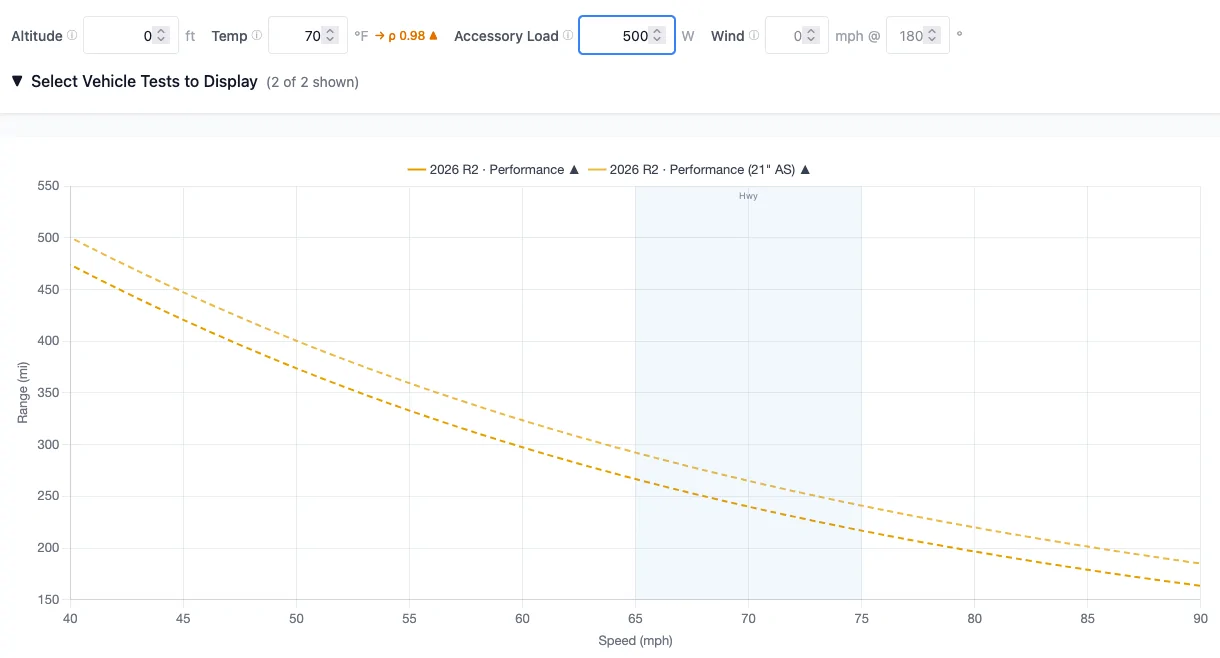
Some calculated example points from the R2 EPA filings below.

Just between 100F and 72F there's a 22 mile range difference. And a 22mi difference between sea level and Denver. Slowing 10mph from 70 to 60 gains 58mi.


Speed (mph)Elevation (ft)Temperature (ºF)Wind @ angle (mph)Range (mi)
600720324
700720266
800720220
705000720288
7050007215 @ 90º281
7007215 @ 90º259
7007215 @ 180º210
700320244
7001000262

1785137882336-33.webp
Why not measure and publish a few? Measure and publish flat-road, 60 degree efficiency at 40, 60, and 80 mph in addition to the conventional/combined city and highway numbers. It's a pretty easy measurement to do.
Sponsored


mkhuffman

Well-Known Member
First Name
Mike
Joined
Nov 9, 2020
Threads
14
Messages
3,100
Reaction score
3,578
Location
Virginia
Vehicles
2025 R1T Tri-Max, Jeep GC-L, VW Jetta
I totally agree it would be useful, but at what speed? What elevation? What temperature? What wind conditions? No one combination will be representative of most peoples use cases.

Some calculated example points from the R2 EPA filings below.

Just between 100F and 72F there's a 22 mile range difference. And a 22mi difference between sea level and Denver. Slowing 10mph from 70 to 60 gains 58mi.


Speed (mph)Elevation (ft)Temperature (ºF)Wind @ angle (mph)Range (mi)
600720324
700720266
800720220
705000720288
7050007215 @ 90º281
7007215 @ 90º259
7007215 @ 180º210
700320244
7001000262

1785137882336-33.webp
IMO the current EPA tests are pretty accurate for typical driving, and they are much more accurate than the WLTP one the EU mandates. Imagine how pissed off the average consumer in the EU must be when they never hit WLTP range estimates.

It is long distance highway driving that EPA fails to be useful for. As you point out, creating a highway test that is representative of everyone's environment and vehicle condition is impossible.

However, a steady state 75 mph range test in controlled conditions would be hugely beneficial for buyers. While people might not be able to always match the conditions in that test, at least it would be a benchmark buyers could use to compare highway performance of different BEVs.

C&D does a 75-mph range test. It takes them a while for them to obtain a vehicle to do the test, and I doubt they have done the R2 yet. And not everyone knows about the test and knows where to look to find it.

I drive faster than 75 on the highway, but I think 75 is still a good benchmark as maintaining 80+ is only common on short stretches in congested areas where most people live. I know, Utah and Texas. And Germany. LOL.
 

Indy avocado

Well-Known Member
First Name
Greg
Joined
Dec 17, 2022
Threads
3
Messages
257
Reaction score
374
Location
Indiana / Switzerland
Website
evbench.pluginpath.com
Vehicles
'22 R1T, '20 Honda E, '23 VW California
Why not measure and publish a few? Measure and publish flat-road, 60 degree efficiency at 40, 60, and 80 mph in addition to the conventional/combined city and highway numbers. It's a pretty easy measurement to do.
IMO the current EPA tests are pretty accurate for typical driving, and they are much more accurate than the WLTP one the EU mandates. Imagine how pissed off the average consumer in the EU must be when they never hit WLTP range estimates.

It is long distance highway driving that EPA fails to be useful for. As you point out, creating a highway test that is representative of everyone's environment and vehicle condition is impossible.

However, a steady state 75 mph range test in controlled conditions would be hugely beneficial for buyers. While people might not be able to always match the conditions in that test, at least it would be a benchmark buyers could use to compare highway performance of different BEVs.

C&D does a 75-mph range test. It takes them a while for them to obtain a vehicle to do the test, and I doubt they have done the R2 yet. And not everyone knows about the test and knows where to look to find it.

I drive faster than 75 on the highway, but I think 75 is still a good benchmark as maintaining 80+ is only common on short stretches in congested areas where most people live. I know, Utah and Texas. And Germany. LOL.

One thing to consider is how would they actually accomplish these tests?

Best case scenario would be a rolling road dyno inside of wind tunnel.

Those things cost hundreds of thousands of dollars per hour to run.

You can't run them outside because you can't control all the atmosphere conditions.

If you just want them run on the dyno, then the charts I've been making from EPA submissions already contain that data.
 

VegasWeezy

Well-Known Member
First Name
Brian
Joined
Mar 7, 2024
Threads
3
Messages
175
Reaction score
316
Location
Las Vegas, NV
Vehicles
2022 Mach E Premium
Occupation
Accountant
Why not measure and publish a few? Measure and publish flat-road, 60 degree efficiency at 40, 60, and 80 mph in addition to the conventional/combined city and highway numbers. It's a pretty easy measurement to do.
Because the general public isn’t very bright, and this would amount to information overload. It would overwhelm the average person and they would be clamoring to go back to a single comparable figure across all vehicles.
 

Redmond Chad

Well-Known Member
Joined
Oct 14, 2022
Threads
4
Messages
298
Reaction score
457
Location
Redmond, WA
Vehicles
R1S (LG, FE, 20"), Tesla Model X
Clubs
 
It certainly is complicated. No single number will ever work for everyone. More data can help (I suspect this is true for most of us in this thread), but it can also confuse. I have written public documents with numbers that I tried hard to make simple, but there just always seems to be some level of confusion in the general public. The EPA publishes 3 numbers (city, highway, combined) and i have seen plenty of online confusion about just those. I have seen a document from the EPA that confirmed that avoiding public confusion is why they don't publish more numbers. (I have not seen something from them that explains why they allow multiple tests).

This isn't just an EV problem. I used to have a Honda insight. I got 62 miles per gallon. The official rating was 66, IIRC. Hypermilers in Florida were getting 90. A car magazine ran one around a track and got 18 (the BMW 3-series that they ran with it did better). There can be quite a spread depending on what you are doing. Online forums were full of complaints from people disappointed in what they were getting. The threads sounded...a lot like this one.
 
Last edited:

Sponsored

CrazyOne

Well-Known Member
Joined
Oct 30, 2021
Threads
3
Messages
1,436
Reaction score
1,231
Location
WA
Vehicles
R1T
Because the general public isn’t very bright, and this would amount to information overload. It would overwhelm the average person and they would be clamoring to go back to a single comparable figure across all vehicles.
When you treat people like they are dumb, it's a self fulfilling prophecy.
 

ksurfier

Well-Known Member
First Name
Ken
Joined
Aug 23, 2022
Threads
55
Messages
1,221
Reaction score
1,163
Location
CA
Vehicles
R1S, Tesla
Occupation
Fake Science Lead
Clubs
 
In the end, I'm more disappointed that Rivian EPA isn't closer to real world. Its Tesla's playbook from 5 years ago. Tesla actually gets EPA or much much closer these days. The Model Y is more efficient at every single speed and situation from the tests that Kyle ran. I was hoping Rivian held itself to a higher standard and was more trustworthy but I guess not.

If Rivian was just more conservative and said that their car did 300 miles EPA, then expectations vs. reality would be more aligned and trust would be much higher.

BTW, the new MYP uses NCMA cells so degradation may be much better than the NCA cells used in the other Model Y variants.
This is spot on and exactly what I found in the 2026 R1S DM Standard...Rivian cooked the books and tried to claim that it gets ~250 miles with the much smaller battery pack. I'm not sure when but Rivian started using a different way to get the EPA range and it grossly exagerates the 'Highway' range...it's a stark reminder of how important the real world testing is since all the EPA values are completely unreliable.
 

AmpedToGo

Member
First Name
David
Joined
Jul 8, 2026
Threads
0
Messages
9
Reaction score
11
Location
Seattle
Vehicles
Tesla Model 3, Tesla Model Y; R2 Reservation holder
Occupation
Retired
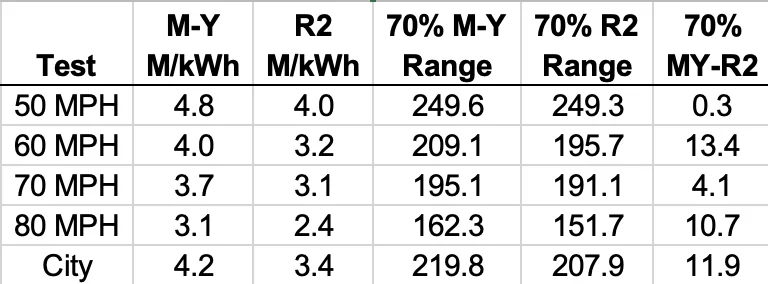
My take: R2 can handle all the same long road trip segments we do today in our 2020 Model Y. The range seems to be within ~15 miles of Model Y range at each speed tested. Showing range using 70% of battery capacity because we avoid charging above 90% on long drives and try to arrive at ~20% SoC. The numbers are similar for 100%.
Rivian R1T R1S 2027 R2 Performance vs. 2026 Model Y Performance - highway efficiency test (Out of Spec comparison) 1785171232142-qk


Spreadsheet here.
 

Mark_AZR1T

Well-Known Member
Site Sponsor
First Name
Mark
Joined
May 28, 2021
Threads
43
Messages
2,259
Reaction score
3,950
Location
Gilbert, AZ
Website
jackpucks.com
Vehicles
R1T Launch, R1S Canyon Red
Clubs
 
I really like this car, but these are potential deal-breakers for me:

1. The reliability of a very early-production vehicle, on top of Rivian’s poor reliability record in general

2. Worse real-world efficiency

3. A/C performance combined with the glass roof’s poor heat protection

4. Questionable seat design and comfort

5. A potentially problematic navigation system and no CarPlay

6. A potentially significant drop in resale value due to obsolete hardware when Gen 3 replaces it

7. The likely need to sell it before the warranty expires because repairs could be extremely expensive

8. The high price for a car that does not offer great range, especially when I could get a Subaru EV for much less with dealer and California discounts, almost at a used-car price
You're definitely not a candidate for an R2
 

Mark_AZR1T

Well-Known Member
Site Sponsor
First Name
Mark
Joined
May 28, 2021
Threads
43
Messages
2,259
Reaction score
3,950
Location
Gilbert, AZ
Website
jackpucks.com
Vehicles
R1T Launch, R1S Canyon Red
Clubs
 
It certainly is complicated. No single number will ever work for everyone. More data can help (I suspect this is true for most of us in this thread), but it can also confuse. I have written public documents with numbers that I tried hard to make simple, but there just always seems to be some level of confusion in the general public. The EPA publishes 3 numbers (city, highway, combined) and i have seen plenty of online confusion about just those. I have seen a document from the EPA that confirmed that avoiding public confusion is why they don't publish more numbers. (I have not seen something from them that explains why they allow multiple tests).

This isn't just an EV problem. I used to have a Honda insight. I got 62 miles per gallon. The official rating was 66, IIRC. Hypermilers in Florida were getting 90. A car magazine ran one around a track and got 18 (the BMW 3-series that they ran with it did better). There can be quite a spread depending on what you are doing. Online forums were full of complaints from people disappointed in what they were getting. The threads sounded...a lot like this one.
Yes, it’s complicated. Highway efficiency matters, especially since 92% of my Arizona–San Diego trip is freeway at 75–78 mph. But I care more about real-world range and charging speed than efficiency alone.

As @AmpedToGo said, give me a slightly larger battery that delivers nearly the same total range, paired with a much faster charging curve, and I’ll gladly accept the efficiency hit. I also don’t care if it costs a little more to charge. We’re not talking Hummer EV or Escalade IQ battery sizes.

And before anyone says, "Just buy a Model Y," you couldn't pay me to own one... well, I did own one once. 😉
 

Sponsored

Redmond Chad

Well-Known Member
Joined
Oct 14, 2022
Threads
4
Messages
298
Reaction score
457
Location
Redmond, WA
Vehicles
R1S (LG, FE, 20"), Tesla Model X
Clubs
 
I've had several Teslas, including a Model Y - that's what I traded in on my R1S. I enjoyed it, especially the driving characteristics and efficiency. Efficiency has always mattered to me.

But being able to easily haul around the grandkids and all of their stuff, and feel better about driving to trailheads, also matter to me. So I decided on an R2 over another Model Y. At the time I ordered (maybe a month ago?) I was sure the R2 wasn't going to be as efficient at highway speeds, but I don't do that much - we like to roadtrip, but we take my wife's Model X (she has a bad back and its seats work well for her - and, it has free supercharging). Even if I do take the R2 somewhere without my wife, I figured the bigger battery and faster charging would make up for at least most of the difference. If it's something I only do once a year, it doesn't have to be the fastest possible. Everything on the market is much faster than the EVs I was road-tripping in 15 years ago.

At the time I placed the order for my R2, from looking at the EPA numbers I thought the R2 might actually match the Y around town, which is where I will do almost all of my driving. But from more recent tests, it looks like it will not. That is a bummer, but I still think the R2 will be a great fit for me. As much as I value good efficiency, there are other things that matter as well - otherwise we would all drive a Model 3 or Lucid Air Pure. You have to settle for the best overall package for you - everyone has different needs, and no single car is the best at everything!
 
Last edited:

shandering

Well-Known Member
First Name
Shane
Joined
May 26, 2026
Threads
0
Messages
174
Reaction score
109
Location
Atlanta
Vehicles
Polestar 2
Occupation
Artist
I think with the 18” original aero wheels it was more like 8%

update: I guess various testing put it between 3.5-5%.
3.5-5% at high speed.
At city driving speed (below 40mph) no difference

Wheel noise is a little higher but at low speed it's probably also not a problem

if you're not road tripping there is no difference and even losing 10 miles of range when road tripping is not a problem for most people. I think it's fair to remove them if you want
 

tivoboy

Well-Known Member
First Name
Paul
Joined
Nov 8, 2025
Threads
3
Messages
420
Reaction score
516
Location
Palo Alto, CA
Vehicles
M3
3.5-5% at high speed.
At city driving speed (below 40mph) no difference

Wheel noise is a little higher but at low speed it's probably also not a problem

if you're not road tripping there is no difference and even losing 10 miles of range when road tripping is not a problem for most people. I think it's fair to remove them if you want
Well of course at low speed has no effect. At speeds under <50 it’s all just about weight.
 

Eric9610

Well-Known Member
Joined
Nov 27, 2023
Threads
16
Messages
869
Reaction score
1,003
Location
So. Cal.
Vehicles
R1T QM, R1S QM, MB E350, MB S63C
Clubs
 
The 2 test methods exist for a reason. Some car companies don't want to waste cost on extra prototypes for the 5 cycle test. Usually, every car tested in the 2 cycle test scores more real world because its an average oof only 2 cycles. With the 5 cycle it will always be equal or less as it's a true indication of actual range. Companies pick the 5 cycle to have a higher rated range, and the 2 cycle gives you a higher actual range. All cars should be forced to use 2 cycle.

The R2 would probably be rated at 275 with 21's and 235 with 20's on a 2 cycle and now you see the problem..
 

JeffnReno

Well-Known Member
First Name
Jeffrey
Joined
Jun 13, 2026
Threads
2
Messages
70
Reaction score
53
Location
Reno, NV
Vehicles
2016 Nissan Rogue, 2018 Tesla Model 3 LRrwd, 2023 Tesla Model Y LR
Occupation
Retired
Clubs
 
In the end, I'm more disappointed that Rivian EPA isn't closer to real world. Its Tesla's playbook from 5 years ago. Tesla actually gets EPA or much much closer these days. The Model Y is more efficient at every single speed and situation from the tests that Kyle ran. I was hoping Rivian held itself to a higher standard and was more trustworthy but I guess not.

If Rivian was just more conservative and said that their car did 300 miles EPA, then expectations vs. reality would be more aligned and trust would be much higher.

BTW, the new MYP uses NCMA cells so degradation may be much better than the NCA cells used in the other Model Y variants.
When we got our '23 Model Y, the rated range was 330 and the day I picked it up I extrapolated 228 so figured close enough. A few weeks later, the EPA told them they would need to recalculate and Tesla dropped the range to 308 overnight. Now after 42k miles it shows 229 at 80% or extrapolates to 286 for 100%. Still works fine for our needs but not what we bought at the time so there's that...:rolleyes:
Sponsored


Top