Sponsored

Towing + Efficiency: Please post your experience!

Thedude

Well-Known Member
Joined
Oct 28, 2022
Threads
4
Messages
1,637
Reaction score
2,929
Location
Alaska
Vehicles
R1T
It's not a surprise because it's a well-known fact that towing with an ICE vehicle will also cut your range by 50%. You just start off with more range in an ICE is all.
My experience with ICE towing is not as dramatic a loss. Depending on what truck I had at the time they didn’t start with more range either. The difference is 10 minutes to get back in the road versus an hour or more.
Sponsored


DrR1T

Member
First Name
Jake
Joined
Sep 24, 2022
Threads
0
Messages
5
Reaction score
5
Location
PA
Vehicles
R1T
Occupation
Doc
That's not a surprise though, it's a well known fact that towing with an electric cuts the range by 50% or more.
I think the quick availability of gas and my prior 36gallon F150 with a 300 mile towing range is what I comparing to. EV world has its pains but I spend way more time driving without towing and enjoy the truck so much that I would never go back.
 

Thedude

Well-Known Member
Joined
Oct 28, 2022
Threads
4
Messages
1,637
Reaction score
2,929
Location
Alaska
Vehicles
R1T
I think the quick availability of gas and my prior 36gallon F150 with a 300 mile towing range is what I comparing to. EV world has its pains but I spend way more time driving without towing and enjoy the truck so much that I would never go back.
Best truck for towing I’ve owned, unfortunately the range limitations did it in for me. Too many times the truck prevented me from doing what I wanted to do so it had to go. I’m very impatiently waiting for new battery and charging tech to come along so I can buy another EV truck.
 

VSG

Well-Known Member
Joined
Oct 3, 2022
Threads
4
Messages
3,205
Reaction score
5,991
Location
WA
Vehicles
R1T LE/RB/OC/20
My experience with ICE towing is not as dramatic a loss.
As long as you compare like to like, there should be no difference in range loss between ICE and EV. Compare ICE F-150 to EV F-150 - with the same shape and coefficient of drag, they have to use approximately the same amount of energy to travel a certain route without a trailer. And with a trailer, the extra energy needed is the same for both vehicles. So the range loss must be approximately the same in both cases.

Of course if you're comparing a full-sized ICE pickup to an EV Tesla, or even to a mid-size EV pickup like the R1T, the vehicle coefficient of drag is going to be much different (much lower for the EV), so the EV will suffer more from the same trailer. But that's not comparing like to like.

In my experience most ICE owners seem oblivious to how things affect their range - whether it's roof racks, brush guards, winches, flood lights, pushed-out wheels, knobby tires, roof top tents, etc.; people will say their mileage is "about the same" with these as without. It's only because EVs make range and mileage so front-and-center, and because of range anxiety from a sparse charging network, that people become hyper focused on how all these things affect their range. Maybe you didn't really know that your old tow vehicle was only getting 8mpg when towing if you didn't explicitly calculate it and just stopped to fill up when you needed to like you always do. With an EV you have to plan ahead more, so it's hard to ignore that you're going to spend twice as long charging when towing, while with an ICE you don't really notice the twice as many stops because you have to stop once in a while anyway and because those stops are relatively short with little waiting around.

Rivian warns you up front to expect up to a 50% range loss when towing, but anyone who has towed before should, IMO, already expect a huge range loss like this. I don't see how the R1T's towing performance can be characterized as "disappointing" just because it's not suited to a specific use case.

And that's my point - I'm not claiming (and neither is Rivian) that the R1T is the best tow vehicle for all use cases. I'm saying buy the vehicle that fits your realistic needs. There is so much "not a real truck" negativity directed towards Rivians and EVs in general that I think it's important not to blame the vehicle when it doesn't turn out to be well-suited for everyone and for every use. There are compromises with every vehicle choice - a dualie may be a great tow vehicle for your fifth wheeler but boy does it suck for a lot of other uses. For MY needs, the R1T checks all the boxes - that's why I bought one - but if my needs were significantly different than the target market I might have made a different choice.
 

Thedude

Well-Known Member
Joined
Oct 28, 2022
Threads
4
Messages
1,637
Reaction score
2,929
Location
Alaska
Vehicles
R1T
As long as you compare like to like, there should be no difference in range loss between ICE and EV. Compare ICE F-150 to EV F-150 - with the same shape and coefficient of drag, they have to use approximately the same amount of energy to travel a certain route without a trailer. And with a trailer, the extra energy needed is the same for both vehicles. So the range loss must be approximately the same in both cases.

Of course if you're comparing a full-sized ICE pickup to an EV Tesla, or even to a mid-size EV pickup like the R1T, the vehicle coefficient of drag is going to be much different (much lower for the EV), so the EV will suffer more from the same trailer. But that's not comparing like to like.

In my experience most ICE owners seem oblivious to how things affect their range - whether it's roof racks, brush guards, winches, flood lights, pushed-out wheels, knobby tires, roof top tents, etc.; people will say their mileage is "about the same" with these as without. It's only because EVs make range and mileage so front-and-center, and because of range anxiety from a sparse charging network, that people become hyper focused on how all these things affect their range. Maybe you didn't really know that your old tow vehicle was only getting 8mpg when towing if you didn't explicitly calculate it and just stopped to fill up when you needed to like you always do. With an EV you have to plan ahead more, so it's hard to ignore that you're going to spend twice as long charging when towing, while with an ICE you don't really notice the twice as many stops because you have to stop once in a while anyway and because those stops are relatively short with little waiting around.

Rivian warns you up front to expect up to a 50% range loss when towing, but anyone who has towed before should, IMO, already expect a huge range loss like this. I don't see how the R1T's towing performance can be characterized as "disappointing" just because it's not suited to a specific use case.

And that's my point - I'm not claiming (and neither is Rivian) that the R1T is the best tow vehicle for all use cases. I'm saying buy the vehicle that fits your realistic needs. There is so much "not a real truck" negativity directed towards Rivians and EVs in general that I think it's important not to blame the vehicle when it doesn't turn out to be well-suited for everyone and for every use. There are compromises with every vehicle choice - a dualie may be a great tow vehicle for your fifth wheeler but boy does it suck for a lot of other uses. For MY needs, the R1T checks all the boxes - that's why I bought one - but if my needs were significantly different than the target market I might have made a different choice.
You pretty much just typed out a bunch of paragraphs repeating everything I said. There is no disagreement here.
 

Sponsored

Epicloop

Well-Known Member
First Name
Ray
Joined
Jun 3, 2023
Threads
11
Messages
541
Reaction score
378
Location
British Columbia
Vehicles
R1S
Occupation
Electrical Contractor
I have an R1T. 20 inch AT’s, and I haul a loadrite Tritoon trailer and southbay 24’ Tritoon. Probably about 5000 pounds. I drive ocean city Maryland coastal driving and 100 miles took me from 100% charge to 13%. Meaning I really have never been able to get more than about 100 miles of range towing my boat. Very disappointing numbers from a truck I absolutely love.
At what speed was that?
 

Mickey

Well-Known Member
First Name
Mickey
Joined
Oct 26, 2022
Threads
0
Messages
83
Reaction score
74
Location
Hoover, Alabama
Vehicles
R1T
Occupation
Retired
As long as you compare like to like, there should be no difference in range loss between ICE and EV. Compare ICE F-150 to EV F-150 - with the same shape and coefficient of drag, they have to use approximately the same amount of energy to travel a certain route without a trailer. And with a trailer, the extra energy needed is the same for both vehicles. So the range loss must be approximately the same in both cases.

Of course if you're comparing a full-sized ICE pickup to an EV Tesla, or even to a mid-size EV pickup like the R1T, the vehicle coefficient of drag is going to be much different (much lower for the EV), so the EV will suffer more from the same trailer. But that's not comparing like to like.

In my experience most ICE owners seem oblivious to how things affect their range - whether it's roof racks, brush guards, winches, flood lights, pushed-out wheels, knobby tires, roof top tents, etc.; people will say their mileage is "about the same" with these as without. It's only because EVs make range and mileage so front-and-center, and because of range anxiety from a sparse charging network, that people become hyper focused on how all these things affect their range. Maybe you didn't really know that your old tow vehicle was only getting 8mpg when towing if you didn't explicitly calculate it and just stopped to fill up when you needed to like you always do. With an EV you have to plan ahead more, so it's hard to ignore that you're going to spend twice as long charging when towing, while with an ICE you don't really notice the twice as many stops because you have to stop once in a while anyway and because those stops are relatively short with little waiting around.

Rivian warns you up front to expect up to a 50% range loss when towing, but anyone who has towed before should, IMO, already expect a huge range loss like this. I don't see how the R1T's towing performance can be characterized as "disappointing" just because it's not suited to a specific use case.

And that's my point - I'm not claiming (and neither is Rivian) that the R1T is the best tow vehicle for all use cases. I'm saying buy the vehicle that fits your realistic needs. There is so much "not a real truck" negativity directed towards Rivians and EVs in general that I think it's important not to blame the vehicle when it doesn't turn out to be well-suited for everyone and for every use. There are compromises with every vehicle choice - a dualie may be a great tow vehicle for your fifth wheeler but boy does it suck for a lot of other uses. For MY needs, the R1T checks all the boxes - that's why I bought one - but if my needs were significantly different than the target market I might have made a different choice.
My complaint concerning the towing is the Range Estimation provided on the screen. Yes... about a 50% reduction from non-towing is certainly expected when towing, it's just that EVs have a "little tank", and this makes towing less enjoyable. The towing Range Estimation cannot be used in trip planning because it is not very useful, and the number will drop like a deflating balloon as you get closer to your destination. Additionally, I find that you may charge enough to go, say, 50 miles but only need 25 to a destination. DO NOT believe this. I drove very conservatively and witnessed drastic drops in remaining charge estimates. 50 miles will drop to 40, 30, and even 20 miles remaining ... but I needed to go 20 miles. What happened to my range buffer?? Oh Crap! Now the range is estimating I only have enough towing range to go 10 miles and I have 14 to go! Now the R1T is at ZERO and warning me to "pull over and call for a tow"!!!

PLEASE RIVIAN, ARE YOU READING THIS? There are a lot of Rivian owners who want to use their vehicle for towing. PLEASE CORRECT THIS PROBLEM ASAP.
 
Last edited:

VSG

Well-Known Member
Joined
Oct 3, 2022
Threads
4
Messages
3,205
Reaction score
5,991
Location
WA
Vehicles
R1T LE/RB/OC/20
The towing Range Estimation cannot be used in trip planning because it is not very useful
Are you talking about the range at destination number shown on the center screen when navigating? A huge consideration with this is that your Rivian has absolutely no way of knowing what you're towing and what sort of a range reduction will result - it has to learn that over time. I don't think there's any way for Rivian to do anything but provide an initial guess number for you then modify it gradually over time to converge on a better number based on your load and driving and route. A nice-to-have feature would be trailer profiles, so that you could have your vehicle learn different trailers and perhaps be able to set a better guess of a number up front before the learning begins.

Or, are you talking about the "range" remaining in the battery pack, as displayed on the driver's screen? That is not a range estimation, it is a "fuel" gauge. It's better IMO to set this to show % only, because "miles" is just the EPA number for your driving mode times the battery percentage, which has little relevance when towing.
 

Mickey

Well-Known Member
First Name
Mickey
Joined
Oct 26, 2022
Threads
0
Messages
83
Reaction score
74
Location
Hoover, Alabama
Vehicles
R1T
Occupation
Retired
Are you talking about the range at destination number shown on the center screen when navigating? A huge consideration with this is that your Rivian has absolutely no way of knowing what you're towing and what sort of a range reduction will result - it has to learn that over time. I don't think there's any way for Rivian to do anything but provide an initial guess number for you then modify it gradually over time to converge on a better number based on your load and driving and route. A nice-to-have feature would be trailer profiles, so that you could have your vehicle learn different trailers and perhaps be able to set a better guess of a number up front before the learning begins.

Or, are you talking about the "range" remaining in the battery pack, as displayed on the driver's screen? That is not a range estimation, it is a "fuel" gauge. It's better IMO to set this to show % only, because "miles" is just the EPA number for your driving mode times the battery percentage, which has little relevance when towing.
I monitor The Efficiency Number on the Driver's display. By already having an established history of towing and non-towing, efficiency I would think the Rivian Navigation trip planning algorithms could more accurately calculate the current kWh usage and the expected available range upon arrival at a waypoint charger.

I know that my typical towing Efficiency is 1.09 kWh/mile. Therefore, I can calculate what my probable range and arrival SOC should be (but I shouldn't have to do this). However, the Navigation distance and waypoint SOC do not correlate with simple mental math from the efficiency, range estimate, distance to a waypoint (i.e. charging station), and the arrival SOC remaining numbers.

I have owned my R1T Quad for a year and found that the navigation waypoint charging "SOC upon arrival" on my truck is not reliable, especially when towing. Good navigation systems do not use EPA estimates. The actual vehicle's performance data, (which is influenced by the heaviness of your right foot and other factors), is what the algorithms use. I found that Rivian's Navigation numbers on my truck, especially when towing, are woefully inaccurate.

I establish my own charging waypoints with a 25-mile buffer to avoid any more anxious "pucker factors" when towing. Yet, as I get closer to a waypoint charging station, sometimes even this buffer (as shown on the arrival data) can quickly vanish. It is a crazy thing to watch, especially when every effort is being made to be as efficient as possible during the trip.

PLEASE, PLEASE Rivian, do something about your Navigation/Trip Planning software.
 

Sponsored

CharonPDX

Well-Known Member
First Name
Charon
Joined
Jul 12, 2021
Threads
31
Messages
2,497
Reaction score
4,171
Location
Cascadia
Vehicles
'22 R1T LE, '16 Model S, '19 Arcimoto FUV
Occupation
InfoSec Geek
Clubs
 
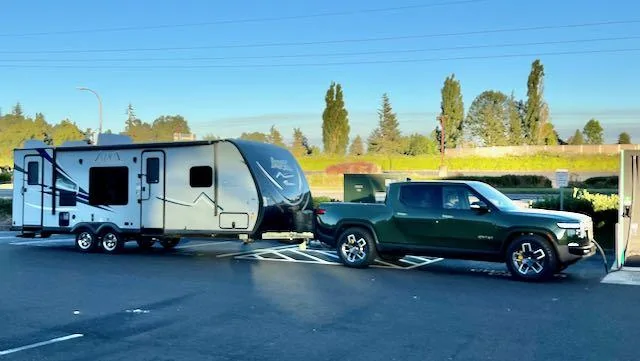
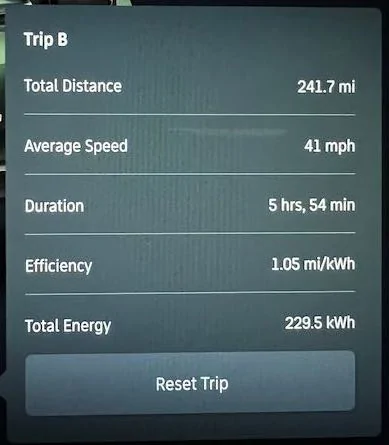
Alright, I have done quite a bit of towing with two different trailers now.

First, the big boy, 28' long, big tall wide front end, 6000-7000 lbs:
Rivian R1T R1S Towing + Efficiency: Please post your experience! IMG_7740

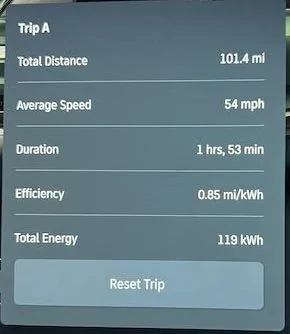
A couple trips with this trailer, this is about right for it:
Rivian R1T R1S Towing + Efficiency: Please post your experience! Apex 1
Rivian R1T R1S Towing + Efficiency: Please post your experience! Apex 2


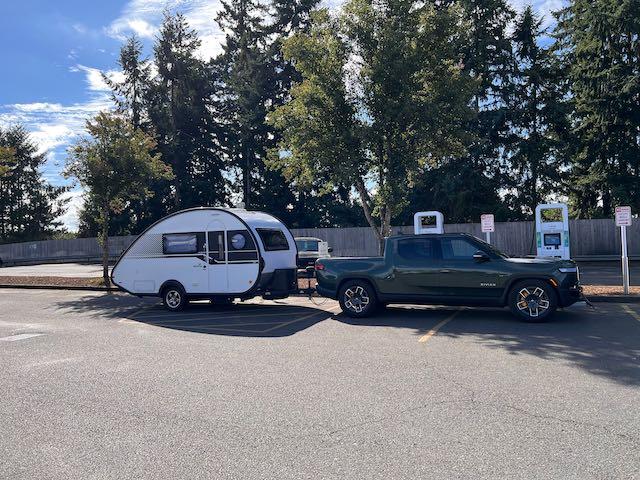
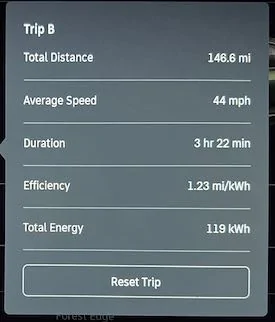
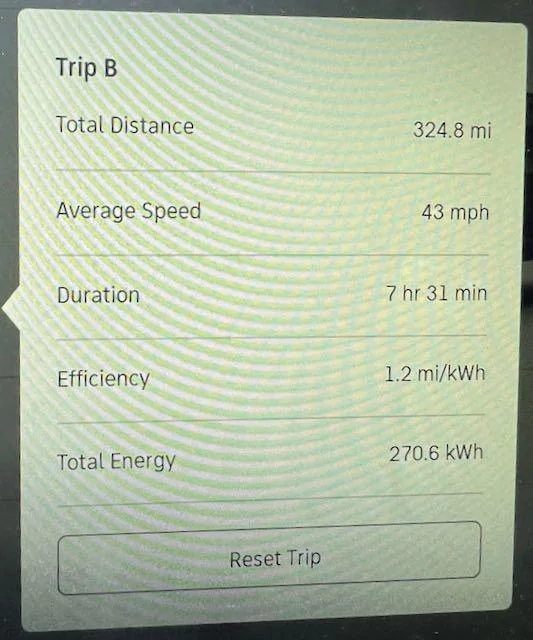
Next is the new li'l guy, 18' long, 8.5' tall, 7.5' wide, much smaller frontal area; 3000ish pounds:
Rivian R1T R1S Towing + Efficiency: Please post your experience! Tab

The "drive it home" trip and the "on the way to Fully Charge Live" trip I'm currently on; the only two trips I've taken with it since buying it two weeks ago:
Rivian R1T R1S Towing + Efficiency: Please post your experience! Tab 1
Rivian R1T R1S Towing + Efficiency: Please post your experience! Tab 2


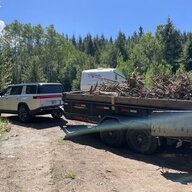
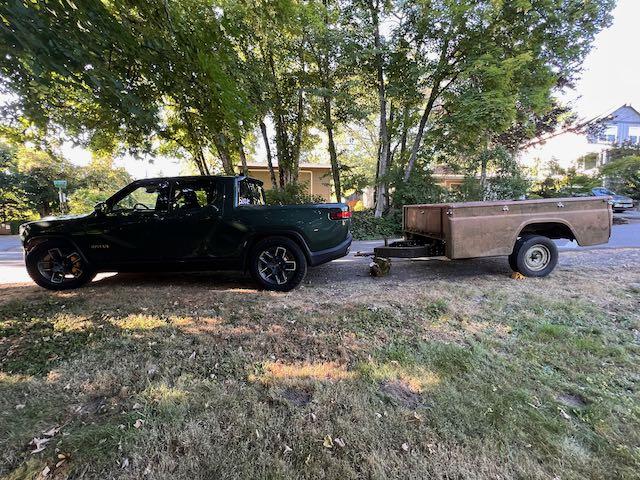
I've also driven with a small open box trailer (the bed of an ancient International Harvester pickup mounted to a basic chassis,) but that has only been around-town driving hauling things back and forth; I haven't specifically noted efficiency using it, but even with it full of a thousand or two pounds of stuff, it doesn't seem to impact efficiency much. (Although I don't think I've ever taken it on the freeway full, only empty.)
Rivian R1T R1S Towing + Efficiency: Please post your experience! Intl

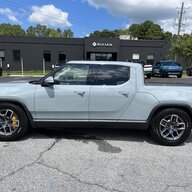
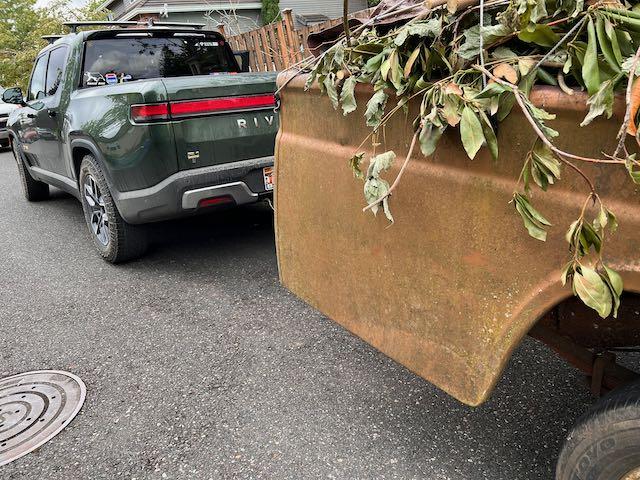
My joke is "the truck is Forest Green, the truck is moss. Not moss green; moss.
Rivian R1T R1S Towing + Efficiency: Please post your experience! Moss


And a small boat (12' ancient aluminum fishing boat, which apparently I have zero photos of?) That would also likely not impact efficiency to any noticeable degree.
 

bd5400

Well-Known Member
Joined
Oct 1, 2021
Threads
14
Messages
885
Reaction score
1,721
Location
Milwaukee
Vehicles
R1T, SL500
Clubs
 
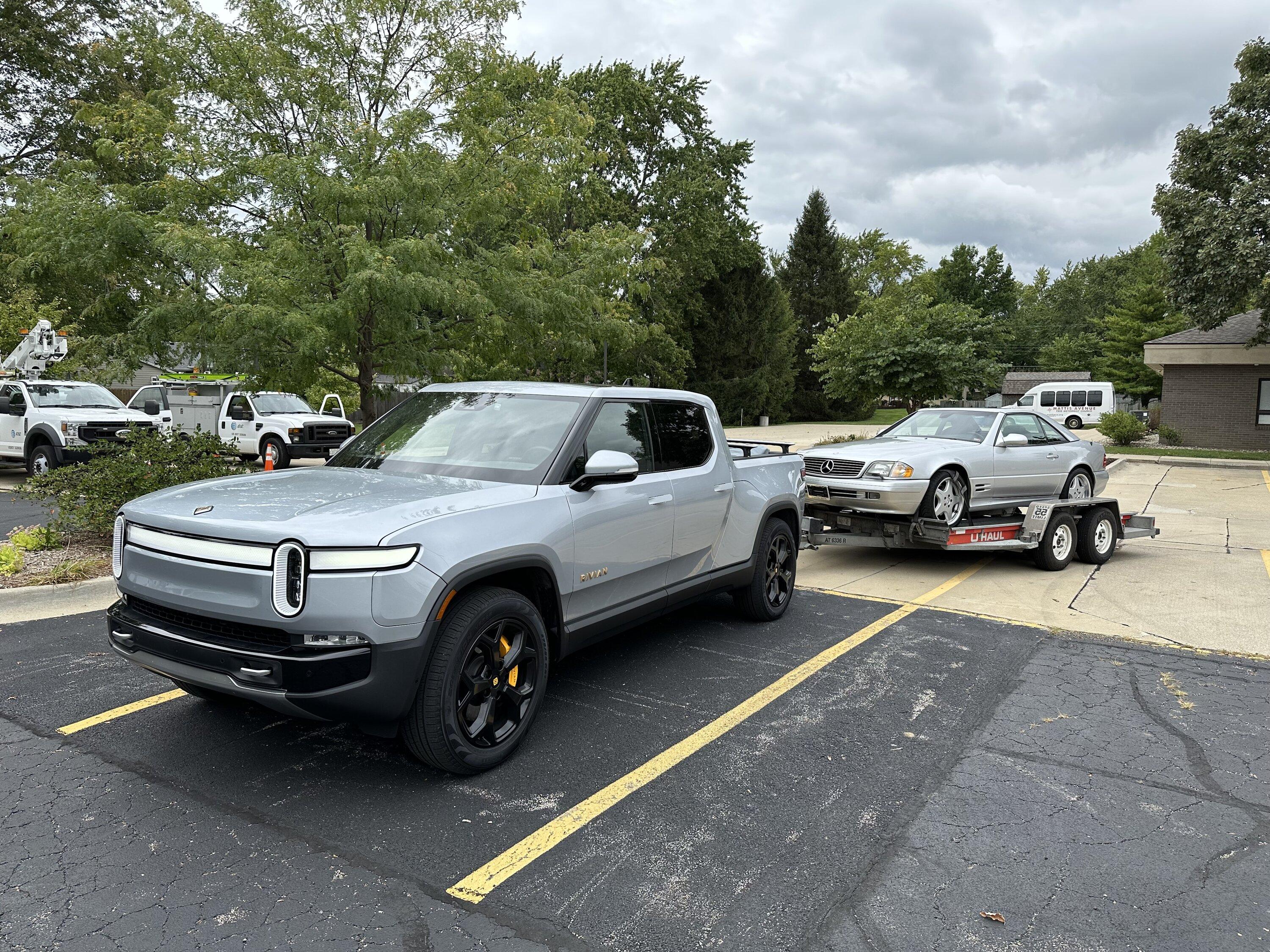
Towed with a Uhaul auto trailer for the first time and got better efficiency than I thought I would. 220 mile trip in upper 60s to 70 degree temps and averaged 1.5 mi/kWh.

Very positive experience overall, except a relatively huge issue is that the Rivian nav will re-route you without telling you and there’s no easy way to revert the route, especially with all driver assistance off. I specifically chose a route that had me stop at a charger that was in a bank parking lot, with plenty of room, and after close of business. Without telling me, the nav changed my route and sent me to a charger that was closer to my destination but was also in a crowded grocery store parking lot and had no extra room for the trailer without being in the way of others. Kind of infuriating, tbh.
Rivian R1T R1S Towing + Efficiency: Please post your experience! IMG_5227
 

pdxdriver

Member
First Name
Rob
Joined
Oct 28, 2022
Threads
0
Messages
6
Reaction score
3
Location
Portland
Vehicles
ordered R1S
Occupation
retired
I monitor The Efficiency Number on the Driver's display. By already having an established history of towing and non-towing, efficiency I would think the Rivian Navigation trip planning algorithms could more accurately calculate the current kWh usage and the expected available range upon arrival at a waypoint charger.

I know that my typical towing Efficiency is 1.09 kWh/mile. Therefore, I can calculate what my probable range and arrival SOC should be (but I shouldn't have to do this). However, the Navigation distance and waypoint SOC do not correlate with simple mental math from the efficiency, range estimate, distance to a waypoint (i.e. charging station), and the arrival SOC remaining numbers.

I have owned my R1T Quad for a year and found that the navigation waypoint charging "SOC upon arrival" on my truck is not reliable, especially when towing. Good navigation systems do not use EPA estimates. The actual vehicle's performance data, (which is influenced by the heaviness of your right foot and other factors), is what the algorithms use. I found that Rivian's Navigation numbers on my truck, especially when towing, are woefully inaccurate.

I establish my own charging waypoints with a 25-mile buffer to avoid any more anxious "pucker factors" when towing. Yet, as I get closer to a waypoint charging station, sometimes even this buffer (as shown on the arrival data) can quickly vanish. It is a crazy thing to watch, especially when every effort is being made to be as efficient as possible during the trip.

PLEASE, PLEASE Rivian, do something about your Navigation/Trip Planning software.
I agree. Software update for trip planning adjusting for topography and load is badly needed. Right now I'm using the app "A Better Route Planner" (ABRP) and it lets you adjust those variables and more. It's not perfect but when setting variables, if you double your payload wt., it's been fairly accurate. I'm driving R1S, towing 3300 lbs, large pack. 22" wheels. On the flat I get about 1.6 mi/kwh, if hills/mountains then 0.8 mi/kwh. I'm also able to only go 100-120 miles between charges.
 

Buckets0fun

Banned
Well-Known Member
Joined
Jul 2, 2023
Threads
4
Messages
143
Reaction score
28
Location
Earth
Vehicles
R1S
Occupation
OF
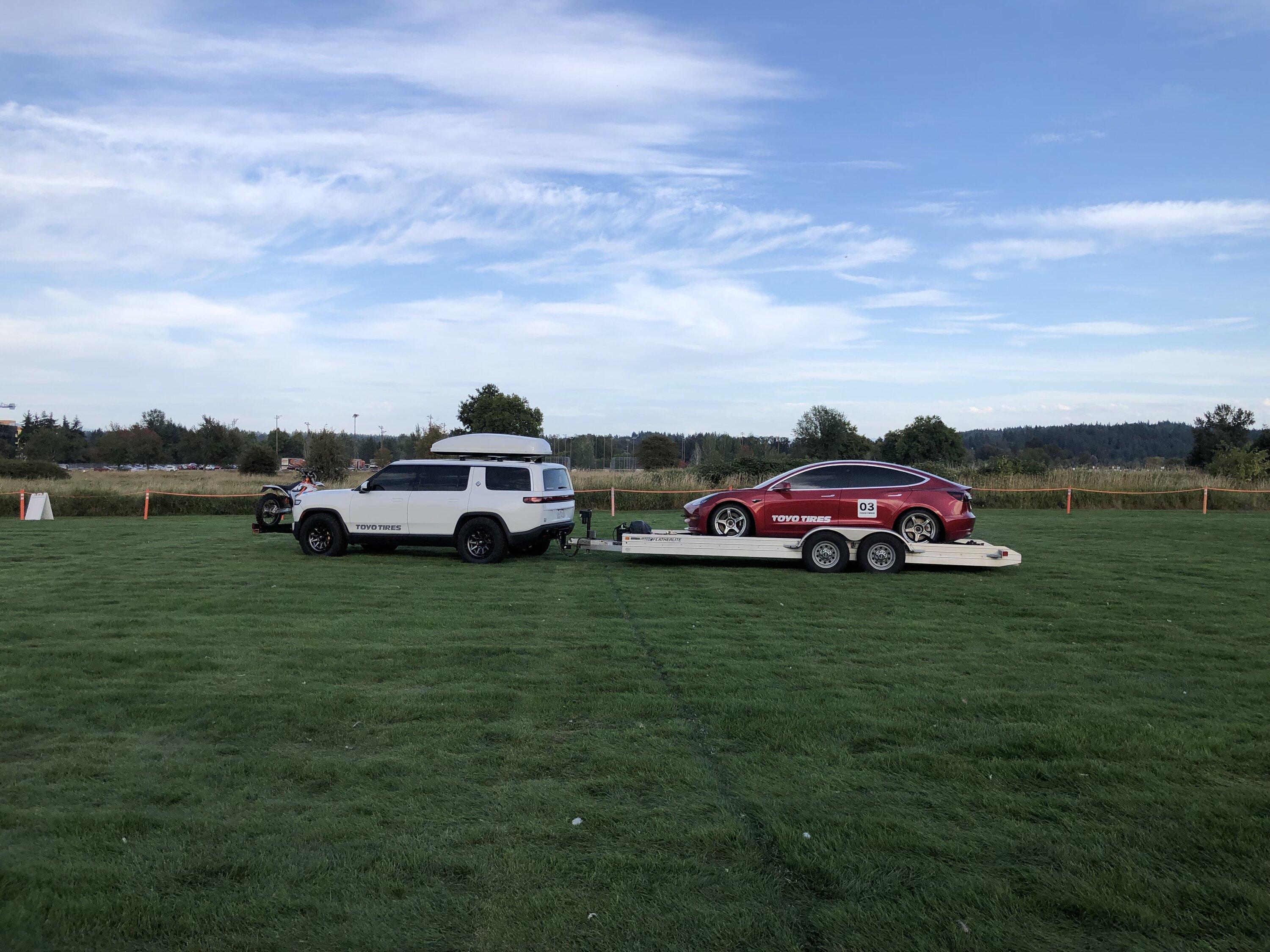
1.2mi/kWh - 850mi, mostly on RAN. Aligned at 11.5” drive height.

Used cat scale for trailer weight 5480lbs, weighsafe hitch for tongue weight. ~500lbs.

Roof box is rather large, but KTM EV hanging off the front is likely the largest range hit.
Rivian R1T R1S Towing + Efficiency: Please post your experience! IMG_4043
 

kiminbend

Member
First Name
Kim
Joined
Jan 19, 2022
Threads
0
Messages
13
Reaction score
12
Location
Bend
Vehicles
R1S, BMW X5, Subaru Outback, Thor KM24 Class C
Occupation
Retired
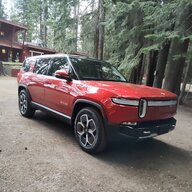
My wife just towed her trailer behind our R1S for the first time. It wasn't a long trip, but she got 1.55mi/kWh.

PXL_20211210_202938953.jpg


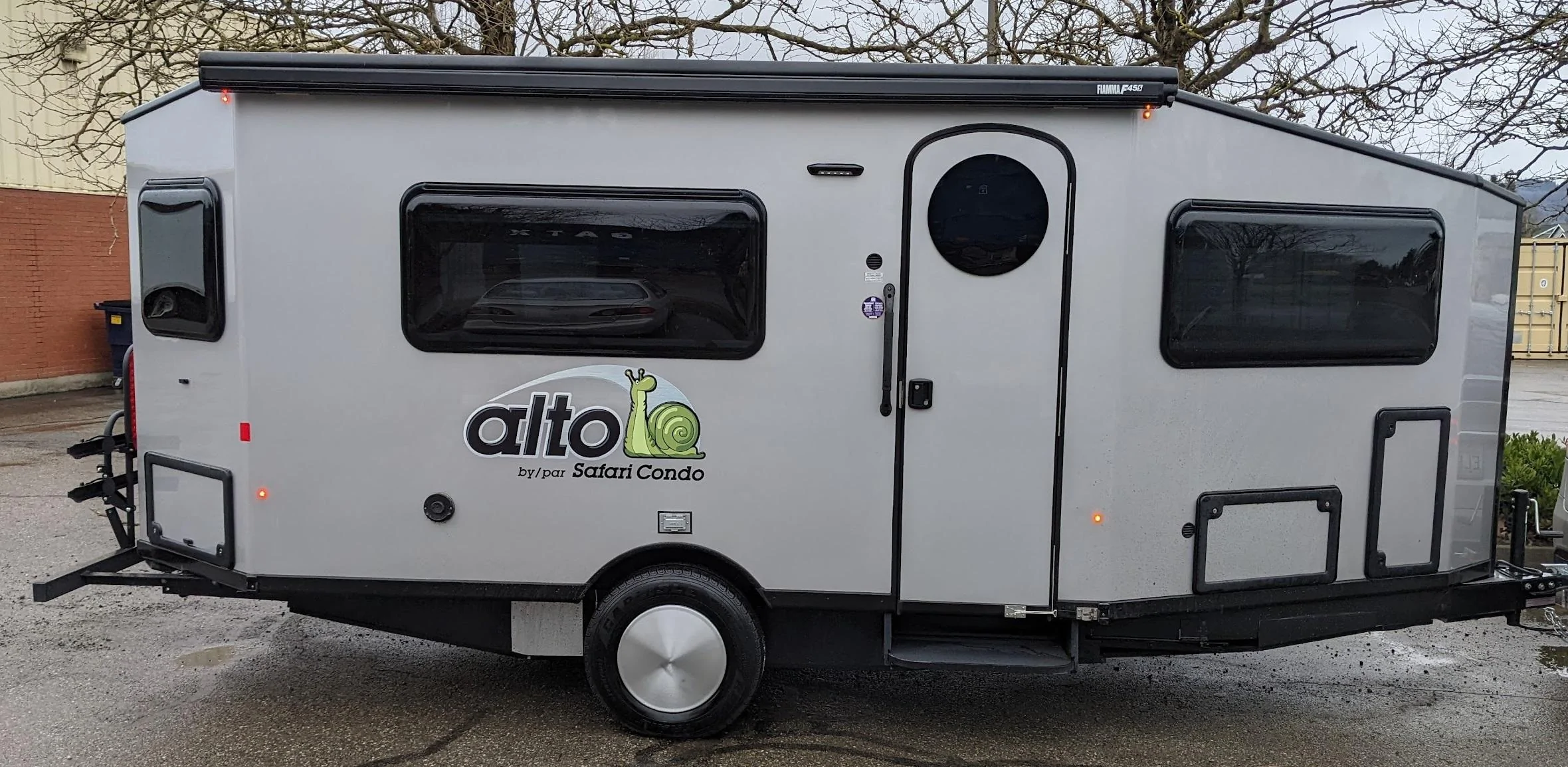
The trailer is a 21' Safari Condo Alto A2124, which is about 3,000lbs empty (it was very much not empty on this trip!). It has a somewhat aero-friendly design - it's likely near the best of "full-size" trailers for aero; though of course something collapsible or half-height would be better.

The route didn't involve much elevation.
Temperatures were in the lower 60's; with a tiny bit of rain.
Speed limits vary from 35-60 along the route, which was just over 56 miles (plus a ferry ride).
Our R1S has 20" wheels with Michelin Defender all-seasons, and Team1EV's aero caps.

1.55mi/kWh is great; that's a theoretical range pushing 200 miles while towing (though of course we'll never try that; I always leave a large buffer if for nothing else than to allow for unexpected headwinds).

We got even better efficiency towing the same trailer with our 2017 Tesla Model X 100D. We've seen anywhere from 1.67 to 1.91 with that (though the routes were different, and of course conditions varied). For reference, the X is rated at about 3.0, and our lifetime average before towing was about 2.7. Towing the A2124 on average was about a 40% hit with the X.

But the Rivian's pack is 1/3 larger, and it's several years newer so no degradation yet. It's less efficient to start with, but that means the percentage hit from a trailer should be smaller (indeed with this trip it was likely around a 30% hit), so the effective towing range - the key metric! - is longer. And the Rivian is easier to hook up and has an integrated brake controller.

Now if only I had a working 12V outlet so I could use the screen for the trailer's rear-view camera...
Thanks for posting about your A2124. Hubby and I are looking to purchase. Currently, the soonest delivery would be March 2025 (2026 model). Look forward to hearing more about your adventures.
Sponsored


Top