Dark-Fx
Well-Known Member
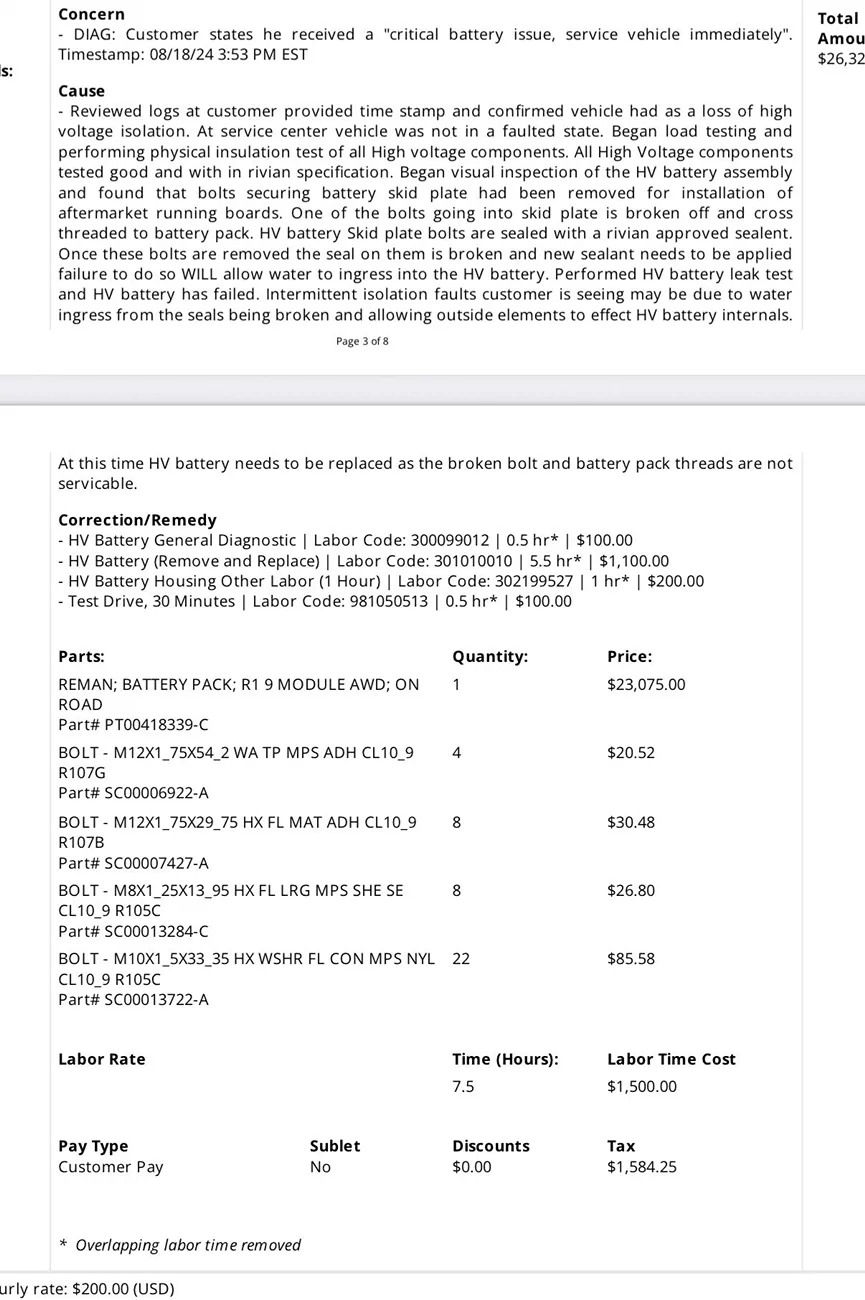
Looks like the answer is probably yes?Does this void your warranty?
Sponsored
Looks like the answer is probably yes?Does this void your warranty?
Looks like the answer is probably yes?
WAIT!
Does that mean everyone with running boards are at risk of water ingress to the HV battery???
Because I for sure didn't receive any "Rivian approved sealant" to reapply to any of my bolts to install my sliders.
@EV Sportline any input?
This is probably a community-wide PSA that needs some attention if I'm reading these notes correctly... Please tell me I'm misreading this?
I have a hard time believing that the bolts that secure the battery to the frame are integral to the battery case seal, but I suppose not impossible. But stuff like this is also one of the reasons I suggested GOAT stay away from anything bolting the battery.WAIT!
Does that mean everyone with running boards are at risk of water ingress to the HV battery???
Because I for sure didn't receive any "Rivian approved sealant" to reapply to any of my bolts to install my sliders.
@EV Sportline any input?
This is probably a community-wide PSA that needs some attention if I'm reading these notes correctly... Please tell me I'm misreading this?
To clarify: your sliders are using different bolts than those listed in @Dark-Fx 's work order listed above?There is no issue or concern with EV Sportline Running Boards / Sliders.
Wow, something sounds wrong with this diagnostic or really poor battery sealing design.Looks like the answer is probably yes?

I couldn't really follow everything going on here and/or any context why things were needed or done, but there is no concern for water intrusion or bolt replacements with our products. If you break bolts and strip them and improperly deal with that -- you're at risk for problems.To clarify: your sliders are using different bolts than those listed in @Dark-Fx 's work order listed above?
Not trying to be a worrywort/freakout, but I sort of assumed most manufacturers were using the same sets of bolts...
My guess is Rivian is referencing these bolts, which I doubt anyone is touching for sliders:To clarify: your sliders are using different bolts than those listed in @Dark-Fx 's work order listed above?
Not trying to be a worrywort/freakout, but I sort of assumed most manufacturers were using the same sets of bolts...

No. But it—any non-factory modification—gives Rivian and any OEM an out. Every modification carries a risk.WAIT!
Does that mean everyone with running boards are at risk of water ingress to the HV battery???
Because I for sure didn't receive any "Rivian approved sealant" to reapply to any of my bolts to install my sliders.
@EV Sportline any input?
This is probably a community-wide PSA that needs some attention if I'm reading these notes correctly... Please tell me I'm misreading this?
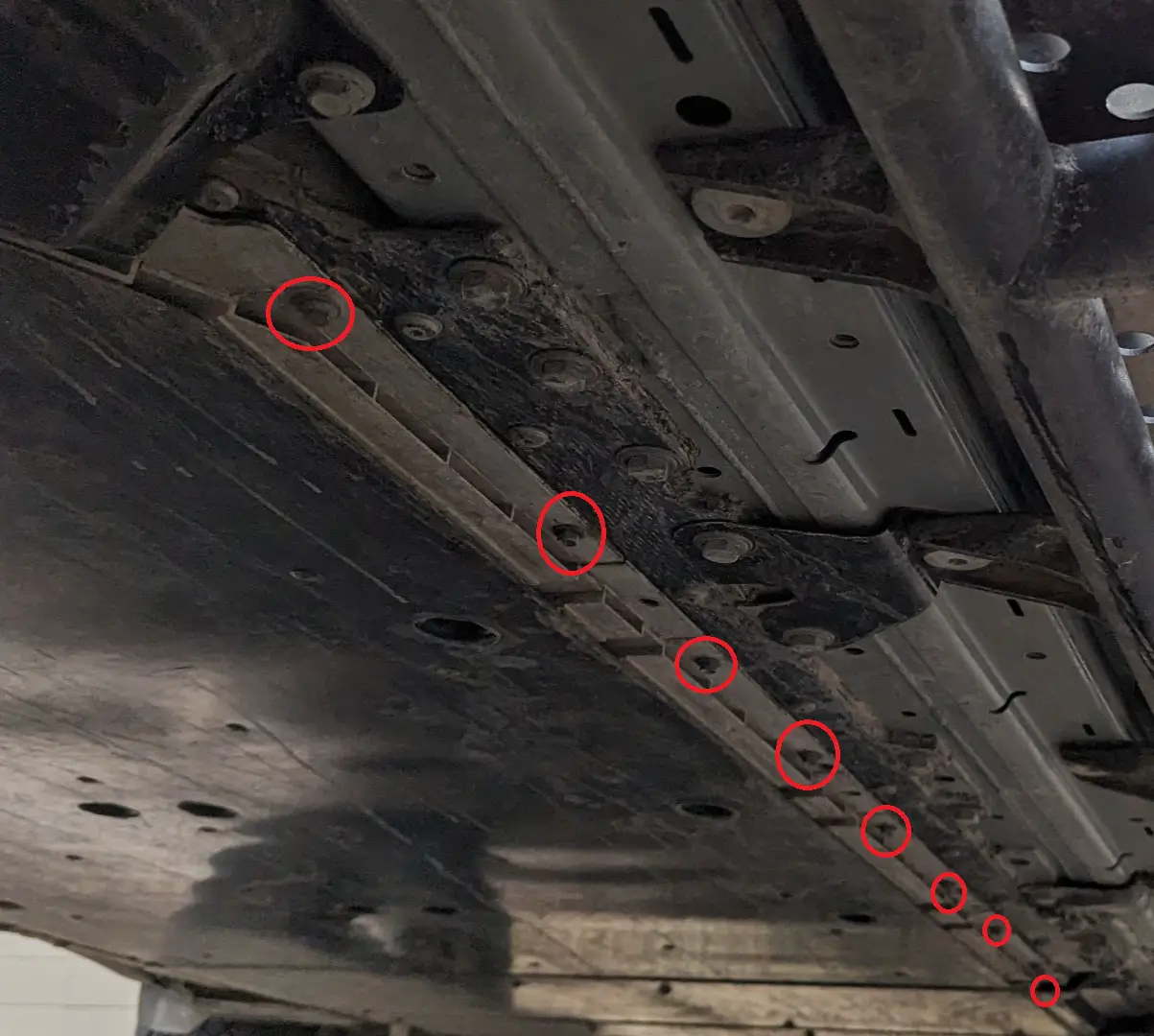
My guess is Rivian is referencing these bolts, which I doubt anyone is touching for sliders:
They do look like they could be inside the sealed battery area. The next row out is sort of close but I've never pulled a pack out of the car, so can't tell for sure.

Moss-Magnusson wants a word.No. But it—any non-factory modification—gives Rivian and any OEM an out. Every modification carries a risk.
Aware of legislation. And it’s the Magunson-Moss Warranty Act. However, it does not bar OEMs from any attempts to deny coverage. Note: in this case, warranty was not voided, only coverage not offered for the pack and subsequent replacement. M-M Act is intended to regulate how warranty disputes are resolved. Any modifications, described by warranty policy, is still a risk. And by signing papers to buy you are agreeing to terms—including that of warranty. Any modifications you make, you knowing make knowing the potential risk. If the owner had chosen to litigate Rivian’s findings that’s when M-M comes into play. It’s good that we have it, but M-M is not the broad consumer protection people like to believe. No law in a capitalist system is that generous.Moss-Magnusson wants a word.
But for real: the only way a modification can carry *true* warranty risk is 1- it directly impacts the thing suspected to be damaged by it, 2- can be proven (by the manufacturer/service) that it did, in fact impact the part(s)/assemblies in question and 3- your service/manufacturer is a jerk (or what you did was egregious and actually, provably, damaging).
My worst experience was also kind of reassuring. I tuned my 2014 Subaru STi using the Cobb Tuning Accessport. Blew my engine. By all rights, what I did was technically not OEM spec. We could argue one way or another if what I did was a risk (philosophically, it was a 'safe' stage II tune with accompanying hardware that had demonstrated-- via my knock sensors and EGTs--I was probably running in some ways, safer than the OEM tune when daily driving the vehicle (obviously not under hard acceleration... we don't need to go down that road: I get it. More power = more risk overall). Anyway, the long and the short of it is, Subaru's response was to 'goodwill' the repair. Which to me, was speak for "we don't want this showing up on our reliability scorecard, so we're going to fix it, because it was probably a manufacturers defect, but we're taking the 'out' that it *might not* be our fault.
ANYWAY, I think my overarching concern here has been addressed. And my thought process was: if there was some kind of sealant I needed on my bolts, I'd get said sealant and apply it (then probably campaign for slider/runner builders to provide said goop). But, it seems we have it figured, and most of us are probably safe.
Thanks for your input!
You're conflating two things, by insisting that M-M isn't a protectorate and that you apparently 'signed your rights away.'Aware of legislation. And it’s the Magunson-Moss Act. However, it does not bar OEMs from any attempts to deny coverage. Note: in this case, warranty was not voided, only coverage not offered for the pack and subsequent replacement. M-M Act is intended to regulate how warranty disputes are resolved. Any modifications, described by warranty policy, is still a risk. And by signing papers to buy you are agreeing to terms—including that of warranty. Any modifications you make, you knowing make knowing the potential risk. M-M is not the broad consumer product people like to believe. No law in a capitalist system is that generous.
Rivian did, in a fashion, attempt to show why. And M-M gives owner right to challenge Rivian—i.e. how on earth a pack that is built sealed can become unsealed if mounting points become unsealed? That would mean their pack isn’t sealed, contrary to claim, unless it’s bolted to frame with sealant on bolts. But did the owner challenge Rivian’s claim and exercise rights provided by M-M? It sounds like the chose to sell to walk/run away from the bad taste. And I agree Rivian’s claim is quite questionable.You're conflating two things, by insisting that M-M isn't a protectorate and that you apparently 'signed your rights away.'
To be clear, Magnuson–Moss DOES, absolutely mean:
An OEM cannot deny warranty coverage unless they can show the modification caused the failure.
This is the key legal protection: Burden of proof is on the OEM, not the consumer. So:
OEMs deny claims that wouldn’t hold up if challenged. Most consumers don’t escalate, don’t file complaints, don’t pursue arbitration, don’t lawyer up. These are the 'denials' you're reading about that you might conflate with the OEM “wins.”
- Your warranty is not “voided”
- Coverage can be denied for a specific repair
- Only if they can causally link the mod to the failure
That’s not the law being weak. That’s consumers not enforcing it. You cannot contract your way around federal consumer protection law. So, your argument about 'signing papers,' is invalid and weak. No judge would uphold it.
Magnuson–Moss doesn’t stop OEMs from denying claims, for sure. However, it absolutely stops them from being legally correct when they deny claims without proof of causation. Most people lose because they don’t enforce their rights, not because the rights don’t exist.
thisYou're conflating two things, by insisting that M-M isn't a protectorate and that you apparently 'signed your rights away.'
To be clear, Magnuson–Moss DOES, absolutely mean:
An OEM cannot deny warranty coverage unless they can show the modification caused the failure.
This is the key legal protection: Burden of proof is on the OEM, not the consumer. So:
OEMs deny claims that wouldn’t hold up if challenged. Most consumers don’t escalate, don’t file complaints, don’t pursue arbitration, don’t lawyer up. These are the 'denials' you're reading about that you might conflate with the OEM “wins.”
- Your warranty is not “voided”
- Coverage can be denied for a specific repair
- Only if they can causally link the mod to the failure
That’s not the law being weak. That’s consumers not enforcing it. You cannot contract your way around federal consumer protection law. So, your argument about 'signing papers,' is invalid and weak. No judge would uphold it.
Magnuson–Moss doesn’t stop OEMs from denying claims, for sure. However, it absolutely stops them from being legally correct when they deny claims without proof of causation. Most people lose because they don’t enforce their rights, not because the rights don’t exist.
 . That battery pack should be sealed independent of the bolts that secure it to the vehicle. Unless you penetrated the battery pack somehow with a bolt I am not understanding this diagnosis. How can you smoke test a pack ...normally done with it out of the vehicle. I am scratching my head.


