
Sponsored

Check my math, please.

Donald Stanfield

Well-Known Member
First Name
Donald
Joined
Jul 31, 2022
Threads
59
Messages
8,307
Reaction score
16,656
Location
USA
Vehicles
2025 R1S Tri Ascend, 2024 i4 M50
Occupation
Stuff and things
The other thing is you cannot really compare these with a Toyota Highlander because your Toyota doesn't have 800Hp or a 3 second 0-60 time. So you're comparing something closer to a race car with a family grocery getter. Compare it to a hellcat grand Cherokee or something in the case of a truck compare the mileage to a TRX or a Ford raptor R.

Apples to apples is important and high performance vehicles always use more energy than non high performance. The bottom line is your R1 is going to be the cheapest vehicle to run by a massive margin compared to anything ICE with comparable performance. If you don't care about performance at all the Aptera BEV is super efficient, buy that.
Sponsored

 

Rivdog

Well-Known Member
First Name
Chris
Joined
Nov 14, 2022
Threads
12
Messages
631
Reaction score
1,616
Location
Oregon
Vehicles
2023 R1T
I think you are paying too much for electricity.. Iā€˜m also in OR and I am on the PGE time of use plan. 10pm-6am means rates of around 0.04/kWh.

So at $4.50/gal I would need are 112 mi/gal to break even with an ICE truck. I think most trucks with the type of build I have would probably only do 10% of that. Of course it’s all more complicated because I have solar panels which means I don’t end up paying any peak rates for my electricity.
I could do TOU to save in charging, true, but it wouldn’t end up working out for me because my family would use too much electricity during peak hours. On the standard plan, the total delivery cost is $0.152 per kWh. With TOU, the rate is cheaper per kWh but you still have to pay the same surcharges, taxes, etc. per kWh. I haven’t looked in a while, but I think it’s like a total of $0.05 per kWh in those additional fees for PGE customers, so TOU would still end up being like $0.09 per kWh, I think.

If you charge at home and drive many miles, it very well could be better though! I only drive about 8,000 miles per year.
 

Redline

Well-Known Member
Joined
Jul 22, 2021
Threads
50
Messages
2,287
Reaction score
4,730
Location
Edina, MN
Vehicles
Rivian R1S
Clubs
 
Feel pretty happy I can charge from 12am-6am for 2.8 cents a kWh.
 

Electrified Outdoors

Well-Known Member
First Name
Ken
Joined
Jan 30, 2023
Threads
63
Messages
3,683
Reaction score
3,980
Location
Mount Airy, Maryland
Website
EVoutdoors.org
Vehicles
2024 Rivian R1S Quad, 2024 Silverado EV RST First Edition
Occupation
Real Estate
Clubs
 
So assuming 128 kwh usable battery you added about 16.5% charge for $4.

So it costs you about $20 to charge it from 0 to 82%. Most folks are not doing that much driving or charging at once.

At 300 miles on 100% that 16.5% is about 50 miles range. About 8 cents per mile roughly.

Very rough figures used here and done quickly.
 

jjswan33

Well-Known Member
First Name
Joshua
Joined
Sep 17, 2021
Threads
135
Messages
4,455
Reaction score
9,876
Location
Sandy, OR
Vehicles
Rivian R1T LE, Hyundai Ioniq 5 Limited
Occupation
Engineer
Clubs
 
I could do TOU to save in charging, true, but it wouldn’t end up working out for me because my family would use too much electricity during peak hours. On the standard plan, the total delivery cost is $0.152 per kWh. With TOU, the rate is cheaper per kWh but you still have to pay the same surcharges, taxes, etc. per kWh. I haven’t looked in a while, but I think it’s like a total of $0.05 per kWh in those additional fees for PGE customers, so TOU would still end up being like $0.09 per kWh, I think.

If you charge at home and drive many miles, it very well could be better though! I only drive about 8,000 miles per year.
Thats fair. I just checked and there is an extra 1.8 cents/kWh. Then some taxes and fees I pay no matter what. I also have solar panels that offset any peak usage.
 

Sponsored

Oldsmobile_Mike

Well-Known Member
First Name
Mike
Joined
Mar 24, 2022
Threads
62
Messages
2,407
Reaction score
3,876
Location
Manassas Park, VA
Vehicles
FG/FE R1T recv'd 3/31/2023
Occupation
I build stuff
Clubs
 
Do you use gas or kerosene lamps to light your house or gas powered steam to power your fridge and washers?

Your electricity bill isn’t 100% for your truck is it?
I agree. OP's math doesn't make sense. In addition to their condescending response to what was obviously meant to be a humorous reply, my assumption is they're probably burning whale oil and communicating by telegraph. ?
 
OP
OP

Clif1f

Member
First Name
Clif
Joined
Aug 25, 2022
Threads
1
Messages
5
Reaction score
4
Location
St Paul, MN
Vehicles
Highlander
Occupation
Retired
Clubs
 
You can also go into gauge view and see exactly how many kWh your Rivian has used. Multiply that by your total electricity delivery cost per kWh and then you’ll have a pretty good estimate of what it costs. I did that the other day and realized that if I had an ICE vehicle that got about 27 MPG at $4.50 per gallon, there wouldn’t be any fuel cost savings with the Rivian.

I didn’t buy a vehicle this expensive to save a few bucks on fuel though, I bought it because it’s freaking awesome. Was a bit surprising nonetheless to see the break even point was so low.
I’ve owned it three days. My sentiments exactly.
 

minneR1Tonka

Member
First Name
Adam
Joined
Nov 1, 2023
Threads
0
Messages
7
Reaction score
8
Location
Minnesota
Vehicles
2023 R1T QM Large Adventure; 2018 XC90 Inscription
Clubs
 
Feel pretty happy I can charge from 12am-6am for 2.8 cents a kWh.
That’s if you want to deal with Xcel’s nonsense EV program and install a separate meter…

OP, who is your service provider? If Xcel or WH, I think you per KWH rate is overstated by about double for standard residential programs
 

ksurfier

Well-Known Member
First Name
Ken
Joined
Aug 23, 2022
Threads
42
Messages
1,049
Reaction score
918
Location
CA
Vehicles
R1SQM, Tesla
Occupation
Fake Science Lead
Clubs
 
As many of you prob. already figured out:
There are 4 primary costs for EVs/cars:
-purchase $
-energy $
-powertain $
-tires+maintenance $
Let’s assume a high usage case where you could squeeze out 25 years and ~600,000 miles.
Annualized costs would be:
Purchase $3400
Enerergy 9/12 MWh depending mi/kWh (2.7/2.0) - $0.30 per KWh - $2700 - $3600
Battery replacement at 11 years (2.0 mi/wh), 14 years (2.7 mi/wh). Assume $30k replacement cost, annualized is $2100 to $2700.
Tires + Maintenance $2000-3000.
Annually, $9200 - 13600
Monthly, $770 - $1,130
Per mile - $0.38 - $0.57
———————
The bigger low efficiency tires have a much higher cost impact than I realized…because they greatly reduce the life of the battery, not something I’ve considered before…good reason to have a second set of wheels!
 

CharonPDX

Well-Known Member
First Name
Charon
Joined
Jul 12, 2021
Threads
31
Messages
2,497
Reaction score
4,171
Location
Cascadia
Vehicles
'22 R1T LE, '16 Model S, '19 Arcimoto FUV
Occupation
InfoSec Geek
Clubs
 
A couple flaws in your pricing:

1. Electricity billing isn't a simple "dollars on the bill divided by kWh used" - many locations/utilities have different rates at different times of day ("time of use" billing) or charge more or less once you exceed a certain kWh used in a month. (My utility charges more once you pass 1000kWh, but a neighboring utility charges *LESS* once you pass 1000kWh.) Plus, electric bills have a certain amount that is fixed every month, regardless of how much energy you use that month. Use less energy, and your "cost per kilowatt-hour" will be effectively higher, because that fixed amount is a larger portion of the bill, while use a lot, and the fixed amount will be a smaller portion of the total.

To figure out the actual cost to charge your vehicle, you'll need to look at your bill to figure out the "incremental cost per kWh" that charging the vehicle adds. Not the whole bill. If you have "time of use" billing, set your vehicle to charge only when electricity is cheapest (usually overnight.)

To use my own bill as an example, my "fixed monthly cost" is $11/month. I could be on vacation for a month and use zero electricity that month, and I'd still pay $11. (Actually a little more, taxes and fees that are a % of total bill are added later, but they're small.)

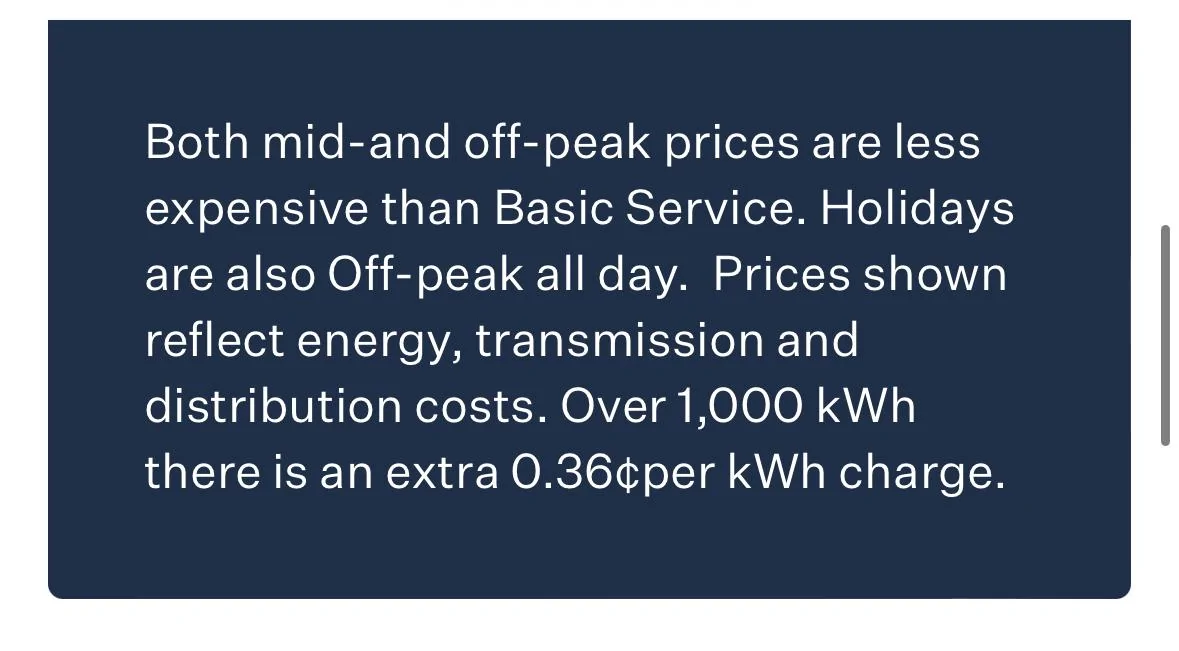
Then I have my actual usage. My bill is a confusing mess, with a dozen different types of charges and credits; but I'll combine them all. I have "time of use" billing. During "peak" times (3 PM to 8 PM) my total cost per kWh is $0.22261. During "off-peak" times (10 PM to 6 AM) it's $0.04123. During "mid-peak" (the spaces in between: 6 AM to 3 PM, 8 PM to 10 PM) it's $0.16896. Then once I use 1000 kWh, any above that adds an extra $0.0036 (slightly more than 1/3 of a cent per kWh.)

With multiple EVs in the house, I use more than 1000kWh most months, so I would count that in my cost.

Because I only charge overnight, I count my charging as the cheapest rate $0.04483 per kWh (with the >1000kWh surcharge.)

2. Your kWh per mile seems way off. Unless you've done all your driving so far towing an unaerodynamic trailer, 21 kWh to drive 21 miles seems bad. Of course, if you've only driven 21 miles, things may be a little wonky. I'd wait for a few hundred miles of driving to get a good measure of your actual efficiency. Depending on your wheel/tire choice, it should be between 1.8 and 2.2 mi/kWh in normal daily driving when not towing.

I'm going to use the bad case. I just got done with a long towing trip. My long-term efficiency of that trip was 1.24 mi/kWh with the trailer. So at my home charging price, I will pay about 3.6 cents per mile.

By comparison, my uncle driving his F-250 diesel, towing his trailer, paying diesel prices in Arizona, was at about 28.6 cents per mile.
 

Sponsored

CrazyOne

Well-Known Member
Joined
Oct 30, 2021
Threads
3
Messages
1,352
Reaction score
1,142
Location
WA
Vehicles
R1T
You missed several things

  • R1 does not use 1 kw/mile. I do 2 short trips of 9 miles each daily. Efficiency is between 1.5 and 2. On long trips this improves significantly.
  • How is your charger calculating energy delivered? Is it accurate? There are charging losses that may be unaccounted for.
  • Vampire drain would 1-2 KW per day, minimum.
R1 isn't cheaper than normal gas vehicles. It could be because of EV fee, poor efficiency, tire wear, service costs etc.

Regarding service costs, I dread them post warranty. They took 4.5 hours to align suspension according to the paperwork. IDK if that's normal, but it would be a $1000 alignment out of warranty.
 

NCRivian

Active Member
First Name
Joe
Joined
Apr 23, 2023
Threads
1
Messages
31
Reaction score
43
Location
Snow Camp, NC
Vehicles
2021 Chevy suburban. 2023 R1T
Occupation
Plumber
First ever post here. I’ll try not to be too long winded. I live in central NC and have a time of use meter. Like the guy from Oregon, my rate is different from 10pm-6am. Mine is reduced to $.03/kWh. I drive around 4,000 miles per month and exclusively charge at home. I have had my R1T now for 6 months and my electric bill year over year comparison shows that I am spending $25 more on average each month now than last year. I was spending $800/month in gas in my Silverado 1500 before I got this truck! For me, the cost savings have been huge. I am on the 21ā€ road tires and have averaged 2.62 miles/kWh for the life of the truck(27,000 miles). Bottom line…it all depends where you live and how you charge on what your energy costs will be.
 

Cascadian

Well-Known Member
First Name
Steve
Joined
Apr 19, 2023
Threads
12
Messages
327
Reaction score
323
Location
Seattle
Vehicles
Volt, Outback
Clubs
 
My most recent electricity bill, including taxes and fees was $122.33. Subtracting the fixed connection charge of $10, the total cost of electricity was $112.33. I used 588 kWh of electricity. Dividing $112.33 by 588, I get a unit cost of $0.1910/kWh. Last night I added 21 kWh of juice to the battery. 21 x 0.1910 = $4.0117 cost to recharge.
The car tells me I added 21 miles of range. So $0.19/mile.

The closest gas station is selling regular for $3.359/gallon. My 2017 Toyota Highlander Hybrid gets about 25 mpg. $3.359/25 = $0.134.

Is this right? Is this the experience of other users?
1 mile per kWh is very low. I have had my S less than a week and I have averaged 1.6. Many owners are are getting near 2 on 20s. I have spent a fair amount of time sitting in it with heating on without driving while I learn how to use the user interface.
One small interval data point is not a good sample to do the math on.
Check the efficiency in your trip data. What are you getting?
Do the math again after you have covered a much larger distance (>200 miles).
 

SANZC02

Well-Known Member
First Name
Bob
Joined
Feb 11, 2021
Threads
50
Messages
7,401
Reaction score
12,689
Location
California
Vehicles
Tesla Model S, LE - R1S
Occupation
Retired
As many of you prob. already figured out:
There are 4 primary costs for EVs/cars:
-purchase $
-energy $
-powertain $
-tires+maintenance $
Let’s assume a high usage case where you could squeeze out 25 years and ~600,000 miles.
Annualized costs would be:
Purchase $3400
Enerergy 9/12 MWh depending mi/kWh (2.7/2.0) - $0.30 per KWh - $2700 - $3600
Battery replacement at 11 years (2.0 mi/wh), 14 years (2.7 mi/wh). Assume $30k replacement cost, annualized is $2100 to $2700.
Tires + Maintenance $2000-3000.
Annually, $9200 - 13600
Monthly, $770 - $1,130
Per mile - $0.38 - $0.57
———————
The bigger low efficiency tires have a much higher cost impact than I realized…because they greatly reduce the life of the battery, not something I’ve considered before…good reason to have a second set of wheels!
Planning for a battery replacement is ok for budgeting but I would be extremely surprised if the Rivian battery needs to be replaced in 11 years.

I have had my Tesla for over 7 years, it dropped about 5% in the first 2-3 years but I’ve only lost ~8% over 7 years and seems like it has been like that for over a year now.

I’d be very surprised if I’m not north of 85% on the Rivian after 10 years.
 

Rivdog

Well-Known Member
First Name
Chris
Joined
Nov 14, 2022
Threads
12
Messages
631
Reaction score
1,616
Location
Oregon
Vehicles
2023 R1T
A couple flaws in your pricing:

1. Electricity billing isn't a simple "dollars on the bill divided by kWh used" - many locations/utilities have different rates at different times of day ("time of use" billing) or charge more or less once you exceed a certain kWh used in a month. (My utility charges more once you pass 1000kWh, but a neighboring utility charges *LESS* once you pass 1000kWh.) Plus, electric bills have a certain amount that is fixed every month, regardless of how much energy you use that month. Use less energy, and your "cost per kilowatt-hour" will be effectively higher, because that fixed amount is a larger portion of the bill, while use a lot, and the fixed amount will be a smaller portion of the total.

To figure out the actual cost to charge your vehicle, you'll need to look at your bill to figure out the "incremental cost per kWh" that charging the vehicle adds. Not the whole bill. If you have "time of use" billing, set your vehicle to charge only when electricity is cheapest (usually overnight.)

To use my own bill as an example, my "fixed monthly cost" is $11/month. I could be on vacation for a month and use zero electricity that month, and I'd still pay $11. (Actually a little more, taxes and fees that are a % of total bill are added later, but they're small.)

Then I have my actual usage. My bill is a confusing mess, with a dozen different types of charges and credits; but I'll combine them all. I have "time of use" billing. During "peak" times (3 PM to 8 PM) my total cost per kWh is $0.22261. During "off-peak" times (10 PM to 6 AM) it's $0.04123. During "mid-peak" (the spaces in between: 6 AM to 3 PM, 8 PM to 10 PM) it's $0.16896. Then once I use 1000 kWh, any above that adds an extra $0.0036 (slightly more than 1/3 of a cent per kWh.)

With multiple EVs in the house, I use more than 1000kWh most months, so I would count that in my cost.

Because I only charge overnight, I count my charging as the cheapest rate $0.04483 per kWh (with the >1000kWh surcharge.)

2. Your kWh per mile seems way off. Unless you've done all your driving so far towing an unaerodynamic trailer, 21 kWh to drive 21 miles seems bad. Of course, if you've only driven 21 miles, things may be a little wonky. I'd wait for a few hundred miles of driving to get a good measure of your actual efficiency. Depending on your wheel/tire choice, it should be between 1.8 and 2.2 mi/kWh in normal daily driving when not towing.

I'm going to use the bad case. I just got done with a long towing trip. My long-term efficiency of that trip was 1.24 mi/kWh with the trailer. So at my home charging price, I will pay about 3.6 cents per mile.

By comparison, my uncle driving his F-250 diesel, towing his trailer, paying diesel prices in Arizona, was at about 28.6 cents per mile.
Are you really only paying an extra $0.0036 per kWh once you eclipse 1000 per month? I’m assuming you also use PGE, so please disregard if I’m wrong. One reason I couldn’t ever switch to TOU is because it says it’s an additional $0.36 per kWh over 1000, not just $0.0036. Like you, I oftentimes go over 1000 at least a few months per year - the worst I ever saw was 1715. That would mean an extra $257 on top of an already hefty bill just for using TOU (would probably be close to $500 for a single month!). But if you’re actually only paying $0.0036, that might be worth the gamble.

Rivian R1T R1S Check my math, please. IMG_1088
Sponsored


Top