
Sponsored

mkg3

Well-Known Member
Joined
Nov 19, 2021
Threads
91
Messages
2,803
Reaction score
3,730
Location
SoCal
Vehicles
R1S, Model 3, Outback, Artura
Clubs
 

jfoonly

Well-Known Member
Joined
Feb 13, 2024
Threads
8
Messages
220
Reaction score
297
Location
Colorado
Website
rivian.com
Vehicles
2024 Gen1 R1S PDM
Clubs
 
Thanks for pointing to this. Some relevant quotes from the study:

Our latest research finds that EV batteries are degrading at 1.8% per year on average. The last time we analyzed battery degradation in 2019, we found an average annual degradation rate of 2.3% (which was already quite good).
...
if you purchase an EV today with a 300-mile range, you would lose, on average, about 21 miles of range after five years and 45 miles after 10 years.
...
high-use electric vehicles did not show significantly higher battery degradation than others
High temps and frequent DCFC result in more degradation.
 

CrazyOne

Well-Known Member
Joined
Oct 30, 2021
Threads
3
Messages
1,362
Reaction score
1,159
Location
WA
Vehicles
R1T
I am more concerned about the failures that lead to thermal runaway. These are detected and cars trigger critical HV battery errors on EVs in general, not just Rivian.
 

Luvolbikes

Well-Known Member
First Name
John
Joined
Sep 8, 2024
Threads
2
Messages
137
Reaction score
245
Location
Tucson
Vehicles
24 R1t, Volt, 25 Equinox ev, F250, buncha bikes.
Occupation
Retired
My Chevy Volt is 12 years old and I can still get close to the original 40 miles on a charge driven correctly. Pushing 90k miles. Still close to 4 miles per kWh. Completely trouble free and almost maintenance free car. Loving my Rivian R1t at 3 months and 2k miles.
 

Riviot

Well-Known Member
Joined
Mar 29, 2021
Threads
121
Messages
6,435
Reaction score
10,834
Location
Kitsap, WA
Vehicles
R1T
Clubs
 
Meh, based on <5 years of poll data, not testing. They admit degradation isn't linear, so that 1.8%/year amortized out to 70% after 20 years doesn't really matter if your cliff drops sooner than that.

They don't even have Rivian data.
Rivian R1T R1S EV Batteries Can Outlast A Vehicle’s Lifetime With Minimal Degradation, Study Finds 1000000173
 

Sponsored

SANZC02

Well-Known Member
First Name
Bob
Joined
Feb 11, 2021
Threads
50
Messages
7,426
Reaction score
12,718
Location
California
Vehicles
Tesla Model S, LE - R1S
Occupation
Retired
Meh, based on <5 years of poll data, not testing. They admit degradation isn't linear, so that 1.8%/year amortized out to 70% after 20 years doesn't really matter if your cliff drops sooner than that.

They don't even have Rivian data.
1000000173.jpg
In my 8 year Tesla experience, I lost most of my range in the first 3 years, close to 5%, I have only lost only 3% since then. Still have 92% of original range at 89k miles.

Probably would have been more but almost always charge at a Supercharger.
 

dradam

Well-Known Member
Joined
Sep 18, 2022
Threads
23
Messages
425
Reaction score
518
Location
Maryland
Vehicles
2023 R1S OC LA Silver 21 as of 23xxx Nov 3, 2023 !!
Degredation is inevitable, but I hope my battery will outlive my needs. The links below from "Engineering Explained" have been posted on this forum before but it seemed relevant for this thread as well. Conceptually they are the best explainations to me of best charging practices to maintain both Li and LFP batteries.


mudito

Well-Known Member
First Name
Aldo
Joined
Jul 30, 2024
Threads
18
Messages
1,011
Reaction score
1,414
Location
Texas
Vehicles
Rivian R1T
I will take that article with a pinch of salt. Let me explain why:
Rivian R1T R1S EV Batteries Can Outlast A Vehicle’s Lifetime With Minimal Degradation, Study Finds 1726671796068-wd


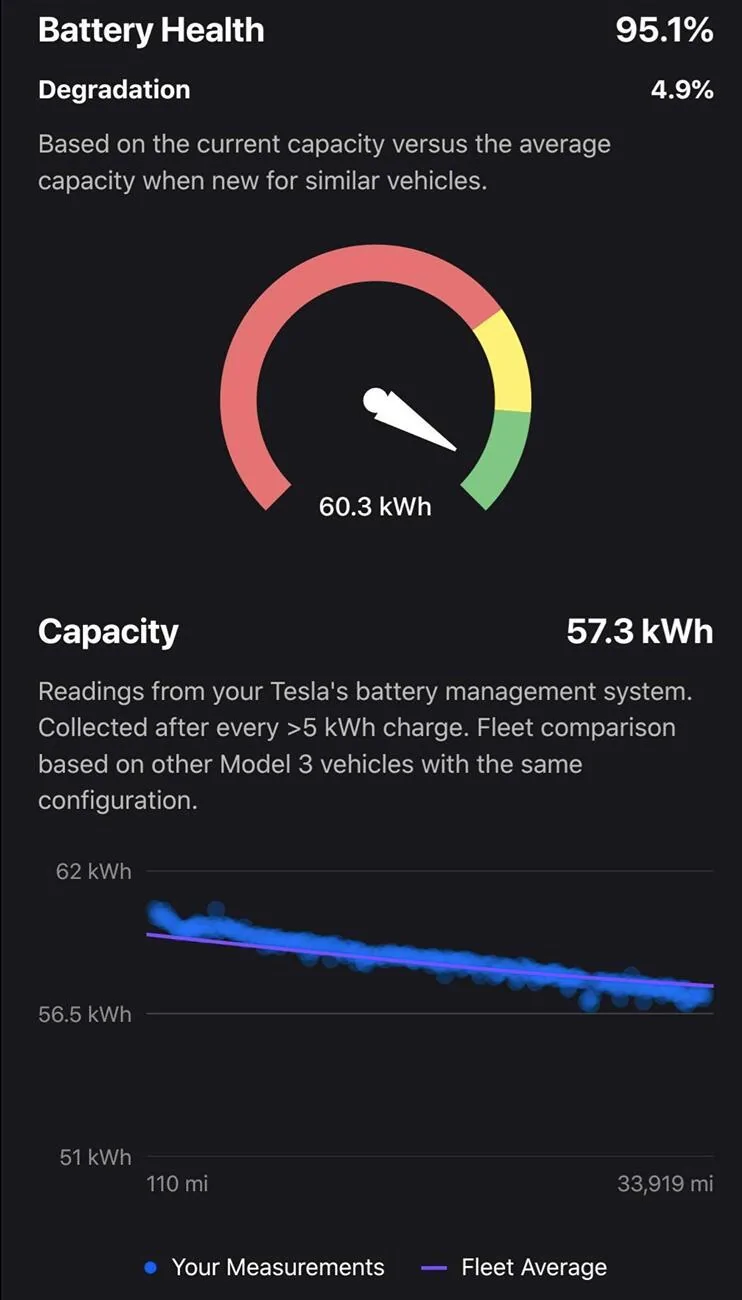
In order to justify my post I will use my wife's Tesla Model 3 Standard RWD (The cheapest) and all the "Tessie" data we have for the past 2 years (exactly two years as of yesterday). You can see I started using Tessie only at 110mi total odometer miles and now sits at almost 34k miles after two years of Realtor work in the DFW area ;)

This vehicle is rated at 57.5 kWh battery, then as far as Tesla and what it's warranty respects, our car "only lost 0.2 kWh" in two years. WOW!! GREAT! ... not so fast :)

The actual original battery capacity when new was ~60 kWh and luckily Tessie accounts for that and tells the truth: 4.9% degradation in two years.

Yes, I know it's not linear but if you extrapolate the curve and also based on the "fleet" data that Tessie has over an 8-10year period, you'll be WAY OVER the 70% battery capacity based on the advertised 57.5 kWh. So marketing automotive firms will say something in the lines of "Based on telemetry data for our Tesla Model 3 RWD Standard Battery with LFP chemistry, we are seeing almost zero degradation from the Originally advertised capacity at two years, and about 5% total degradation after 8 years"

So, again... take the original article with a pinch of salt :)
 

SRO

Well-Known Member
First Name
Steve
Joined
Mar 21, 2023
Threads
3
Messages
299
Reaction score
142
Location
Carson City nv
Vehicles
R1T
Occupation
retired

beatle

Well-Known Member
Joined
Jun 20, 2024
Threads
17
Messages
1,148
Reaction score
1,563
Location
Springfield, VA
Vehicles
'23 R1T PDM Max, '97/'25 Miatas, '19 Monkey
Occupation
IT
Clubs
 
The bigger problem is the overall failure rate of battery packs. Most people can plan for and deal with battery degradation, but suddenly being hit with a pack failure can be a financial hit that a lot of people aren't able to easily absorb. Unlike an ICE vehicle, you have no idea when things are about to fail and brick the pack.
 

Sponsored

emoore

Well-Known Member
Joined
Nov 29, 2020
Threads
4
Messages
3,815
Reaction score
4,240
Location
Colorado
Vehicles
2022 R1T
The bigger problem is the overall failure rate of battery packs. Most people can plan for and deal with battery degradation, but suddenly being hit with a pack failure can be a financial hit that a lot of people aren't able to easily absorb. Unlike an ICE vehicle, you have no idea when things are about to fail and brick the pack.
But how often does that happen? Seems like most battery pack failures happen early one and are replaced under warranty.
 

RedRaiderRivian

Well-Known Member
Joined
Dec 23, 2022
Threads
0
Messages
358
Reaction score
535
Location
San Antonio
Vehicles
2022 Rivian R1T - Canyon Red, 2016 Nissan Leaf
Clubs
 
The bigger problem is the overall failure rate of battery packs. Most people can plan for and deal with battery degradation, but suddenly being hit with a pack failure can be a financial hit that a lot of people aren't able to easily absorb. Unlike an ICE vehicle, you have no idea when things are about to fail and brick the pack.
With modern ICE engines, I am not sure you have any more warning. The Ford Ecoboost engines are notorious for throwing an internal timing chain with little warning and completely destroying the engine.
 

SRO

Well-Known Member
First Name
Steve
Joined
Mar 21, 2023
Threads
3
Messages
299
Reaction score
142
Location
Carson City nv
Vehicles
R1T
Occupation
retired
The bigger problem is the overall failure rate of battery packs. Most people can plan for and deal with battery degradation, but suddenly being hit with a pack failure can be a financial hit that a lot of people aren't able to easily absorb. Unlike an ICE vehicle, you have no idea when things are about to fail and brick the pack.
What studies do you have regarding battery failure rates. I believe the warranties for batteries exceed those for ICE. But not sure since the last time I bought an ICE was like 2008.
 

mudito

Well-Known Member
First Name
Aldo
Joined
Jul 30, 2024
Threads
18
Messages
1,011
Reaction score
1,414
Location
Texas
Vehicles
Rivian R1T
What studies do you have regarding battery failure rates. I believe the warranties for batteries exceed those for ICE. But not sure since the last time I bought an ICE was like 2008.
In mileage, they're pretty much the same warranties (depending on brands of course), which is normally 100k miles for both Batteries and ICE engines.

In terms of time, the industry standard in ICE is ~5yrs while Batteries are around ~8yrs.

This is of course normal due to the difference in complexity between one and the other (how many things can go wrong with both). So I would say that today's EVs warranties are even with today's ICE vehicles.

An ICE can and will suddenly die (happened 4 weeks ago with my 'weekend vehicle', now I need a new engine ? ), and batteries also can suddenly short itself and die as well.

The ONLY difference I see for owners of EVs, is that we are still behind in terms of Servicing our vehicles as we have DECADES of experience and independent shops working on ICE vehicles and only maybe a ˜decade of experience in supporting EVs
 

COdogman

Well-Known Member
First Name
Brian
Joined
Jan 21, 2022
Threads
33
Messages
11,641
Reaction score
34,494
Location
CO
Vehicles
2023 R1T
Occupation
Cyber defender
Clubs
 
The bigger problem is the overall failure rate of battery packs. Most people can plan for and deal with battery degradation, but suddenly being hit with a pack failure can be a financial hit that a lot of people aren't able to easily absorb. Unlike an ICE vehicle, you have no idea when things are about to fail and brick the pack.
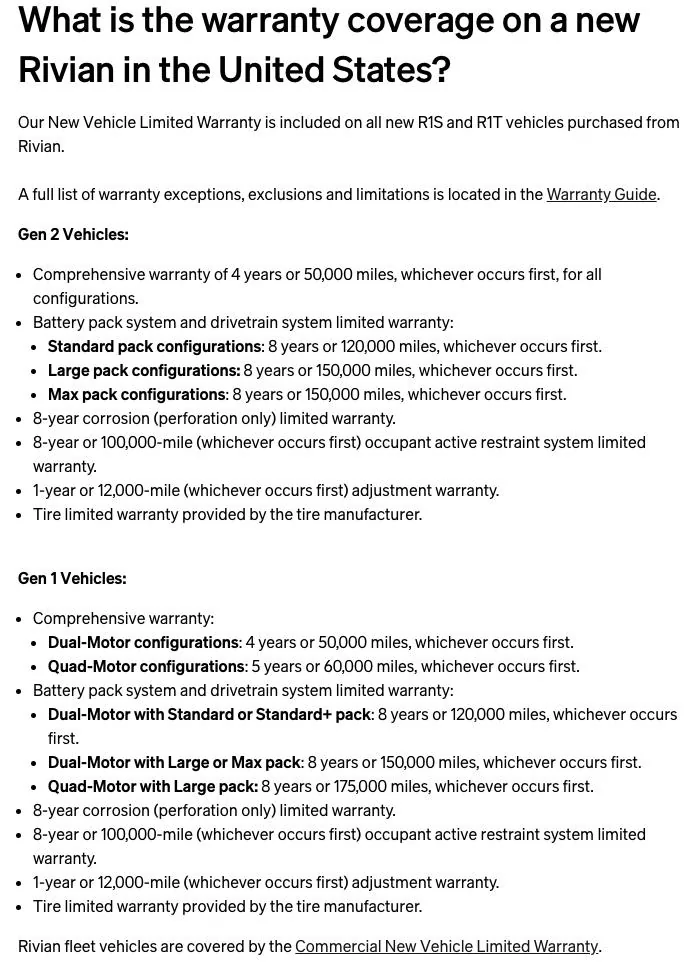
Rivian's battery warranty is 175k miles for a large quad R1T. I will be dead long before I reach that mark.

Mine failed in June at approx 9k miles and they replaced it very quickly (6 days from drop off to pick up).

Rivian R1T R1S EV Batteries Can Outlast A Vehicle’s Lifetime With Minimal Degradation, Study Finds Image 9-18-24 at 11.02 AM
Sponsored


Top