R1Thor
Well-Known Member
- First Name
- Joe
- Joined
- Aug 9, 2023
- Threads
- 8
- Messages
- 1,531
- Reaction score
- 2,409
- Location
- Lancaster, PA
- Vehicles
- 23QM R1T, Limestone + Ocean Coast, 21" & UBS
- Occupation
- Mechanical Engineering Lead
- Thread starter
- #1
Good Day Ladies and Gents, and especially the fellow nerd who will actually read this!
This is the moment you've all been waiting for (well, the 3 of you who were heavily invested in debating the efficacy of aftermarket cabin air filters in a vendor post on this very forum).
Introduction
This report aims to evaluate the performance of the Rivian OEM (Mann) air filter in comparison to available aftermarket HVAC / Cabin Air Filters. Given the industries we serve and the industry regulations around personal protective equipment (PPE) regulated personal air filtration, we do not have the ability to test exactly for automotive spec HEPA filtration.
The automotive standards for automotive filtration can be found here: https://www.aivc.org/sites/default/files/members_area/medias/pdf/Conf/1999/paper095.pdf
Notably, the ability to performatively test to 105 L/s (liters per second), 70 L/s, and 35 L/s are the defined flow rates for this industry and compliance governance. Our equipment can test up to 120 SLPM but is typically calibrated to test at 85 SLPM (standard liters per minute) and below. Therefore, our testing was performed initially at 85 SLPM and re-performed at 32 SLPM for comparative reasons, as is standard practice in all filter leak testing standards and regulations.
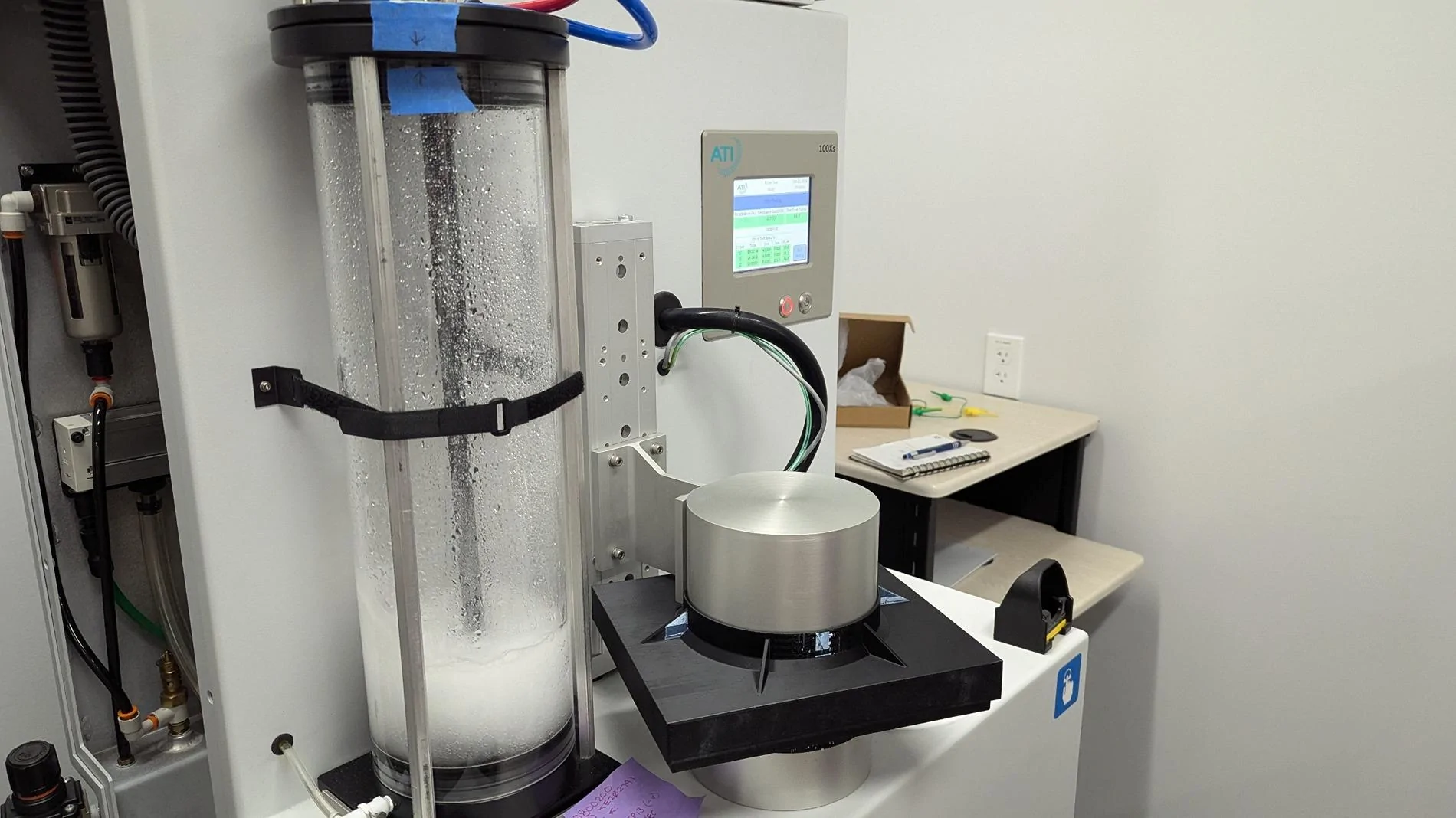
The equipment: I have access to ATI’s 100X Automated Filter Tester which is certified and compliant with NIOSH 42 CFR Part 84, ISO 23328, GB 2626, JICOSH/JMOL, GB 19083, GB/T 32610, YY0469, YY 0469, EN 12941/12942, EN 143/EN 149, ASTM F3502-21, ASTM F2100-23, and our company is in the process of certifying for ISO 17025 compliance.
The 100XS we used tests at the Count Median Diameter (CMD) of 0.075 μm ± 0.02, with a Geometric Standard Deviation (GSD) of ≤ 1.86, with typical concentrations between 15 and 25 mg/m3. Our challenge aerosol of choice was Salt (NaCl) solution with a flow accuracy to ± 0.4% of reading, plus ± 0.2% full scale. Aerosol detection specifications are as follows: Dynamic Range 0.1 μg/m³ to >200 mg/m³, accurate to ± 1% of reading; Penetration 0.0005%; Efficiency 99.9995%. Our unit and all the reagents, components, and supporting equipment comply to the most recent published and ratified standards and certifications as validated by third party lab testing for: CE, RoHS, FCC, and CSA.
Generally, this test equipment is provisioned for use with Flat sheet Filter media, Filtering Face pieces, Medical Device filters, and PAPR filters of all types and geometries including HEPA and ULPA grade and electret media. Typical industry use case of this equipment is to test and quality control validate filter media, cartridges, and industrial hygiene applications.
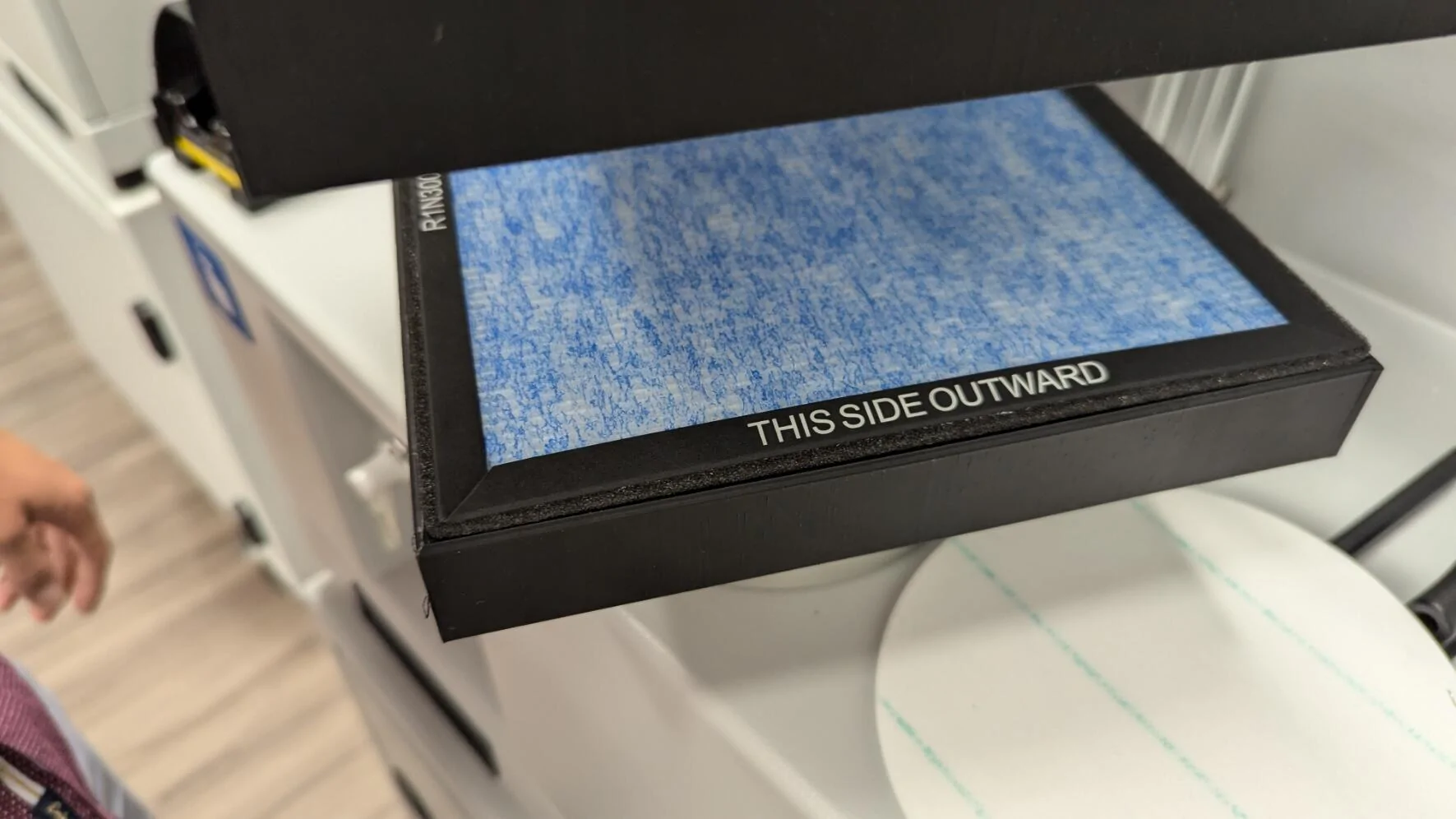
We used our standard automatic [filter media holder] chuck outfitted with a custom adapter that was designed to fit the geometric size of Rivian’s designated cabin filter cartridge location. To note: the orientation of measurement is relatively oriented orthogonal to the mounting of Rivian’s air collection, but would maintain the same fluid path, nonetheless. Also to note: the test fixture was developed to seal along the topmost boundary edges of the filters, which should mimic the intended sealing surfaces of Rivian’s air intake design.
Assumptions
The following assumptions were made:
I CANNOT and do not certify performance of these as HVAC air filters. I am credentialed and trained as a Mechanical Engineer to develop and integrate the test equipment (as noted above, for the intents and industries noted above) but am not a certified air filtration engineer or media certification technician by any stretch of the definition. I did work directly with a PhD Filtration Applications Engineer on this testing, and he is remaining anonymous as we’re not doing this as a professional endeavor.
All content is for educational purposes only. We do not intend for the content to be a substitute for professional advice or evaluation, counseling, certification, or formal representation outside of the scope of this comparative effort. Our content doesn’t engage visitors into a professional relationship.
Testimonials from myself and our engineers reflect our personal experiences and outcomes. Testimonials do not guarantee, warrant, or predict these or any other results. Every test setup is unique, and we did not procure a statistical sample of filters at regular QAE inspection point intervals.
Before posting any content, we do our best to ensure the accuracy and completeness of the information.
Raw Data
The following is based on the testing and test setup using an ATI 100XS configured Automated Filter Leak Tester and input and expertise of our Applications and Field Engineering team.
Aftermarket Filter #1
Aftermarket Filter #2
Aftermarket Filter #3: Every Amp
Analysis (Informal)
A few very important notables:
Given the costs, performance data, and observations, I personally will use Aftermarket Filter #3 heretofore. There may be OTHER manufacturers out there that I have not tested that could perform better (or worse, of course). But I single-handly financed this testing, so I stopped at 4x new Rivian Filters and the cost of the adapter and my time.
Appendix
All citations and references are included within the document.
Relevant images of test setup here:


This is the moment you've all been waiting for (well, the 3 of you who were heavily invested in debating the efficacy of aftermarket cabin air filters in a vendor post on this very forum).
Report on Rivian OEM & Aftermarket Cabin Air Filtration Performance with respect to Penetration and Pressure Drop
Introduction
This report aims to evaluate the performance of the Rivian OEM (Mann) air filter in comparison to available aftermarket HVAC / Cabin Air Filters. Given the industries we serve and the industry regulations around personal protective equipment (PPE) regulated personal air filtration, we do not have the ability to test exactly for automotive spec HEPA filtration.
The automotive standards for automotive filtration can be found here: https://www.aivc.org/sites/default/files/members_area/medias/pdf/Conf/1999/paper095.pdf
Notably, the ability to performatively test to 105 L/s (liters per second), 70 L/s, and 35 L/s are the defined flow rates for this industry and compliance governance. Our equipment can test up to 120 SLPM but is typically calibrated to test at 85 SLPM (standard liters per minute) and below. Therefore, our testing was performed initially at 85 SLPM and re-performed at 32 SLPM for comparative reasons, as is standard practice in all filter leak testing standards and regulations.
The equipment: I have access to ATI’s 100X Automated Filter Tester which is certified and compliant with NIOSH 42 CFR Part 84, ISO 23328, GB 2626, JICOSH/JMOL, GB 19083, GB/T 32610, YY0469, YY 0469, EN 12941/12942, EN 143/EN 149, ASTM F3502-21, ASTM F2100-23, and our company is in the process of certifying for ISO 17025 compliance.
The 100XS we used tests at the Count Median Diameter (CMD) of 0.075 μm ± 0.02, with a Geometric Standard Deviation (GSD) of ≤ 1.86, with typical concentrations between 15 and 25 mg/m3. Our challenge aerosol of choice was Salt (NaCl) solution with a flow accuracy to ± 0.4% of reading, plus ± 0.2% full scale. Aerosol detection specifications are as follows: Dynamic Range 0.1 μg/m³ to >200 mg/m³, accurate to ± 1% of reading; Penetration 0.0005%; Efficiency 99.9995%. Our unit and all the reagents, components, and supporting equipment comply to the most recent published and ratified standards and certifications as validated by third party lab testing for: CE, RoHS, FCC, and CSA.
Generally, this test equipment is provisioned for use with Flat sheet Filter media, Filtering Face pieces, Medical Device filters, and PAPR filters of all types and geometries including HEPA and ULPA grade and electret media. Typical industry use case of this equipment is to test and quality control validate filter media, cartridges, and industrial hygiene applications.
We used our standard automatic [filter media holder] chuck outfitted with a custom adapter that was designed to fit the geometric size of Rivian’s designated cabin filter cartridge location. To note: the orientation of measurement is relatively oriented orthogonal to the mounting of Rivian’s air collection, but would maintain the same fluid path, nonetheless. Also to note: the test fixture was developed to seal along the topmost boundary edges of the filters, which should mimic the intended sealing surfaces of Rivian’s air intake design.
Assumptions
The following assumptions were made:
- All filter media is nominally installed according to the vendor’s intended fluid path. (In other words, we did not ‘flip’ the filters to test reverse flow path or alter the path in any meaningful way.)
- All filter media should be fully sealed along the perimeter of the filter, as installed. Any opportunity for fluid flow around the filter, would essentially negate the intent of the filter by allowing for unfiltered air to enter the HVAC system.
- The OEM Rivian filter is considered the ‘standard’ and the remaining filters are compared to the OEM.
- As noted above, given the limitation of our equipment to challenge the performance of automotive cabin air filters, we are only utilizing this is as a comparative analysis of characteristics for penetration performance and pressure drop between the OEM and aftermarkets.
I CANNOT and do not certify performance of these as HVAC air filters. I am credentialed and trained as a Mechanical Engineer to develop and integrate the test equipment (as noted above, for the intents and industries noted above) but am not a certified air filtration engineer or media certification technician by any stretch of the definition. I did work directly with a PhD Filtration Applications Engineer on this testing, and he is remaining anonymous as we’re not doing this as a professional endeavor.
All content is for educational purposes only. We do not intend for the content to be a substitute for professional advice or evaluation, counseling, certification, or formal representation outside of the scope of this comparative effort. Our content doesn’t engage visitors into a professional relationship.
Testimonials from myself and our engineers reflect our personal experiences and outcomes. Testimonials do not guarantee, warrant, or predict these or any other results. Every test setup is unique, and we did not procure a statistical sample of filters at regular QAE inspection point intervals.
Before posting any content, we do our best to ensure the accuracy and completeness of the information.
Raw Data
The following is based on the testing and test setup using an ATI 100XS configured Automated Filter Leak Tester and input and expertise of our Applications and Field Engineering team.
| OEM Rivian Test Filter | ||||
| Test 1: | 85. SLPM | |||
Penetration (%) | Resistance (Pressure Drop, mm H2O) | |||
4.5 | 0.2 | |||
| Test 2: | 85. SLPM | |||
Penetration (%) | Resistance (Pressure Drop, mm H2O) | |||
8.7 | 0.2 | |||
| NOTE: There are concerns will the sealing of this filter about its perimeter | ||||
| Test A: | 32 SPLM | |||
Penetration (%) | Resistance (Pressure Drop, mm H2O) | |||
2.2 | 0.2 | |||
| NOTE: There are concerns will the sealing of this filter about its perimeter | ||||
| Test A: | 85. SLPM | DIRTY/used OEM Rivian Test Filter (16,117 miles) | ||
Penetration (%) | Resistance (Pressure Drop, mm H2O) | |||
49 | 0.2 | |||
| NOTE: There are concerns will the sealing of this filter about its perimeter | ||||
| Test B: | 32 SLPM | DIRTY/used OEM Rivian Test Filter (16,117 miles) | ||
Penetration (%) | Resistance (Pressure Drop, mm H2O) | |||
21.25 | 0.2 | |||
| NOTE: There are concerns will the sealing of this filter about its perimeter |
Aftermarket Filter #1
| Test 1: | 85. SLPM | |
Penetration (%) | Resistance (Pressure Drop, mm H2O) | |
7.9 | 0.7 | |
Compared to Target: | 176% | 350% |
| NOTE: There are concerns will the sealing of this filter about its perimeter | ||
| Test 2: | 85. SLPM | |
Penetration (%) | Resistance (Pressure Drop, mm H2O) | |
10.8 | 0.8 | |
Compared to Target: | 240% | 400% |
| Test A: | 32 SPLM | |
Penetration (%) | Resistance (Pressure Drop, mm H2O) | |
13.35 | 0.8 | |
Compared to Target: | 297% | 400% |
Aftermarket Filter #2
| Test 1: | 85. SLPM | |
Penetration (%) | Resistance (Pressure Drop, mm H2O) | |
1.96 | 0.5 | |
Compared to Target: | 44% | 250% |
| Test 2: | 85. SLPM | |
Penetration (%) | Resistance (Pressure Drop, mm H2O) | |
1.7 | 0.8 | |
Compared to Target: | 38% | 400% |
| Test A: | 32 SPLM | |
Penetration (%) | Resistance (Pressure Drop, mm H2O) | |
0.7 | 0.8 | |
Compared to Target: | 16% | 400% |
Aftermarket Filter #3: Every Amp
| Test 1: | 85. SLPM | ||
Penetration (%) | Resistance (Pressure Drop, mm H2O) | ||
0.15 | 0.6 | ||
Compared to Target: | 3% | 300% | |
| Test 2: | 85. SLPM | ||
Penetration (%) | Resistance (Pressure Drop, mm H2O) | ||
0.18 | 0.6 | ||
Compared to Target: | 4% | 300% | |
| Test A: | 32 SPLM | ||
Penetration (%) | Resistance (Pressure Drop, mm H2O) | ||
0.06 | 0.6 | ||
Compared to Target: | 1% | 300% |
Analysis (Informal)
A few very important notables:
- Rivian OEM (Mann) air filter does not appear to have been engineered to seal on all 4 sides of its perimeter (you can see this based on the ‘fuzzy’ gasket manufactured into the edge of the filter housing). It’s also very concerning, and notable to our AE that the outer edge is not rigid. Best practice when developing filters is to have a hard boundary edge that can seal against a mating surface.
This could be overcome with appropriate gasketing on the cartridge (or installation provision) of the air handling equipment. As far as we could tell, no such provision is made. We could be wrong, but in our opinion, Rivian’s OE filter, when installed properly, is likely to leak. And as can be ascertained from the data, likely leaks more over time.
- Note that, when compared to Rivian, all Aftermarket filters have a higher pressure drop. This means that the path of air flow has a higher resistance versus OEM nominal. THAT SAID, even though the numbers appear extreme (300% greater than OE), it’s likely that:
A) this is incurred due to a better seal than OEM (air cannot leak by, therefore it all has to filter through the media, which is the desired convention) and
B) Even at the uppermost value of 0.8 mm H2O, we do not feel as though that’s a significant enough pressure delta to incur any measurable mechanical impact on the air handling systems. Especially when accounting for the cross sectional area of the filter that the fluid may flow through. However, this should be monitored over time (in other words, how much does this increase over time.)
- It should also be noted that the OE ‘used’ filter did not incur an increase in pressure drop, which further informs the leakage. There were no obvious surface defects in the pleated fibers, and based on what we were seeing, still believe that the filter was leaking around its perimeter, which seems to have weakened over time (with use).
- Based on the data, 2 of the 3 aftermarket filters are suitable for use, both performing significantly better over the OE filter from a penetration standpoint. As noted, our equipment is designed to challenge filtration media in the HEPA particulate range and has a nominal particle size distribution (PSD) that covers the range of challenge as an industry standard as such. Technically, to qualify as a “HEPA” filter, the design must reduce the HEPA particulate size penetration by 99.7%. So, a penetration value less than 0.3% would certify that metric.
- Based on #3, Rivian’s own OE filter is NOT likely HEPA compliant.
The only filter that was hypothetically able to reach HEPA compliance (by our metrics, which again comes with the gigantic caveat that we’re not challenging this filter media to spec due to the difference in industry standards) was the final filter (Aftermarket #3) which achieved 0.15, 0.18, and 0.06% penetration (<0.3%) as tested.
- More cost is not better. The most expensive filter on this list, Aftermarket Filter #2, with shipping and taxes made it over $40. While it did outperform Rivian’s OE, it likely did so for the simple fact that it seals about the perimeter.
- All 3 of the aftermarket filters appeared very similar to one another from an aesthetic standpoint. In fact, in a blind test, I don’t know that I would be able to identify which is which. There is only subtlety when it comes to markings, and none of the filters had the vendors’ information listed (no branding, logos, trademarks, etc). The only notable text was with respect to install orientation. That said, don't judge a book by its cover: clearly the functional and internal mechanistic properties of these filters varied significantly, and there is a clear performance delta between all of them. [What matters is on the inside]
- The better performing filters fit compliantly (read: more snugly/ tightly installed) into the test fixture (and the Rivian Filter Cartridge/Tray).
- It’s possible that a ‘looser’ test fixture may result in a better OE performance filter, as it may have prevented some distortion on the outward edge of the Mann filter. It’s very difficult to tell, as I don’t have the exact geometry Rivian was using and didn’t tear the Cabin Filter Cartridge/Tray out of the truck to get more accurate geometry. The test fixture was developed by measuring all the filters themselves and determining a best-practice path forward to incorporating it into our test setup.
Given the costs, performance data, and observations, I personally will use Aftermarket Filter #3 heretofore. There may be OTHER manufacturers out there that I have not tested that could perform better (or worse, of course). But I single-handly financed this testing, so I stopped at 4x new Rivian Filters and the cost of the adapter and my time.
Appendix
All citations and references are included within the document.
Relevant images of test setup here:
Sponsored
Last edited: