Indy avocado
Well-Known Member
- Thread starter
- #1
I did a deep dive on page 3 of the State of Charge 10-80% charging thread, but someone suggested I put some of the deep dive here in a separate thread.
This is *not* comprehensive, despite the length. I will update this top post with relevant points based on any comments I get as I get time to gather data.
TL;DR
R2 charges very well *for a 400V vehicle* and is efficient for its shape. In absolute terms, its charge rate and practical highway "miles per minute of charging" are within a rounding error of the Tesla Model Y and it marginally beats the mainstream peers on the market today (Trailseeker, Blazer EV, Prologue, etc.) in charging performance (not by as much as the 220+ kW peak suggests). The usable highway range is competitive, falling right in line with the competition. Expect 250-285mi at 70mph in fair weather 100%→0%. Expect 27-32 minute 10-80% charges, adding 180mi of real-world range. (A more optimal strategy, where infrastructure allows, is to charge for 20-25 minutes, which will easily add 160mi of usable range.)
Methodology & Sourcing Disclosure
Before the data, transparency on where everything comes from:
Part 1: Charging Performance
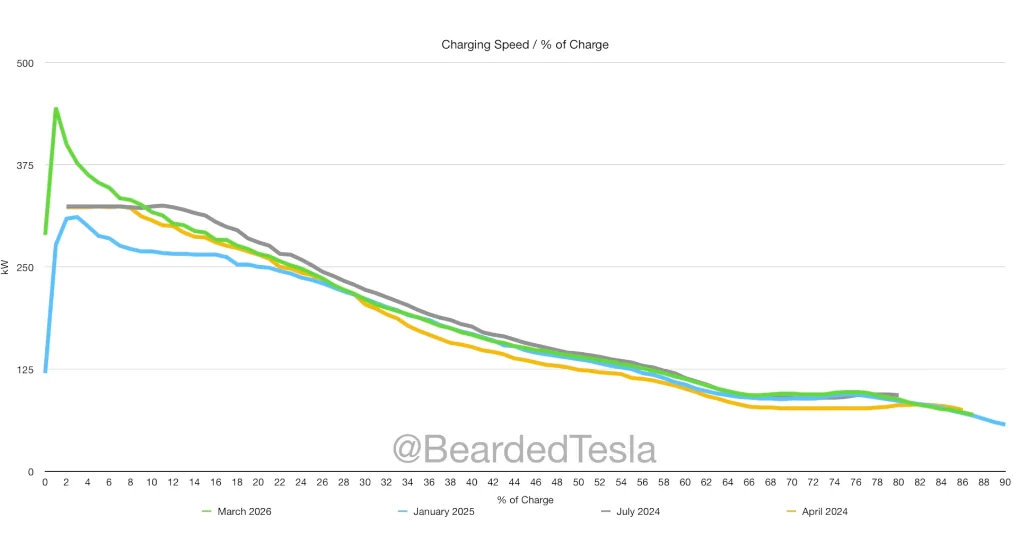
First up, we can look at a collection of charging events I have. The State of Charge video seems to be basically ideal and confirmed by other charging events. It looks like there's a hair of thermal overhead starting later in the charge.

This shows us that there's not a thermal penalty to using a 600A capable charger and getting that maximum speed below 40%. Overall, this looks like a well controlled curve that is entirely limited by charger/port current below 35-40% (so 800V would help down there, but we'll get to that later).
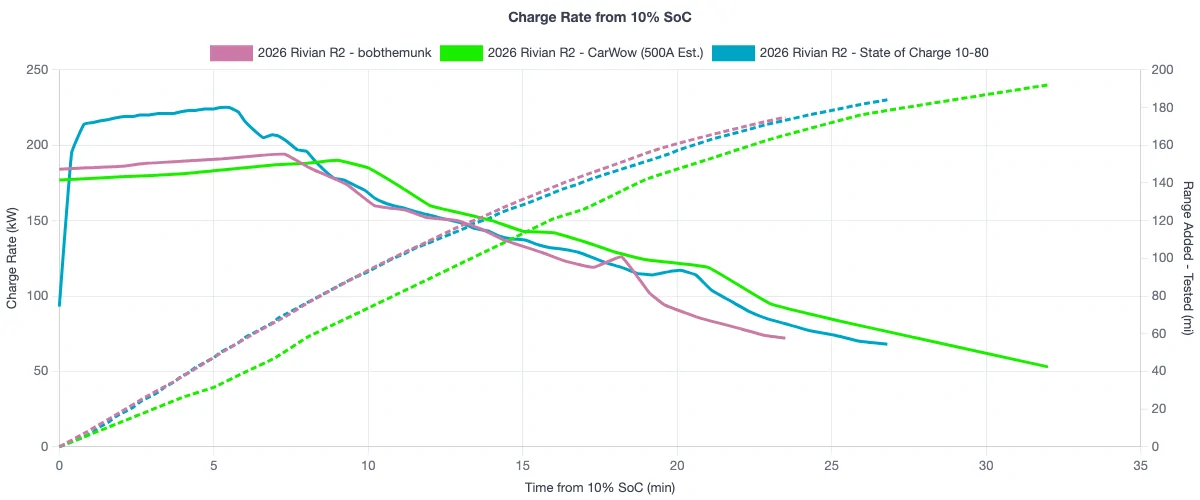
And to get you familiar with the graphs I'll be using...
Here's charging rate, and more importantly, range added, by time. The dashed lines use the right axis. So the R2 gains 160mi of range after 20-22.5 minutes in these 3 charging events, normalized to starting at 10%.
Now, the important part, the Head-to-head comparisons:
First up, let's compare to the big brother, the R1S (dual-max), as well as the Subaru Trailseeker (simliar market), and of course, the Telsa Model Y.
What we see here, looking at the range added (dashed line) is that the R2 is just a hair behind the Model Y until about 10 minutes, at which point they are effectively identical in range added. Similarly, it's just a hair ahead of the R1S until this point thanks to the superior efficiency. But by 25 minutes, the R1S has 30-40more usable miles "in the tank". The R1S will still be the superior road tripping vehicle.
What's possibly more interesting to this market is the comparison to the Trailseeker. The trailseeker has a really underwhelming charging rate, but it is damn near flat. And it's just a hair more efficient than the R2. The R2 builds a nice lead to 10 minutes, and then they basically match 1:1. You're only losing 10-20 miles of range in the Trailseeker vs R2 in a typical charging session.
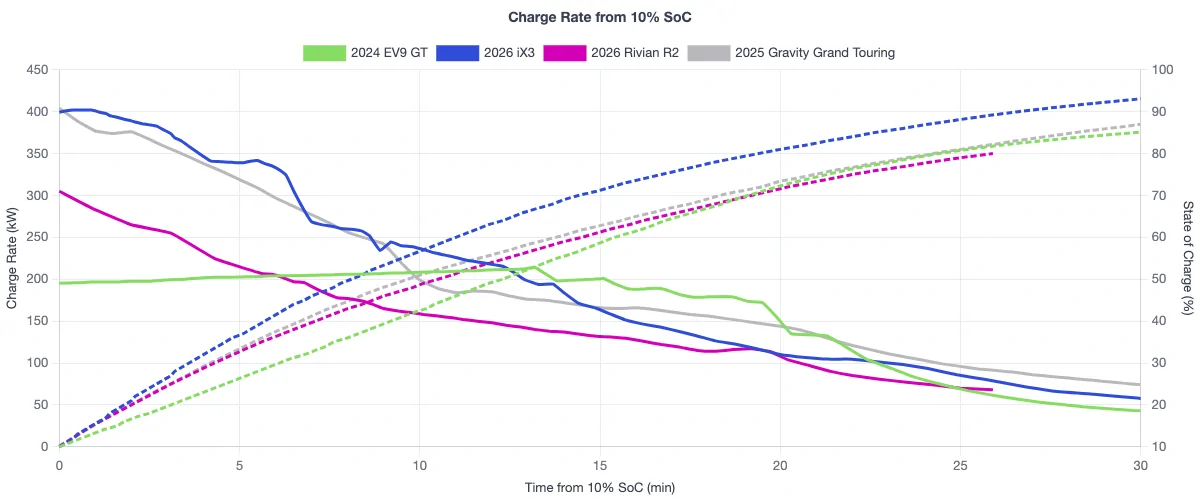
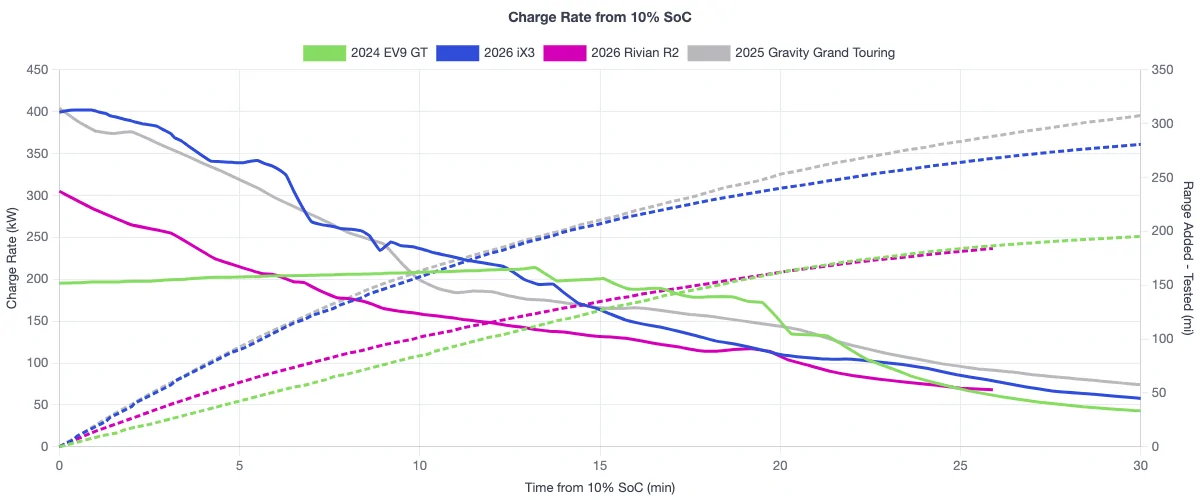
And then lets compare to some 800V vehicles that are slightly out of class:
The R2 directly competes with the EV9 for the first 10 minutes despite the lack of 800V architecture.
But the iX3... absolutely blows them out of the water, gaining range twice as fast until about 15 minutes.
This gets into the next section...
Part 2: The 400V vs. 800V Debate
Flagging up front: this section leans more heavily on inference and my own read of the curves than Part 1. The underlying charts are real data; the conclusions drawn from them are more debatable.
The R2 is a 400V class vehicle. RJ stated this is to hold costs down - a reasonable decision. But (I suspect) Rivian knew that 400V is a severe bottleneck on charging performance at low states of charge. So the R2 launches supporting up to 640A charging, but almost no public infrastructure can deliver that today. As of now, only three hardware classes in the US support 600A:
US DC fast charging hardware breaks down into roughly three tiers:
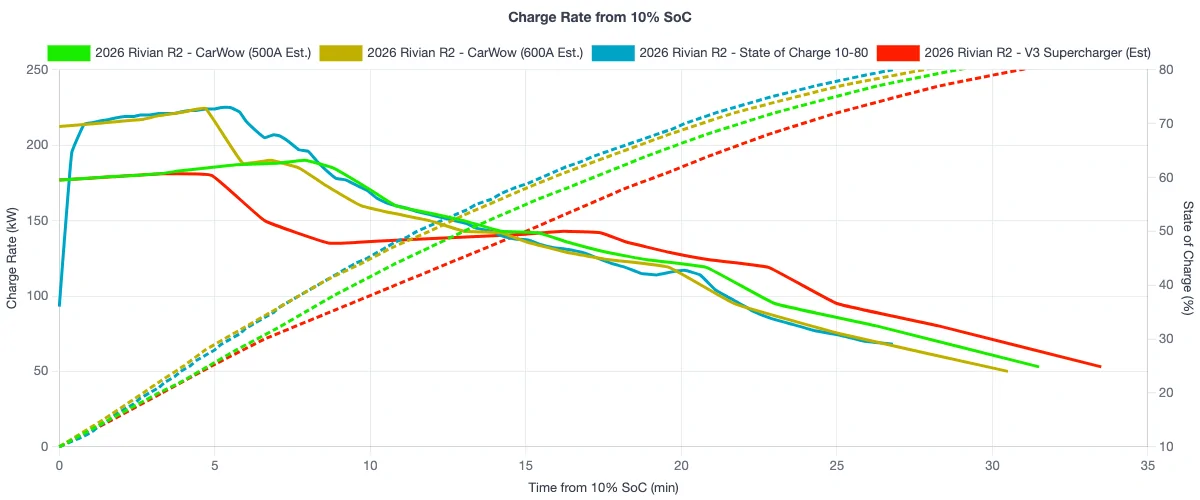
Caveat: V3 derating is genuinely easy to not notice in practice. If you're the kind of driver who plugs in around 20-25% SoC rather than deeper into the battery, you may never hit the window where it matters. [And this is "speculative"] I've seen 500A for as little as 2 minutes and as long as 10 minutes. For this analysis, I assumed my Model Y charge test defined the curve - so dropping off of 500A at 5 minutes and smoothly ramping down to 350A.
How these different charging speeds actually play out V3 vs. 500A vs. 600A
Net effect on charge time:
Roughly a 1–3 minute difference between 500A- vs 600A-capable equipment. It's a modest gap, and only accessible at a few hundred sites nationwide.
Roughly a 4-5 minute difference between 600A-capable vs V3 superchager - will likely take about 31-32 minutes to get 10-80%
Note, per the State of Charge testing, pushing 600A through a CCS adapter has shown thermal issues (melting). None of the adapters available on the market at this time are rated for 600A continuous.
Would 800V actually help R2's charging? [speculative]
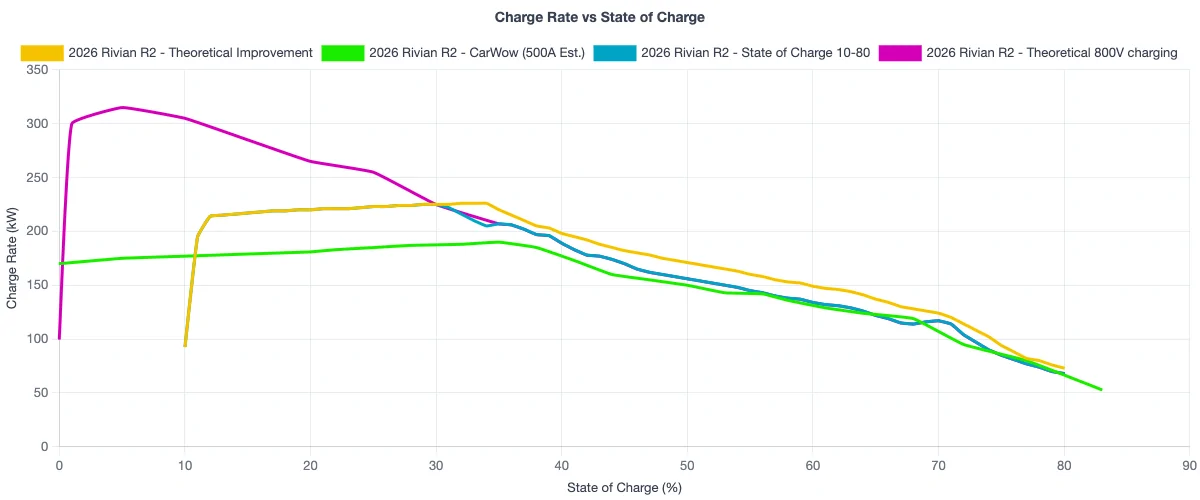
First, here's what the curves might look like (my best guess) if Rivian had implemented 800V charging (Pink) and if they can software "unlock" a touch more performance or thermal overhead (Yellow). Finally, I've kept the 500A curve (Green), as that's the case for most charging sites.
Looking at R2's charge curve, the current-limited portion (where 400V would be the actual bottleneck) appears to end somewhere around 30% (600A) to 35% (500A) SoC. Beyond that point, the curve looks like it's governed by cell chemistry / thermal limits, not by how much current the charger can deliver — R2 isn't pulling anywhere near 500A past 40%.
The takeaway (generalizable to many other EVs) an 800V architecture would not speed up the back 2/3 of R2's charging session at all — from ~35-40% SoC onward, R2's own pack is the limiting factor, not the voltage or current available at the charger. The benefit of 800V, if any, would be confined to the front portion of the curve (below ~35-40%), and only when using hardware capable of actually delivering that power.
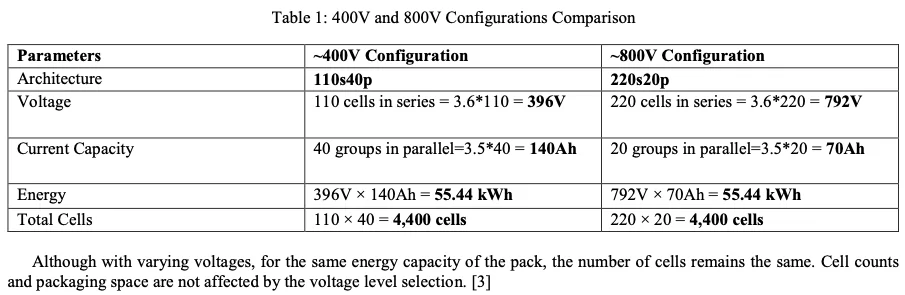
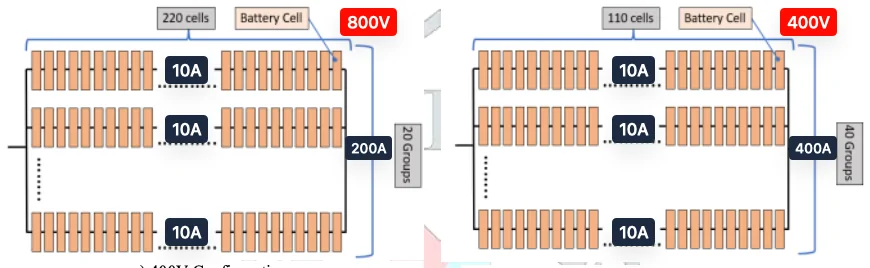
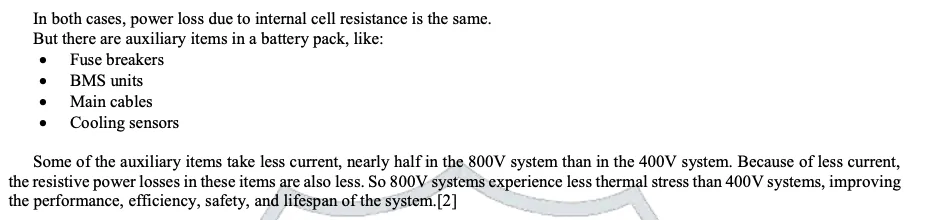
800V architecture does not, by itself, improve a battery's ability to accept power. It changes how much current is needed to deliver a given power level (lower current for the same kW), which matters for cable/connector thermal limits and charger hardware design, but the cells still have the same power-acceptance capability regardless of pack voltage.
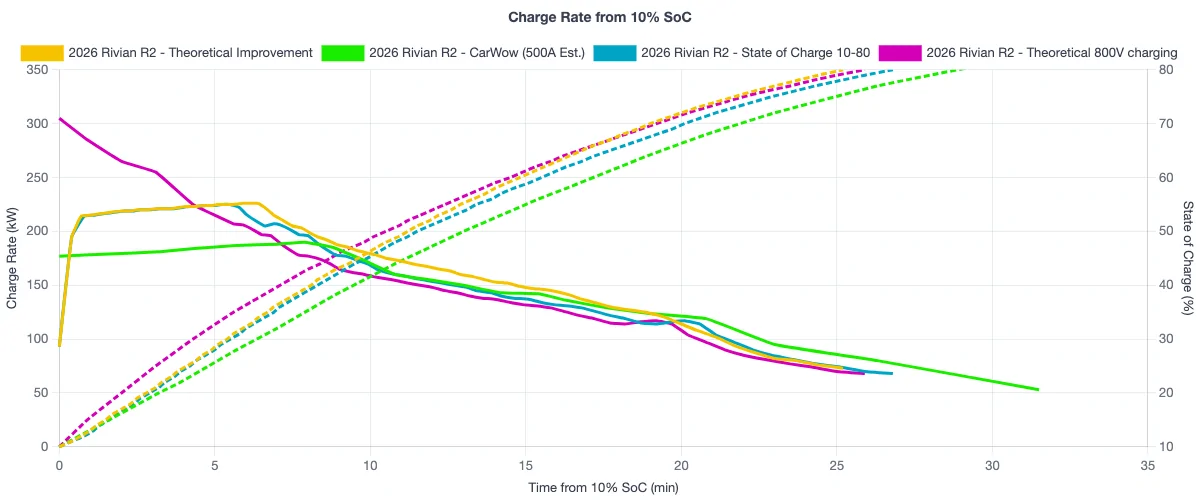
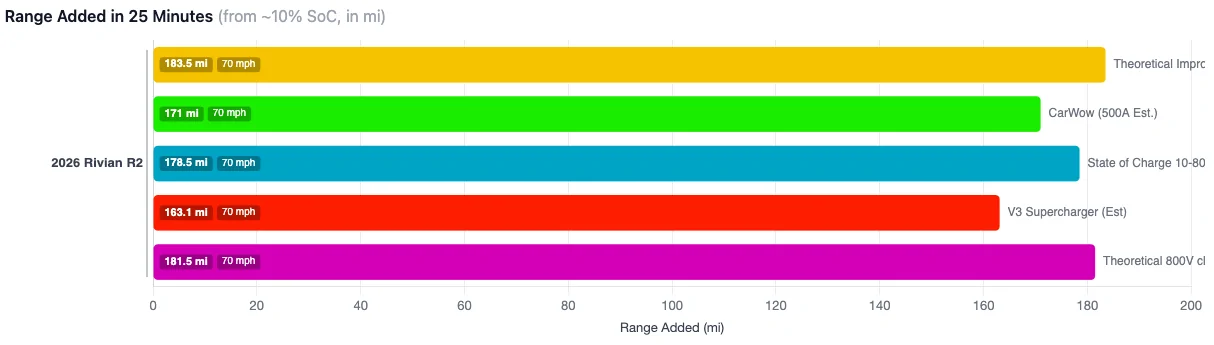
And here's how these estimates translate to actual charging times:

It seems an 800V architecture would save about 1.5 minutes from 10-30% on a 600A charger, and 2.5 minutes from 10% to 35% on a 500A charger. These savings persist to the end of the charging session. 10-80% would drop from about 27/29 minutes to 25-26 minutes.
But we can see that even on 400V, R2 could achieve the same 25 minute 10-80% charge with a modest 10-20kW improvement in charging speeds from 40-75%.
Why 800V isn't a clean win
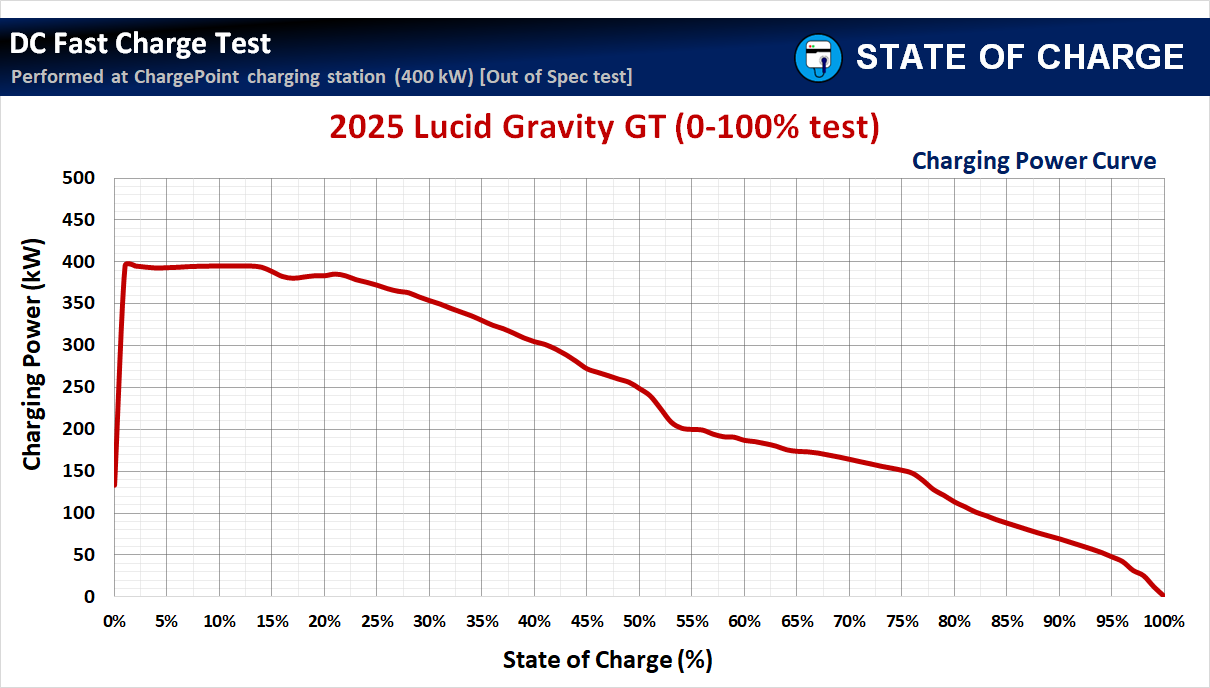
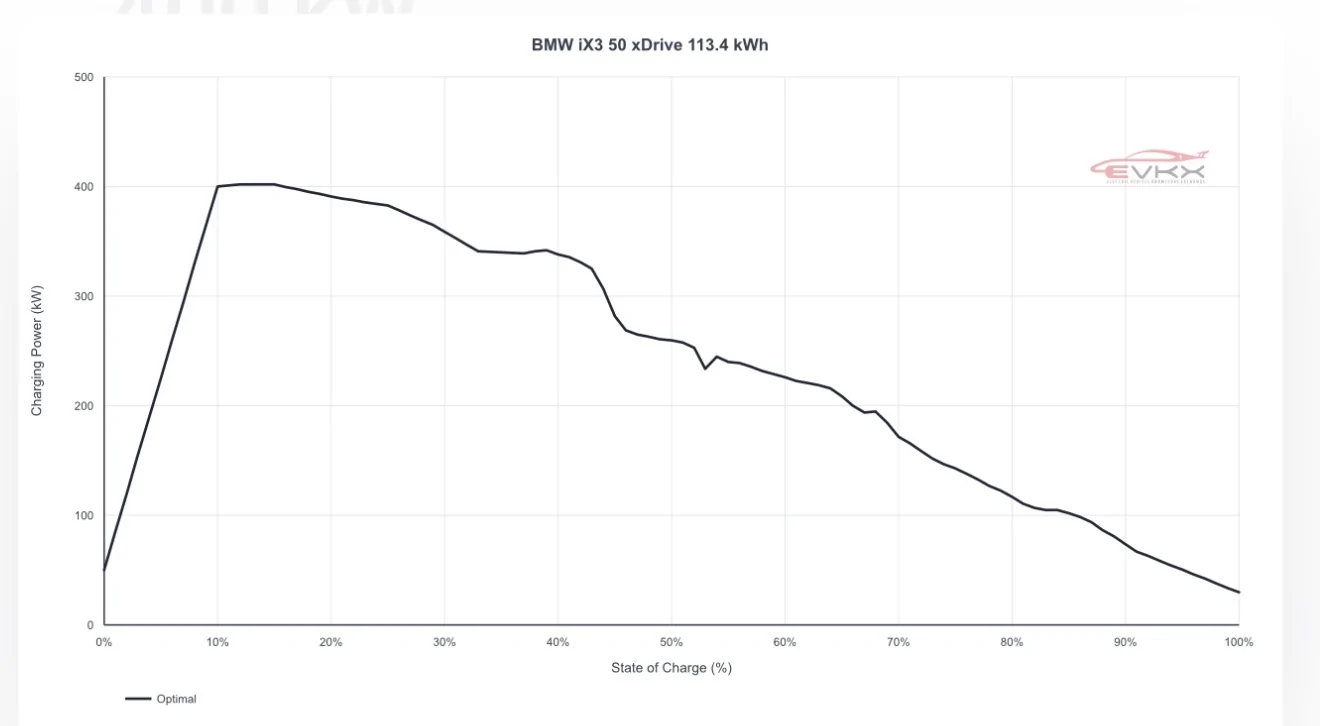
First, my argument: 800V has no real downside. Vehicles like the Lucid Gravity and BMW iX3 demonstrate that an 800V vehicle can sustain 190–225 kW even on a Tesla Supercharger via boost conversion. So in principle, 800V shouldn't cost you anything even on "wrong voltage" hardware.
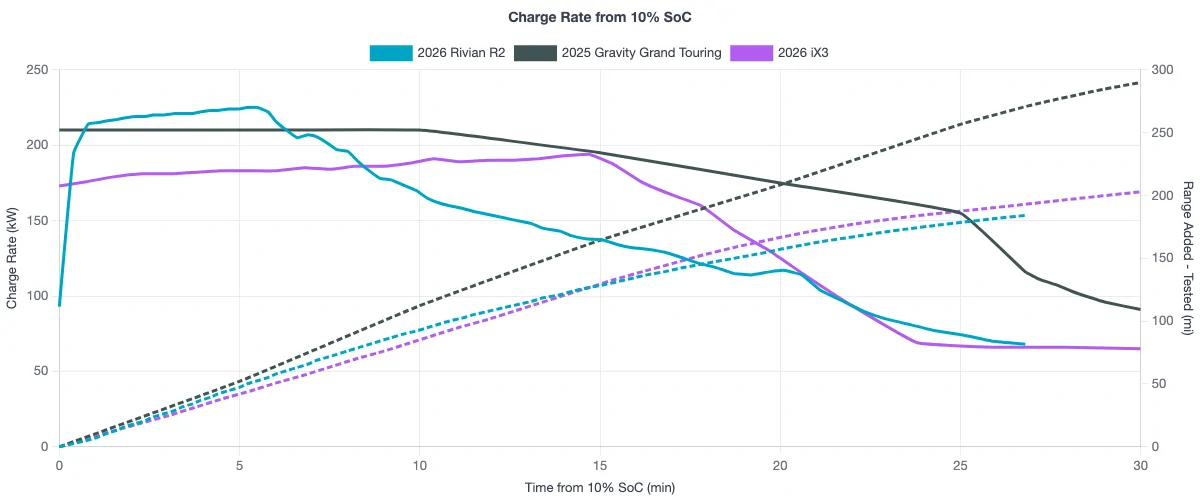
Here's the R2 laid up against tests of the Gravity and iX3 on V3.5 superchargers:
Part 3: Range
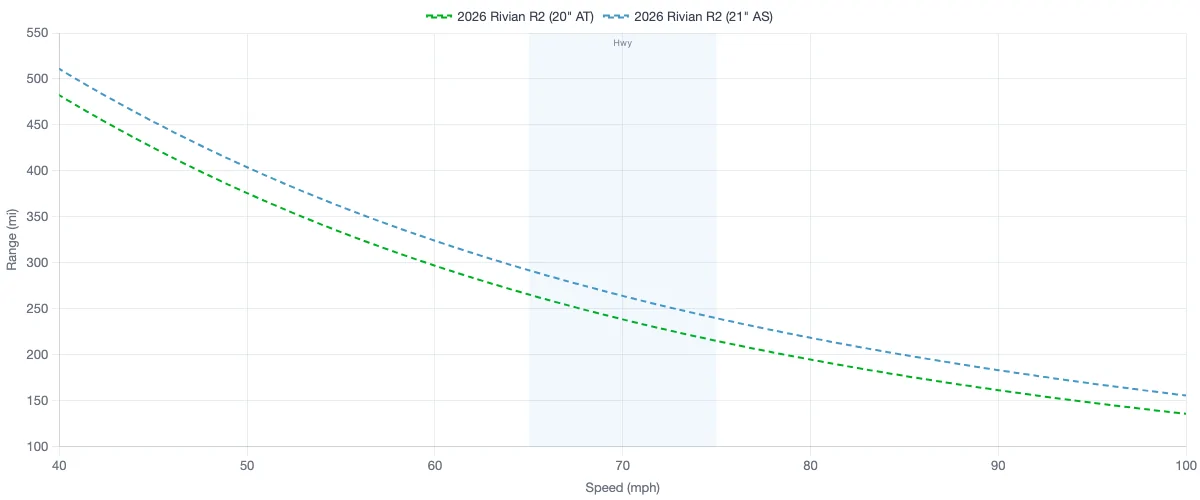
To be filled out more when I have more reliable data, but here's what the EPA dynomometer coefficients suggest - and it matches Toms test when adjusted for elevation:
Part 4: Practical roadtrip comparisons
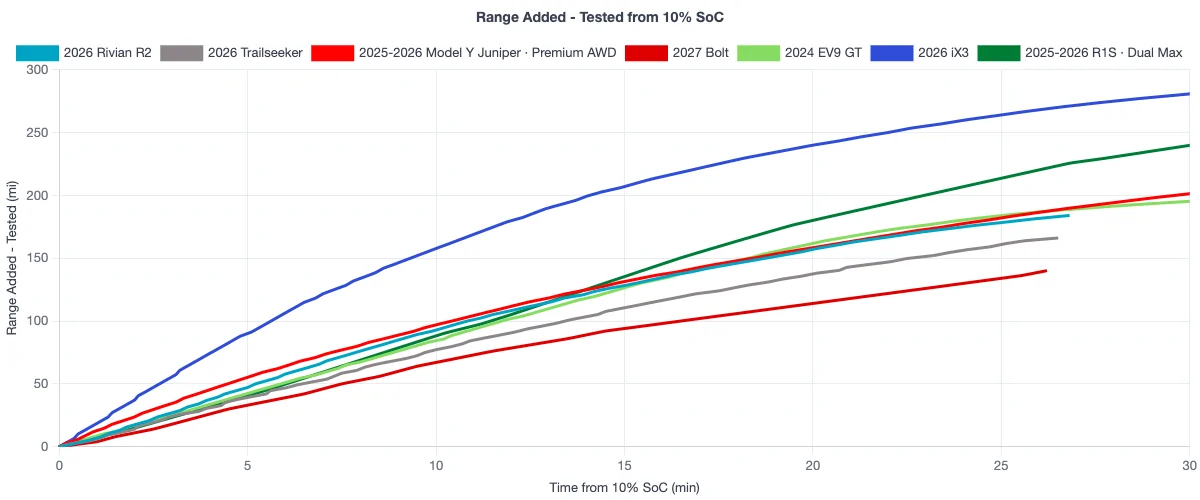
Look at this first chart. You can hardly pick apart R2 from the competition.


And if we run a roadtrip simulation, driving 140 miles between charges at 75mph over 600mi, we can see that R2 takes a little over an hour longer than what would be totally feasible in a ICE vehicle, and about 8 minutes longer (within the noise) vs. a Model Y. Even a Chevy Bolt only takes 25 minutes longer! (Sorry, slipping into commentary.)
In reality, the difference of +/- 30 minutes over a 9hr drive is totally negligible. Nerds like me demand faster, but that's my greedy American bias.

Commentary (my opinion)
I came into this with a bias: I think R2's charging is fine but not impressive, mostly because it doesn't move the ball forward industry-wide.
It matches practical (miles/min) performance that Tesla had nailed by 2020. In energy added, its arguably *worse* than a 2020 Audi Etron. That's a very "keeping up" result, not a "raising the bar" one, where global competition is charging at twice the average rate. And it's launching into an increasingly 800V-capable charging landscape, so even the current limitations are not a strong excuse.
As the "theoretical improvement" curve shows, 400V isn't *the* problem. It's that these batteries only charge *adequately* - 2.5C at 30%, but falling to 1C before 80%. It's right in line with a Chevy Bolt, Subaru Trailseeker, and R1S. The iX3 and Kia EV9 are MUCH faster charging up here, holding over 2C to 60%.
What I appreciate: R2 modestly beats mainstream 400V competitors like the bZ and Trailseeker, and matches the "industry standard" Model Y. And it clearly outclasses the performance of GMs mass-market vehicles.
For a boxy, dual-motor SUV, that's a win.
What disappoints me: The US charging network is already majority 800V-capable, and even if it wasn't, the top half of the charge curve can barely compete with legacy OEMs. It's not the step foward I'd hoped a clean-sheet 2026 platform would deliver. I worry that in 2 years it will seems a little like a dinosaur, as the first gen Bolt and Kona do today. I hope they have an updated battery in the works.
I'm similarly disappointed by R2's range. Not that R2 should match R1S (a 320-380 mi usable-at-70-mph vehicle is genuinely a different class). But the Model Y beats the R2 outright, and the iX3 beats it by a wide margin.
My personal desire is 250+ miles from 80% SoC at 70 mph, since that translates to a reliable 2 hours of driving (180+ miles) at 75-80 mph in winter conditions.
The R2 doesn't clear that bar.
Range is luxury - it saves you money with more miles covered from cheap L2 charging, and provides flexibility with how long driving legs can be. I think this is where R2 will feel weakest as a tow vehicle or as a "go deep into a national park" adventure rig. To be clear, the range isn't a practical dealbreaker for most trips — it just doesn't quite match the brand's adventure-oriented image, in my opinion.

This is *not* comprehensive, despite the length. I will update this top post with relevant points based on any comments I get as I get time to gather data.
TL;DR
R2 charges very well *for a 400V vehicle* and is efficient for its shape. In absolute terms, its charge rate and practical highway "miles per minute of charging" are within a rounding error of the Tesla Model Y and it marginally beats the mainstream peers on the market today (Trailseeker, Blazer EV, Prologue, etc.) in charging performance (not by as much as the 220+ kW peak suggests). The usable highway range is competitive, falling right in line with the competition. Expect 250-285mi at 70mph in fair weather 100%→0%. Expect 27-32 minute 10-80% charges, adding 180mi of real-world range. (A more optimal strategy, where infrastructure allows, is to charge for 20-25 minutes, which will easily add 160mi of usable range.)
Methodology & Sourcing Disclosure
Before the data, transparency on where everything comes from:
- Charge curve and range-added data are hand-compiled from various sources that I find trustworthy or can corroborate. Out of Spec, Bjorn Nyland and State of Charge primarily, with some Reddit and Forum-sourced data points included where supporting evidence (video & logged data) was provided.
- I am often plotting time* on the X-axis, as that is (in my opinion) the meaningful metric. Additionally, some figures are normalized/massaged/extended to correct for missing data points. Watch for (est) or (theoretical) on the plots.
- Range estimates are all based upon demonstrated range in a real world, steady state driving scenario in a loop. These are normalized to 70mph if not tested at 70mph.
- All R2 data is for the **Performance/Launch (Dual-Motor) trim**, currently the only trim available.
Part 1: Charging Performance
First up, we can look at a collection of charging events I have. The State of Charge video seems to be basically ideal and confirmed by other charging events. It looks like there's a hair of thermal overhead starting later in the charge.
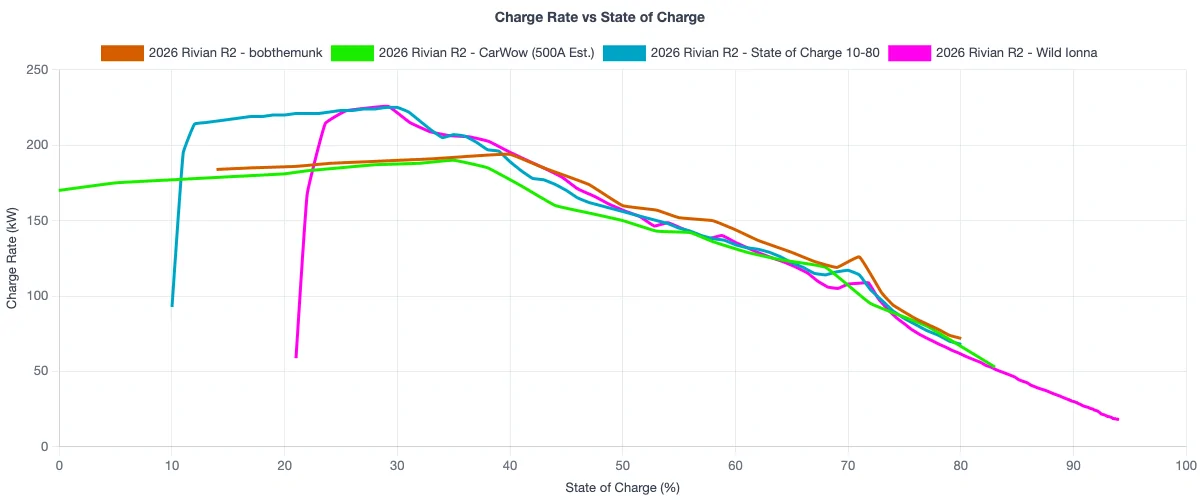
This shows us that there's not a thermal penalty to using a 600A capable charger and getting that maximum speed below 40%. Overall, this looks like a well controlled curve that is entirely limited by charger/port current below 35-40% (so 800V would help down there, but we'll get to that later).
And to get you familiar with the graphs I'll be using...
Here's charging rate, and more importantly, range added, by time. The dashed lines use the right axis. So the R2 gains 160mi of range after 20-22.5 minutes in these 3 charging events, normalized to starting at 10%.
Now, the important part, the Head-to-head comparisons:
First up, let's compare to the big brother, the R1S (dual-max), as well as the Subaru Trailseeker (simliar market), and of course, the Telsa Model Y.
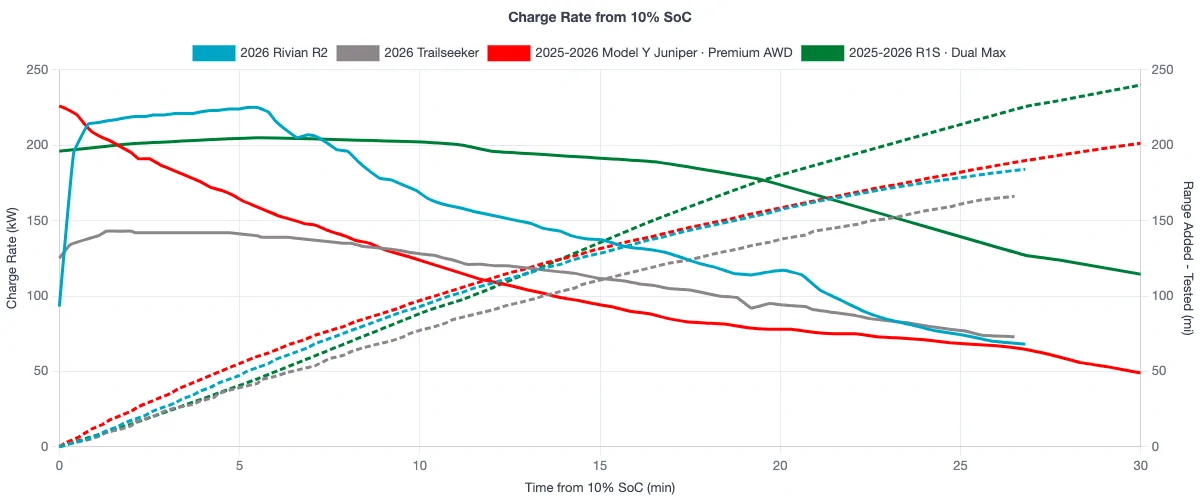
What we see here, looking at the range added (dashed line) is that the R2 is just a hair behind the Model Y until about 10 minutes, at which point they are effectively identical in range added. Similarly, it's just a hair ahead of the R1S until this point thanks to the superior efficiency. But by 25 minutes, the R1S has 30-40more usable miles "in the tank". The R1S will still be the superior road tripping vehicle.
What's possibly more interesting to this market is the comparison to the Trailseeker. The trailseeker has a really underwhelming charging rate, but it is damn near flat. And it's just a hair more efficient than the R2. The R2 builds a nice lead to 10 minutes, and then they basically match 1:1. You're only losing 10-20 miles of range in the Trailseeker vs R2 in a typical charging session.
And then lets compare to some 800V vehicles that are slightly out of class:
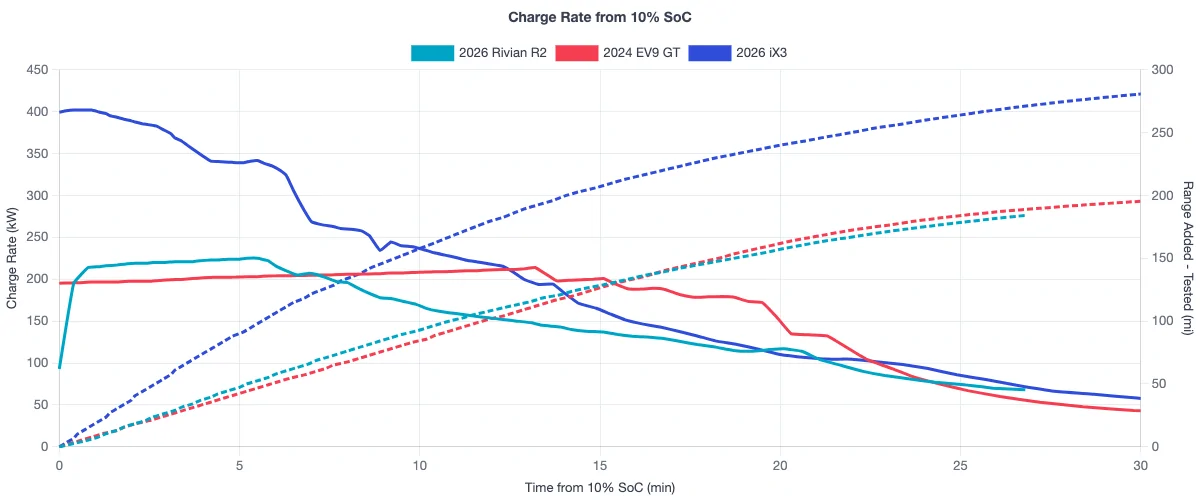
The R2 directly competes with the EV9 for the first 10 minutes despite the lack of 800V architecture.
But the iX3... absolutely blows them out of the water, gaining range twice as fast until about 15 minutes.
This gets into the next section...
Part 2: The 400V vs. 800V Debate
Flagging up front: this section leans more heavily on inference and my own read of the curves than Part 1. The underlying charts are real data; the conclusions drawn from them are more debatable.
The R2 is a 400V class vehicle. RJ stated this is to hold costs down - a reasonable decision. But (I suspect) Rivian knew that 400V is a severe bottleneck on charging performance at low states of charge. So the R2 launches supporting up to 640A charging, but almost no public infrastructure can deliver that today. As of now, only three hardware classes in the US support 600A:
US DC fast charging hardware breaks down into roughly three tiers:
- ~2,500 sites: 500A-capable
- Electrify America, EVgo, and similar CCS networks
- ~800 V3.5 (400V) and 14 V4 (800V) Tesla Superchargers
- ~500 sites: 600A-capable
- Rivian Adventure Network*, IONNA, Walmart*, Mercedes*
- * Not alll ports, but most
- Rivian Adventure Network*, IONNA, Walmart*, Mercedes*
- ~2,200 V3 Tesla Supercharger sites that typically throttle down from 500A to their continuous rating of 350A
- These chargers are limited to 350A continuously. They *will* deliver 500A for a few minutes, with duration highly variable based on age and weather.
- A bunch of crappy 200A, 300A, 350A limited CCS chargers (all support 800V)
Caveat: V3 derating is genuinely easy to not notice in practice. If you're the kind of driver who plugs in around 20-25% SoC rather than deeper into the battery, you may never hit the window where it matters. [And this is "speculative"] I've seen 500A for as little as 2 minutes and as long as 10 minutes. For this analysis, I assumed my Model Y charge test defined the curve - so dropping off of 500A at 5 minutes and smoothly ramping down to 350A.
How these different charging speeds actually play out V3 vs. 500A vs. 600A
Net effect on charge time:
Roughly a 1–3 minute difference between 500A- vs 600A-capable equipment. It's a modest gap, and only accessible at a few hundred sites nationwide.
Roughly a 4-5 minute difference between 600A-capable vs V3 superchager - will likely take about 31-32 minutes to get 10-80%
Note, per the State of Charge testing, pushing 600A through a CCS adapter has shown thermal issues (melting). None of the adapters available on the market at this time are rated for 600A continuous.
Would 800V actually help R2's charging? [speculative]
First, here's what the curves might look like (my best guess) if Rivian had implemented 800V charging (Pink) and if they can software "unlock" a touch more performance or thermal overhead (Yellow). Finally, I've kept the 500A curve (Green), as that's the case for most charging sites.
Looking at R2's charge curve, the current-limited portion (where 400V would be the actual bottleneck) appears to end somewhere around 30% (600A) to 35% (500A) SoC. Beyond that point, the curve looks like it's governed by cell chemistry / thermal limits, not by how much current the charger can deliver — R2 isn't pulling anywhere near 500A past 40%.
The takeaway (generalizable to many other EVs) an 800V architecture would not speed up the back 2/3 of R2's charging session at all — from ~35-40% SoC onward, R2's own pack is the limiting factor, not the voltage or current available at the charger. The benefit of 800V, if any, would be confined to the front portion of the curve (below ~35-40%), and only when using hardware capable of actually delivering that power.
800V architecture does not, by itself, improve a battery's ability to accept power. It changes how much current is needed to deliver a given power level (lower current for the same kW), which matters for cable/connector thermal limits and charger hardware design, but the cells still have the same power-acceptance capability regardless of pack voltage.
And here's how these estimates translate to actual charging times:
It seems an 800V architecture would save about 1.5 minutes from 10-30% on a 600A charger, and 2.5 minutes from 10% to 35% on a 500A charger. These savings persist to the end of the charging session. 10-80% would drop from about 27/29 minutes to 25-26 minutes.
But we can see that even on 400V, R2 could achieve the same 25 minute 10-80% charge with a modest 10-20kW improvement in charging speeds from 40-75%.
Why 800V isn't a clean win
First, my argument: 800V has no real downside. Vehicles like the Lucid Gravity and BMW iX3 demonstrate that an 800V vehicle can sustain 190–225 kW even on a Tesla Supercharger via boost conversion. So in principle, 800V shouldn't cost you anything even on "wrong voltage" hardware.
Here's the R2 laid up against tests of the Gravity and iX3 on V3.5 superchargers:
Part 3: Range
To be filled out more when I have more reliable data, but here's what the EPA dynomometer coefficients suggest - and it matches Toms test when adjusted for elevation:
Part 4: Practical roadtrip comparisons
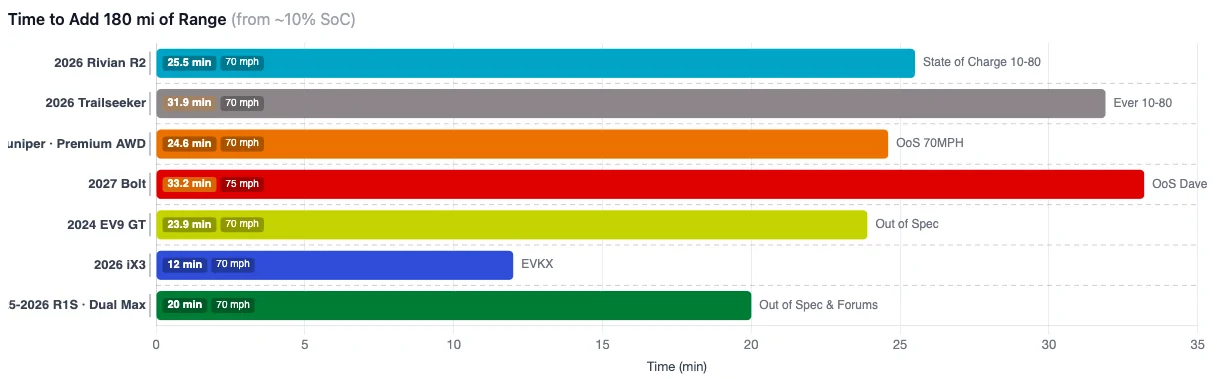
Look at this first chart. You can hardly pick apart R2 from the competition.
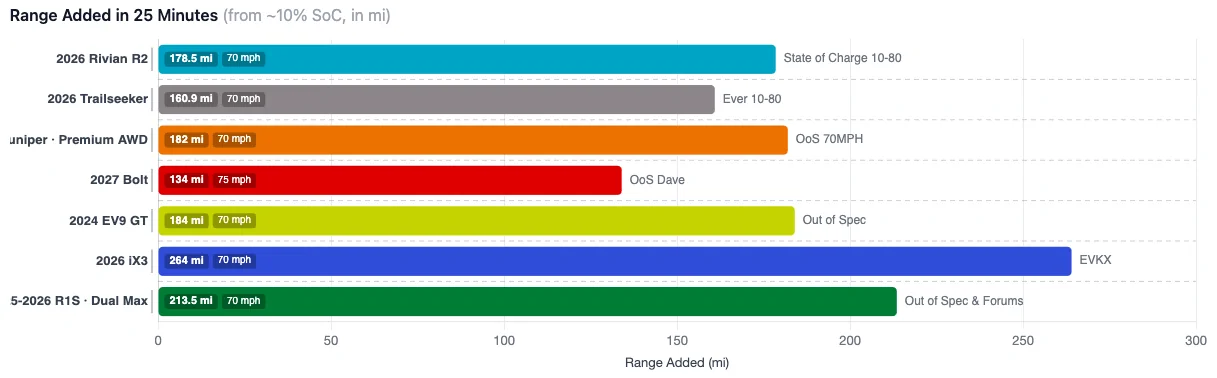
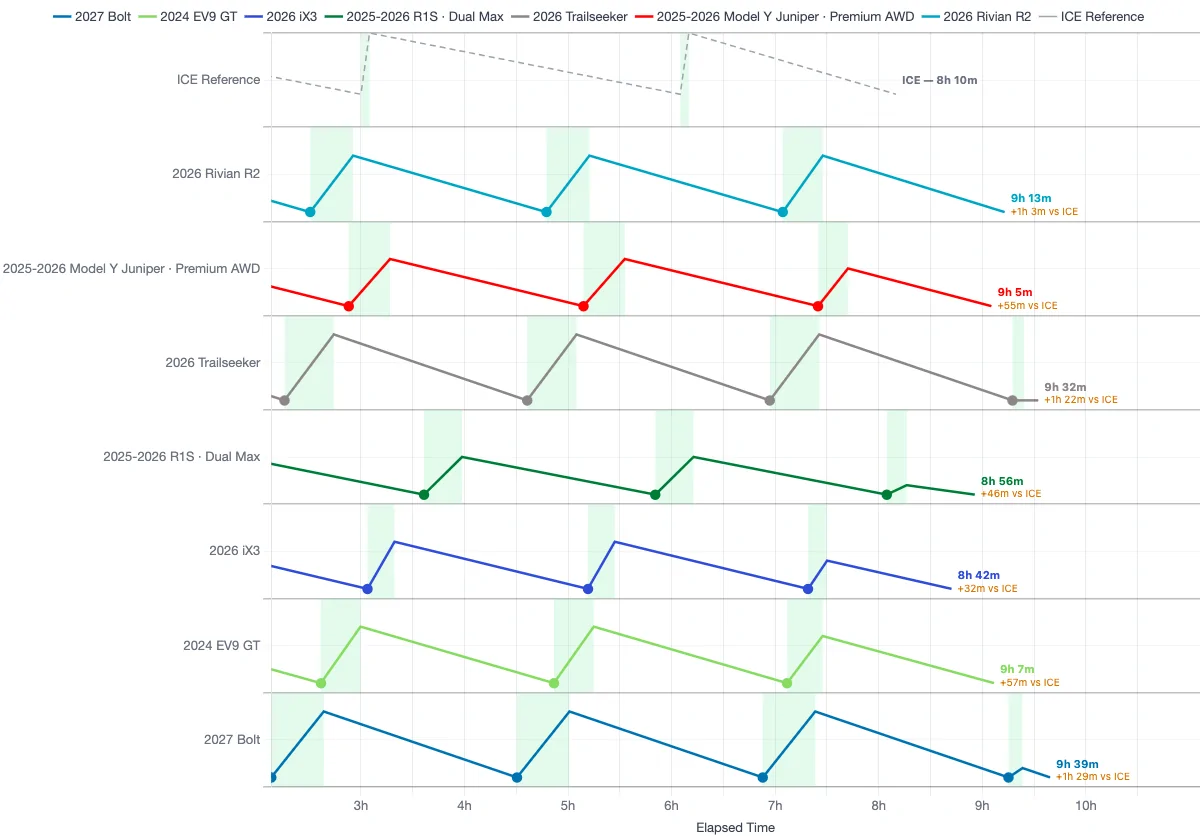
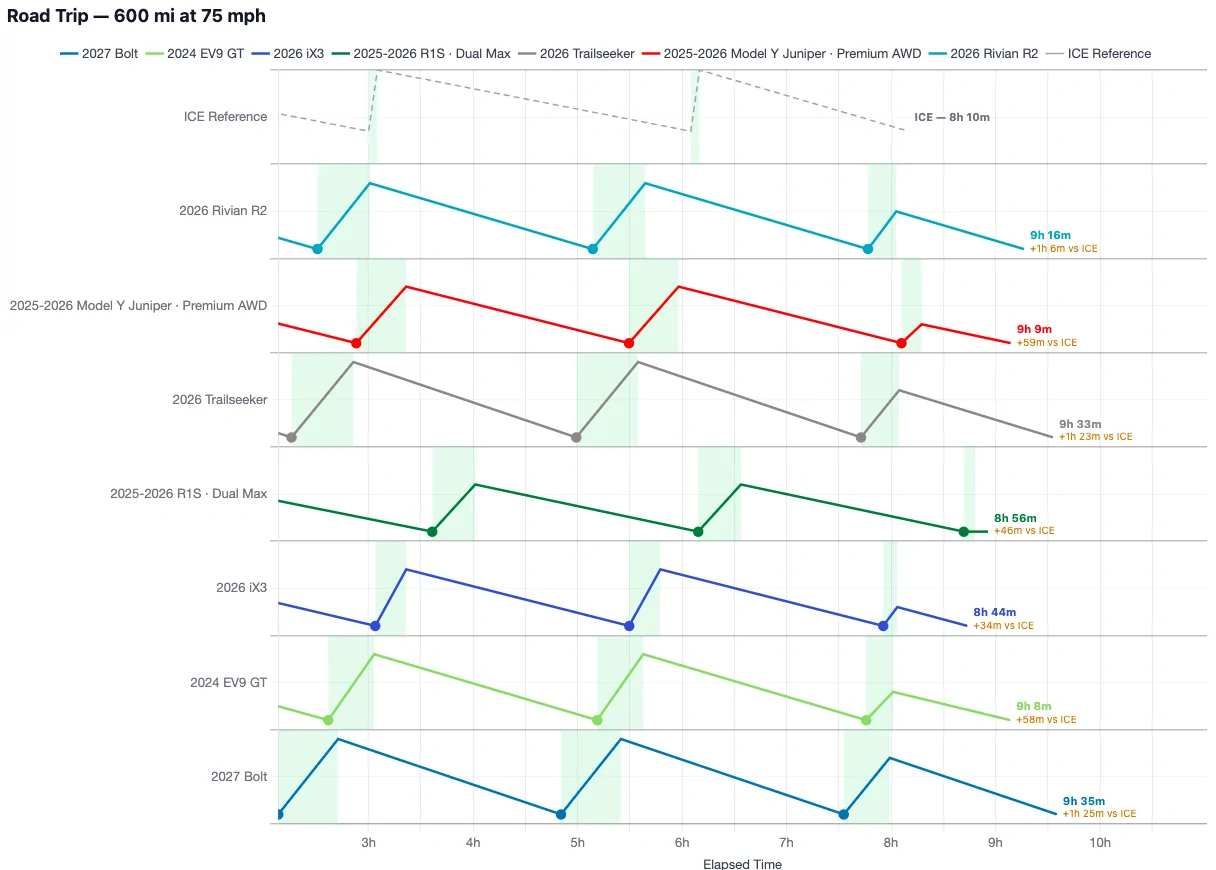
And if we run a roadtrip simulation, driving 140 miles between charges at 75mph over 600mi, we can see that R2 takes a little over an hour longer than what would be totally feasible in a ICE vehicle, and about 8 minutes longer (within the noise) vs. a Model Y. Even a Chevy Bolt only takes 25 minutes longer! (Sorry, slipping into commentary.)
In reality, the difference of +/- 30 minutes over a 9hr drive is totally negligible. Nerds like me demand faster, but that's my greedy American bias.
Commentary (my opinion)
I came into this with a bias: I think R2's charging is fine but not impressive, mostly because it doesn't move the ball forward industry-wide.
It matches practical (miles/min) performance that Tesla had nailed by 2020. In energy added, its arguably *worse* than a 2020 Audi Etron. That's a very "keeping up" result, not a "raising the bar" one, where global competition is charging at twice the average rate. And it's launching into an increasingly 800V-capable charging landscape, so even the current limitations are not a strong excuse.
As the "theoretical improvement" curve shows, 400V isn't *the* problem. It's that these batteries only charge *adequately* - 2.5C at 30%, but falling to 1C before 80%. It's right in line with a Chevy Bolt, Subaru Trailseeker, and R1S. The iX3 and Kia EV9 are MUCH faster charging up here, holding over 2C to 60%.
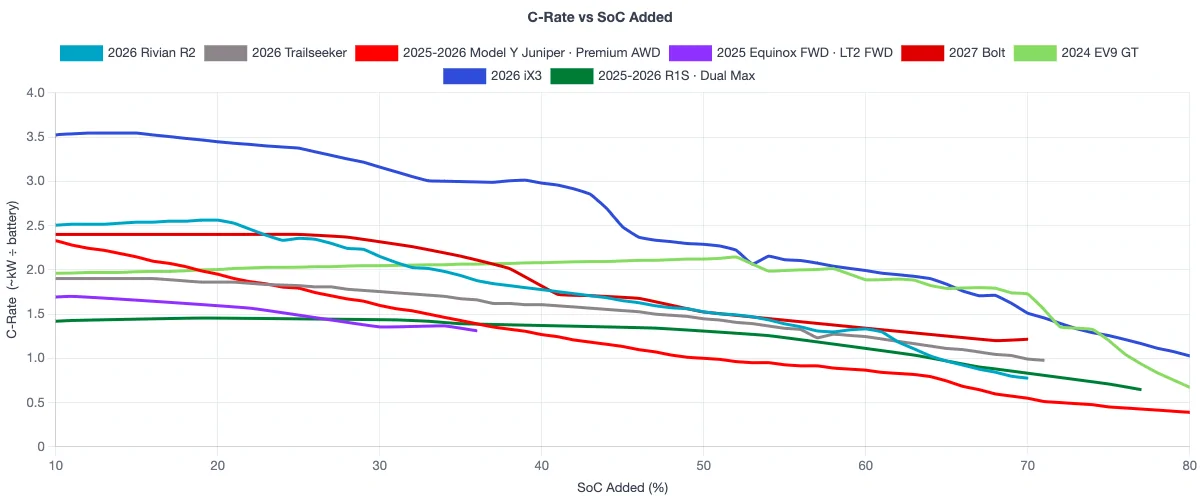
What I appreciate: R2 modestly beats mainstream 400V competitors like the bZ and Trailseeker, and matches the "industry standard" Model Y. And it clearly outclasses the performance of GMs mass-market vehicles.
For a boxy, dual-motor SUV, that's a win.
What disappoints me: The US charging network is already majority 800V-capable, and even if it wasn't, the top half of the charge curve can barely compete with legacy OEMs. It's not the step foward I'd hoped a clean-sheet 2026 platform would deliver. I worry that in 2 years it will seems a little like a dinosaur, as the first gen Bolt and Kona do today. I hope they have an updated battery in the works.
I'm similarly disappointed by R2's range. Not that R2 should match R1S (a 320-380 mi usable-at-70-mph vehicle is genuinely a different class). But the Model Y beats the R2 outright, and the iX3 beats it by a wide margin.
My personal desire is 250+ miles from 80% SoC at 70 mph, since that translates to a reliable 2 hours of driving (180+ miles) at 75-80 mph in winter conditions.
The R2 doesn't clear that bar.
Range is luxury - it saves you money with more miles covered from cheap L2 charging, and provides flexibility with how long driving legs can be. I think this is where R2 will feel weakest as a tow vehicle or as a "go deep into a national park" adventure rig. To be clear, the range isn't a practical dealbreaker for most trips — it just doesn't quite match the brand's adventure-oriented image, in my opinion.
Sponsored