
stewmander
Member
All the more reason to go with a more widely available tire size, no?Good for you but the R2 doesn't have a full spare tire with either wheel option so it wouldn't be any different in this case.
Sponsored
All the more reason to go with a more widely available tire size, no?Good for you but the R2 doesn't have a full spare tire with either wheel option so it wouldn't be any different in this case.

I had 22” Michelin Defender tires on. A common tire. But, because of the load rating I still had to wait 2 days to get a tire shipped to replace my blow out. The 20” diameter on R2 might be a more common diameter but the load rating is not. I’ve had two instances of waiting for a replacement tire to be shipped and the delay was not due to diameter but the load rating. The whole 20” vs 21” debate is rather pointless in my opinion.All the more reason to go with a more widely available tire size, no?
Why? Sure you can drive a couple days on the spareAll the more reason to go with a more widely available tire size, no?
Scheduled for October-November. I am just a "suggesting offroad tires for a mass market vehicle" antagonist. I would never go offroad or care i just like the styling inside and out.Are you looking to purchase an R2 or just an R2 antagonist?


7% rejected?Current stats for Rivian Roamer dataset:
practical tie: strongly suggested
7% 21” advantage: increasingly strongly rejected
meaningful 21” advantage: unsupported
20” advantage: unsupported statistically
formal ±3% equivalence: not quite established yet

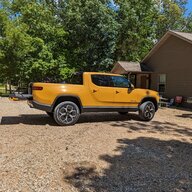
About 3 weeks ago. Nail through edge of tire.When was the last time you blew a tire in a manner that you needed a replacement (instead of a plug)? I'll put my faith in Rivian service centers having enough tires in stock or giving me a loaner instead.
...because if you don't have a full size spare tire you may not always have the option to wait for a replacement.Why? Sure you can drive a couple days on the spare
Thanks for the heads up, I will pay more attention to that and double check availability in terms of delivery and not just what's offered.I had 22” Michelin Defender tires on. A common tire. But, because of the load rating I still had to wait 2 days to get a tire shipped to replace my blow out. The 20” diameter on R2 might be a more common diameter but the load rating is not. I’ve had two instances of waiting for a replacement tire to be shipped and the delay was not due to diameter but the load rating. The whole 20” vs 21” debate is rather pointless in my opinion.
It's ground hog day! You're still beating this dead horse.Current stats for Rivian Roamer dataset:
practical tie: strongly suggested
7% 21” advantage: increasingly strongly rejected
meaningful 21” advantage: unsupported
20” advantage: unsupported statistically
formal ±3% equivalence: not quite established yet
Ok, but no R2 has a full size spare tire regardless of wheel choice. (I personally couldn't care less I won't even get the compact spare tire)...because if you don't have a full size spare tire you may not always have the option to wait for a replacement.


No one in any scenario in any video or any post is getting epa range on the 21s.I worry if any statisticians are reading this thread they're gonna have a heart attack. So many "conclusions" based on uncontrolled observations. The only reliable comparison would be to take 2 vehicles under the exact same controlled environment, each with the different wheel/tire package, and run them from 100% to 0%.
Oh wait, that's what the EPA did. And the EPA says the 21" Pirelli AS tires are 8% more efficient.
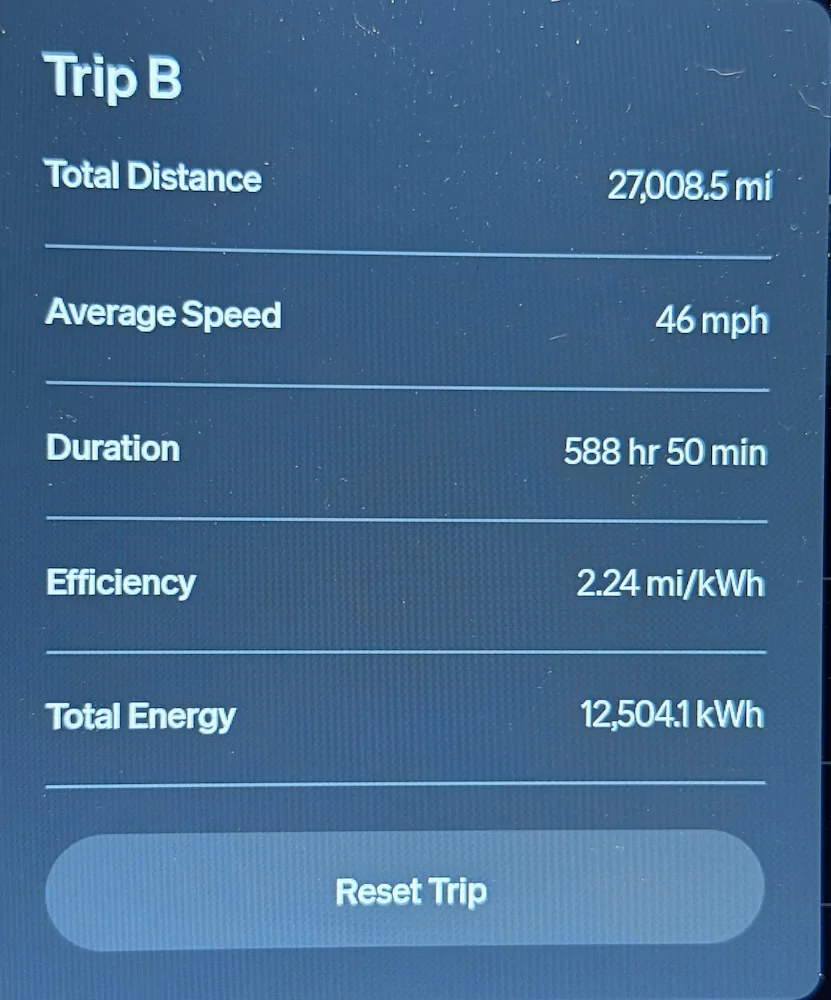
For example, I drive an R1S with over 27,000M on the original 20" wheels with Pirelli All Terrain Plus tires and have a lifetime efficiency of 2.24mi/kWH. That's even better than the 2.20mi/kWh for the 22" Pirelli Scorpion MS tires that Rivian Roamer shows with over 4 million miles of data. But that doesn't mean my AT tires are more efficient than the MS tires. Even though I represent 27,000 miles of data, that's nowhere near statistically significant. The R2 data on RR is less than twice that amount (~50K miles per tire type), so drawing conclusions from such a small data set is improper. Once you get into the millions of miles you might consider addressing trends. (For the record, my Pirelli AT Plus tires on Rivian Roamer with over 3M miles of data is only 1.98mi/kWh. I'm the outlier).

So why is the RR data not reflecting the EPA-measured advantage for the Pirelli all season tires? I don't know. The EPA rating is measured on tires that have 4,000 miles on them - maybe the Pirellis take longer to break in. Or maybe R2 owners who choose the AS Pirellis drive more aggressively and use Sport Mode more than those who choose the T/A+. That probably explains why my R1S all terrain tire efficiency is so good - I'm a pretty conservative driver.
Overall it's wrong to jump to conclusions that the data don't support, like "these tires have about the same efficiency", especially when it contradicts the most tightly controlled comparison data we have, which is the EPA rating.
Time to change the title of the thread.