Sponsored

usofrob

Well-Known Member
First Name
Robert
Joined
Apr 9, 2022
Threads
5
Messages
671
Reaction score
583
Location
Michigan
Vehicles
Tesla 3, lotus Elise
Occupation
MBSE
The "10% challenge" video" you referenced above showed adding 42.5 kWh in 15 min (horrible charging according to "Out of Spite Kyle" @moosehead).

Under "ideal" circumstances with no "de-rating", we should expect to add around 50-52 kWh of energy (200+ kW, if we start from 10-20% SOC).
Wait, what? Kyle was saying it was a major fail because he only got 80% of ideal? Ugh :(
Sponsored


LR4toR1S

Well-Known Member
Joined
Nov 6, 2024
Threads
22
Messages
194
Reaction score
213
Location
Remotely Happy
Vehicles
Lr4, MachE, R56s, R1S Dual Max
Occupation
Minister of Awesomeness, Professional Musician
Wait, what? Kyle was saying it was a major fail because he only got 80% of ideal? Ugh :(
Kyle works with so many BEV that what we wouldn't notice....he does. He has seen very fast and efficient charging curves from other BEVs. The rest of us schmoes wouldn't notice or care a whole bunch and just live with it. Kyle knows we shouldn't HAVE to. So he gets irritated. Kyle is our man of the future. Once you have seen it you don't want to go back....much like rotary phones that only work at your house. Those would make us irritated. If we didn't know anything else? We wouldn't care.
 
OP
OP
Budman

Budman

Well-Known Member
First Name
Rick
Joined
Oct 22, 2021
Threads
58
Messages
815
Reaction score
2,507
Location
Minnesota
Vehicles
Honda CRV
Clubs
 
Rick, you are amazing. I love this post.

I am surprised the heat pump is not making a measurable difference in cold temperatures. I wonder if you will see a trend after you get more data points. That said, I think the difference is likely to be less than 10%, so considering all the other variables, it may be hard to pick that one out as the cause.

If I lived in MN, I would insulate the glass roof. That has to be adding significant heating overhead to each trip. But even with good insulation on the glass, the difference will be hard to measure. A 2-3% improvement would add less than 10 miles in cold temps. Still, I would take it!
Thanks MK. I’ve been a fan of your posts on the Mach-e forum and here as well.

I suspect that over time I will see a small heat pump benefit but it will be small.

As notes elsewhere, the heat pump is a bit noisy. Sounds like the Gen1 when battery preconditioning is engaged but not quite that loud. But boy does that baby put out the heat! And quick. In about 1 minute after a cold start up it is buying out very warm air. On balance though I would rather have the Gen 1 HVAC. I’m happy with all other aspects of the Gen 2.
 

Rearls2506

New Member
First Name
Rich
Joined
Nov 22, 2024
Threads
0
Messages
1
Reaction score
0
Location
Odessa, Tx
Vehicles
2025 R1T
I've been a R1T owner for about 2.5 years now. First a Gen 1 Quad Motor Large Battery which I recently traded in for a Gen 2 Dual Motor Max Pack. Combined, I have about 60,000 miles on the two vehicles. I'm a bit of a data geek (35 years experience as a Mechancal Design and Test Engineer), I've collect detailed data on my road trip efficiency, range, and charging performance.

What follows is a detailed summary of the data I collected which I offer to you as another reference source to compliment the observations given by some popular YouTube Influencers. I often find those YouTube videos to be superficial despite their length, lacking statistical rigor and proper context, and sometimes just plain wrong.

KEY POINTS TO BE MADE BELOW:
Gen 2 and Gen 1 have similar efficiencies.
Heat pump not yet seen to provide a benefit
Overall range figures meet EPA estimates when driven on a mix of city/rural/highway route.
Gen 2 and Gen 1 have similar fast charging performance.
The most optimal road trip charging strategy is to stop for around 20 to 25 minutes and add around 60 kWh of energy.
It is not necessary to start a charging session at very low states of charge (like 10%) to have a fast road trip. Starting around 20% will yield roughly the same overall time with much less risk.


DETAILED ANALYSIS

Efficiency and Range:

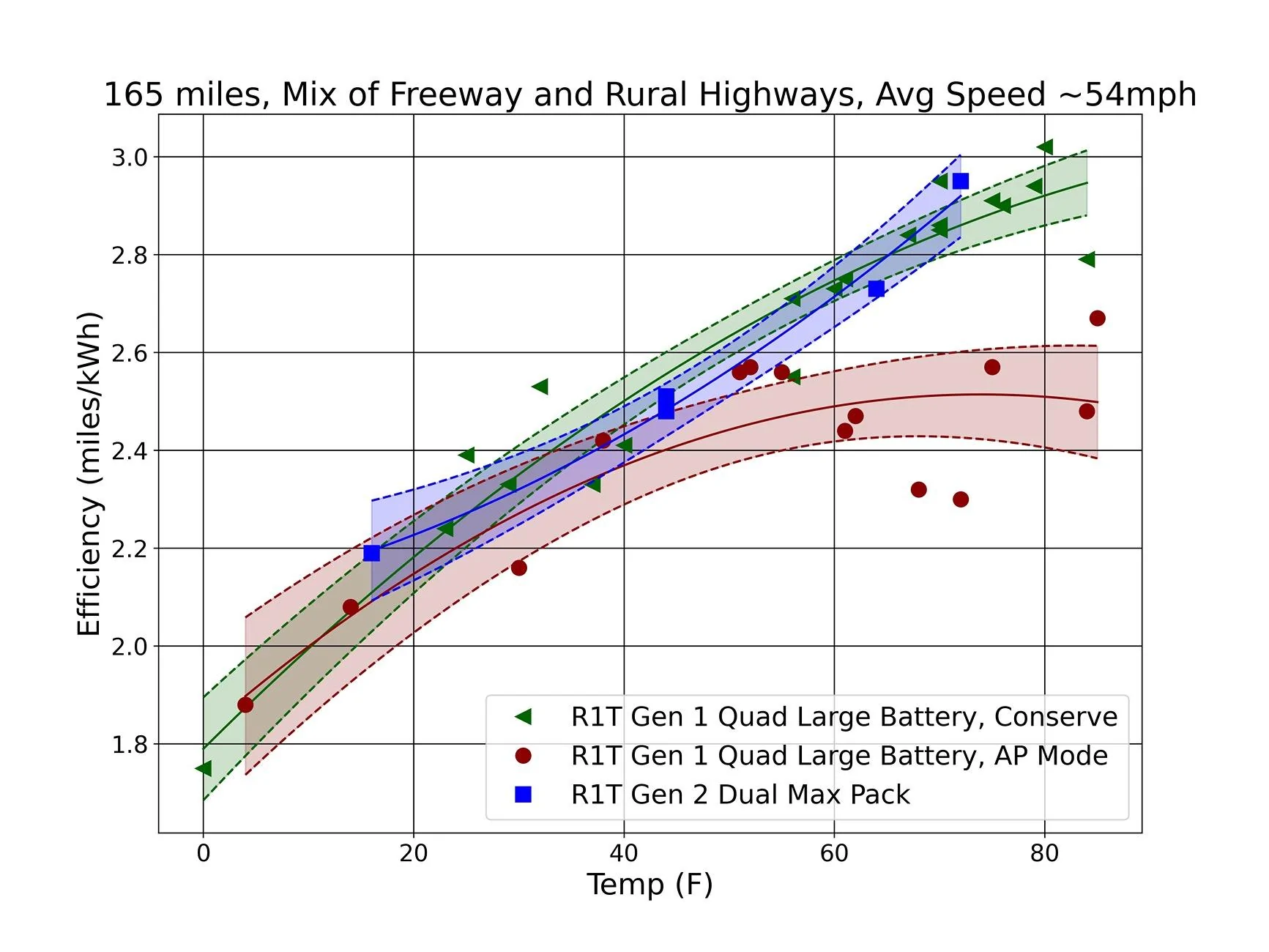
I drive the same 165 mile route frequently. It's a mix of 70mph Freeway and 55mph rural roads with frequent slower sections through intersections and small towns. I think it is close-ish to the EPA combined city/highway test cycle. As such, I have observed my R1Ts have closely matched the EPA stated values for range.

I've posted versions of this next chart many times on this forum. However, this time I have enough data on the Gen 2 Dual Motor Max pack to start making statistically meaningful comparisons. The shaded areas are the 95% confidence intervals on the calculated mean line fit.

Points to Make:
The Gen 2 Dual Motor Max Pack (22" wheels) has very similar efficiency vs temperature performance as the Gen 1 Quad Motor Large Battery (21" wheels) when in Conserve Mode.

I've not yet observed any meaningful efficiency benefit from the heat pump in the Gen 2 vehicle. Sample size is still a bit small, perhaps a benefit will emerge over time.

For the Gen 1 Quad, in warmer temperatures, at the speeds I travel on this route, there is a significant improvement in efficiency in conserve vs all. purpose.

*** This is not a 75 mph highway speed efficiency test. I am not claiming I see this efficiency at higher speeds for extended periods. ****
R1T efficiency vs temp.jpg


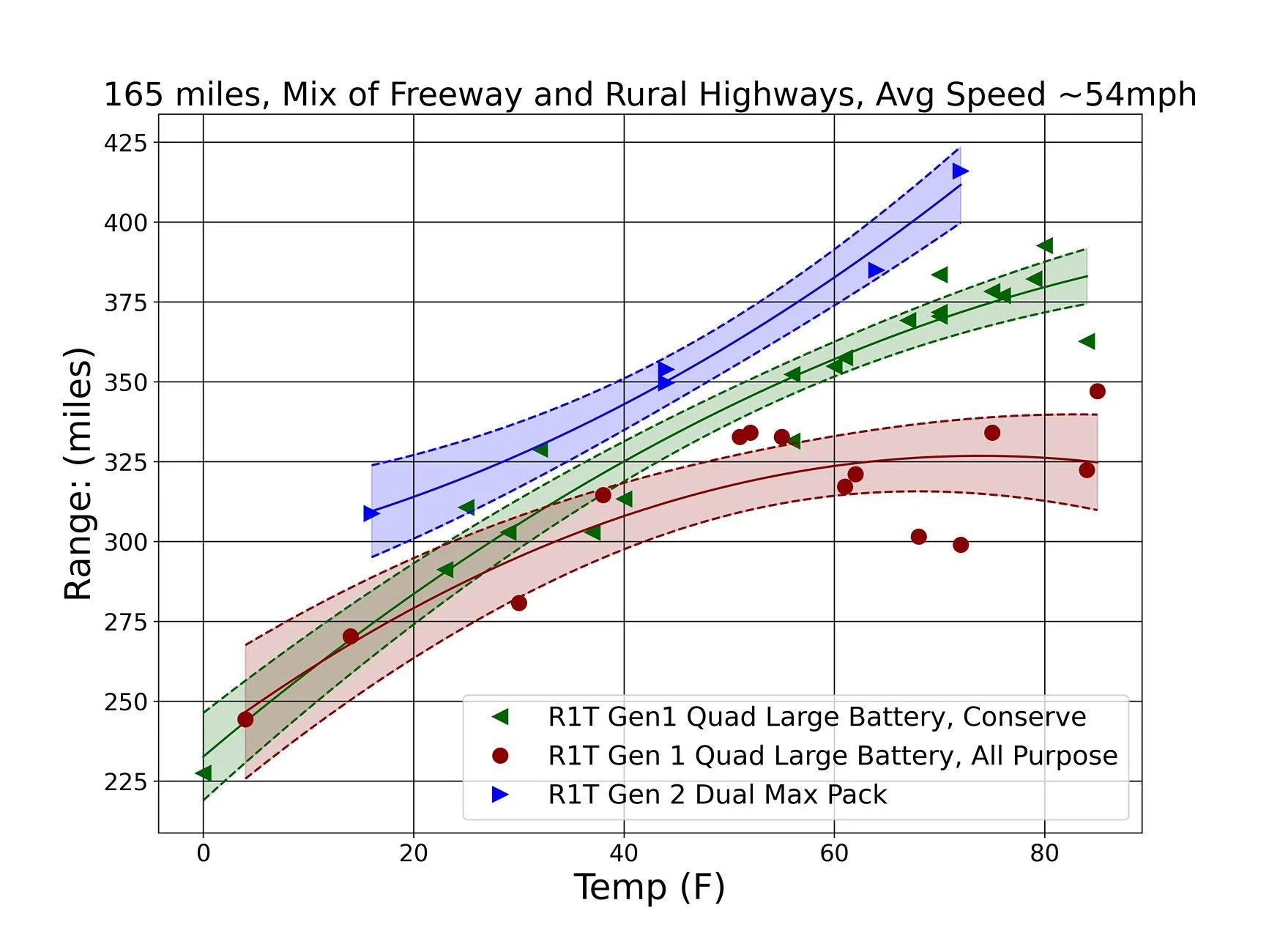
The calculated full pack range I would see based on these efficiency numbers is shown below;

Points to Make:
Assuming a 131 kWh battery pack for the Gen 1 Quad vehicle. A 141 kWh battery pack for the Gen 2 max pack.

As noted above. My observed range is inline with the EPA test (420 miles for Gen 2 Max Pack).

At around 70 deg F, the range increase in the Gen 2 to Gen 1 is inline with expectations given the 10 kWh larger battery (10 kWh * 3 m/kWh = 30 miles more range)

*** This is not a 75 mph highway speed range test. I am not claiming I see this range at higher speeds for extended periods. ****
R1T range vs temp.jpg


Charging Analysis:
I've used Electrify America charges a lot on several long road trips with my Gen 1 Large Pack vehicle. The EA app history provides info on total charging time and energy delivered. I've only done a few charging sessions with the Gen 2 Max pack but I wanted to present these results as it is this topic where I the biggest difference of opinion compared to some of the recent YouTube video on the Gen 2 Max Pack charging behavior.

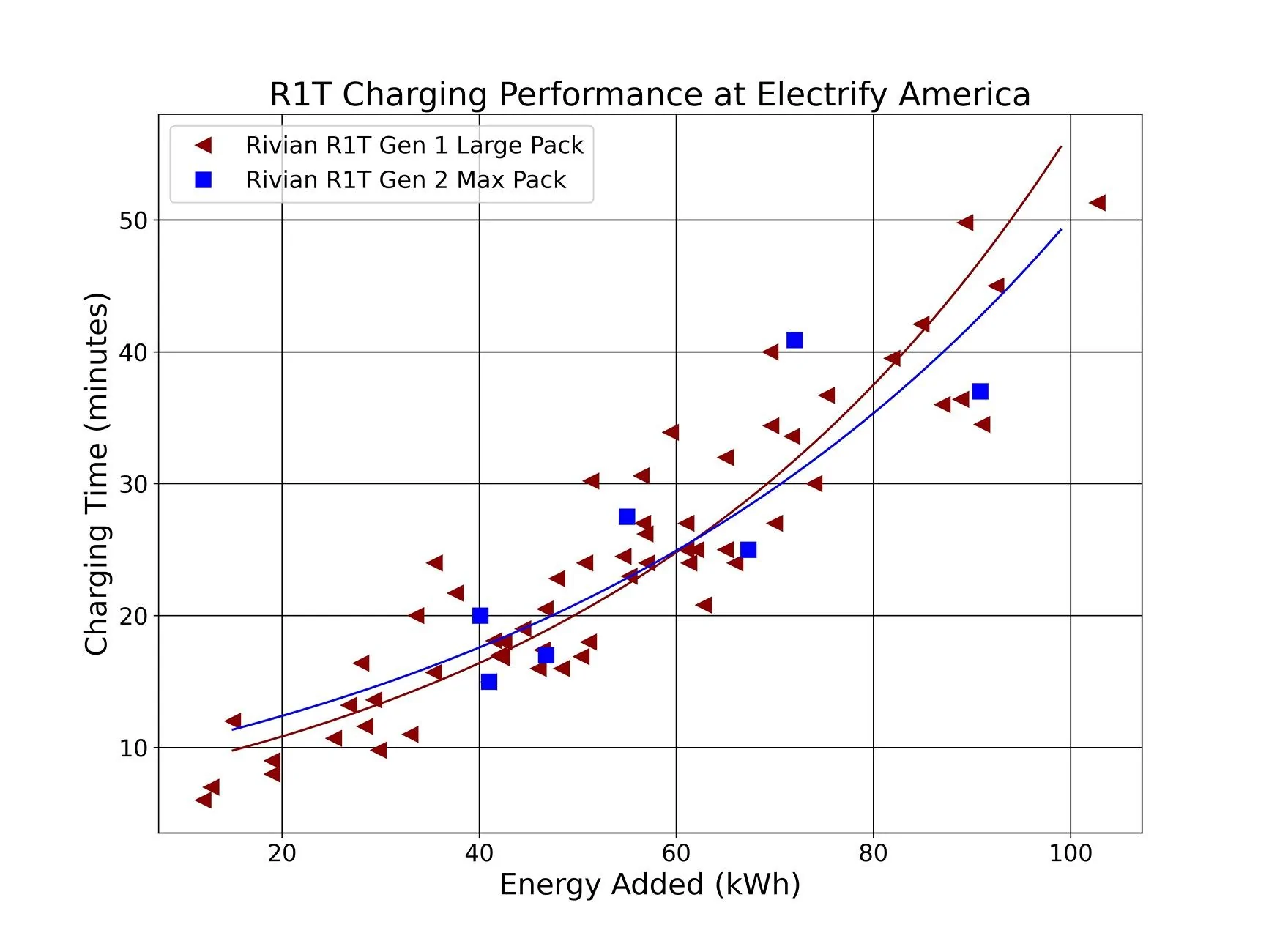
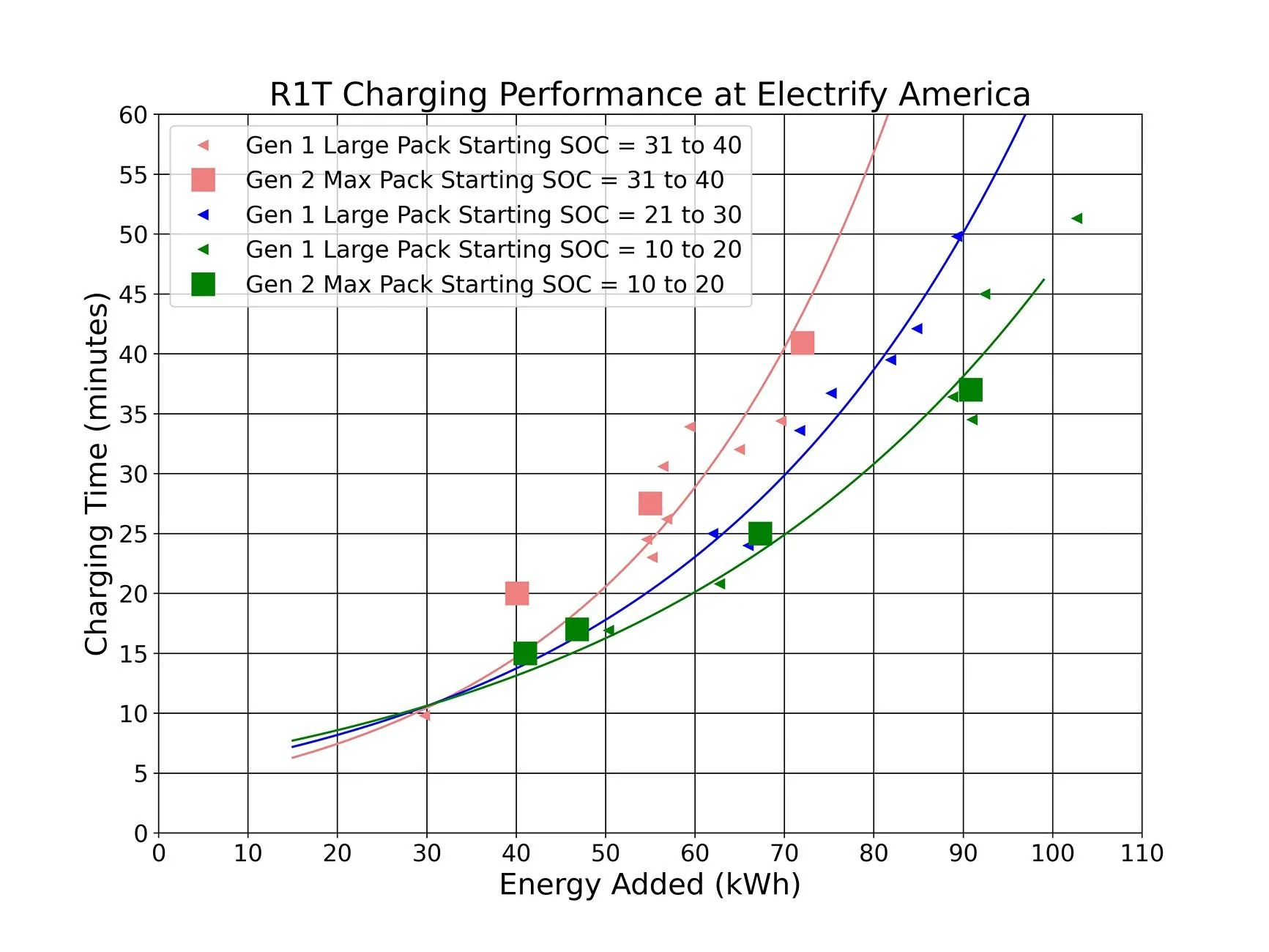
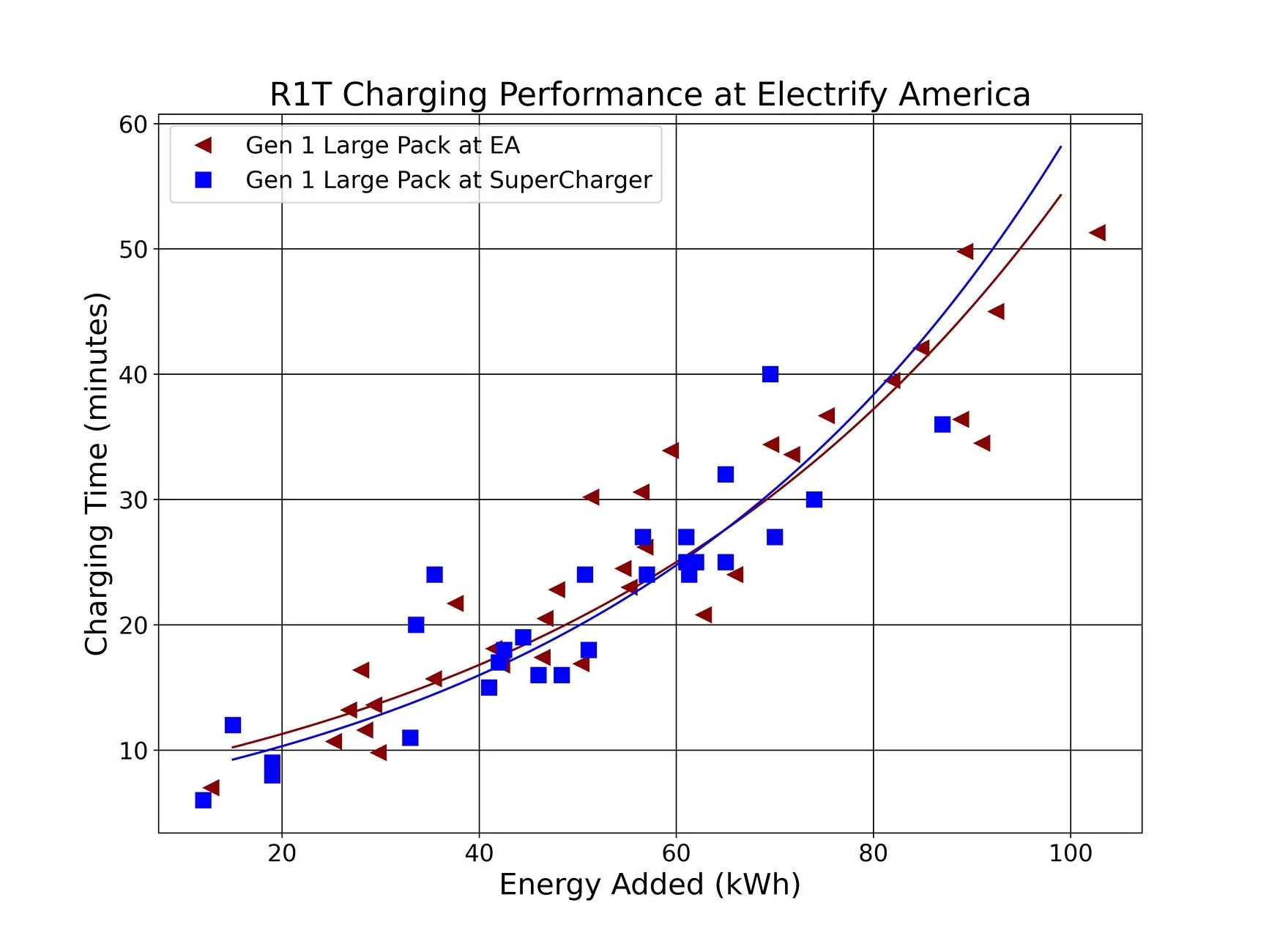
First chart: The chart below shows the total energy delivered during a charging session on the horizontal axis and the time spend charging on the vertical axis.

Points to Make:
To a first order estimate, the Gen 1 Large pack and Gen 2 Max pack appear to have very similar charging performance when comparing multiple charging sessions of each and taking into account the inevitable variability the occurs when charging an electric vehicle.

As most of us are aware, charging performance follows an exponential function. Adding more and more energy takes longer and longer as the battery gets more fully charged. I used an exponential line fit algorithm to create the solid lines seen on the chart.

One of the data points shown I took from the "10% challenge" video recently posted that was the subject of particular ire from the YouTube influencer.

I don't want to linger too long on this chart because there are some other variables at play that are very important that must be taken into account. These following charts do this.
Charge Time G1 vs G2.jpg


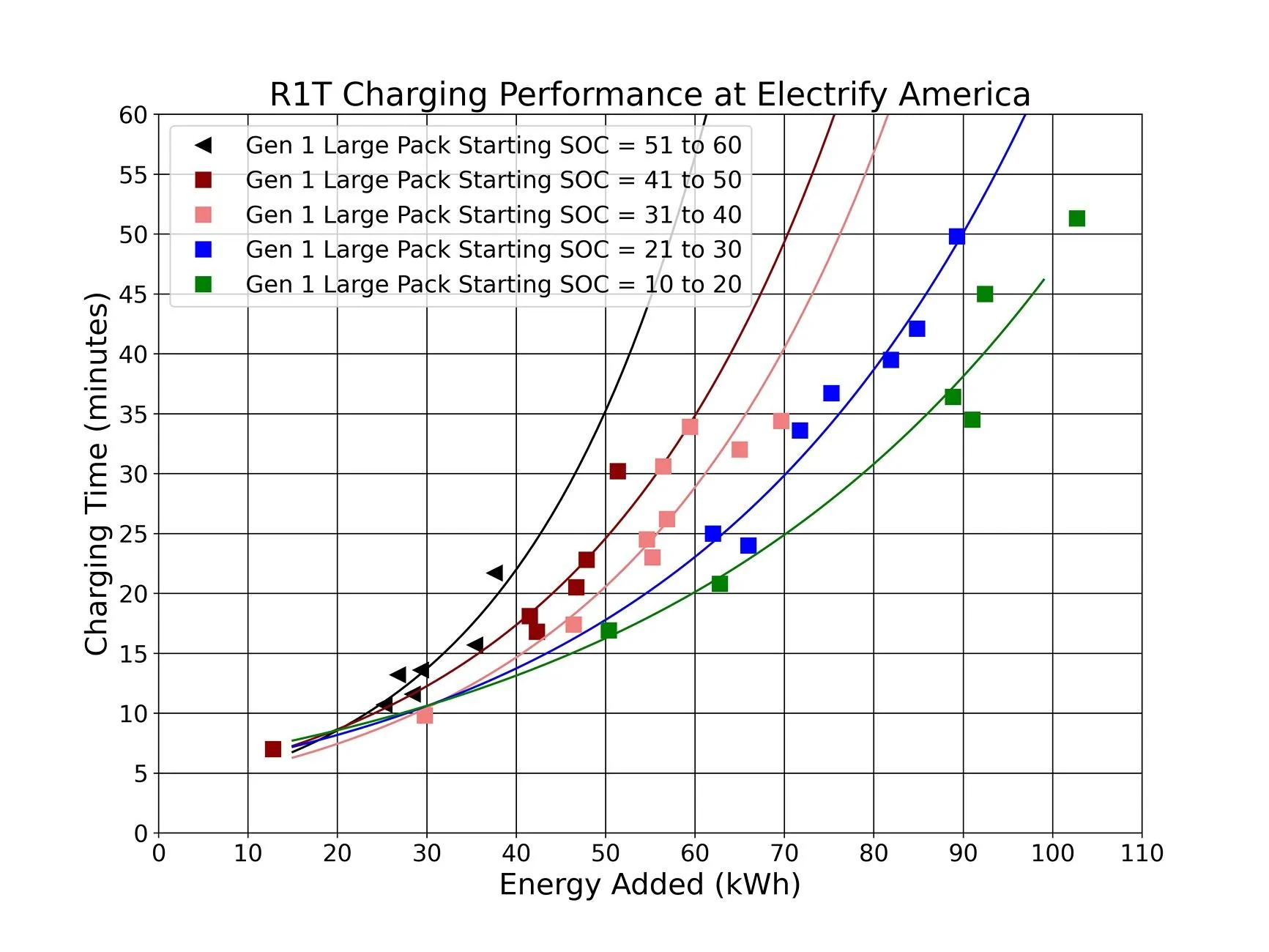
Charging performance is very dependent on the starting state of charge (denoted SOC on the charts). A low initial SOC will charge faster than a high initial SOC. Fortunately, the EA app history shows the starting and ending SOC for each session. The Tesla app does not do this so I can't do a similar exercise for the supercharger data.

In the next chart I created separate data sets to fit the exponential line to based on the initial states of charge. The data bins are; 10% to 20% initial SOC, 21% to 30% initial SOC, 31% to 40% initial SOC, etc.

Points to Make:
This chart only shows Gen1 Large Pack data (Gen 2 added into the following chart).

You can clearly see the impact of starting a session with a battery that is relatively full (red data, >40% charged. Black data >50% SOC at start of session).

But, charging performance is not overly sensitive to initial SOC if below <30% and the energy added is <70 kWh or so. The green and blue lines are pretty close together and differ by only a couple minutes of charging time. It does not really matter much too much if the battery is say 15% full or 25% full when you start, you get about the same charging performance.

Charge Time by SOC.jpg


Gen1 Large Pack vs Gen 2 Max Pack Charger Performance

I've done a few charging sessions with the Gen 2 Max Pack. The sessions were at starting states of charge of <20% or between 30% and 40%. For clarity I removed the other data bins. And I added in the data from the "10% challenge" YouTube video.

Points to Make:
Gen 2 Max Pack shown in the large square markers.

When factoring in the initial states of charge of the batteries, the Gen 2 Max Pack has charged very similarly to the Gen 1 Large Pack

Over more charging sessions perhaps a difference will emerge but the difference would likely be on the order of a couple minutes or less.

*** Disclaimer: My Gen 2 Max pack sessions have been in cool to cold weather. I have not evaluated the performance in temperatures >50 Deg F ****


G1 vs G2.jpg


Efficient Road Trip Charging Strategy for Rivian Vehicles

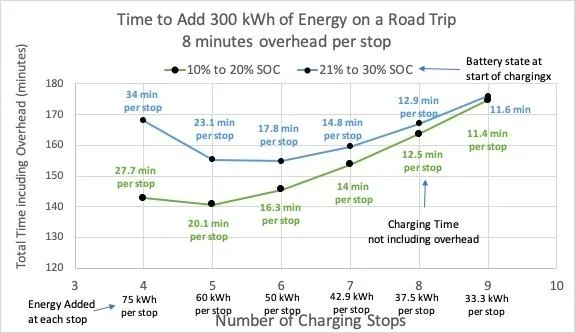
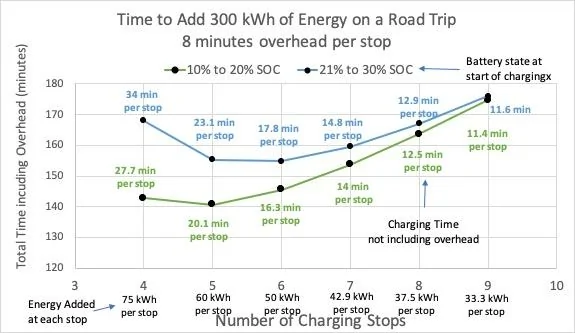
With the exponential curve fits vs SOC in hand I can do some interesting road trip simulations to evaluate different charging strategies. For the example that follows I said a traveler needs to add 300 kWh of energy on the road (about 600 to 700 miles of traveling). I looked at charging times if stopping 4, 5, 6, 7, 8 or 9 times. The required energy to be added at each stop is 300 divided by n (number of stops) which works out to 75, 60, 50, 42.5, 37.5 or 33.3 kWh per stop. For the first chart I assumed 8 minutes of overhead time per stop (getting off the highway, traversing to the charger, fiddling with apps, get back on the freeway).

Chart explanation:
Actual charging time calculated for the exponential curve fits are in the text blocks next to each data point.
The horizontal axis is number of stops and energy to be added.
Vertical axis is total charing + overhead time summed up over the n number of stops
Green line assuming a starting state of charge of <20% and the blue is starting SOC between 21% and 30%

Points to Make:
The optimal solution for Rivian vehicles is a 5 stop strategy onboarding 60 kWh with charging times between 20 and 23 minutes depending on initial battery level.

Faster overall charging time is quicker with very low battery levels but I view this as a high risk, low reward strategy. Adding 15 minutes to my is insignificant compared to the consequences pushing the envelope and running out of battery.

A wide range of solutions are within 15 minutes of the "best" solution. To me, that does not matter. Don't obsess over charging stops/battery levels etc. Charge when the battery is down around 20% or so, charge for 20 to 25 minutes an add around 60 kWh.

Eight minutes of overhead might be on the high side the the 2nd chart shows a 4 minute over head simulation.

8 min OH.jpg


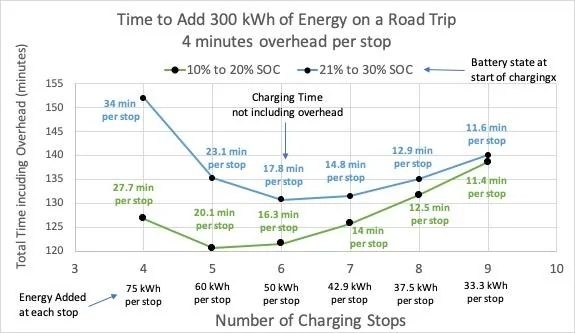
4 Minutes of overhead:
Points to Make:
With less overhead a 6 stop strategy might be ever so slightly better than the 5 stop strategy.
Again, many solutions are within 10 minutes of the "best" solution. Don't obsess over it.

Speaking of obsessing... A well known YouTube Influencer seems to be very obsessed with charging speeds and strategies. The 10% challenge test with 15 minutes of charging time is held as an example of a smart road trip strategy. Strictly speaking, 15 minutes of charging time is demonstratively NOT the best solution for the Rivian vehicles. It is not significantly worse that the best and it might be the best for other vehicles but not for Rivian vehicles.

4 min OH.jpg


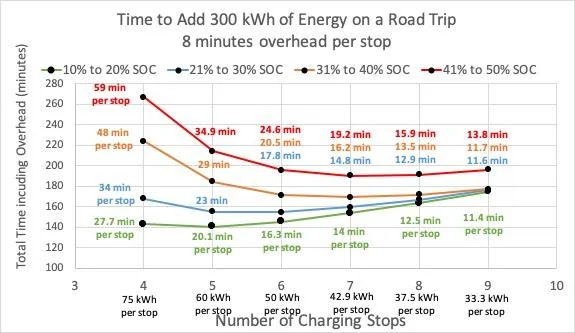
For completeness the chart below included how much time it would take if you initiated every charging session with a pretty full battery. It could add over an hour to your trip time.

8min OH 4 curves.jpg


Bonus chart:
Supercharger vs Electrify America; I can’t break it out by initial SOC but lumping everything together shows the Superchargers and EA to be, on average, the same for charging times.

Charge Time EA vs SC.jpg


8 min OH.jpg
I have the same 2025 Gen 2 set up. What do you think is the optimal speed for the best range on highway trips? I travel a lot on the highway and I’m looking for the longest range possible. I appreciate your response.
 

Sponsored

DayTripping

Well-Known Member
First Name
Timothy
Joined
Sep 12, 2024
Threads
13
Messages
1,544
Reaction score
2,133
Location
DFW
Vehicles
Gen1 R1T QM, S Plaid, Highland 3 Perf, 3 Long Range, R2 on order
Occupation
Consultant
The slower you go, the better your range. That's the simple answer. If I do 45-50 mph in my Gen1 quad motor, in conserve mode, my efficiency is about 3.7-4.0 mi/kWh. So, theoretically, I could go about 500 miles on my large pack.

Above 60 mph aero drag becomes the big energy consumer.
 
OP
OP
Budman

Budman

Well-Known Member
First Name
Rick
Joined
Oct 22, 2021
Threads
58
Messages
815
Reaction score
2,507
Location
Minnesota
Vehicles
Honda CRV
Clubs
 
I have the same 2025 Gen 2 set up. What do you think is the optimal speed for the best range on highway trips? I travel a lot on the highway and I’m looking for the longest range possible. I appreciate your response.
Like DayTripping said, go the slowest you can to maximize range. Drag is a cubic function of speed so a little faster is a lot more draggy.
 

Jabbahop

Well-Known Member
First Name
Michael
Joined
Sep 5, 2021
Threads
28
Messages
264
Reaction score
423
Location
utah and vermont
Vehicles
‘14 BMW i3, ‘19 BMW i3, ‘22 R1T -> ‘24 R1S Max
Occupation
retired
Rick, you are amazing. I love this post.

I am surprised the heat pump is not making a measurable difference in cold temperatures. I wonder if you will see a trend after you get more data points. That said, I think the difference is likely to be less than 10%, so considering all the other variables, it may be hard to pick that one out as the cause.

If I lived in MN, I would insulate the glass roof. That has to be adding significant heating overhead to each trip. But even with good insulation on the glass, the difference will be hard to measure. A 2-3% improvement would add less than 10 miles in cold temps. Still, I would take it!
there is a video on youtube where they compared a BMW i3 with heat pump and one without and at least in British winter weather there wasn’t a big difference. Their conclusion was the motors take so much more energy to move the car compared to heat the car that an improvement in overall efficiency (driving + heating). Now the i3 is obviously a very different car (and older).
 

fxstein

Well-Known Member
First Name
Oliver
Joined
Sep 17, 2024
Threads
10
Messages
126
Reaction score
249
Location
California
Vehicles
2023 R1T Quad Adventure
Clubs
 
Awesome work. Very much appreciated! Trying to understand what the vehicle is doing was the main reason why I integrated mine with Home Assistant so every minute of data is automatically logged in a single place.
Driving, charging and even just phantom draining away…
 

Pacernow

Well-Known Member
First Name
Reese
Joined
Sep 28, 2024
Threads
15
Messages
174
Reaction score
89
Location
East Texas
Vehicles
2021 Tesla Model Y LR AWD
Occupation
Semi retired
I was wondering if you could do a conclusion with all of your key findings. It would be great to look at all of the key points/findings in one area.
Thank you
 

Sponsored

Donald Stanfield

Well-Known Member
First Name
Donald
Joined
Jul 31, 2022
Threads
59
Messages
8,311
Reaction score
16,661
Location
USA
Vehicles
2025 R1S Tri Ascend, 2024 i4 M50
Occupation
Stuff and things
As a Gen 1 R1s quad owner I see very little motivation to consider Gen 2 as an upgrade, but I would seriously consider upgrading to a Rivian that can charge at 300+kW and consistently hold that power for 15-20 min. If GM (Silverado) can do this why not Rivian?
"Why not Rivian?"

...because their battery pack thermal management would need to improve and more importantly they would need a nominal 600v - 900v pack voltage to reach 300+ kW and hold it (near it) for any length of time.

I'm no battery engineer, but the pack size is a major reason you will see higher speeds on the Silverado. The pack is 100kWh bigger than the Rivian's so there is more room at the higher speed to put the electrons. As a battery gets fuller the charge rate slows to not burn up the battery. Bigger battery means more charge to get full which means longer charging times at a higher rate.

There's another side to this that people don't often consider, and that's what happens when you run into a derated charger. As someone who's taken many road trips, the biggest problem I've encountered was slowed chargers. If you come across a charger that will only output 150kW or less I'd much rather be in my Rivian than a Silverado because it might add 10 min to your charge time in the Rivian but 45 min in your Silverado.
 

R1Tom

Well-Known Member
First Name
Tom
Joined
May 19, 2022
Threads
37
Messages
3,621
Reaction score
4,862
Location
Wisc
Vehicles
Riv R1T
Occupation
Sales
I'm no battery engineer, but the pack size is a major reason you will see higher speeds on the Silverado. The pack is 100kWh bigger than the Rivian's so there is more room at the higher speed to put the electrons. As a battery gets fuller the charge rate slows to not burn up the battery. Bigger battery means more charge to get full which means longer charging times at a higher rate.

There's another side to this that people don't often consider, and that's what happens when you run into a derated charger. As someone who's taken many road trips, the biggest problem I've encountered was slowed chargers. If you come across a charger that will only output 150kW or less I'd much rather be in my Rivian than a Silverado because it might add 10 min to your charge time in the Rivian but 45 min in your Silverado.
Not sure I get your logic here?

Seems like you are saying smaller gas tanks are better because they take less time to fill? Meaning more stops for less time...but more stops.

What am I missing?
 

JeromePowell

Well-Known Member
Joined
Nov 12, 2024
Threads
5
Messages
132
Reaction score
252
Location
Chapel Hill, North Carolina
Vehicles
2023 Audi E-Tron Chronos, 2007 Porsche Cayman S, 2010 Nissan Xterra Off Road
I am no engineer either, though I did own a Taycan with a battery pack below 100 kWh; it could pull 270 kW way longer than my R1T QM Large Pack can hold 217 kW.

Believe it or not you really do not lose much time charging on a 150 kW DCFC (provided it operating correctly). State of Charge has tested side by side and real world you lose maybe a few minutes on a 150 kW vs 350 kW with the Taycan (large pack).

People really get stuck on peak charge rate like they get stuck on 0-60 times, horsepower, etc. It's really not about the peak, it's about the curve and spending time in the highest/flattest area before going to the next DCFC.

My 2023 E-Tron Chronos charges way better than our R1T and so did my old Polestar 2 LRDM PPP+; yes, smaller battery packs and lower peak charging rates. The E-Tron charges just below 150 kW from 0%-79% without preconditioning; has a ton of cobalt in the battery pack. Even with range below 200-miles usable it is quicker than the R1T on a road trip (provided EA is working properly).
 

Donald Stanfield

Well-Known Member
First Name
Donald
Joined
Jul 31, 2022
Threads
59
Messages
8,311
Reaction score
16,661
Location
USA
Vehicles
2025 R1S Tri Ascend, 2024 i4 M50
Occupation
Stuff and things
Not sure I get your logic here?

Seems like you are saying smaller gas tanks are better because they take less time to fill? Meaning more stops for less time...but more stops.

What am I missing?
Doesn’t mean more stops necessarily because that depends on battery size AND efficiency. For example the hummer has a 220kWh pack and has the rated mileage similar to a gen 1 quad in conserve. In an ideal world the hummer can charge faster than the R1 but because of the greater inefficiency and bigger battery the actual time at the charger for a given distance is about the same.

Charging speed is only one aspect of the equation. Bigger batteries have to charge faster to get the same percentage of charge, bigger batteries are heavier and vehicles with more weight are less efficient. So just adding bigger packs doesn’t give a better return automatically.

Also as I said, comparing peak charge rates is useful but not always guaranteed. There have been many trips I’ve taken where chargers were derated. You wish for the smallest and most efficient vehicles in that scenario. My wife’s BMW charges just as fast mileage wise as my Rivian does with a much slower rate of charge because it’s more efficient with a smaller battery.

The tl;dr here is looking at one aspect like charge rate or battery size isn’t that useful when comparing how well a vehicle will road trip or cover distance using fast charging.
 

Donald Stanfield

Well-Known Member
First Name
Donald
Joined
Jul 31, 2022
Threads
59
Messages
8,311
Reaction score
16,661
Location
USA
Vehicles
2025 R1S Tri Ascend, 2024 i4 M50
Occupation
Stuff and things
I am no engineer either, though I did own a Taycan with a battery pack below 100 kWh; it could pull 270 kW way longer than my R1T QM Large Pack can hold 217 kW.

Believe it or not you really do not lose much time charging on a 150 kW DCFC (provided it operating correctly). State of Charge has tested side by side and real world you lose maybe a few minutes on a 150 kW vs 350 kW with the Taycan (large pack).

People really get stuck on peak charge rate like they get stuck on 0-60 times, horsepower, etc. It's really not about the peak, it's about the curve and spending time in the highest/flattest area before going to the next DCFC.

My 2023 E-Tron Chronos charges way better than our R1T and so did my old Polestar 2 LRDM PPP+; yes, smaller battery packs and lower peak charging rates. The E-Tron charges just below 150 kW from 0%-79% without preconditioning; has a ton of cobalt in the battery pack. Even with range below 200-miles usable it is quicker than the R1T on a road trip (provided EA is working properly).
Yes. It’s about the curve but it’s also about pack size. Since the Taycan has a smaller pack you need less power to fill it. Therefore a slower rate of charge will impact charge time less than it would on a vehicle with a larger pack even assuming the same efficiency on a percentage basis. Larger batteries take longer to fill given the same charge rate.

There is no free lunch and simply giving a vehicle a bigger battery or faster charging won’t guarantee that you spend less time at a charger to go the same distance as a smaller
Battery with slower charging.
Sponsored


Top