
Sponsored

mkhuffman

Well-Known Member
First Name
Mike
Joined
Nov 9, 2020
Threads
14
Messages
2,885
Reaction score
3,235
Location
Virginia
Vehicles
2025 R1T Tri-Max, Jeep GC-L, VW Jetta
So for Gen 2 Max pack, to achieve longer and higher battery performance, I should do daily charge to 70% even though my commute is only 10-20 miles a day... Do I understand it right?
The basic rule is short charges are better than long charges, and lower SoC is better than high SoC (not too low, of course). Also consider how long it sits at a specific SoC. If it sits at 70% for a week, it is more stressful to the battery than if it sits at 60%.

The safest thing for the battery would be to charge it to 70% when it hits 50%. I guess that is about three of your commutes. Those 20% charges are small and it keeps the SoC in the safest zone.

That said, you could definitely plug in every day and charge to 70% and I doubt there would be any measurable difference in battery health in the time you own the truck.

People really over think this. Just charge it like you need to to use it as a vehicle. If you need to charge it to 100% every day because of a long commute, do it. That is why Rivian has a buffer built into the battery. Yes it is more stressful on the battery, but if you need it, do it and don't worry about it.
Sponsored

 

newbilization

Well-Known Member
Joined
Aug 21, 2024
Threads
16
Messages
58
Reaction score
32
Location
MD
Vehicles
R1S Gen 2, MDX
The basic rule is short charges are better than long charges, and lower SoC is better than high SoC (not too low, of course). Also consider how long it sits at a specific SoC. If it sits at 70% for a week, it is more stressful to the battery than if it sits at 60%.

The safest thing for the battery would be to charge it to 70% when it hits 50%. I guess that is about three of your commutes. Those 20% charges are small and it keeps the SoC in the safest zone.

That said, you could definitely plug in every day and charge to 70% and I doubt there would be any measurable difference in battery health in the time you own the truck.

People really over think this. Just charge it like you need to to use it as a vehicle. If you need to charge it to 100% every day because of a long commute, do it. That is why Rivian has a buffer built into the battery. Yes it is more stressful on the battery, but if you need it, do it and don't worry about it.
Thanks you for the detailed explanation!!
 

Yossarian

Well-Known Member
Joined
Oct 20, 2020
Threads
45
Messages
934
Reaction score
922
Location
SE Pennsylvania
Vehicles
R1T,Telluride, Wee-Strom, Lynskey Cooper
I very much appreciate informative threads like this.

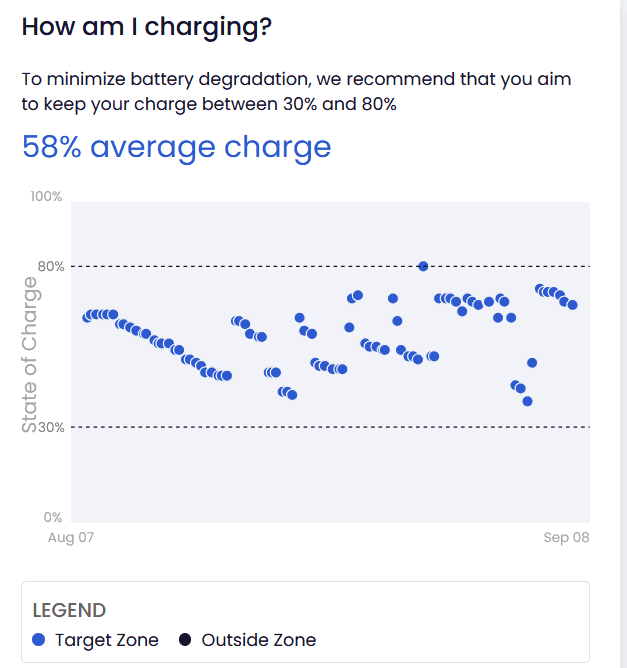
My R1T is the first electric vehicle I've owned, so have zero prior experience in the care and feeding of EV batteries. From what I've read, including the comments in this thread, the general rule is to keep the SOC between about 70% and 30% and to charge frequently. I follow the first of the suggestions pretty scrupulously, but really only plug the Rivian a few times each week. This appears to be ignoring the "always be charging" rule, and I wonder if doing so has a deleterious impact to battery health and longevity.

Should I be charging more frequently? Another question: how do I determine the number of cycles? If I go from 30% to 65% three times is that roughly one complete cycle (~35% each time)?

Here's a graph of my charging from Recurrent. The outlier charge to 80% was in preparation for a trip to the mountains, about 110 miles away. I can easily get there on less than that of course, but wanted some buffer to allow me to run several errands before being able to plug in again.
Rivian R1T R1S Engineering Explained: Best practices tips to slow down LFP Battery degrading & extend SOH life 1725714863465-hv
 
Last edited:

Hereforthesnacks

Well-Known Member
Joined
Jun 6, 2024
Threads
3
Messages
1,258
Reaction score
1,477
Location
West Coast
Vehicles
Ford Bronco
Maybe I lucked out in the past. I put 85k miles on my Chevy Bolt. We would drive to about 30-40% and then charge to 100%. Charging every 2-3 days. Range never seemed to change. I could always get 200 miles per charge out of it for 6 years. When I traded it in, the battery evaluation was that the battery was in “immaculate” condition. ?‍♂
 

Sponsored

Hereforthesnacks

Well-Known Member
Joined
Jun 6, 2024
Threads
3
Messages
1,258
Reaction score
1,477
Location
West Coast
Vehicles
Ford Bronco
Another long term data point:
2016 Model S 90kwh (which was never 90, I digress)
214k miles / 8 years old
BMS reads about 59kwh usable. At EPA consumption for that model of 290 watts/mile, 203 miles of range, down from its day 1 brand new range of 292 (~85kwh, Tesla lies).

On the one hand, that's 30% range loss, but on the other hand, that's only 30%.

All that to say this though. Tesla owners pride themselves on bragging about how little range loss they have according to the number on the dash. I would argue the real data is in the BMS for all EVs, so 99% of us will never know the true capacity losses.
Yeah Tesla lies about just about everything. But they were so far ahead of the pack, everyone bought in.

I know two people who paid for FSD ($10k) in maybe 2017. lol they are not happy.

Interestingly, I’d say I have a few friends that are unhappy with Tesla battery degradation. So sentiment there may be changing.
 

mkhuffman

Well-Known Member
First Name
Mike
Joined
Nov 9, 2020
Threads
14
Messages
2,885
Reaction score
3,235
Location
Virginia
Vehicles
2025 R1T Tri-Max, Jeep GC-L, VW Jetta
I very much appreciate informative threads like this.

My R1T is the first electric vehicle I've owned, so have zero prior experience in the care and feeding of EV batteries. From what I've read, including the comments in this thread, the general rule is to keep the SOC between about 70% and 30% and to charge frequently. I follow the first of the suggestions pretty scrupulously, but really only plug the Rivian a few times each week. This appears to be ignoring the "always be charging" rule, and I wonder if doing so has a deleterious impact to battery health and longevity.

Should I be charging more frequently? Another question: how do I determine the number of cycles? If I go from 30% to 65% three times is that roughly one complete cycle (~35% each time)?

Here's a graph of my charging from Recurrent. The outlier charge to 80% was in preparation for a trip to the mountains, about 110 miles away. I can easily get there on less than that of course, but wanted some buffer to allow me to run several errands before being able to plug in again.
1725714863465-hv.png
I would not let the battery get below 40% on a regular basis. That is just me, because 40%-60% is the happiest place for the battery, and low charge is not a good thing for battery health. So, I would continue doing what you have been doing but change the floor to 40%.

Again, as I posted and others (like Glembi a new minutes ago), it really isn't going to make that much of a difference anyway unless you plan to keep the truck for 10 or 20 years. And then maybe, just maybe, being so careful will result in a battery with a measurably higher health.

Rivian and other BEV manufacturers put a lot of effort into the Battery Management System (BMS) so that it keeps the battery healthy for a long time, even if you often charge to 100%. Rivian recommends you don't do 100% charges regularly, as does everyone I think, but even if you do the increased stress on the battery health might not ever be noticeable to you. Ever. Especially if you keep the truck for less than 5 years.

Just do what makes you feel good and use it like it is meant to be used. Charge it as high as you need to.

Personally, I never let the battery get below 60% when at home because I want the car ready to go if I need to take an unexpected trip. My charge zone is 60-80%. But that is just me. Yes, 80% is more stressful than 70%, but I don't like having a vehicle I cannot use because the charge is too low to get me where I need to go.
 

Dave Cundiff

Well-Known Member
First Name
Dave
Joined
Feb 28, 2024
Threads
4
Messages
1,178
Reaction score
1,596
Location
Pacific County, Washington
Vehicles
'23 R1S (DM,Max); '23 R1T (QM,Lg); '23 Chevy Bolt
Our "typical commute" is ten miles in a day. Maybe 50% of our weekdays are "typical" in that sense. Schedules and destinations change frequently for both of us.

50% is enough to get us from our home to a fast charger in any direction on an urgent trip. So, unless we expect a longer trip, we charge to 50% whenever we hit 40%.

When a longer trip is likely, we usually try to charge enough that we'll be around 50% when we're halfway through the expected travel for the day.

I also try to charge more slowly and to lower states of charge when the day, and the battery, are warm.

All that being said, taking care of the battery shouldn't be a source of worry. As @mkhuffman says, most EV manufacturers including Rivian have Battery Management Systems that minimize harm to our batteries even when we don't take the best care of them.

Best if we UNDERSTAND optimal battery management, then do what makes the most sense for us. Our vehicles should exist to serve us. We don't exist to serve our vehicles.

Best wishes!
 
Last edited:

dleepnw

Well-Known Member
Joined
May 13, 2021
Threads
149
Messages
3,029
Reaction score
3,428
Location
WA
Vehicles
Rivian, Toyota, Lexus
Clubs
 
wow, this goes against what ive heard/read about LFP batteries - specifically that its fine to charge to 100% daily
 

Supratachophobia

Well-Known Member
Joined
Apr 8, 2023
Threads
9
Messages
1,781
Reaction score
2,122
Location
Ohio
Vehicles
S
Clubs
 
Yeah Tesla lies about just about everything. But they were so far ahead of the pack, everyone bought in.

I know two people who paid for FSD ($10k) in maybe 2017. lol they are not happy.

Interestingly, I’d say I have a few friends that are unhappy with Tesla battery degradation. So sentiment there may be changing.
Well, I actually have some really good data in a spreadsheet and how Tesla lists the battery reserve as available when the car is at high SOC but removes it from the calculation below 20%.

Basically every Tesla is 15-20 miles overstated on the dash and there are several kwh available below zero (but it's dangerous to use them as the car performs unwell or not at all at such low SOC).
 

Sponsored

Hereforthesnacks

Well-Known Member
Joined
Jun 6, 2024
Threads
3
Messages
1,258
Reaction score
1,477
Location
West Coast
Vehicles
Ford Bronco
Well, I actually have some really good data in a spreadsheet and how Tesla lists the battery reserve as available when the car is at high SOC but removes it from the calculation below 20%.

Basically every Tesla is 15-20 miles overstated on the dash and there are several kwh available below zero (but it's dangerous to use them as the car performs unwell or not at all at such low SOC).
love the diligence. Annoying that transparency is hard to find…


Top