Beanejar
Well-Known Member
- Thread starter
- #1
Hi - I’m looking for experiences and technical input, particularly from anyone who has experienced a ball-joint failure or dealt with XCare on a similar suspension claim.
Vehicle: 2023 R1S Launch Edition
Mileage: approximately 63,000
My right-front upper ball joint suddenly separated at low speed while driving on soft/compacted sand, in Sand Mode, while changing the suspension height from High to Highest - in a line of other amazing Rivian enthusiasts in their R1S’s and R1T’s. Fortunately, no one was injured.
What makes this particularly concerning is that Rivian had performed a paid Comprehensive Inspection approximately four months and ~6,600 miles before the failure. The Rivian invoice states that the complete inspection was performed according to Rivian instructions and documented:
“No visible suspension faults or loose fasteners.”
Rivian has subsequently told me that at that inspection:
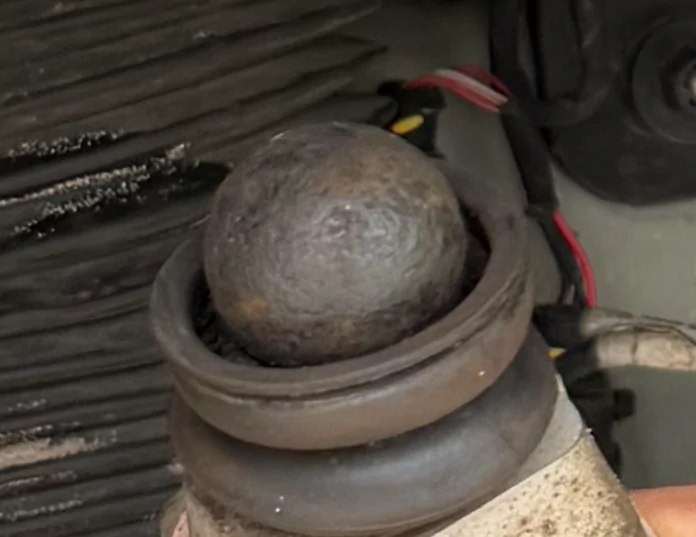
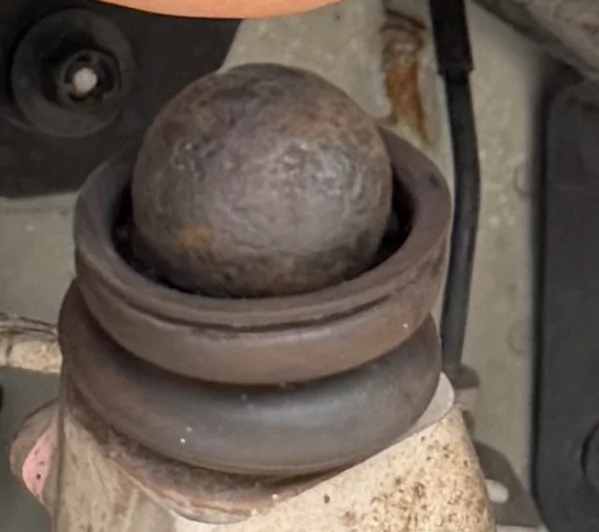
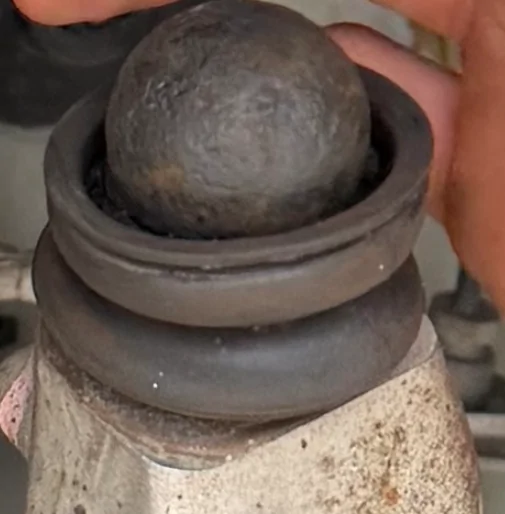
I have an XCare vehicle service contract. XCare reviewed photographs of the failed ball joint and denied coverage based on what it describes as rust and pitting, citing exclusions for corrosion/water intrusion.
During reconsideration, XCare specifically stated:
“the failure was due to water ingress past the boot seal”
After I provided the previous Rivian inspection findings, XCare maintained its denial and stated:
“6,658 miles is a significant amount of operating time, and the water ingress and subsequent corrosion occurred after that inspection took place.”
Because XCare's denial had become specifically based on water ingress, I asked Rivian whether its physical examination of the failed component actually showed evidence that water had entered the joint.
Rivian responded:
“we did not find any evidence of water in it.”
Rivian has also told me there was no evidence that the ball joint had previously been leaking grease and that the pitted appearance is how the ball joint is “how all failed ball joints look and this ball joint is no different.”
I am not arguing that these photographs show no pitting or corrosion-like surface deterioration. There clearly is substantial surface deterioration visible in the photographs. Rivian and XCare differ, however, on what that appearance means in relation to the cause of the failure.
What I am trying to determine is whether that appearance actually establishes the causal sequence XCare is relying upon:
water entered past the boot/seal → caused corrosion/pitting → corrosion caused the ball joint to separate
—or whether the photographed condition can also be seen on a ball joint after mechanical failure and does not, by itself, establish the cause.
I am having Rivian preserve the failed ball joint and boot/seal rather than discard them, and I am considering having the component independently examined by a forensic mechanical/materials engineer.
The resulting repair estimate is now more than $8,000, pending full evaluation of the system. The ball-joint separation also damaged the right-front damper, and Rivian advises that the original damper configuration is no longer available for this repair, requiring replacement with the newer configuration on both front sides.
I’ve seemingly exhausted the direct appeal process with XCare; the denial has now been reviewed collectively by its supervisory team and maintained.
I also found a recent report here from another Rivian owner whose vehicle was over 60,000 miles and whose Rivian Comprehensive Inspection reportedly identified ball-joint play, resulting in replacement of the affected components. I realize that is not necessarily the same failure mechanism as mine, but it made me particularly interested in whether there are other examples.
Has anyone here:
If anyone here has professional experience with ball joints or automotive failure analysis, I'd also appreciate thoughts on what can—and cannot—reasonably be concluded about the cause of failure from these photographs alone.
I’ll attach the photographs XCare provided and relied upon for its denial.
I’ve also asked Rivian to reconsider full or partial goodwill assistance, given how close the failure occurred to the warranty mileage limit, the recent Comprehensive Inspection, and Rivian's subsequent findings, but they have declined thus far.
This is disappointing to say the least. As a Compass Yellow R1S, I’ve spent hours in parking lots talking about how amazing this vehicle is…now appreciating how amazingly expensive it can be, too.
Thanks. I’m trying to gather comparable experiences and technical information before deciding how to proceed. Have a great day out there.


Vehicle: 2023 R1S Launch Edition
Mileage: approximately 63,000
My right-front upper ball joint suddenly separated at low speed while driving on soft/compacted sand, in Sand Mode, while changing the suspension height from High to Highest - in a line of other amazing Rivian enthusiasts in their R1S’s and R1T’s. Fortunately, no one was injured.
What makes this particularly concerning is that Rivian had performed a paid Comprehensive Inspection approximately four months and ~6,600 miles before the failure. The Rivian invoice states that the complete inspection was performed according to Rivian instructions and documented:
“No visible suspension faults or loose fasteners.”
Rivian has subsequently told me that at that inspection:
- the ball-joint boot was not torn;
- the ball joint was not loose;
- it was not leaking grease; and
- there was no evidence suggesting the joint was failing at that time.
I have an XCare vehicle service contract. XCare reviewed photographs of the failed ball joint and denied coverage based on what it describes as rust and pitting, citing exclusions for corrosion/water intrusion.
During reconsideration, XCare specifically stated:
“the failure was due to water ingress past the boot seal”
After I provided the previous Rivian inspection findings, XCare maintained its denial and stated:
“6,658 miles is a significant amount of operating time, and the water ingress and subsequent corrosion occurred after that inspection took place.”
Because XCare's denial had become specifically based on water ingress, I asked Rivian whether its physical examination of the failed component actually showed evidence that water had entered the joint.
Rivian responded:
“we did not find any evidence of water in it.”
Rivian has also told me there was no evidence that the ball joint had previously been leaking grease and that the pitted appearance is how the ball joint is “how all failed ball joints look and this ball joint is no different.”
I am not arguing that these photographs show no pitting or corrosion-like surface deterioration. There clearly is substantial surface deterioration visible in the photographs. Rivian and XCare differ, however, on what that appearance means in relation to the cause of the failure.
What I am trying to determine is whether that appearance actually establishes the causal sequence XCare is relying upon:
water entered past the boot/seal → caused corrosion/pitting → corrosion caused the ball joint to separate
—or whether the photographed condition can also be seen on a ball joint after mechanical failure and does not, by itself, establish the cause.
I am having Rivian preserve the failed ball joint and boot/seal rather than discard them, and I am considering having the component independently examined by a forensic mechanical/materials engineer.
The resulting repair estimate is now more than $8,000, pending full evaluation of the system. The ball-joint separation also damaged the right-front damper, and Rivian advises that the original damper configuration is no longer available for this repair, requiring replacement with the newer configuration on both front sides.
I’ve seemingly exhausted the direct appeal process with XCare; the denial has now been reviewed collectively by its supervisory team and maintained.
I also found a recent report here from another Rivian owner whose vehicle was over 60,000 miles and whose Rivian Comprehensive Inspection reportedly identified ball-joint play, resulting in replacement of the affected components. I realize that is not necessarily the same failure mechanism as mine, but it made me particularly interested in whether there are other examples.
Has anyone here:
- had an upper ball joint fail or actually separate on an R1S/R1T?
- had Rivian identify excessive ball-joint play, particularly around or above 60K miles?
- seen similar pitting/corrosion on a failed Rivian ball joint?
- had a ball joint fail without an obviously torn boot or previous grease leakage?
- had a recent Rivian Comprehensive Inspection followed by a ball-joint failure?
- had XCare approve or deny a Rivian suspension claim because of corrosion or water intrusion?
If anyone here has professional experience with ball joints or automotive failure analysis, I'd also appreciate thoughts on what can—and cannot—reasonably be concluded about the cause of failure from these photographs alone.
I’ll attach the photographs XCare provided and relied upon for its denial.
I’ve also asked Rivian to reconsider full or partial goodwill assistance, given how close the failure occurred to the warranty mileage limit, the recent Comprehensive Inspection, and Rivian's subsequent findings, but they have declined thus far.
This is disappointing to say the least. As a Compass Yellow R1S, I’ve spent hours in parking lots talking about how amazing this vehicle is…now appreciating how amazingly expensive it can be, too.
Thanks. I’m trying to gather comparable experiences and technical information before deciding how to proceed. Have a great day out there.
Sponsored
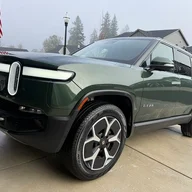
 I know, could get it wrapped…. Another couple of years of a useful vehicle moving our young adults’ stuff back and forth/around the college houses…