ACDC
Well-Known Member
- First Name
- Michael
- Joined
- Feb 26, 2019
- Threads
- 117
- Messages
- 192
- Reaction score
- 996
- Location
- Portland OR
- Vehicles
- 2013 Outback, 2012 Tacoma
- Thread starter
- #1
New WIRED interview article with RJ Scaringe.
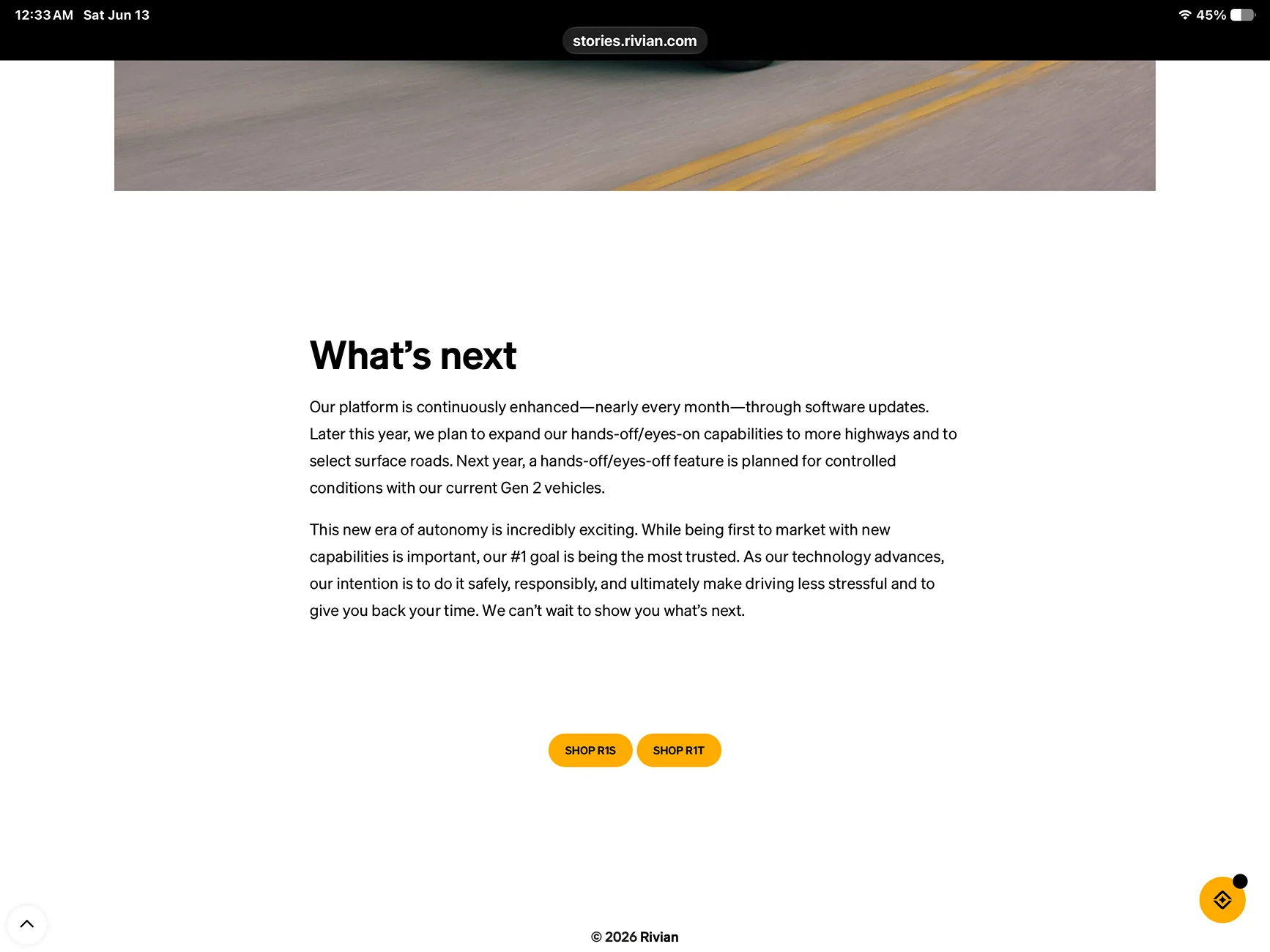
2 things I found interesting... never heard him call the current Autonomy platform as "gen 2.5". Also, the stat about 6,000 person engineering team for the R2.
https://www.wired.com/story/interview-with-rivian-ceo-rj-scaringe/
Article Summary (via Gemini AI):
1. The Financial Reality and Vertical Integration Gamble
The profile contextualizes Rivian’s operational reality against its massive multi-billion-dollar cumulative cash burn. Unlike legacy automakers that rely heavily on a sprawling tier-one supplier network, Scaringe outlines why Rivian gambled on deep vertical integration—building their own software architecture, drive units, gearboxes, and custom autonomy chips in-house.
2. Autonomy Architecture and the "Gen 2.5" Software Roadmap
Scaringe details the technological evolution of Rivian’s driver assistance systems, clarifying the progression from their early architecture to the software driving their newest high-volume vehicles:
3. Manufacturing Scaling and Georgia Optimization
The interview details how Rivian is adapting its manufacturing network to transition from a niche luxury builder into a profitable mainstream brand.
4. Direct Perspectives on Competitors and Automotive Design
The interview closes with Scaringe sharing blunt, unfiltered assessments of the broader automotive industry and design choices:
2 things I found interesting... never heard him call the current Autonomy platform as "gen 2.5". Also, the stat about 6,000 person engineering team for the R2.
https://www.wired.com/story/interview-with-rivian-ceo-rj-scaringe/
Article Summary (via Gemini AI):
1. The Financial Reality and Vertical Integration Gamble
The profile contextualizes Rivian’s operational reality against its massive multi-billion-dollar cumulative cash burn. Unlike legacy automakers that rely heavily on a sprawling tier-one supplier network, Scaringe outlines why Rivian gambled on deep vertical integration—building their own software architecture, drive units, gearboxes, and custom autonomy chips in-house.
- The Scale Dilemma: Scaringe acknowledges the extreme financial risk of this strategy. He states that a vertically integrated loop is "extraordinarily expensive" and cannot be financially rationalized if the company remains a lower-volume player stuck at its legacy R1 production scale (~50,000 to 65,000 units a year).
- The 6,000-Person Team Stakes: Breaking corporate norms by explicitly quantifying what a failure to scale would mean, Scaringe admits that if their high-volume vehicle platforms fail to establish mass-market traction, Rivian would have to radically reconfigure its entire business model. Specifically, he notes they would no longer be able to justify maintaining their 6,000-person engineering team and would have to abandon their deep in-house development philosophy.
2. Autonomy Architecture and the "Gen 2.5" Software Roadmap
Scaringe details the technological evolution of Rivian’s driver assistance systems, clarifying the progression from their early architecture to the software driving their newest high-volume vehicles:
- The Gen 1 Mobileye Realization: Scaringe reveals that almost at the exact moment they launched the original R1 platform in late 2021, they realized their Mobileye-based hardware architecture was a dead end that could not support a modern transformer-based "early fusion" AI model. This realization forced them to rapidly pivot, hire an entirely new engineering team, and build their modern data flywheel stack from the ground up.
- The "Gen 2.5" Autonomy Step: While Rivian's newest production vehicles deploy their cutting-edge RAP1 (Rivian Autonomy Platform 1) compute—boasting custom dual chips pushing a massive 1,600 TOPS of total compute—Scaringe adds critical context to the software stack. He refers to the initial, current phase of their end-to-end Large Driving Model (LDM) execution as "Gen 2.5." It serves as an interim developmental step focused on perfecting highly capable, point-to-point supervised driving. He explicitly manages long-term expectations, noting that while the physical hardware foundations (including 11 cameras, radars, and a 900-foot LiDAR) are locked in, true unsupervised, eyes-off autonomy remains a progressive future tier as the model matures.
- The Sensor Thesis vs. Tesla: He explains that keeping multiple non-overlapping sensor modalities (cameras, radar, and LiDAR) despite the bill-of-materials cost is a deliberate strategy to catch up to Tesla faster. The radar and LiDAR data act as "ground truth" to rapidly train the neural net's cameras to understand difficult real-world edge cases—like distinguishing shapes through blinding snow, dense fog, or harsh reflections—without needing millions of vehicles on the road to collect data.
3. Manufacturing Scaling and Georgia Optimization
The interview details how Rivian is adapting its manufacturing network to transition from a niche luxury builder into a profitable mainstream brand.
- Georgia Plant Upsizing: Scaringe outlines the long-term production roadmap for the company’s multi-billion-dollar facility in Georgia. Driven by early consumer demand signals for the R2, Rivian optimized and expanded its phase-one blueprint for the factory, officially raising its initial Phase 1 annual target from 200,000 vehicles to 300,000 vehicles. This expanded manufacturing footprint is deliberately designed to provide the headroom needed for future vehicle variants, the upcoming R3/R3X enthusiast platforms, and an eventual expansion into Europe.
4. Direct Perspectives on Competitors and Automotive Design
The interview closes with Scaringe sharing blunt, unfiltered assessments of the broader automotive industry and design choices:
- The Tesla Monopoly: Scaringe characterizes the US electric vehicle market as "wildly underserved," stating that Tesla's Model 3 and Model Y holding over half the market share is an unhealthy monopoly driven purely by a lack of alternative, compelling choices for mainstream buyers under $50,000.
- The Tesla Cybertruck: While applauding Tesla's willingness to take a radical design risk, Scaringe explicitly categorizes the Cybertruck as a "failure" as a mass-market vehicle. He notes that its intense product trade-offs and extreme aesthetic choices meant it was destined to remain a niche product rather than a universally appealing volume vehicle.
- Ferrari’s "Luce" Concept: Turning to high-end automotive design, Scaringe highlights Ferrari’s electric "Luce" concept (designed in collaboration with Jony Ive and Marc Newson). He strongly praises its interior execution, specifically admiring its commitment to tactile, physical haptics and buttons over a purely screen-centric ecosystem.
Sponsored
Last edited: