Sponsored

Jeremy3292

Well-Known Member
First Name
Jeremy
Joined
Apr 27, 2026
Threads
1
Messages
289
Reaction score
336
Location
South Carolina
Vehicles
R2
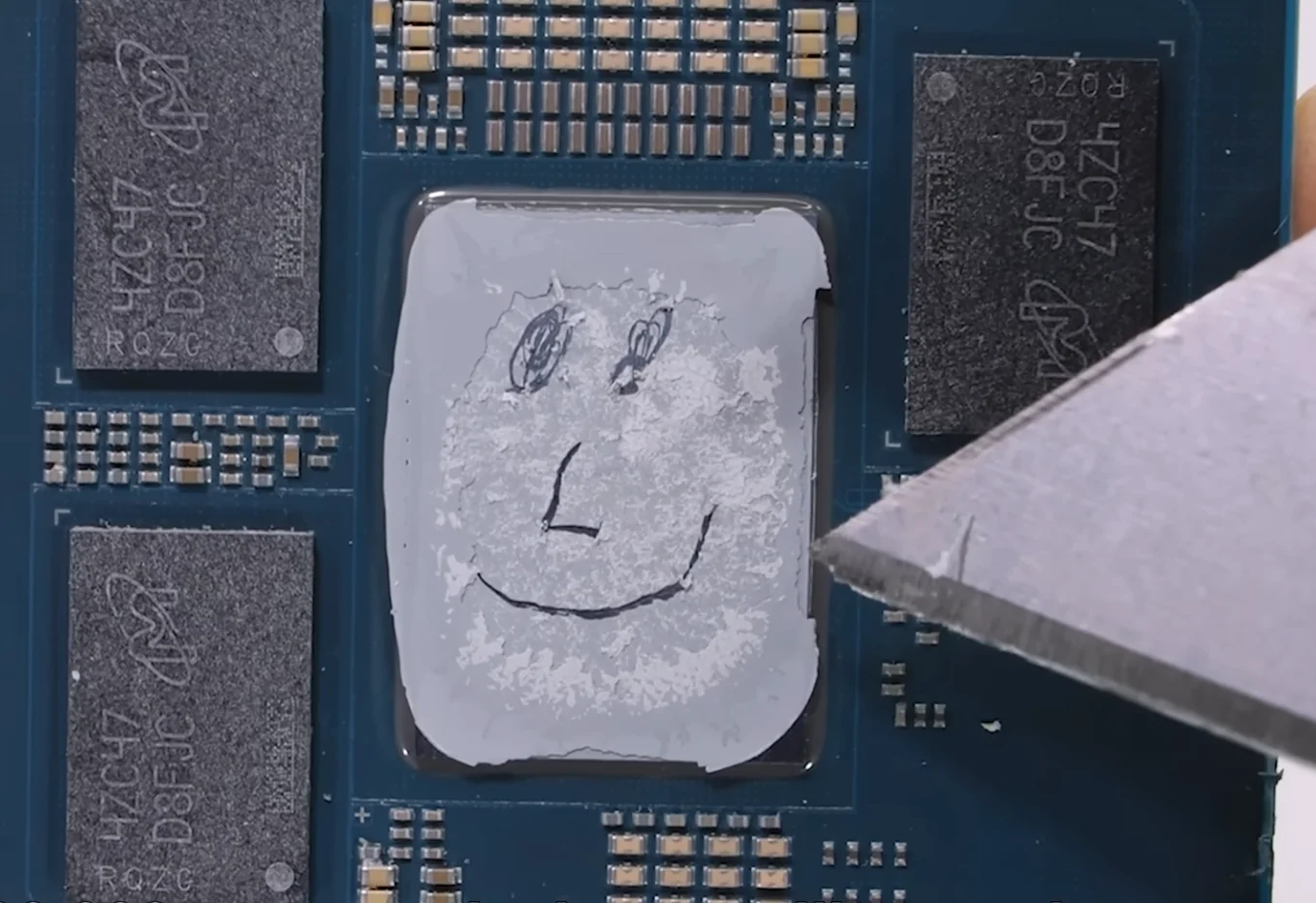
He tears the chip apart. It's as simple as looking at how much memory there is.

It's literally right there. 18gb

Keep in mind tesla has 384 GB/s in a chip from 2022. 205GB/s is ridiculously low

Screenshot 2026-05-01 163414.webp
Where does it say on those chips 18 GB of RAM? If you have the decoder please feel free to educate.
Sponsored


shandering

Well-Known Member
First Name
Shane
Joined
May 26, 2026
Threads
0
Messages
49
Reaction score
24
Location
Atlanta
Vehicles
Polestar 2
Occupation
Artist
Where does it say on those chips 18 GB of RAM? If you have the decoder please feel free to educate.
Feed that into any AI you want and it will give you your answer

Those chips are 6gb each

The only speculation here is whether or not the use more in the production computer. I asked grok and it says the cost difference is $400-800 to go to 64gb. That's a lot of money

You add in lidar ($250), Radars ($250) extra cameras ($250) and then it gets expensive. Especially if in the long run you don't need any of this

I think elon revealed that the HW4 computer costs $650
 
Last edited:

Riviot

Well-Known Member
Joined
Mar 29, 2021
Threads
121
Messages
6,430
Reaction score
10,805
Location
Kitsap, WA
Vehicles
R1T
Clubs
 
You should never buy anything that's technology related if you want it to be relevant in more than a year or two.
Yeah but when Google says "Our phones will take amazing pictures of the moon...eventually" with the hardware that's shipped, they end up making those phones capable through software updates at a later date.

Rivian never did that with the hardware they shipped, despite continuing to market "R1s" as capable "in the future" for months after customers owned and without distinguishing it would be on a different platform...then wiped it from the website and attempted to wipe it from our memories.

"These aren't the gen1 capabilities you're looking for..."

Rivian R1T R1S Self driving update: Gen 2 and Gen 3 Autonomy on R2 should be similar for a "couple of years" 1000009071
 

Jeremy3292

Well-Known Member
First Name
Jeremy
Joined
Apr 27, 2026
Threads
1
Messages
289
Reaction score
336
Location
South Carolina
Vehicles
R2
Feed that into any AI you want and it will give you your answer

Those chips are 6gb each

The only speculation here is whether or not the use more in the production computer. I asked grok and it says the cost difference is $400-800 to go to 64gb. That's a lot of money

You add in lidar ($250), Radars ($250) extra cameras ($250) and then it gets expensive. Especially if in the long run you don't need any of this

I think elon revealed that the HW4 computer costs $650
The updated radars and cameras are already in R2 production. The only that isn't is the LIDAR unit and Gen3 RAP1 chip. So the price difference between R2 Gen2 and Gen3 autonomy hardware would only be between the current NVIDIA Orin chip and RAP1 chip + LIDAR.
 

Jeremy3292

Well-Known Member
First Name
Jeremy
Joined
Apr 27, 2026
Threads
1
Messages
289
Reaction score
336
Location
South Carolina
Vehicles
R2
Feed that into any AI you want and it will give you your answer

Those chips are 6gb each
I asked Gemini and got the same thing you said above for RAP1 (6 GB x 3 = 18 GB x 2 = 32GB RAM), but the current Nvidia Orin setup is 64 GB RAM (32 GB x 2) per Gemini, so it wouldn't make sense to cut it in half for RAP1. But Gemini told me the following when I asked:

"Ultimately, the older NVIDIA Orin setup required 64 GB of RAM because it was an off-the-shelf tool fighting a massive data-moving bottleneck. By moving the memory directly inside the main brain package via MCM technology and writing a compiler specifically for their own chip, Rivian built a platform that is drastically faster, 50% physically smaller, and infinitely more efficient—allowing them to comfortably drop the total RAM pool down to 36 GB."


It seems Rivian and Tesla are also using completely different models requiring completely different RAM specs:


It looks like RAM capacity is a massive bottleneck for Tesla because of a critical difference in how Tesla and Rivian design their hardware architectures.

While Rivian built a custom Multi-Chip Module (MCM) to bring memory directly onto the processor, Tesla is running into the absolute limits of traditional, discrete motherboard layouts. Because of this, Tesla's AI models are outgrowing their older hardware, forcing them to cram more and more RAM into newer generations.

The situation boils down to a few major factors.

1. The HW3 vs. HW4 "Memory Wall"
Tesla is currently facing a massive hurdle with Hardware 3 (HW3/AI3). Elon Musk publicly noted that HW3 is severely limited because it suffers from lower memory capacity and just one-eighth of the memory bandwidth found in HW4.

Tesla’s software team writes their Full Self-Driving (FSD) models to be as large and complex as possible to achieve human-level driving.
  • The Problem: The HW3 RAM pool is physically too small to hold the full weight of Tesla's latest neural networks.
  • The Consequence: To make new FSD versions work on older HW3 cars, Tesla engineers have to spend months ruthlessly compressing and "emulating" the code (often referred to as running a "Lite" version of the model) just so it can fit inside the hardware's memory buffer.
Because compressing a model inherently reduces its accuracy, Tesla must use more RAM in newer hardware to let their AI reach its full potential.

2. Tesla's Off-Chip Latency Penalty
Unlike Rivian's RAP1 chip—where data only travels a millimeter to the processor—Tesla’s hardware generations (like HW4) use discrete memory packages soldered to the motherboard around the SoC.

When a processor has to pull massive AI video data from chips sitting across a circuit board, it creates latency. To prevent the processor from sitting idle while waiting for data, the system needs a massive memory buffer (more GB) and a wider memory bus to force enough data through the pipeline. Tesla uses sheer volume and bus width to overcome the physical distance between the RAM and the brain.

3. The "Vision-Language" Era (AI5 Spec Leap)
Looking forward, Tesla’s next-generation AI5 (Hardware 5) chip completely blows the doors off previous RAM requirements. Early samples of the AI5 board show it surrounded by 12 massive SK hynix memory packages (likely GDDR6 or GDDR7), pushing the hardware up to an estimated 96 GB to 144 GB of high-speed RAM.

Tesla needs this massive explosion in gigabytes because they are moving toward Vision-Language-Action models.

  • The car won't just look for lane lines; it will actively read, understand, and reason through complex visual scenes like a human would (e.g., understanding a construction worker's hand gestures or a complex text sign).
  • These LLM-style driving models have billions of parameters. To run them locally in a car without relying on the cloud, the vehicle requires a massive, high-bandwidth pool of RAM just to store the active model state.
Summary
RAM matters so much to Tesla right now because their software ambitions are outgrowing their older hardware's physical capacity. While Rivian used custom packaging to make 36 GB hyper-efficient, Tesla’s strategy relies on traditional board architecture paired with massive end-to-end AI models—meaning every major software breakthrough they have requires a massive physical upgrade in gigabytes and bandwidth to avoid hitting a hardware wall.
 
Last edited:

Sponsored

tivoboy

Well-Known Member
First Name
Paul
Joined
Nov 8, 2025
Threads
2
Messages
179
Reaction score
182
Location
Palo Alto, CA
Vehicles
M3
The updated radars and cameras are already in R2 production. The only that isn't is the LIDAR unit and Gen3 RAP1 chip. So the price difference between R2 Gen2 and Gen3 autonomy hardware would only be between the current NVIDIA Orin chip and RAP1 chip + LIDAR.
And I believe, could be wrong, but didn’t Rivian say in their R2/technology day that all the other bits, the cameras, the onboard i/o and ”bus” and other things like connectors were all several generations compatible?

So I’m think MAYBE there is a way in the future to do at least a cpu/gpu upgrade?.. most likely NOT Lidar.

??
 

Jeremy3292

Well-Known Member
First Name
Jeremy
Joined
Apr 27, 2026
Threads
1
Messages
289
Reaction score
336
Location
South Carolina
Vehicles
R2
And I believe, could be wrong, but didn’t Rivian say in their R2/technology day that all the other bits, the cameras, the onboard i/o and ”bus” and other things like connectors were all several generations compatible?

So I’m think MAYBE there is a way in the future to do at least a cpu/gpu upgrade?.. most likely NOT Lidar.

??
Yeah that video from JerryRigsEverything linked above talks about it - towards the middle of the video. Not LIDAR but chip/memory upgrades it seems.
 

Jeremy3292

Well-Known Member
First Name
Jeremy
Joined
Apr 27, 2026
Threads
1
Messages
289
Reaction score
336
Location
South Carolina
Vehicles
R2
Keep in mind tesla has 384 GB/s in a chip from 2022. 205GB/s is ridiculously low
Rivian’s RAP1 memory bandwidth is technically slower than Tesla’s AI4 and AI5 chips.

When you lay the numbers out side-by-side, the raw throughput gap looks massive:

ArchitectureMemory TypeRated Memory BandwidthPurpose
Rivian RAP1 (ACM3)LPDDR5X (MCM)~205 GB/sDedicated Automotive Driving Engine
Tesla AI4 (HW4)GDDR6 (Discrete)~384 GB/sUniversal FSD Model Engine
Tesla AI5 (HW5)GDDR6/7 (Integrated Substrate)~768 to 1,500+ GB/sMulti-Workload Supercomputer (Car, Robot, Dojo)
However, this is not a problem for Rivian, because memory bandwidth requirements are dictated by the type of sensors and data the chip has to process. Tesla has a massive "bandwidth tax" that Rivian simply doesn't have to pay.

Why Tesla Needs Insane Bandwidth
Tesla famously relies on a Vision-Only approach. They do not use radar, and they do not use LiDAR.

Because Tesla has stripped out all other sensor types, their AI model has to recreate a 3D understanding of the world using pure 2D video frames. To do this accurately, their neural networks must ingest high-resolution video streams from 8+ cameras, run massive spatial memory networks (tracking objects even when they are temporarily blocked by a truck), and predict depth calculations entirely through math.

Processing raw video frames at high framerates and constantly comparing past video frames to present video frames requires moving an unfathomable volume of raw data back and forth between the processor and the RAM every millisecond. If Tesla didn't have 384 GB/s (AI4) or 1,000+ GB/s (AI5) of bandwidth, their vision pipeline would choke.

Why Rivian Can Cruise at 205 GB/s
Rivian uses a Multi-Modal sensor suite. The upcoming ACM3 stack pairs its 11 cameras with 5 radars and a long-range LiDAR system.

LiDAR doesn't require complex AI math to "guess" depth; it physically shoots lasers to return a precise, instant 3D point cloud of the car's surroundings.

  • The Bandwidth Savings: Because the 3D geometry of the world is handed to the RAP1 chip natively via the hardware sensors, the neural network doesn't have to burn massive amounts of memory bandwidth processing and reprocessing video pixels just to estimate distance.
  • Efficiency: Rivian's ~205 GB/s of bandwidth is explicitly tuned to feed their 1,600 TOPS sparse-inference engine. Because their data-handling is highly optimized by sensor fusion, 205 GB/s is more than enough to handle 5 billion pixels per second without ever hitting a bottleneck.
Summary
Tesla’s AI5 is a raw-bandwidth monster because its software has to do the heavy lifting of turning 2D camera pixels into 3D space, all while preparing to run humanoid robots.

Rivian's RAP1 treats autonomy like a lean, specialized tool. By letting physical LiDAR do the depth math, they keep their memory bandwidth demands drastically lower—achieving incredible real-world driving compute without needing to build an expensive, power-hungry, data-center-grade memory pipe inside the car.
 

shandering

Well-Known Member
First Name
Shane
Joined
May 26, 2026
Threads
0
Messages
49
Reaction score
24
Location
Atlanta
Vehicles
Polestar 2
Occupation
Artist
Rivian’s RAP1 memory bandwidth is technically slower than Tesla’s AI4 and AI5 chips.

When you lay the numbers out side-by-side, the raw throughput gap looks massive:

ArchitectureMemory TypeRated Memory BandwidthPurposeRivian RAP1 (ACM3)LPDDR5X (MCM)~205 GB/sDedicated Automotive Driving EngineTesla AI4 (HW4)GDDR6 (Discrete)~384 GB/sUniversal FSD Model EngineTesla AI5 (HW5)GDDR6/7 (Integrated Substrate)~768 to 1,500+ GB/sMulti-Workload Supercomputer (Car, Robot, Dojo)
However, this is not a problem for Rivian, because memory bandwidth requirements are dictated by the type of sensors and data the chip has to process. Tesla has a massive "bandwidth tax" that Rivian simply doesn't have to pay.

Why Tesla Needs Insane Bandwidth
Tesla famously relies on a Vision-Only approach. They do not use radar, and they do not use LiDAR.

Because Tesla has stripped out all other sensor types, their AI model has to recreate a 3D understanding of the world using pure 2D video frames. To do this accurately, their neural networks must ingest high-resolution video streams from 8+ cameras, run massive spatial memory networks (tracking objects even when they are temporarily blocked by a truck), and predict depth calculations entirely through math.

Processing raw video frames at high framerates and constantly comparing past video frames to present video frames requires moving an unfathomable volume of raw data back and forth between the processor and the RAM every millisecond. If Tesla didn't have 384 GB/s (AI4) or 1,000+ GB/s (AI5) of bandwidth, their vision pipeline would choke.

Why Rivian Can Cruise at 205 GB/s
Rivian uses a Multi-Modal sensor suite. The upcoming ACM3 stack pairs its 11 cameras with 5 radars and a long-range LiDAR system.

LiDAR doesn't require complex AI math to "guess" depth; it physically shoots lasers to return a precise, instant 3D point cloud of the car's surroundings.

  • The Bandwidth Savings: Because the 3D geometry of the world is handed to the RAP1 chip natively via the hardware sensors, the neural network doesn't have to burn massive amounts of memory bandwidth processing and reprocessing video pixels just to estimate distance.
  • Efficiency: Rivian's ~205 GB/s of bandwidth is explicitly tuned to feed their 1,600 TOPS sparse-inference engine. Because their data-handling is highly optimized by sensor fusion, 205 GB/s is more than enough to handle 5 billion pixels per second without ever hitting a bottleneck.
Summary
Tesla’s AI5 is a raw-bandwidth monster because its software has to do the heavy lifting of turning 2D camera pixels into 3D space, all while preparing to run humanoid robots.

Rivian's RAP1 treats autonomy like a lean, specialized tool. By letting physical LiDAR do the depth math, they keep their memory bandwidth demands drastically lower—achieving incredible real-world driving compute without needing to build an expensive, power-hungry, data-center-grade memory pipe inside the car.

None of that is remotely correct. More sensors requires more memory bandwidth. More cameras means more memory bandwidth

There is effectively zero evidence that having lidar/radar adds any ability to an end to end transformer based neural network system. You can see this with every chinese car out there. There is no accident/edge case handling that is remotely like FSD and no evidence of a lidar doing anything in any scenario that vision would have failed. If anything it is quite the opposite.

There is also zero evidence when legit robotaxis like waymo have more than a terabyte/s of memory bandwidth

in the case of rivian, 99% of their driving including all depth estimation will come from cameras like Tesla. Except they have more of them and higher resolution which requires more memory bandwidth

Tesla is using GDDR6x memory. That is 2x more expensive than LP memory. Tesla wouldn't be using it if they didn't need it.
 
Last edited:

DuoRivian

Well-Known Member
Joined
Sep 3, 2023
Threads
3
Messages
1,592
Reaction score
1,752
Location
California
Vehicles
Rivian R1T and an R1S
Occupation
IT
Clubs
 
From earlier posts it sounds like the current version 2 ADAS chip in the R1 and soon R2 is comparable to Tesla HW4 with a fuller sensor suite (radar). Therefore given the right software FSD style autonomy should be possible on the current setup? If that’s right then RAP1 is not really need for a very good experience. Am I mistaken?
 

Sponsored

shandering

Well-Known Member
First Name
Shane
Joined
May 26, 2026
Threads
0
Messages
49
Reaction score
24
Location
Atlanta
Vehicles
Polestar 2
Occupation
Artist
From earlier posts it sounds like the current version 2 ADAS chip in the R1 and soon R2 is comparable to Tesla HW4 with a fuller sensor suite (radar). Therefore given the right software FSD style autonomy should be possible on the current setup? If that’s right then RAP1 is not really need for a very good experience. Am I mistaken?
FSD style autonomy is possible on much less. The issue is the software seems to not be easy and rivian shows no evidence of getting FSD levels of autonomy any time soon.

There is also the issue that if rivian needs the extra TOPS of the RAP1 hardware for whatever reason then there is less incentive to develop for the older chip
 

DuoRivian

Well-Known Member
Joined
Sep 3, 2023
Threads
3
Messages
1,592
Reaction score
1,752
Location
California
Vehicles
Rivian R1T and an R1S
Occupation
IT
Clubs
 
FSD style autonomy is possible on much less. The issue is the software seems to not be easy and rivian shows no evidence of getting FSD levels of autonomy any time soon.

There is also the issue that if rivian needs the extra TOPS of the RAP1 hardware for whatever reason then there is less incentive to develop for the older chip
That makes sense. I assume on advantage for Rivian with RAP1 is cost since Nvidia have a 70% profit margin some/most of which goes when buying direct from TMSC (obviously a cost to design the chip).
 

Jeremy3292

Well-Known Member
First Name
Jeremy
Joined
Apr 27, 2026
Threads
1
Messages
289
Reaction score
336
Location
South Carolina
Vehicles
R2
That makes sense. I assume on advantage for Rivian with RAP1 is cost since Nvidia have a 70% profit margin some/most of which goes when buying direct from TMSC (obviously a cost to design the chip).
Not to mention the 5nm process is mature with high yield + less desirable now for smartphones.
 

Dark-Fx

Well-Known Member
First Name
Brian
Joined
Jul 15, 2020
Threads
147
Messages
13,517
Reaction score
27,275
Location
Michigan
Vehicles
R1T, R1S, Livewire One, Sierra EV, R1S
Occupation
Engineering
Clubs
 
Yeah but when Google says "Our phones will take amazing pictures of the moon...eventually" with the hardware that's shipped, they end up making those phones capable through software updates at a later date.

Rivian never did that with the hardware they shipped, despite continuing to market "R1s" as capable "in the future" for months after customers owned and without distinguishing it would be on a different platform...then wiped it from the website and attempted to wipe it from our memories.

"These aren't the gen1 capabilities you're looking for..."

1000009071.gif
I think your analogy has some room for improvement.

I'm looking at it like this:

You've met someone with a dating profile that says they want to have kids. The first date, they say "we're going to make beautiful kids together some day". You think that's a bit forward, but that's what you're looking for in a relationship, so you keep dating them. You date for a while, then try having kids. The first kid takes a few years of trying, comes out, and it's the ugliest kid you've ever seen. So you try again.

The second kid's even uglier than the first. You find out it's because of a genetic condition, that has a 100% chance of being transmitted to your children together, so you're never going to have good looking kids with your spouse. You start thinking about splitting up. Your spouse is suddenly outside of their warranty period, and starts having all kind of weird issues you decide you don't want to deal with anymore.

But then, you finally meet your spouse's older sibling, who already has a kid, and the kid is pretty goofy looking, but not nearly as ugly as your own kids.

You find out they are single, so that piques your interest. You get to know them a bit better, and find out they still want to have more kids. You decide to go all in, sell your current kids, and start dating the older sibling. Maybe the genetic condition won't be a concern this time, but it's too hard to know up front. Now, you've been dating for a while, and you're thinking about trying to have kids again. <---we are here


Top