
Sponsored

TomServo2112

Well-Known Member
Joined
Aug 13, 2024
Threads
2
Messages
163
Reaction score
214
Location
Southern California
Vehicles
Gen 2 R1S DPM, Large Pack, R2 res holder
Here we go. Even after they’ve delivered on what everyone wanted in a charge port, the bitch session finds a way…
There’s some hyperbole. “Safer engineering” != a “bitch session..”. Your reply does, though.
Sponsored


CharonPDX

Well-Known Member
First Name
Charon
Joined
Jul 12, 2021
Threads
31
Messages
2,515
Reaction score
4,202
Location
Cascadia
Vehicles
'22 R1T LE, '16 Model S, '19 Arcimoto FUV
Occupation
InfoSec Geek
Clubs
 
Alright, to do the deep dive on "400V vs 800V" - The connector is irrelevant to the voltage, and to the maximum charge speed.

Basically all current "full size electric vehicles" (so not counting motorcycles, semis, or other specialty) use battery packs whose nominal (fully charged) voltage is somewhere between 300V and 1000V. The voltage varies as the battery discharges, lower voltage at empty than at full. Rivian's pack is ~215V when completely empty, (Rivian doesn't let it get that empty, you'll probably be at ~300V when the vehicle refuses to drive any more,) up to ~460V when completely full (again, Rivian doesn't let you actually charge the pack to truly 100%, real top is about 440V.)

They all have onboard chargers to convert 120V or 240V AC power (like you'd find in your house running a standard household outlet or an electric stove or dryer,) into their proper battery voltage. So when AC charging (using the J1772 plug on all current Rivians) your speed is limited to the lower of the charge station or your vehicle's onboard charger. Rivian's onboard charger is 11.5kW, so even if you plug in to a 19.2kW station, you're only going to charge at 11.5kW, because that's what the onboard charger can handle. An old Chevrolet Volt can only handle 3.6kW; an F-150 Lightning can do 19.2kW. These pull in either 120V or 240V at varying Amps. While there may be some slight voltage sag under load, you're going to be drawing very close to the rated voltage the whole time. Plug in to a household outlet, and you may be at 110V, but you'll be at 110V drawn the whole time.

"Rapid charging" using the CCS plug (or a Supercharger for native-NACS) feeds DC electricity directly to the battery pack - at the battery pack's current voltage. So if you were to plug in at 90%, it would be feeding a little over 400V; if you were to plug in at 0%, it would be feeding a little over 300V. So all DC stations have to be able to vary their voltage. And different vehicles operate at different voltages. The Hummer EV's peak voltage is ~350V.

So we have all these different voltages of car batteries. Before about 2015, "400V class" was the norm - all EVs used a battery pack whose nominal voltage was between 300V and 500V, we call all these "400V class". So all DC chargers supported sending voltage in the 300-500V range.

The Porsche Taycan and Audi e-Tron GT released in 2020 with "800V" systems -voltages between about 600 and 1000 Volts. It was known this was coming, so charge station manufacturers and networks had already started adding "800V" chargers. But notably Tesla didn't. Because Tesla's network was Tesla only, and all Teslas were 400V.

† Yes, GM famously touts the Hummer EV's "800V charging" - the vehicle's entire architecture is based on a 350V system. Then when you plug in to an "800V capable" charger, it splits the battery pack into two sections, and connects them in series to double the voltage - 700V, which is close enough to be in the "800V class" range. Of note, the Cybertruck is the opposite - it is a "completely 800V architecture", but it splits the battery in half and puts them in parallel to drop the voltage in half when you plug in to a 400V Supercharger - which is most of them.

But all "800V" vehicles have *some* method to charge from 400V. For the Hummer EV, it just doesn't do the "800V switch." Hyundai's 800V systems use the motors as a step-down transformer, but the motors can't handle a lot of power done this way, so they charge from 400V chargers way slower than just "half their 800V".

The connector is irrelevant to the voltage. Tesla has finally started rolling out "V4" Superchargers that are 800V. But even most of the V4 dispensers still have V3 charging hardware behind them, so even most "V4" stations are still 400V only. But there are some old CCS stations still out there that are 400V only. (They tend to be 50kW stations or even lower, where it doesn't really matter.)

Hyundai's NACS-native issues are that they are an 800V vehicle with a port that the overwhelming majority of the stations for are still 400V-only, so they rely on the vehicle doing the voltage conversion. That isn't an issue for Rivian, with its 400V vehicles - a NACS-native R1T would still be capable of 220kW. A Hyundai with native NACS port, if it was plugged in to one of the few V4 Superchargers, would be able to get its full speed.

The other side of 400V vs 800V is that to draw the same amount of power, you need less Amperage. Watts = Volts time Amps. So 220kW (Rivian's max) can be achieved by either 500 Amps at 440 Volts; or as on a Hyundai, by drawing only 275 Amps at 800 Volts. Higher amperage means more waste heat, so an "800V" vehicle charging wastes less of the incoming energy as heat at equal kW ratings. In addition, higher amperage means you need thicker cables. So charge stations tend to be limited not in "actual kW", but in amperage. Basically all charge stations other than Tesla Superchargers cables are rated for 500 Amps maximum, which means 220kW is the absolute limit a "400V" (actually 440V) Rivian will ever be able to get.

But if Rivian were to switch to an 800V system, they could theoretically get higher than 220kW, because they would no longer be limited by the 500 Amp limit. (Tesla Superchargers are rated for over 600 Amps, so a NACS-native Rivian could in theory draw over 250kW.) Of course, then it all comes down to what the pack itself is capable of, and has proper cooling for.
 

Dark-Fx

Well-Known Member
First Name
Brian
Joined
Jul 15, 2020
Threads
148
Messages
13,593
Reaction score
27,467
Location
Michigan
Vehicles
R1T, R1S, Livewire One, Sierra EV, R1S
Occupation
Engineering
Clubs
 

DayTripping

Well-Known Member
First Name
Timothy
Joined
Sep 12, 2024
Threads
13
Messages
1,544
Reaction score
2,133
Location
DFW
Vehicles
Gen1 R1T QM, S Plaid, Highland 3 Perf, 3 Long Range, R2 on order
Occupation
Consultant
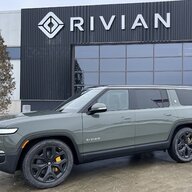
The more I see the wheels and the contrasting color, the less I like them.
 

Sponsored

narmstrong79

Well-Known Member
First Name
Nick
Joined
Apr 2, 2022
Threads
62
Messages
867
Reaction score
1,209
Location
New Hampshire
Website
www.youtube.com
Vehicles
2024 Rivian R1S Performance Dual Motor Standard+
Occupation
Marketing
Clubs
 
If they switched this to an 800 V architecture, I would upgrade in a heartbeat
800v wouldn't make a difference. And 800v with native NACS wouldn't makes sense.

They need to redesign the whole battery pack to use better cells as well as have better thermal management. The majority of the superchargers, aren't 800v capable and won't be for a long time... Especially if Tesla's subsidies are in jeopardy.
 

Supratachophobia

Well-Known Member
Joined
Apr 8, 2023
Threads
9
Messages
1,781
Reaction score
2,122
Location
Ohio
Vehicles
S
Clubs
 
I'm uneducated on the 800v architecture, what benefit does that bring?
None. To begin with, very few "800v" cars are actually 800 volt. And we lack a charging network wholy ready for it, and the Rivian thermals couldn't keep up anyway. Soooo....

....down vote away.
 

UnsungZero_OldTimeAdMan

Well-Known Member
First Name
Barnum
Joined
Mar 20, 2023
Threads
68
Messages
8,699
Reaction score
11,937
Location
SoCal
Vehicles
'23 GW Quad-Large R1T "Ghost"
Occupation
Advertising Circus
Wait until you have to pay for staggard tires. Looking at you Tesla Arachnids....
Looking at prices online for the Michelin PS S5, it's close to $600/tire. Plus, it's a performance tire on a very heavy vehicle. Those squeamish about short tread life will be in for a shock. Can't rotate front to back. Might be able to swap side-to-side if not directional (doesn't appear to be). But you'd have to pay for mounting and remounting for each wheel.
 
Last edited:

DayTripping

Well-Known Member
First Name
Timothy
Joined
Sep 12, 2024
Threads
13
Messages
1,544
Reaction score
2,133
Location
DFW
Vehicles
Gen1 R1T QM, S Plaid, Highland 3 Perf, 3 Long Range, R2 on order
Occupation
Consultant
Wait until you have to pay for staggard tires. Looking at you Tesla Arachnids....
Been there, done that with my Plaid. I went to a square fitment when I installed very lightweight, forged wheels. I still have the staggered fitment on my Model 3 Performance. Not sure if I want to invest in yet another set of wheels. Not to mention the tire warranties are cut in half, if there even is one.
 

Sponsored

savethemanual

Well-Known Member
Joined
May 18, 2024
Threads
15
Messages
913
Reaction score
1,563
Location
Earth
Vehicles
Future R2
The new summer tire option is going to chew through rubber, can only imagine how low the mileage is going to be on those shoes before needing replacing....and you can't rotate F to B.
 

SANZC02

Well-Known Member
First Name
Bob
Joined
Feb 11, 2021
Threads
50
Messages
7,431
Reaction score
12,724
Location
California
Vehicles
Tesla Model S, LE - R1S
Occupation
Retired
Just a couple of random thoughts.

I’m curious how many people think having a NACS port opens up all Superchargers to these vehicles. Not curious enough to create a poll but still curious.

Those thinking now you need 2 adapters if you have the NACS port as if that is not true currently. With the current port J1772/CCS1 you need 2 adapters between DCFC and L2. Even Tesla (assuming you have a Tesla that supports the CCS protocol) you need 2 adapters, it is just a bit more confusing as the in and out ports look the same with a NACS plug between L2 and L3 adapters they just behave differently.

My personal opinion, adding native NACS ports before CCS chargers add the native NACS cables does more to add confusion than it does to minimize it.
 

Dark-Fx

Well-Known Member
First Name
Brian
Joined
Jul 15, 2020
Threads
148
Messages
13,593
Reaction score
27,467
Location
Michigan
Vehicles
R1T, R1S, Livewire One, Sierra EV, R1S
Occupation
Engineering
Clubs
 
I got the sarcasm, I just don’t agree with you.
You don't agree with facts? Non-Tesla NACS does absolutely 100% not work on v2 or v1 superchargers.
 

captainjp

Well-Known Member
First Name
John
Joined
Oct 18, 2024
Threads
9
Messages
1,230
Reaction score
1,866
Location
New Jersey
Vehicles
Gen 2 R1T
Clubs
 
Just a couple of random thoughts.

I’m curious how many people think having a NACS port opens up all Superchargers to these vehicles. Not curious enough to create a poll but still curious.

Those thinking now you need 2 adapters if you have the NACS port as if that is not true currently. With the current port J1772/CCS1 you need 2 adapters between DCFC and L2. Even Tesla (assuming you have a Tesla that supports the CCS protocol) you need 2 adapters, it is just a bit more confusing as the in and out ports look the same with a NACS plug between L2 and L3 adapters they just behave differently.

My personal opinion, adding native NACS ports before CCS chargers add the native NACS cables does more to add confusion than it does to minimize it.
One cannot deny that Superchargers are the most-prevalent charging option. In my personal experience, I’ve not had any problems with compatibility. In addition, RANs will have the NACS option going forward.
as for L2, my current installation utilizes Tesla’s UWC. Compatibility is not an issue for me. The NACS connection for DCFC is far-superior to the alternatives. In my opinion, of course.
Sponsored


Top