
Sponsored

Trip planing and charging costs

Yossarian

Well-Known Member
Joined
Oct 20, 2020
Threads
45
Messages
934
Reaction score
922
Location
SE Pennsylvania
Vehicles
R1T,Telluride, Wee-Strom, Lynskey Cooper
Even though I'm retired, I'm lucky enough to still be a reasonably proficient skier and for quite some time now, have driven west from PA to the Wasatch, typically with a stop of a few days in CO on the drive out. Until this year, that trip was in an ICE vehcile but now that I have I an R1T, am considering taking the pickup.

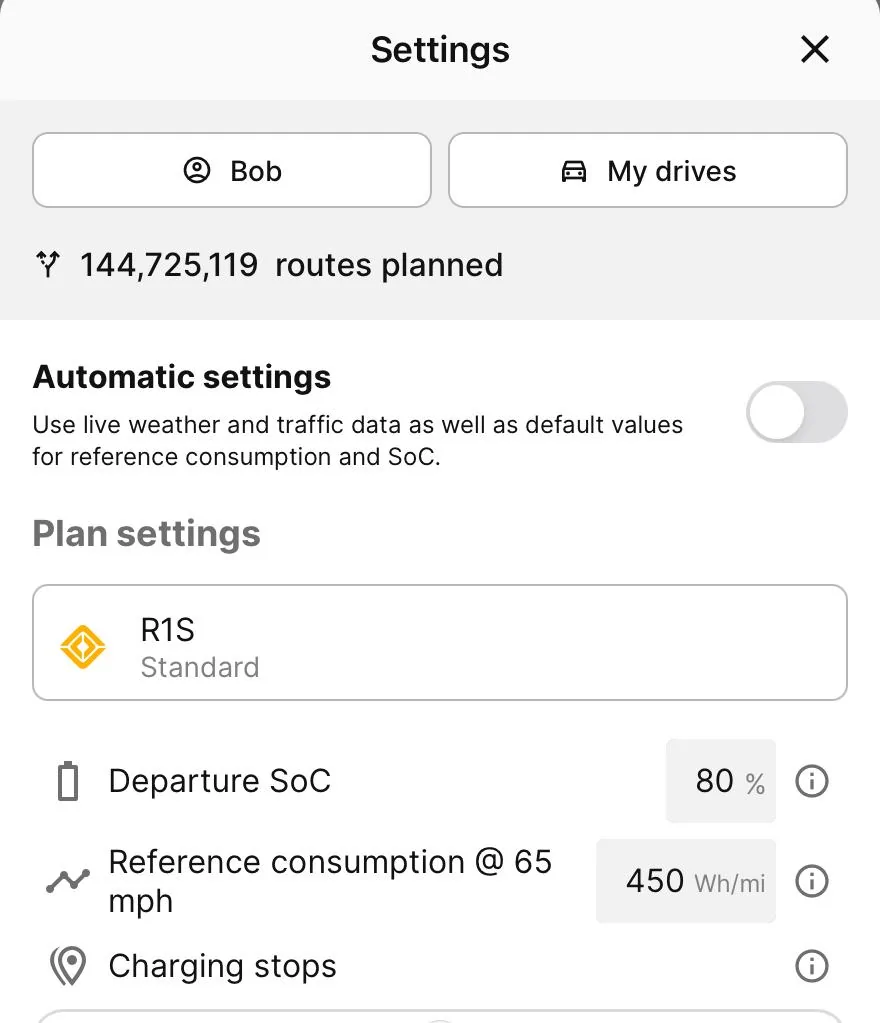
I understand the challenges of EV's on long trips and in cold weather, and while these can't be entirely eliminated, it looks to me that detailed planning can mitigate them to a great extent. With that in mind, I've started to do some planning, using [for now anyway] ABRP. While ABRP seems to do a pretty good job in identifying charging locations, I think that their estimates of consumption and cost are way off. The consumption figure is a bit understandable - I wasn't able to change things to full winter conditions (newbie at ABRP) thoughI did set the travel temp to 0C/32F. The cost estimates it supplies (in Euros) also seem far too low.

The trip in ABRP shows me going from the Phila area to Dillon, CO and then to SLC with a total one-way consumption estimate of 1,150 kWh for a cost of 307 Euro. That's just over 2 mi per kWh and about $330 or $0.30 for each KWh. I think both are far too optimistic.

It's early days for me for R1T ownership (PDM with a Large pack and stock 20"AT tires), and I'm presently at just over 2 mi/kWh. I plan to change tires for the winter, but even the best 3P tires are probably not going to do too much for range. My guess, is that I will see efficiency somewhere under 1.5 mi/kWh much of the time, with a drop to around or even a bit below 1.0 in headwinds, on snow or at elevation.

If I use a semi-educated guess of an average of 1.25 m/kWh, and assume that round trip will be about 5,200 miles (including local driving), that means the Rivian will use about 4,200 kWh. It's hard to determine what the per kWh cost of charging is, but if it's $0.50, a figure that seems to be in the ballpark based on what I've seen posted in this forum, that means about $2,100 in charging costs. I'm sure subscriptions can reduce that figure a bit, but I'd have to think by not much more than a couple of hundred dollars.

Am I off base with the assumptions and calculations?
Sponsored
 

VSG

Well-Known Member
Joined
Oct 3, 2022
Threads
4
Messages
3,266
Reaction score
6,116
Location
WA
Vehicles
R1T LE/RB/OC/20
Why are you still using the setting for Euros? Sure that's the default, because they're a Swedish company, but it you go through all the settings (and you should) you can set it to use dollars.

I think your estimate of 1.25m/kWh is ridiculously low. For the 4100 mile trip I took last year, my R1T/QM/20" got 2.21m/kWh, and that was with a RTT.

I suggest using ABRP's default of 2 to start with - plan a few trips of a few hundred miles, then take those trips and compare what the plan was vs what you actually got. In my experience ABRP is really very conservative in what it estimates, and you will always get to your location with more battery that it predicted. You can always set your reference consumption to reflect your actual driving better, but I think using the default of 2 won't get you into any trouble. You can also export your plan to a spreadsheet - I did this for the first couple of longer trips I took then entered the actual numbers along the way (travel time, energy consumption, battery SoC, charging time) to compare to the predicted numbers. That gave me confidence in what ABRP was telling me.

I don't know how ABRP computes costs, but I don't pay too much attention to that number. It's going to cost what it's going to cost, so focus on cost savings when you can, rather than the absolute number. Regardless, you're assuming an unreasonably high cost. If you plan on spending each night at a place you can get a free overnight charge, then that will reduce your cost by 25% or so. Also avoid the high-priced stations - check out the cost of the planned stations and if they are not reasonable then re-do your plan.

For my trip I ended up spending only ~$330 to charge over 4100 miles. (I did get three free RAN sessions and 1 free EA session along the way, however. And many places also have increased their prices since last year.) I never paid >$0.50 anywhere. Sign up for the membership price (EA, Tesla, etc.), use it for the month you're traveling, and after one day it will have more than paid for itself. Use chargers/networks that charge per-minute if available - that's far cheaper (I paid $0.35/minute which came out to $0.14/kWh at an EVGo in SLC, for example). And if you stop at somewhere that has a free L2 charger, use it even if you don't need to charge. You may find the cheapest route is not the shortest route, so if cost is your biggest concern then take advantage of the opportunity to see some sights on the road less travelled.
 

SANZC02

Well-Known Member
First Name
Bob
Joined
Feb 11, 2021
Threads
50
Messages
7,445
Reaction score
12,750
Location
California
Vehicles
Tesla Model S, LE - R1S
Occupation
Retired
Even though I'm retired, I'm lucky enough to still be a reasonably proficient skier and for quite some time now, have driven west from PA to the Wasatch, typically with a stop of a few days in CO on the drive out. Until this year, that trip was in an ICE vehcile but now that I have I an R1T, am considering taking the pickup.

I understand the challenges of EV's on long trips and in cold weather, and while these can't be entirely eliminated, it looks to me that detailed planning can mitigate them to a great extent. With that in mind, I've started to do some planning, using [for now anyway] ABRP. While ABRP seems to do a pretty good job in identifying charging locations, I think that their estimates of consumption and cost are way off. The consumption figure is a bit understandable - I wasn't able to change things to full winter conditions (newbie at ABRP) thoughI did set the travel temp to 0C/32F. The cost estimates it supplies (in Euros) also seem far too low.

The trip in ABRP shows me going from the Phila area to Dillon, CO and then to SLC with a total one-way consumption estimate of 1,150 kWh for a cost of 307 Euro. That's just over 2 mi per kWh and about $330 or $0.30 for each KWh. I think both are far too optimistic.

It's early days for me for R1T ownership (PDM with a Large pack and stock 20"AT tires), and I'm presently at just over 2 mi/kWh. I plan to change tires for the winter, but even the best 3P tires are probably not going to do too much for range. My guess, is that I will see efficiency somewhere under 1.5 mi/kWh much of the time, with a drop to around or even a bit below 1.0 in headwinds, on snow or at elevation.

If I use a semi-educated guess of an average of 1.25 m/kWh, and assume that round trip will be about 5,200 miles (including local driving), that means the Rivian will use about 4,200 kWh. It's hard to determine what the per kWh cost of charging is, but if it's $0.50, a figure that seems to be in the ballpark based on what I've seen posted in this forum, that means about $2,100 in charging costs. I'm sure subscriptions can reduce that figure a bit, but I'd have to think by not much more than a couple of hundred dollars.

Am I off base with the assumptions and calculations?
Under settings you can change the currency to USD. I used these settings in ABRP for my R1S in January 2023 for a 5500 mile trip and had no issues. In the beginning I would charge higher than suggested just to have a buffer but as the trip progressed I became much more comfortable with the suggested charge limits at the stops.

I will say in my experience traveling in winter even on cold days, the first drive of the day was less efficient but subsequent stretches after charging stops the battery stayed warm and range was less impacted. That was true in my R1S as well as Model S.

Rivian R1T R1S Trip planing and charging costs IMG_3717
 
OP
OP
Yossarian

Yossarian

Well-Known Member
Joined
Oct 20, 2020
Threads
45
Messages
934
Reaction score
922
Location
SE Pennsylvania
Vehicles
R1T,Telluride, Wee-Strom, Lynskey Cooper
Thanks for the feedback. I knew ABRP was a European company, but not that they were Swedish. The surprise then is that their cost calculator defaults to the Euro and not to their official currency, the Swedish krona . . .

Anyway, I've done a bit more research and will eventually refine my estimates based on that information. Until then, here's a summary of some of the information I found.

One fairly large (10,000 vehicles) study of the impact of cold weather on range found that of the 18 models included in their data, the average loss was just under 30%. Interestingly, this varied rather widely, with Tesla models averaging a 55% loss but the Audi E-trons only 20%. Rivians weren't included in the data, but a recent Car & Driver test of their R1T indicated a 27% range drop. I plan to do a more detailed power consumption estimate that will apply differing usage rates based on location, and would like to figure a way to add in the potential for adverse effects of headwinds and abnormally low temperatures. Temps below 0F are common in higher elevations, and can often be encountered in the Plain states as well. The winter headwinds can also be brutal, though thankfully they are really only adverse on the outbound leg.

As far as charging costs, there is some, but not a lot of data available, though it's possible to ge it at the charging station level. EA states that their average rate is $0.43/kWh, which of course varies by location. None of the others, Tesla SC, EVGo, Shell, etc seem to provide any idea of average pricing, so I will try to get cost info on the individual chargers on the planned route via Plug Share. Ditto for locations using Charge Point. Based on the limited research I've done so far however, it looks like a $0.50/kWh estimate before applying any subscription discounting is not all that far off. I don't know if it will be possible, but I'd like to be able to plug the Rivian during the hotel stays. It may or may not be possible to plan to stay at locations with L2 charging, but even if it's to a 110/120 connection, it would help. I wouldn't expect that this would charge the battery to an appreciable extent, but it should offset the current that will be diverted to pre-conditioning and at least preserve range.
 
Last edited:

Mathme

Well-Known Member
First Name
Matt
Joined
Jul 25, 2022
Threads
3
Messages
1,378
Reaction score
1,814
Location
Los Altos, CA
Vehicles
R1T: El Cap, OC, 20AT, Off road package
Occupation
High Tech
Like others, I think your cost of $.50/kWh is on the high side. With the subscription price, I've seen EA stations out in CA (where electricity is pricy) run in the .37-.42 range depending on the station.

Efficiency numbers are pretty low as well. in $15k miles on my truck R1T Large 20ATs, I've bounced between 1.95 and 2.0 miles/kWh. I used to drive from the Bay Area to Lake Tahoe and back quite frequently and even on that trip (which is 0-7400-0 elevation wise) I'd still get the 1.95-2.0 efficiency. Do note that on the trip from Sacramento (sea level) to Lake Tahoe (7400 foot pass) I'd regularly go from 85% Soc to 25-30% ... and the efficiency meter would be down to that 1.25. It takes a lot of juice to crawl up those 4-5 mile stretches at 6% grade.

One thing I've found works well when on a longer road trip is I'll use a tool like ABRP to plan it, but then with the truck, I only enter one my next stop in GPS. The truck does a fairly good job of estimating your mile range in the Nav, and I avoid getting routed to some odd-ball DCFC chargers.

I'd also make a note to turn off the blended braking (if you have it turned on) . On some of those long downhill stretches, you'll end up dragging your rear brakes and all that really does is wear out the pads and heat up your brakes (which will reduce your braking efficiency in a panic stop).

Enjoy the drive! The Rivian will do great!
 

Sponsored

Riviot

Well-Known Member
Joined
Mar 29, 2021
Threads
121
Messages
6,437
Reaction score
10,876
Location
Kitsap, WA
Vehicles
R1T
Clubs
 
I consider myself conservative, but you numbers take it to another level! As others said, 2mpk and $.40/kWh are more normal.

Highways/DCFC are the only times EVs are anywhere near close to ICE costs per mile. Don't write off the savings you'll have charging L2 in UT zipping hill to hill.
 

Rural1T

Well-Known Member
First Name
Brett
Joined
Mar 17, 2024
Threads
4
Messages
45
Reaction score
58
Location
Montana
Vehicles
R1T
As someone who lives in the mountains out West, I think 2.0 mpk is a reasonable average efficiency estimate for planning a trip in the cold. If you want to plan more conservatively, in my R1T (Dual, Max, AT) I average 1.8 mpk at 75-80 mph in temps between 10°-0°F (~20% efficiency loss).

If you do the math, the efficiency loss in the cold doesn't effect leg length on a road trip much, assuming you're an average driver who stops every 2-3 hours for a break. However, in very cold temperatures, most DCFC equipment isn't as efficient and you can expect slower charging speeds and longer charging stops.

I'll also agree heavily with the above comments that using L2 charging on a road trip really helps to keep costs down. It's also important when road tripping in cold weather because charging overnight L2 keeps the battery warm, which minimizes efficiency loss on the first leg.
 

SANZC02

Well-Known Member
First Name
Bob
Joined
Feb 11, 2021
Threads
50
Messages
7,445
Reaction score
12,750
Location
California
Vehicles
Tesla Model S, LE - R1S
Occupation
Retired
On trips with my Rivian I usually go super conservative and estimate 2 miles per kWh at 50 cents and have never spent more than I estimated.

I do want to reiterate about effeciency loss in cold weather. I just did a 6500 mile trip this past January in my Tesla Model S where much of the trip going east was in temps well below 20 degrees. It included one 700 mile day that started at -8 degrees in New Mexico and never got out of Single digits. I typically get around 310 watts per mile (3.2 miles per kWh) and even on that stretch after the first stretch and the battery warmed up the subsequent legs were very close to typical in the 3 mile per kWh range.

In my personal experience traveling in cold weather, unless you are doing stretches under 200 miles between overnight stays the range drop is there but not severe.
 

jjswan33

Well-Known Member
First Name
Joshua
Joined
Sep 17, 2021
Threads
135
Messages
4,455
Reaction score
9,880
Location
Sandy, OR
Vehicles
Rivian R1T LE, Hyundai Ioniq 5 Limited
Occupation
Engineer
Clubs
 
To add to what @SANZC02 said about cold weather efficiency.

Comparing the Rivian to Teslas and other small EVs (that are more efficient) will not be a good way to estimate R1 range losses. I'd be surprised if it was more than 10-12% in a Rivian. Since the Rivian is half as efficient as many of those cars the amount of extra energy needed to heat the cabin/battery is a smaller percentage of the battery.

I have estimated my winter range loss to be on the order of 0.1-0.15 mi/kWh.

Keep shredding ?â›·
 
OP
OP
Yossarian

Yossarian

Well-Known Member
Joined
Oct 20, 2020
Threads
45
Messages
934
Reaction score
922
Location
SE Pennsylvania
Vehicles
R1T,Telluride, Wee-Strom, Lynskey Cooper
Thanks again for the input.

I put together a more granular estimate of consumption based on location and likely weather and road conditions, using a range of 1.8 to 2.1 mi/kWh. In general, this meant using a higher efficiency value for much of the eastern and mid-west legs, and the higher numbers in parts of the Plains of states and at higher elevation areas. The weighted average doing this turned out to be about 1.85 mi/kWh. Based on the input from this thread (and thanks again), that seems to be a conservative figure for sure, but not unrealistically high and good enough for planning purposes.

What I found regarding charging rates was a bit surprising. The rates I saw posted are quite high, with very little variation by location, except for the non-network sites. I know that many who responded think that $0.50 per kWh is too high, but from what I saw on Plug Share, it actually seems to be more than bit on the low side.

I used the Plug Share info to put the table below together, but could not find rates for the RAN, Tesla or CP. I used placeholder values for them in the table, based on what I found in various forum postings or on-line articles. The non-network value is more or less an average of what I saw on Plug Share which ranged from about $0.65 to as high as $0.89 per kWh.
Provider
Rate (kWh)
Charge Point​
$0.45​
Electrify America​
$0.56​
EV Connect​
$0.59​
EV Go​
$0.56​
EV Go (at service plazas)​
$0.75​
Non-network​
$0.70​
RAN​
$0.35​
Tesla SC​
$0.50​

The rates in the table about do not take into account any discounts that may be available with a subscription. The rates also do not take into account other charges that would increase cost, such as access fees or per hour charges.

Based on the new info and revised methodology, the estimate for the charging cost for the planned 5,200 mile trip is now about $1,150 or $0.22 per mile. ABRP shows 18 recharge stops each way; 3 each at EA, EVGo, RAN and Tesla, 2 each at ChargePoint, EVGo and EVGo at service plazas, and one each at the others (non-network, EV Connect).
 

Dave Cundiff

Well-Known Member
First Name
Dave
Joined
Feb 28, 2024
Threads
4
Messages
1,182
Reaction score
1,600
Location
Pacific County, Washington
Vehicles
'23 R1S (DM,Max); '23 R1T (QM,Lg); '23 Chevy Bolt
Thanks again for the input.

I put together a more granular estimate of consumption based on location and likely weather and road conditions, using a range of 1.8 to 2.1 mi/kWh. In general, this meant using a higher efficiency value for much of the eastern and mid-west legs, and the higher numbers in parts of the Plains of states and at higher elevation areas. The weighted average doing this turned out to be about 1.85 mi/kWh. Based on the input from this thread (and thanks again), that seems to be a conservative figure for sure, but not unrealistically high and good enough for planning purposes.

What I found regarding charging rates was a bit surprising. The rates I saw posted are quite high, with very little variation by location, except for the non-network sites. I know that many who responded think that $0.50 per kWh is too high, but from what I saw on Plug Share, it actually seems to be more than bit on the low side.

I used the Plug Share info to put the table below together, but could not find rates for the RAN, Tesla or CP. I used placeholder values for them in the table, based on what I found in various forum postings or on-line articles. The non-network value is more or less an average of what I saw on Plug Share which ranged from about $0.65 to as high as $0.89 per kWh.
Provider
Rate (kWh)
Charge Point​
$0.45​
Electrify America​
$0.56​
EV Connect​
$0.59​
EV Go​
$0.56​
EV Go (at service plazas)​
$0.75​
Non-network​
$0.70​
RAN​
$0.35​
Tesla SC​
$0.50​

The rates in the table about do not take into account any discounts that may be available with a subscription. The rates also do not take into account other charges that would increase cost, such as access fees or per hour charges.

Based on the new info and revised methodology, the estimate for the charging cost for the planned 5,200 mile trip is now about $1,150 or $0.22 per mile. ABRP shows 18 recharge stops each way; 3 each at EA, EVGo, RAN and Tesla, 2 each at ChargePoint, EVGo and EVGo at service plazas, and one each at the others (non-network, EV Connect).
Having just completed an R1T trip from Gaithersburg to our Pacific Ocean community, @Yossarian, I am of course a complete expert -- on my own experience, but not on yours! Your mileage will always vary.

From that vast perspective, I can say that RAN is the only entity above that has consistent pricing. Every other network has enormous local variation -- Tesla's mostly based on the cost of power to them, and everyone else's mostly based on the whims of each site's host/owner.

In general, non-networked sites are slower -- but they may be perfectly adequate for your needs at any given time, and they are often (but not always) less expensive.

Our coast-to-coast payments ranged from $0.00/kWh to $0.64/kWh, averaging $0.156/mile -- with free overnight charging at three of the five hotels. You might pay more than $0.22 if you only use ABRP/Rivian Navigation recommendations. You might pay less than $0.22 if you research all locations on PlugShare, and if you are willing to spend more time charging in order to save money.

My "gut feeling" about your analysis, @Yossarian, is that your estimates are at least realistic and any error is likely on the conservative side (assuming worse fuel economy, and higher charging costs, than you are likely to see on the actual trip). That may result in a happy trip, because we all compare our experiences with our expectations.

As you plan your trip, don't forget to enjoy the journey!
Sponsored


Top