
Sponsored

What's the future of charging look like?

BigSkies

Well-Known Member
First Name
Brian
Joined
Sep 4, 2021
Threads
18
Messages
1,246
Reaction score
2,672
Location
Denver
Vehicles
R1T, Model Y
Clubs
 
I think the technology is actually closer than many think.

Two examples:
1. The first portable solar generator, with Li-NMC SST cells. By estimate it is ~40% more energy dense than comparable products but with a cost premium of 25-30% or so. Yoshino
2. A company I invest in SLDP (a small investment and down 75% from when I bought it ?‍♂ ), in there most recent q3 earnings they announced that they have shipped samples to BMW for 'automotive qualification'. Their tech sounds pretty cool to me, https://www.solidpowerbattery.com/. But who knows most of these companies will fail.
Yea, I’ve been casually following SolidPower, QuantumScape Sila and Amperius. The technology is fundamentally functional in the lab and being used in niche & test environments.

It’s just such a long development cycle. Something in testing might make its way into a small volume production car in ~3-5 years. But making it into mass market will take additional years of building multi-billion dollar factories before the industry can support material production.
Sponsored

 

Milermore

Well-Known Member
Joined
Oct 24, 2022
Threads
1
Messages
186
Reaction score
218
Location
Oregon
Vehicles
R1S
Clubs
 
several years ago I read an article about wireless charging from roads.
The article was mostly about how glass could be used to make roads stronger, easier to replace and repair, etc... and placing conductive charging underneath that would charge EVs as they drove down the road.
I have no idea if that's feasible, reasonable, or even doable, but it made a good article.
 

CharonPDX

Well-Known Member
First Name
Charon
Joined
Jul 12, 2021
Threads
31
Messages
2,523
Reaction score
4,213
Location
Cascadia
Vehicles
'22 R1T LE, '16 Model S, '19 Arcimoto FUV
Occupation
InfoSec Geek
Clubs
 
Charging is problematic on road trips for a variety of reasons (broken equipment, long lines, derating, etc) . What does the future of charging look like?

-Super fast top ups (5 minutes max) due to higher voltage vehicle systems

-Battery pack replacement, meaning drive over a stall and a robot replaces your battery pack within a few minutes

-Roads and parking stalls will have wireless charging so no stops needed

-Ranges will be 1000 miles+ so less frequent charging required

?


-
All of those have been claimed to be coming, most of those have been found to be not feasible in reality.

5 minute top-ups would require ridiculously high power into the charging station. That's a bigger problem than the actual battery side. (Although there is the new Megawatt Charging System - MCS - that can go up to 3 MW. If a Rivian's 135kWh battery could accept 3 MW from 0-100%, it would fill up in three minutes.) Although the battery side is a huge hurdle, too. "Higher voltage" isn't the answer. Just from the way Lithium Ion batteries work, you want to slow down charging near the end for the longevity of the battery. It would take all new battery technology to allow for maximum-speed charging the entire capacity. (And companies are working on it. Much like fusion power, they always seem to be "5 years from commercial release" though.)

Replacement is a thing. There are EV companies in China doing it. Even Tesla tried it back in 2012-2014. It "works", but the big problem is that to have proper economies of scale, battery packs would need to be standardized. Otherwise you'd have to have separate stations for each brand, which would have to stock different batteries for each model. Tesla alone has five different form factors of battery pack (six once Cybertruck starts shipping,) in ten different capacities. Imagine trying to make one swap station that can do the Ford Focus Electric and the F-150 Lightning… Much less a Mini EV and a Hummer EV.

Yeah, no. Not for roads. Multiple companies have tried it, and it's terrible. HUGELY inefficient for moving vehicles. Parked vehicles, though… There are multiple industry standards for it - BMW released a vehicle with it a decade ago. But again, there are inefficiencies, and plugging and unplugging doesn't take more than a few seconds.

Why? Why do a 1000 mile vehicle? How many people drive more than 300 miles in a day? (And I say this as someone who just finished a 4500 mile road trip.) Why cart around 3-5x as much battery as you need every day just so you don't have to plug in as often? Ubiquitous L2 charging is the answer. Put L2 chargers everywhere. Top up while grocery shopping, top up while at the movie theater, charge up overnight at home. It takes a couple extra seconds. Rather than the need to stop for an hour or two to add 1000 miles of range every couple weeks.
 
OP
OP
PBRAZ

PBRAZ

Well-Known Member
First Name
Mike
Joined
Aug 11, 2022
Threads
21
Messages
234
Reaction score
257
Location
Orange County, CA
Vehicles
GMC Denali, Range Rover
All of those have been claimed to be coming, most of those have been found to be not feasible in reality.

5 minute top-ups would require ridiculously high power into the charging station. That's a bigger problem than the actual battery side. (Although there is the new Megawatt Charging System - MCS - that can go up to 3 MW. If a Rivian's 135kWh battery could accept 3 MW from 0-100%, it would fill up in three minutes.) Although the battery side is a huge hurdle, too. "Higher voltage" isn't the answer. Just from the way Lithium Ion batteries work, you want to slow down charging near the end for the longevity of the battery. It would take all new battery technology to allow for maximum-speed charging the entire capacity. (And companies are working on it. Much like fusion power, they always seem to be "5 years from commercial release" though.)

Replacement is a thing. There are EV companies in China doing it. Even Tesla tried it back in 2012-2014. It "works", but the big problem is that to have proper economies of scale, battery packs would need to be standardized. Otherwise you'd have to have separate stations for each brand, which would have to stock different batteries for each model. Tesla alone has five different form factors of battery pack (six once Cybertruck starts shipping,) in ten different capacities. Imagine trying to make one swap station that can do the Ford Focus Electric and the F-150 Lightning… Much less a Mini EV and a Hummer EV.

Yeah, no. Not for roads. Multiple companies have tried it, and it's terrible. HUGELY inefficient for moving vehicles. Parked vehicles, though… There are multiple industry standards for it - BMW released a vehicle with it a decade ago. But again, there are inefficiencies, and plugging and unplugging doesn't take more than a few seconds.

Why? Why do a 1000 mile vehicle? How many people drive more than 300 miles in a day? (And I say this as someone who just finished a 4500 mile road trip.) Why cart around 3-5x as much battery as you need every day just so you don't have to plug in as often? Ubiquitous L2 charging is the answer. Put L2 chargers everywhere. Top up while grocery shopping, top up while at the movie theater, charge up overnight at home. It takes a couple extra seconds. Rather than the need to stop for an hour or two to add 1000 miles of range every couple weeks.
All great points. I'm landing on a 500 real world mile capacity with wireless charging.

One issue I'm trying to contemplate involves the logistics of bringing enough power to say a grocery store or Walmart parking lot where all/most spaces are lit up. Even at L2, with every car charging, that's an insane amount of power which would require huge infrastructure changes both to the grid and last mile. Where is that money coming from? Is it even possible?

Given this, I don't know if everyone will ABC (always be charging). Or maybe they will, but it will require some sort of AI built in to the chargers and vehicles so that they can all communicate to dictate priority and power allocation. For example, you need to run to the store to grab some milk and have 68% SOC when you get there. You're headed back home to your own charger after - do you really need to top off?

To that point, most of your every day charging will be at home or work. It's the road trip and towing folks where we are seeing the biggest issues now. Again, maybe some standard communication protocols where you punch in your trip to your nav and provide a bit more info. "I'm going here, here and here. I'm having lunch here, taking a break here, going shopping here for this long. I'm towing this and it weighs this."

That info is then automatically communicated to the chargers along the route to develop a smart charging plan. If you don't need 350kw, don't call for it. If you do, charge away.
 

Sponsored

Dark-Fx

Well-Known Member
First Name
Brian
Joined
Jul 15, 2020
Threads
148
Messages
13,612
Reaction score
27,527
Location
Michigan
Vehicles
R1T, R1S, Livewire One, Sierra EV, R1S
Occupation
Engineering
Clubs
 

BigSkies

Well-Known Member
First Name
Brian
Joined
Sep 4, 2021
Threads
18
Messages
1,246
Reaction score
2,672
Location
Denver
Vehicles
R1T, Model Y
Clubs
 
All of those have been claimed to be coming, most of those have been found to be not feasible in reality.

5 minute top-ups would require ridiculously high power into the charging station. That's a bigger problem than the actual battery side. (Although there is the new Megawatt Charging System - MCS - that can go up to 3 MW. If a Rivian's 135kWh battery could accept 3 MW from 0-100%, it would fill up in three minutes.) Although the battery side is a huge hurdle, too. "Higher voltage" isn't the answer. Just from the way Lithium Ion batteries work, you want to slow down charging near the end for the longevity of the battery. It would take all new battery technology to allow for maximum-speed charging the entire capacity. (And companies are working on it. Much like fusion power, they always seem to be "5 years from commercial release" though.)

Replacement is a thing. There are EV companies in China doing it. Even Tesla tried it back in 2012-2014. It "works", but the big problem is that to have proper economies of scale, battery packs would need to be standardized. Otherwise you'd have to have separate stations for each brand, which would have to stock different batteries for each model. Tesla alone has five different form factors of battery pack (six once Cybertruck starts shipping,) in ten different capacities. Imagine trying to make one swap station that can do the Ford Focus Electric and the F-150 Lightning… Much less a Mini EV and a Hummer EV.

Yeah, no. Not for roads. Multiple companies have tried it, and it's terrible. HUGELY inefficient for moving vehicles. Parked vehicles, though… There are multiple industry standards for it - BMW released a vehicle with it a decade ago. But again, there are inefficiencies, and plugging and unplugging doesn't take more than a few seconds.

Why? Why do a 1000 mile vehicle? How many people drive more than 300 miles in a day? (And I say this as someone who just finished a 4500 mile road trip.) Why cart around 3-5x as much battery as you need every day just so you don't have to plug in as often? Ubiquitous L2 charging is the answer. Put L2 chargers everywhere. Top up while grocery shopping, top up while at the movie theater, charge up overnight at home. It takes a couple extra seconds. Rather than the need to stop for an hour or two to add 1000 miles of range every couple weeks.
I agree on the charger speed being an issue for ultra-fast charging.

But it seems like the physics of the next generation of batteries will likely allow higher power input across the charging curve without the same thermal issues. A Rivian of today mostly sustains charging rates around 150kW, and slower towards the top of the charge. I think most consumers will be happy with the end result if the next generation can sustain 250kW or even 350kW for sustained periods of time. That would cut charging time to a point where most people wouldn't consider it an inconvenience compared to a gas station.

I also view greater access to L2 chargers as a key enabler of the next wave of potential EV buyers. This could be L2 chargers at rental properties, where people work, train stations, etc. These chargers aren't super important to people that own their homes. But giving the ~35% of renters confidence that they can find a charging solution even if they happen to move is important for adoption.

I remain convinced that battery swapping and wireless charging are doomed ideas outside of niche applications.
 

Supratachophobia

Well-Known Member
Joined
Apr 8, 2023
Threads
9
Messages
1,781
Reaction score
2,122
Location
Ohio
Vehicles
S
Clubs
 
The future? Well, we can't overcome physics with Lithium ion cylindrical battery tech. So 800v is just about the lowest hanging fruit for companies to adopt. Beyond that, we need a fundamental shift to something like solid state batteries that can just plain charge faster. But then those will come with potential tradeoffs like charge cycles and cold weather performance. So basically, nothing in the immediate future.

No to wireless charging, tons of waste, greater heat, and unknown electromagnetic consequences.

No to battery swap, way too much infrastructure and materials (extra batteries laying around).
 

UnsungZero_OldTimeAdMan

Well-Known Member
First Name
Barnum
Joined
Mar 20, 2023
Threads
68
Messages
8,753
Reaction score
11,999
Location
SoCal
Vehicles
'23 GW Quad-Large R1T "Ghost"
Occupation
Advertising Circus
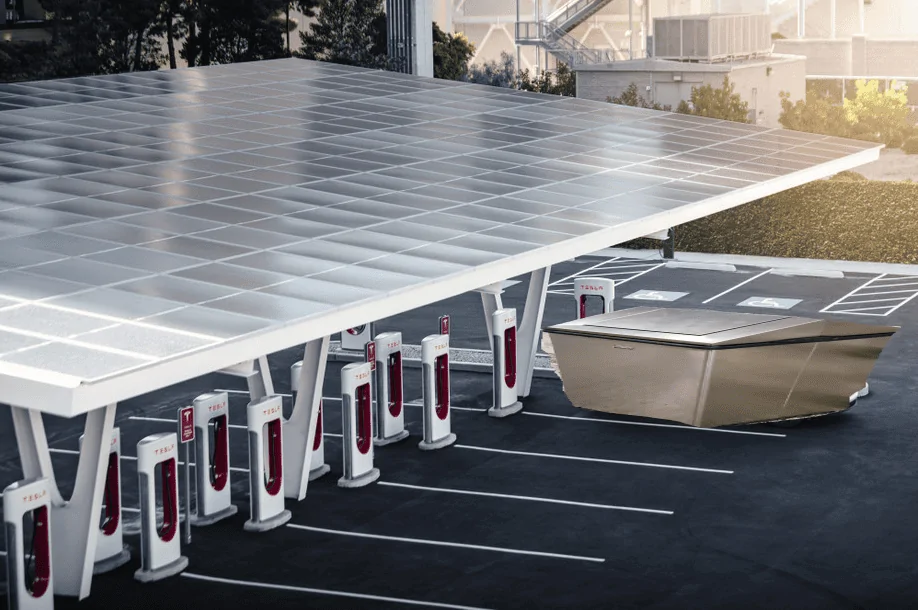
Near future it’s still going to be a mess. All the different disorganized networks with not much competition between them. More needs to be done on the legislative level to really give the industry motivation to shape up. Distant future, hopefully a lot more organized sites and use of solar canopies and other renewables to supplement the traditional grid.
 

Kenmecca

Well-Known Member
First Name
Ken
Joined
Jun 21, 2021
Threads
2
Messages
194
Reaction score
225
Location
SF Bay Area
Website
www.Directlineanswers.com
Vehicles
R1S; Audi A5
Occupation
Business Owner
Near future it’s still going to be a mess. All the different disorganized networks with not much competition between them. More needs to be done on the legislative level to really give the industry motivation to shape up. Distant future, hopefully a lot more organized sites and use of solar canopies and other renewables to supplement the traditional grid.
This!!! Totally agree to fix the current state of mish mash is to standardize (like requiring Apple to move to USB-C) We should be able to pull up to a WORKING charging station and have no less than 150K with a standard plug and integrated in our vehicles plug/play. Ive been to a number of basically broken stations that seem to relate to not getting the payment system working. Once we are all on the same page things will move faster to get stations online. I think the next phase will finding ways to make batteries denser, cheaper to make, lighter so we can get 600+ miles on a charge. I generally drive from the Bay Area down to San Diego, or Bay Area to Oregon in one day which is about 550 miles.
 

Sponsored

UnsungZero_OldTimeAdMan

Well-Known Member
First Name
Barnum
Joined
Mar 20, 2023
Threads
68
Messages
8,753
Reaction score
11,999
Location
SoCal
Vehicles
'23 GW Quad-Large R1T "Ghost"
Occupation
Advertising Circus
This!!! Totally agree to fix the current state of mish mash is to standardize (like requiring Apple to move to USB-C) We should be able to pull up to a WORKING charging station and have no less than 150K with a standard plug and integrated in our vehicles plug/play. Ive been to a number of basically broken stations that seem to relate to not getting the payment system working. Once we are all on the same page things will move faster to get stations online. I think the next phase will finding ways to make batteries denser, cheaper to make, lighter so we can get 600+ miles on a charge. I generally drive from the Bay Area down to San Diego, or Bay Area to Oregon in one day which is about 550 miles.
Agree. However battery side of things take much longer. Mining operations take much longer. Battery plants also take a long time to build and ramp. Battery tech development also very slow moving (but check out Amprius and silica anode). Because of all this, I don’t think we will feel true impact of IRA for some time… if it doesn’t get undone by politics.

Charging stations are relatively simple and take less time/investment. The biggest stumbling block is state/local red tape for construction.

Big oil is getting involved in mining and charging too. There was some news about this just this week. When they really up their involvement, I think we will see a significant shift.
 
Last edited:

mkg3

Well-Known Member
Joined
Nov 19, 2021
Threads
91
Messages
2,813
Reaction score
3,747
Location
SoCal
Vehicles
R1S, Model 3, Outback, Artura
Clubs
 
There's a saying that goes:

"you only know what you know, and you don't know what you don't know..."

There are so many concepts out there for future charging and people are constantly working on them - publicly and stealthily.

Also there are non-battery approaches too so time horizon plays a lot into guessing where we might be in different times.

As for SSB, I see the first real application in eVTOL/air taxis rather than mass produced autos. Still, you might find it in exotic sports cars to keep the weight down and still have decent performance and range. I know There are Chinese and Korean makers already offering SSB as an option but not quite the mainstream.

Definitely wireless charging and maybe embedded into some major tollways to extend the range AND included in the toll charge.

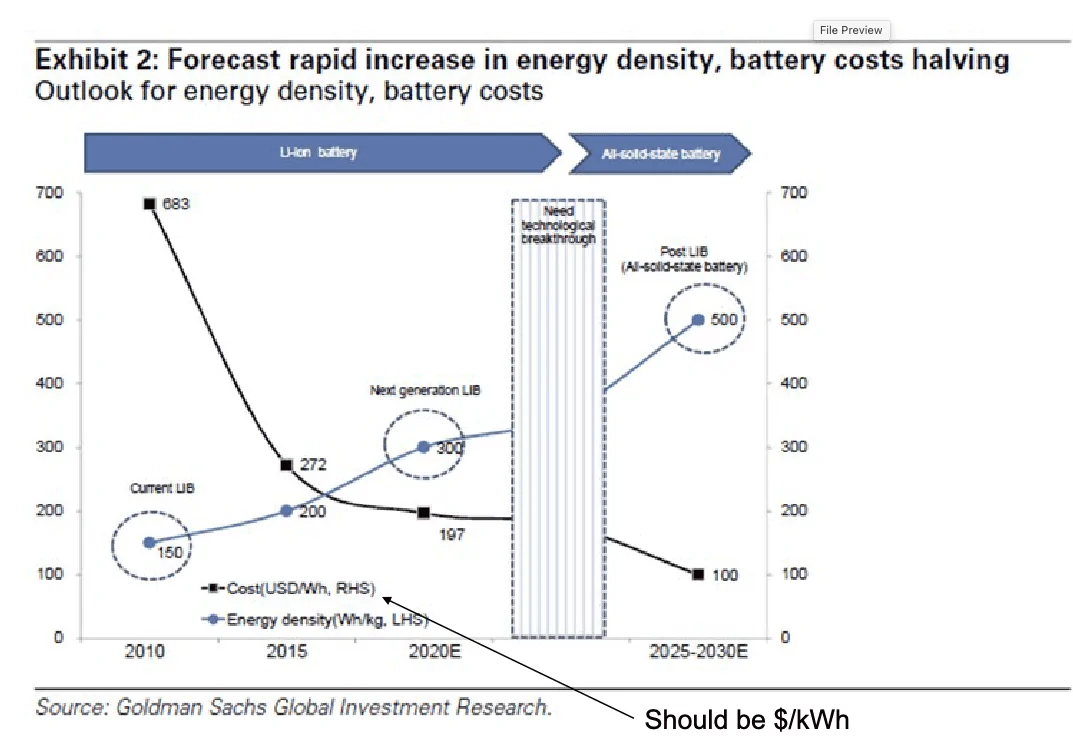
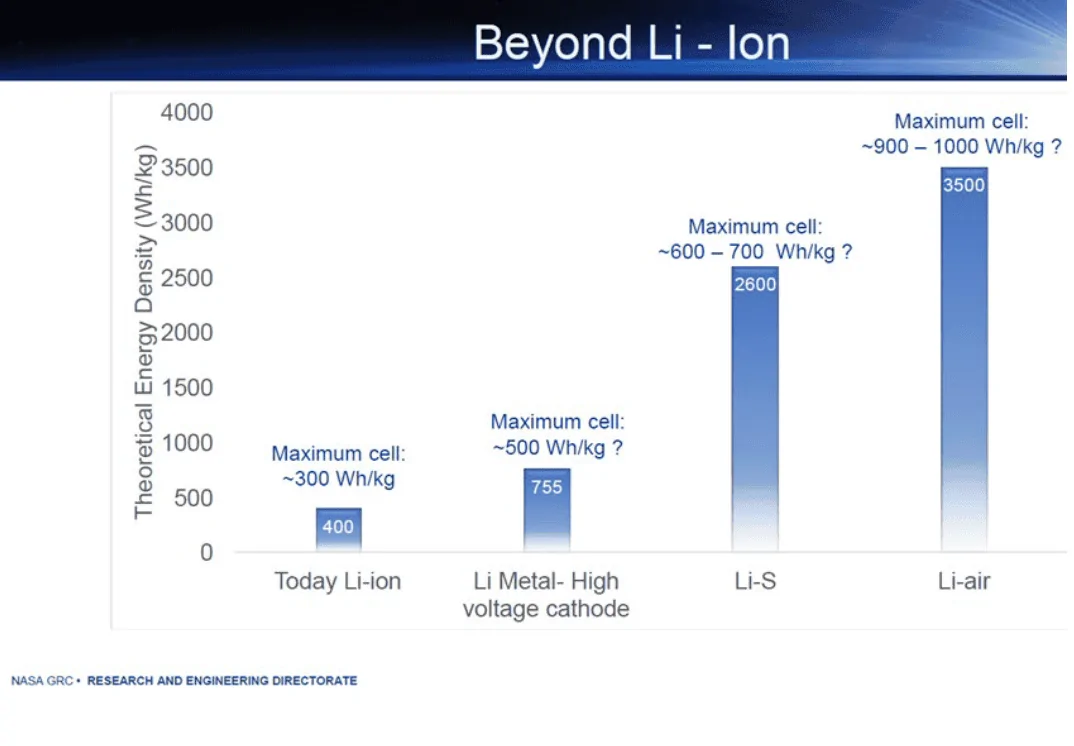
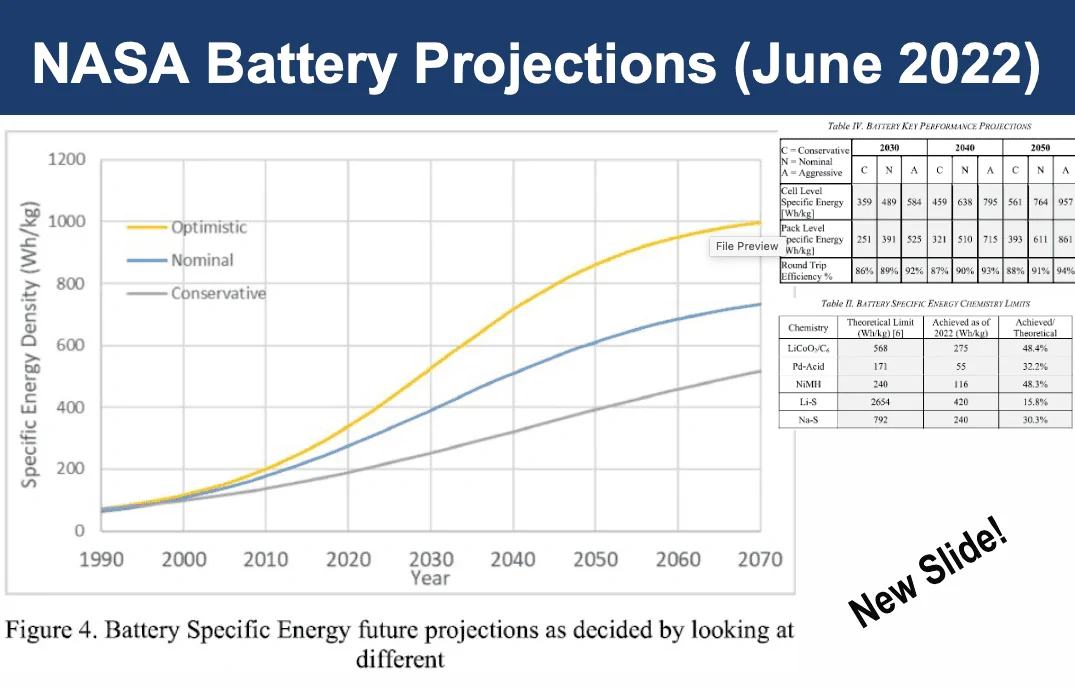
Lastly, here are few charts from an aerospace electric propulsion worksop in 2022:

Rivian R1T R1S What's the future of charging look like? 1700336546445


Rivian R1T R1S What's the future of charging look like? 1700336571006


Rivian R1T R1S What's the future of charging look like? 1700336622554
 

BigSkies

Well-Known Member
First Name
Brian
Joined
Sep 4, 2021
Threads
18
Messages
1,246
Reaction score
2,672
Location
Denver
Vehicles
R1T, Model Y
Clubs
 
Here's some links to various battery tech companies I casually follow. They're great sources of information if you're searching for new ways to lose money in the stock market:

Reading their materials is a good way to understand where the technology potentially can go. Although I've been around Silicon Valley type companies long enough to be highly skeptical that they will get to all of the benchmarks in their marketing materials.

https://amprius.com/
https://www.quantumscape.com/
https://www.solidpowerbattery.com/
https://www.silanano.com/
https://prieto.com/
 

madgrey

Well-Known Member
First Name
Allan
Joined
Feb 26, 2022
Threads
4
Messages
903
Reaction score
1,241
Location
Fidalgo Island, WA
Vehicles
2022 R1T, 2016 Miata, 2015 Viper
Occupation
Hardware Design Verification
I don't think wireless charging can be efficient without being standardized, and even with standardization, I don't see it covering all types of vehicles given the various form-factors. This seems like a garage only thing, but much more expensive than the alternative wired version for very little gain in convenience.

Battery replacement violates the KISS law of engineering. Engineers are already fighting cost/weight/size/packaging/availability etc. adding more dimensions to the problem due to having to be able to easily remove (and connect/disconnect) a massive battery makes no sense to me. A small replaceable module might make sense, as an add on for range, but still not seeing a big benefit.

Just give 300+ miles of real world range and a reliable charger at my destination.
 

Count Orlok

Well-Known Member
Joined
May 17, 2022
Threads
185
Messages
2,564
Reaction score
5,348
Location
Wisconsin & New Mexico
Vehicles
2022 R1S/ 2024 INEOS Grenadier/ 1969 Ford / etc.
Occupation
retired
Clubs
 
I think the technology is actually closer than many think.

Two examples:
1. The first portable solar generator, with Li-NMC SST cells. By estimate it is ~40% more energy dense than comparable products but with a cost premium of 25-30% or so. Yoshino
FWIW, The Count has the Yoshino B4000 SST and it is the bee's knees.
Sponsored


Top