
Sponsored

EV's more expensive to charge than ICE Counterparts?

Zoidz

Well-Known Member
First Name
Gil
Joined
Feb 28, 2021
Threads
226
Messages
5,203
Reaction score
11,705
Location
PA
Vehicles
23 R1S Adv, Avalanche, BMWs-X3,330cic,K1200RS bike
Occupation
Engineer
Nit, if you have net metering, charging isn't free, because you'd otherwise be paid for those electrons. And then there's the cost of the solar system. ROI is typically 20-30 years, and panels are typically only good for 25 years, so you're only breaking even.

I like the idea of being able to charge after a natural disaster has knocked out electricity, though you could do the same thing with gallons of gas and a generator, albeit in a more polluting, louder way.
I'm planning a solar install for next spring and doing research. Similar to EV batteries, quality solar panels today have a 25 to 30 year warranty, guaranteed to provide up 85% (example) of their rated power. Just like an EV battery, the panel is still very usable after it passes that spec, with reduced output. Depending on the application, the panel could have another 5 to 10 years of useful life if the reduced capacity is acceptable.

ROI is more typically 10 - 15 years these days. Combined with a 30% tax credit, it's a decent investment.
Sponsored


 

docwhiz

Well-Known Member
First Name
Mark
Joined
May 22, 2023
Threads
5
Messages
668
Reaction score
618
Location
Lake Tahoe, California
Vehicles
Tesla Model S LR (2022), Land Rover Discovery 2
Occupation
Retired
Nit, if you have net metering, charging isn't free, because you'd otherwise be paid for those electrons. And then there's the cost of the solar system. ROI is typically 20-30 years, and panels are typically only good for 25 years, so you're only breaking even.

I like the idea of being able to charge after a natural disaster has knocked out electricity, though you could do the same thing with gallons of gas and a generator, albeit in a more polluting, louder way.
My solar PV system paid for itself in 6 years. I now have free electricity. Net metering allows me to use the grid for free storage until I need the power. I don't get paid for yearly excess but come out about even.
 

NineElectrics

Well-Known Member
Joined
Aug 7, 2022
Threads
49
Messages
915
Reaction score
1,126
Location
US
Vehicles
R1S
My solar PV system paid for itself in 6 years. I now have free electricity. Net metering allows me to use the grid for free storage until I need the power. I don't get paid for yearly excess but come out about even.
Six years! What’s your secret? Did you install it yourself? Do the panels track the sun? I’ve also never seen a net metering setup where the panels completely cover all residential usage—especially with an EV. Great job all around.
 

Donald Stanfield

Well-Known Member
First Name
Donald
Joined
Jul 31, 2022
Threads
59
Messages
8,326
Reaction score
16,674
Location
USA
Vehicles
2025 R1S Tri Ascend, 2024 i4 M50
Occupation
Stuff and things
Most net metering doesn’t pay out, and if it does pay out it it’s usually at “fuel avoidance rates” which is like a third of a quarter of retail rates.

Solar ROI is also variable. In many places it’s sub 10-year ROI, like for me I’m running at about a 5 year ROI, maybe even less depending upon interest rates and future utility electrical cost escalation.
This is what I've learned about electricity and solar panels. Where I live I've priced it out and its a bad investment to go solar. The utility has zero buyback and power is really cheap here. Getting a service costs nothing worth complaining about.

So I was confused why some people went solar. Until I found out their utility costs are an order of magnitude higher than mine. That would change the payback figures substantially.
 

docwhiz

Well-Known Member
First Name
Mark
Joined
May 22, 2023
Threads
5
Messages
668
Reaction score
618
Location
Lake Tahoe, California
Vehicles
Tesla Model S LR (2022), Land Rover Discovery 2
Occupation
Retired
Six years! What’s your secret? Did you install it yourself? Do the panels track the sun? I’ve also never seen a net metering setup where the panels completely cover all residential usage—especially with an EV. Great job all around.
Yes, mostly diy. Much cheaper. Also, some surplus panels. All are fixed ground arrays. Lot of tree shading so challenging.
 

Sponsored

md2023

Well-Known Member
Joined
Mar 20, 2023
Threads
3
Messages
358
Reaction score
253
Location
New England
Vehicles
Subaru
Clubs
 
This is what I've learned about electricity and solar panels. Where I live I've priced it out and its a bad investment to go solar. The utility has zero buyback and power is really cheap here. Getting a service costs nothing worth complaining about.

So I was confused why some people went solar. Until I found out their utility costs are an order of magnitude higher than mine. That would change the payback figures substantially.
I am in a similar position where it is either a minor loss $ wise or essentially break even after about 12-15 years. But I am ok with that given the environmental benefit and likely future changes/restrictions/laws/price increases around energy and replacement of other ICE vehicle with an EV. Install is scheduled for November.
 

shandel

Well-Known Member
Joined
Jul 20, 2022
Threads
6
Messages
254
Reaction score
201
Location
Half Moon Bay, CA
Vehicles
R1S FG/FE Adventure 20, Audi e-tron, Jeep Wrangler
Clubs
 
Nit, if you have net metering, charging isn't free, because you'd otherwise be paid for those electrons. And then there's the cost of the solar system. ROI is typically 20-30 years, and panels are typically only good for 25 years, so you're only breaking even.

I like the idea of being able to charge after a natural disaster has knocked out electricity, though you could do the same thing with gallons of gas and a generator, albeit in a more polluting, louder way.
The ROI on a solar system is typically 7-8 years. Mine will have a positive return in about 8 years according to my calculations. It does depend on what your local energy cost is, of course. And since ours is relatively high compared to other places the return is quicker.
 

miasm

Well-Known Member
Joined
May 18, 2022
Threads
2
Messages
121
Reaction score
142
Location
ABQ, NM
Vehicles
R1T
This is what I've learned about electricity and solar panels. Where I live I've priced it out and its a bad investment to go solar. The utility has zero buyback and power is really cheap here. Getting a service costs nothing worth complaining about.

So I was confused why some people went solar. Until I found out their utility costs are an order of magnitude higher than mine. That would change the payback figures substantially.
Yea, we have low rates here (~$0.13/kWh blended average for the month) and expensive solar install ($4+/W). It generally didn't make sense for me, until it did.

Tesla install flat at $2/W with 0-down 0.99%APR alongside federal tax credit for 25%. So, install $40k system go live in November, make a couple $350 payments and then get a $10k check in the bank. Now I have solar installed and $10k more than I had in my bank than before.

Take the $10k, and put into 6-month, and single year / multi-year CD, and use the $10k to pay for all my solar payments. 3 years into my 10 year loan period, am just now starting to run short on the money I got from my rebate check. In that time I've saved about $12k in electrical costs and have sub $30k left on my loan, meaning I'm $18k away from break-even, putting me about 5 years out from break-even totalling 8 years. In the meantime electricity prices are set to rise ~30% for me next year, bringing the break-even rate in by a year or so down to 7 years. Further rate increases will just accelerate it.

And that's with two powerwalls installed -- if I had done just pure solar with the insane deal Tesla was offering, I'd be at a solid 5 year ROI. The powerwalls hurt that a lot, but I bought them so that I'd have power when the grid goes down and also to buffer against eventual very high time of use rates in the evening that I see coming down the pipe...
 
Last edited:

cjust2006

Well-Known Member
Joined
May 9, 2022
Threads
27
Messages
326
Reaction score
415
Location
Houston, TX
Vehicles
R1T Adv Limestone
Occupation
IT Analyst
Yeah, if you take the regions where electricity is the most expensive as your total sample dataset, then of course the numbers are high.

It costs me, worse case right now charging at home from 0% to 100%, $11.47 for 300 miles...

Inevitably, someone is going to send me this article and, when I tell them these facts, they will still not believe me and think I'm just protecting my ego...
 

miasm

Well-Known Member
Joined
May 18, 2022
Threads
2
Messages
121
Reaction score
142
Location
ABQ, NM
Vehicles
R1T
Yeah, if you take the regions where electricity is the most expensive as your total sample dataset, then of course the numbers are high.

It costs me, worse case right now charging at home from 0% to 100%, $11.47 for 300 miles...

Inevitably, someone is going to send me this article and, when I tell them these facts, they will still not believe me and think I'm just protecting my ego...
My electrical rates are close to yours ($0.07/kWh for the first 450kWh in the month, $0.10/kWh for the next 450kWh and then $0.18/kWh for anything above that), and solar still made sense for me and makes sense for many of my neighbors. But you do have to be able to qualify for the credit, and you have to find an installer that'll install at ~$2-$2.4/W instead of the $4-$5/W that most places want to charge. I'm not sure it makes sense right now anymore with the current interest rate situation though.

TL;DR -- it's about more than just electrical rates -- local installer prices matter as much if not more since there can be >2x variability between installers in what they'll charge you, and interest rates. Solar makes sense even at $0.10/kWh if you can get it installed for a reasonable rate and get low interest rates. In Australia and other places that can get it installed for $1/W or even less it's a no-brainer practically regardless of what your electricity rates are.
 

Sponsored

defcon888

Well-Known Member
First Name
Keith
Joined
May 23, 2023
Threads
6
Messages
1,227
Reaction score
926
Location
Auburn, Ca
Vehicles
2023 R1T, 2021 Toyota RAV4 Prime
Occupation
Making money
Clubs
 
I didn't bother reading the article because it is always bashing on EV's. Did they mention that 80% of people charge at home where the cost per kW is about $0.12/kW compared to an EA station at about $0.36/kW when going on long trips?

We have a Toyota RAV4 Prime. In CommieFornia the price of gas in our area is $4.90/gallon. When I fill up the 12-gallon tank it costs me $58.00 worse case.

I drive 145 miles 1 way to work (stay there M-W and then drive home). I drive the R1T because we get to charge for free at work. It does take 3 days to charge it back to about 280 miles (we only get 4 hour blocks at work).

My wife drives the Rav4 Prime and only drives locally so we charge that up at night and it get 40+ miles per charge and I have only filled it up 1 time in the last month.
 

mikehmb

Well-Known Member
First Name
Mike
Joined
Jan 12, 2022
Threads
154
Messages
2,303
Reaction score
5,224
Location
SF Bay Area
Vehicles
My name is Mike, and I have a (car) problem
The high is SOCal at 47 cents per KWh

https://www.businessinsider.com/ev-charging-cost-versus-gas-car-truck-suv-2023-7
I live in SoCal and with a SDG&E plan devised for EVs I pay about 15 cents per KWh during super off-peak hours. If believe most counties offer a similar plan.
Oh, my friend. Those of us stuck with PGE are jealous. And those in SacMUD service areas laugh at all of us (at 11c/kWh off peak).

Best case in a PGE territory: 27c off-peak (12a-3p). It’s about the best you can get. Thankfully, I live somewhere that A/C is not required in the home, so my usage, esp with PV, is pretty low for general household stuff. But 3 EVs make an impact.

Still cheaper than gas, tho. By a long-shot, even at peak rates.
 

AlanP

Well-Known Member
First Name
Alan
Joined
Jul 2, 2021
Threads
12
Messages
158
Reaction score
119
Location
La Canada
Vehicles
R1S, Wife Solterra
Occupation
Retired
Clubs
 
If you are on a road trip, not charging at home, then it could cost more. In your example you state it would have to be $.42/kwh to be equivalent to your ICE F-150. EA normal pricing has been $.48/kwh (without Pass+), and in my area during peak hours EVGO is $.69/kwh. Much worse than your F-150.

But at home I pay only $.07/kwh, but APS is trying to raise the rates now by 23%.
[/QUOTELOL -Move to California where it is $.62 /kWH during peak times for SCE and even more in Riverside county.
 

Joseph D

Well-Known Member
First Name
Joseph
Joined
Mar 2, 2023
Threads
1
Messages
58
Reaction score
105
Location
Sacramento, CA
Vehicles
2022 R1T
Occupation
GIS Analyst
Clubs
 
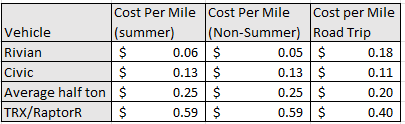
Sacramento, CA area here. I pay at off peak $.12/$.09 per Kwh during the summer/non-summer months, and on road trips $.35/Kwh at EA. Brings us to this spreadsheet I made on the spot because the math is very easy and leave it to news outlets to not bother to check for themselves.
Rivian R1T R1S EV's more expensive to charge than ICE Counterparts? 1691101503998

Rivian R1T R1S EV's more expensive to charge than ICE Counterparts? 1691101515897

Little to say its much cheaper than even my civic prior for my everyday driving, and cheaper than any other truck you would compare it to in everything else. This is not including other maintenance as others in this thread have already brought up.
Sponsored


Top