
Sponsored
R1T DM Large Pack 21" wheels, no additional options - $80,750

Friar_J
Active Member
Are you including the destination fee? That doesn't count towards MSRP so the LA Silver R1T with 21" road wheels and black mountain interior comes in at $79k and does qualify for the tax credit.
Sponsored
mtberman
Well-Known Member
It’s a dual motor ($73,000) + large pack ($6000) = $79,000Good to know! Is this Long Range?
The range is said to be 352 but that’s in Rivian Miles™️.

evhelphub
Well-Known Member
- First Name
- Wes
- Joined
- Aug 27, 2021
- Threads
- 17
- Messages
- 636
- Reaction score
- 1,273
- Location
- USA
- Website
- evhelphub.com
- Vehicles
- VW ID4, R2 (on order); Prev: R1T QM, Model S, Model 3, Model Y
"Rivian Miles" were pretty damn good on my quad R1T with 21s in conserve mode. Probably better than any other EV I've ever had in terms of meeting expectations of what is advertised.It’s a dual motor ($73,000) + large pack ($6000) = $79,000
The range is said to be 352 but that’s in Rivian Miles™️.
I think Rivian would do well to reduce the price slightly so that other paint/interior options could all fit in under $79k.
Last edited:
mtberman
Well-Known Member
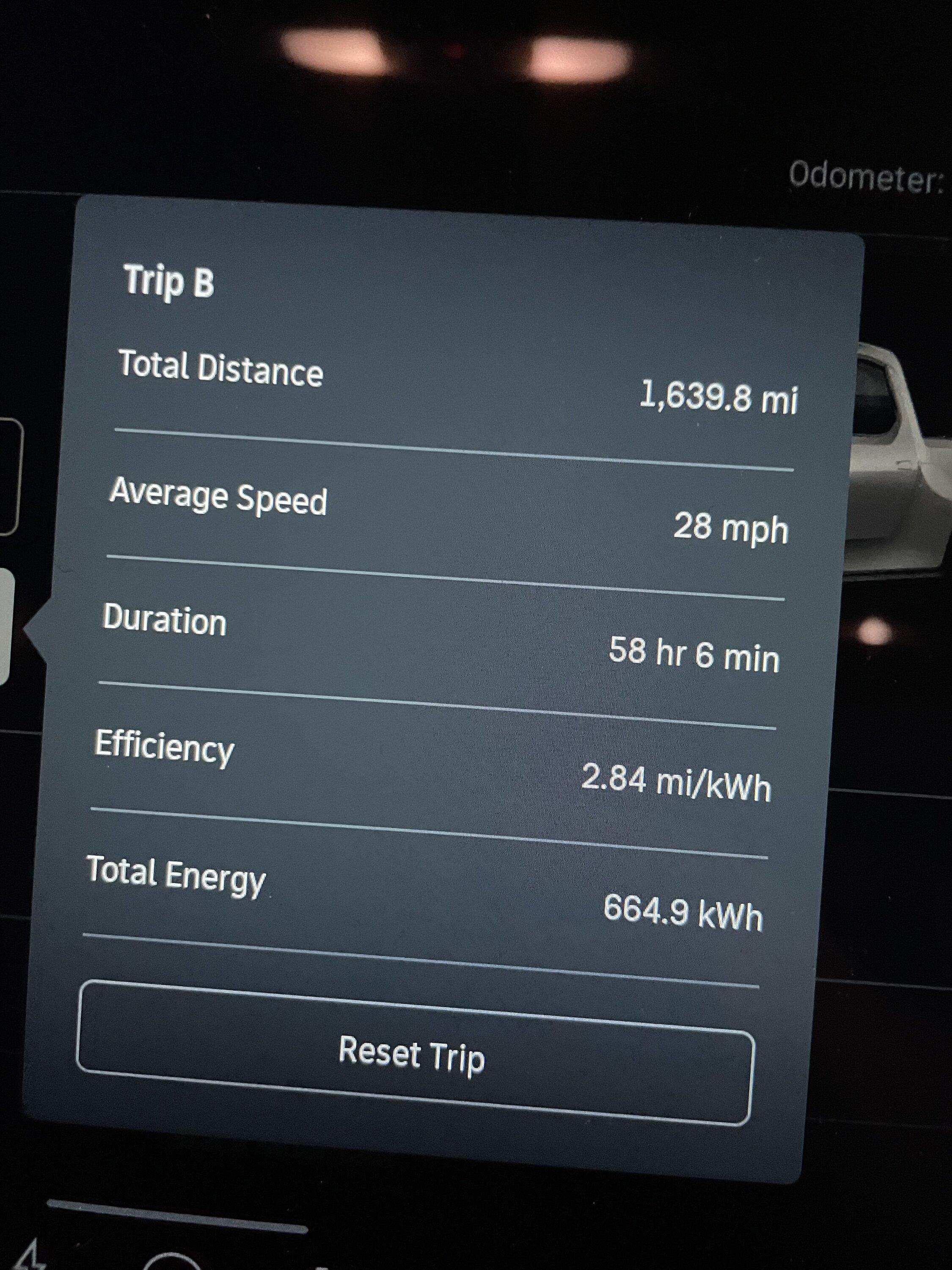
So right. My Audi e-tron easily got the 222 mile rating. After Dieselgate they knew better than to fudge the mileage. For me it was LA Silver or nothing because I can’t make it work financially without the credits. Here is my efficiency so far:

s4wrxttcs
Well-Known Member
- Joined
- Aug 16, 2022
- Threads
- 4
- Messages
- 1,292
- Reaction score
- 1,493
- Location
- Snohomish, WA
- Vehicles
- Rivian R1T
- Occupation
- Engineer
The EPA rating has almost no meaning because its based on a use case that almost no EV owner even has.So right. My Audi e-tron easily got the 222 mile rating. After Dieselgate they knew better than to fudge the mileage. For me it was LA Silver or nothing because I can’t make it work financially without the credits. Here is my efficiency so far:
My commute is 9 miles each way and there is absolutely no way its going to get anywhere close to rated range doing that.
My every 2 week road trip is 220 miles each way, and for that trip there is also no way I'm going to get rated range. In fact with a 90% charge my Rivian will tell me there isn't enough range to make it (while in all purpose mode with 21" tires). So even the Rivian itself is skeptical of its own range. Haha
For that trip the least efficient is the return leg due to prevailing winds. With that direction my 100% range in All-purpose mode is approximately 280 miles. That's not too far off the rated range of 328 miles. It's pretty close because the highest speed limit is 60mph.
With a 100% charge I don't think I'll ever have to do stop to charge, but with a 90% charge I'll likely have to use conserve mode at least on the way back.
I do want to eventually get 20" AT tires, but that might make the trip more challenging range wise.
I'd love to try a Taycan on this journey to see how it fairs or an E-Tron GT.
izgoy
Well-Known Member
- Thread starter
- #10
It should be no problem charging to 90% overnight and adding 10% before you leave once every two weeks to leave with 100% SOC. It won’t hurt your battery.My every 2 week road trip is 220 miles each way, and for that trip there is also no way I'm going to get rated range. In fact with a 90% charge my Rivian will tell me there isn't enough range to make it (while in all purpose mode with 21" tires). So even the Rivian itself is skeptical of its own range. Haha
Sponsored
VSG
Well-Known Member
Wrong way to look at it.The EPA rating has almost no meaning because its based on a use case that almost no EV owner even has.
There is NO rating that will match most EV owners. No matter what way you measure "range", it will always be based on certain assumptions about a lot of things. And the way people drive will always be changing. To change the assumptions based on current fads means that the measurement will not have objective truth.
So ask yourself, what measure of "range" is useful? The only sensible answer is a measure that has strict test conditions specified so that the measurement can be REPRODUCIBLE by anyone at any time by using the same test conditions. Again, this measurement will not match most owners, regardless of the test conditions, but it will NOT be subjective, and WILL have long-term relevance.
Right now, the EPA rating is the ONLY range rating that does this, and is the ONLY range rating that has remained consistent over the years so that measurements made this year may be compared to measurements made 10 years ago.
It doesn't matter at all if the EPA conditions match your driving, or even if they match the "average" owner's driving. What matters is that it's a reproducible number. Moreover, it does not have to match any "average" to be useful!
All other types of range measurements, ESPECIALLY the youtubers, are anecdotal and changing, and are done differently for different years and different vehicles, and are therefore useless for general use. While they represent one (and only one) data point, that data point will not match anyone else's pattern of use and so will merely be one data point, not a measurement which by definition requires a statistically significant collection of many data points.
The utility of the EPA range is not that it matches *your* range, but that it's a constant that *you* can measure against. It is intended to allow you to comparison shop one vehicle against the other: If you know you always get the EPA range on one vehicle, you will probably always get the EPA range on another vehicle. If you always get less than the EPA range on one vehicle, you will always get less than the EPA range on another vehicle. Because the way *you* drive has been taken out of the equation when you compare the two numbers.
You can't make this comparison with other numbers because those numbers are "measured" with different conditions, by different individuals or organizations, and in different ways. And year-to-year, the test conditions change. These individuals or organizations can only measure a subset of vehicles (unlike the EPA rating), so that comparing when two vehicles you're probably comparing two number taken by different organizations, defeating the purpose of a standardized measurement.
You have years of experience driving cars, so you should have years of experience paying attention to the mileage you get on those cars and comparing that mileage against the published EPA number. That should give you a very good idea of what to expect from a new vehicle. Frankly, very few people I have met do that except for maybe the first few months they own the vehicle. Very few people seem to have any awareness how, e.g., cross bars or a roof rack affect their mileage. Very few people seem to know or care how adding an aggressive M/T tire affects their mileage. They just read the EPA number and say "I get about (EPA range) miles per gallon" and don't even bother to monitor that over time (even though a loss of mileage is a great indicator of the health of your vehicle).
Again, while EPA conditions might not match *your* driving, or what you assume is the *average* driving pattern, the EPA rating is the *only* number we have that can be used to tell us how far *we* will be able to drive in any specific vehicle without refueling.
It is a mistake to confuse an anecdote with a measurement. This does not mean the person relating the anecdote is wrong, it just means it's one data point that does not imply anything about the general case. To wit: If it snows once in Houston, that does not mean global warming is fake news. It just means it snowed once in Houston.
s4wrxttcs
Well-Known Member
- Joined
- Aug 16, 2022
- Threads
- 4
- Messages
- 1,292
- Reaction score
- 1,493
- Location
- Snohomish, WA
- Vehicles
- Rivian R1T
- Occupation
- Engineer
The EPA rating doesn't do the one thing you're expecting from it.Wrong way to look at it.
There is NO rating that will match most EV owners. No matter what way you measure "range", it will always be based on certain assumptions about a lot of things. And the way people drive will always be changing. To change the assumptions based on current fads means that the measurement will not have objective truth.
So ask yourself, what measure of "range" is useful? The only sensible answer is a measure that has strict test conditions specified so that the measurement can be REPRODUCIBLE by anyone at any time by using the same test conditions. Again, this measurement will not match most owners, regardless of the test conditions, but it will NOT be subjective, and WILL have long-term relevance.
Right now, the EPA rating is the ONLY range rating that does this, and is the ONLY range rating that has remained consistent over the years so that measurements made this year may be compared to measurements made 10 years ago.
It doesn't matter at all if the EPA conditions match your driving, or even if they match the "average" owner's driving. What matters is that it's a reproducible number. Moreover, it does not have to match any "average" to be useful!
All other types of range measurements, ESPECIALLY the youtubers, are anecdotal and changing, and are done differently for different years and different vehicles, and are therefore useless for general use. While they represent one (and only one) data point, that data point will not match anyone else's pattern of use and so will merely be one data point, not a measurement which by definition requires a statistically significant collection of many data points.
The utility of the EPA range is not that it matches *your* range, but that it's a constant that *you* can measure against. It is intended to allow you to comparison shop one vehicle against the other: If you know you always get the EPA range on one vehicle, you will probably always get the EPA range on another vehicle. If you always get less than the EPA range on one vehicle, you will always get less than the EPA range on another vehicle. Because the way *you* drive has been taken out of the equation when you compare the two numbers.
You can't make this comparison with other numbers because those numbers are "measured" with different conditions, by different individuals or organizations, and in different ways. And year-to-year, the test conditions change. These individuals or organizations can only measure a subset of vehicles (unlike the EPA rating), so that comparing when two vehicles you're probably comparing two number taken by different organizations, defeating the purpose of a standardized measurement.
You have years of experience driving cars, so you should have years of experience paying attention to the mileage you get on those cars and comparing that mileage against the published EPA number. That should give you a very good idea of what to expect from a new vehicle. Frankly, very few people I have met do that except for maybe the first few months they own the vehicle. Very few people seem to have any awareness how, e.g., cross bars or a roof rack affect their mileage. Very few people seem to know or care how adding an aggressive M/T tire affects their mileage. They just read the EPA number and say "I get about (EPA range) miles per gallon" and don't even bother to monitor that over time (even though a loss of mileage is a great indicator of the health of your vehicle).
Again, while EPA conditions might not match *your* driving, or what you assume is the *average* driving pattern, the EPA rating is the *only* number we have that can be used to tell us how far *we* will be able to drive in any specific vehicle without refueling.
It is a mistake to confuse an anecdote with a measurement. This does not mean the person relating the anecdote is wrong, it just means it's one data point that does not imply anything about the general case. To wit: If it snows once in Houston, that does not mean global warming is fake news. It just means it snowed once in Houston.
You're expecting a reproduceable and comparable results, and that's not the reality of it. Companies are allowed a certain level of leeway in what wheels/tires to use during the test, and I believe their also allowed to downgrade the EPA numbers to a lower amount than what the vehicle actually achieved.
Back in 2018 Tesla advertised three different variations of the Model 3 as having the same EPA range. We know that's impossible because they came with different wheel/tires/etc. I think they got away with it because they could artificially lower the EPA range of one variant, and use smaller tires for the test for the less performing one despite the tires not even coming standard with the vehicle.
Porsche did something similar where they opted to go with a different size tire for their EPA ratings on a newer model year. They had good rationality in that the wheel/tire was more popular. but, it did bring the numbers higher.
Rivian did a great job setting expectations when it came to wheels/tires. But, not every company has.
The other difference is with gas cars we had city driving MPG, and freeway driving.
These two use cases are very different so I find it odd that there isn't an equal comparison for EV buyers. Like how do I know as a consumer that the Taycan with its dual-gear setup is more efficient than a Model S while on the freeway at actual typical freeway speeds? The EPA rating has no way of telling me that.
I don't expect any rating to encompass all the variabilities or for it to be perfect. With Gas cars it never was, but it was usually at least in the ballpark.
For me personally I try to wait a bit before buying an EV to see what customers are getting with it.
Is it like an Audi where customers are beating EPA estimates? or is it like a Tesla where the EPA numbers are practically imaginary.
I knew before I got the Rivian that customers were generally happy with the range, and that played into my purchasing decision. Way more so then it did with gas cars.
mtberman
Well-Known Member
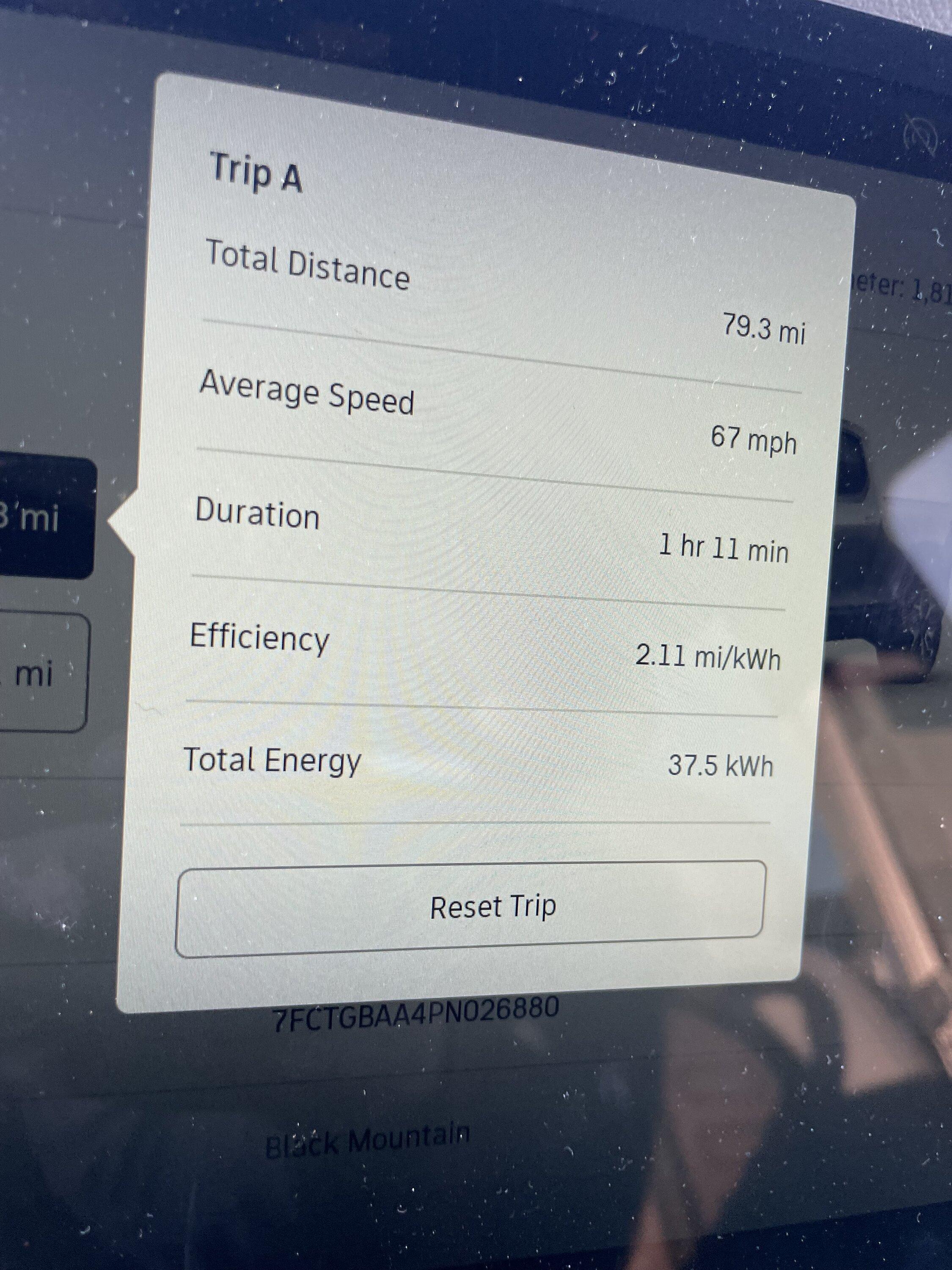
Here is the same truck doing a roughly 80 round trip mile freeway drive in temperatures around 35 degrees with the cruise set at 83 MPH.So right. My Audi e-tron easily got the 222 mile rating. After Dieselgate they knew better than to fudge the mileage. For me it was LA Silver or nothing because I can’t make it work financially without the credits. Here is my efficiency so far:
Sponsored
Similar threads
- Replies
- 27
- Views
- 6,952

- Replies
- 18
- Views
- 2,515

- Replies
- 17
- Views
- 1,955

- Replies
- 11
- Views
- 1,386
