

superfluid
Well-Known Member
- Joined
- Mar 29, 2021
- Threads
- 20
- Messages
- 290
- Reaction score
- 923
- Location
- Austin, TX
- Vehicles
- Rivian R1S, Kia Telluride
- Occupation
- Tech and data
- Thread starter
- #1
Back in Februrary 2024, I posted my first audio system calibration of my Gen 1 R1S Elevation. This forum responded hugely and requested Meridian measurements and recommendations. I didn’t have a Meridian vehicle, so @RivianBowerbird stepped up and donated several hours and his Gen 1 R1T Meridian to the cause. We had a great time listening to and adjusting his system, and shooting the breeze about Rivian- and non-Rivian-related subjects. Now that Rivian added Atmos support and made many significant changes to the performance of audio systems across configurations, he volunteered again to see how far Rivian’s premier Gen 1 sound system had come. Far it had.
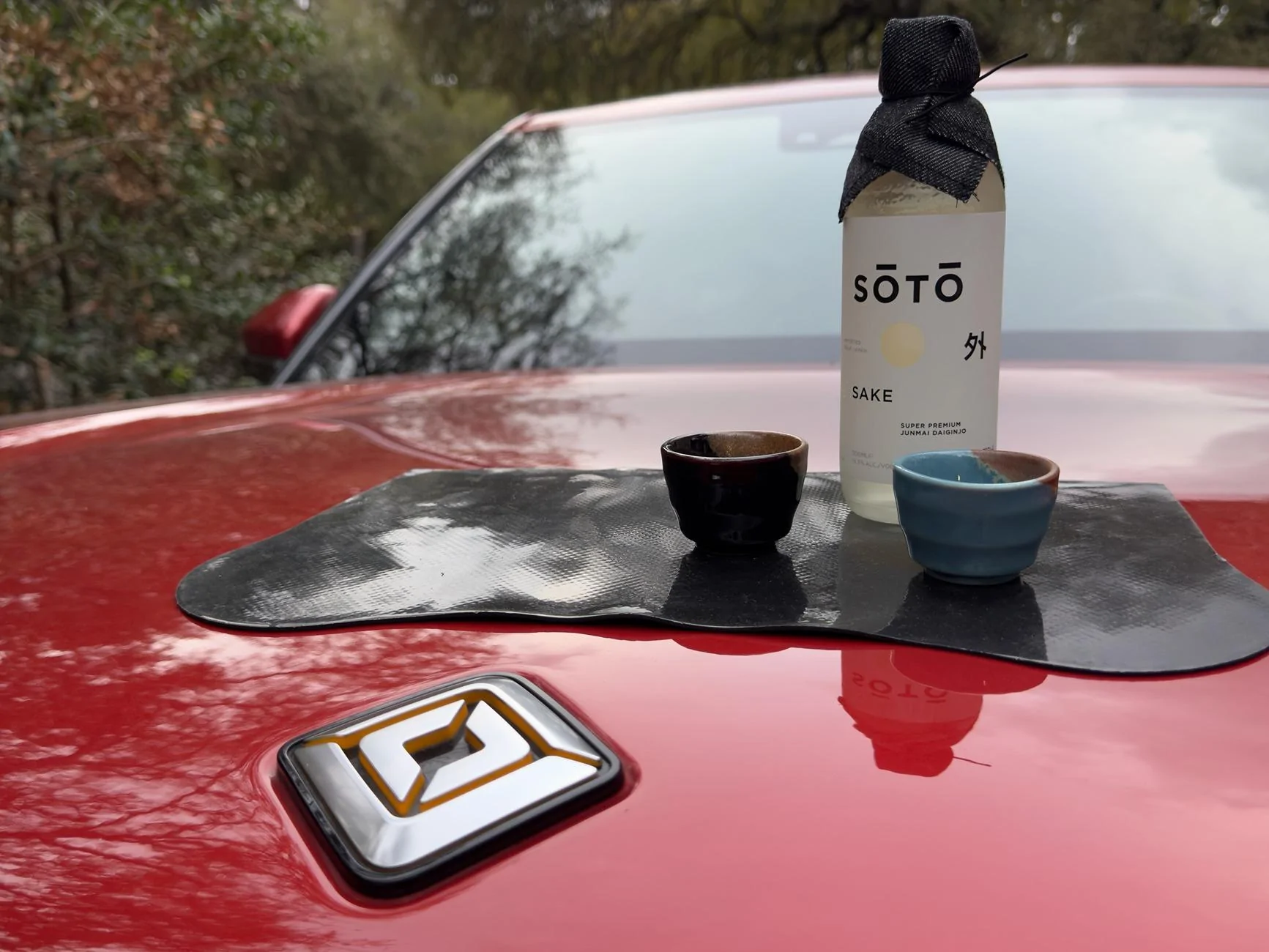
Thanks to all of you forum members who generously donated in the past, RivianBowerBird and I enjoyed one of my favorite bottles—a Sōto, a stupendously bright and clean junmai daiginjo—to celebrate good work and a new friendship. Seriously, connecting with fellow Rivian owners in this way is what makes all this work worth it.
If this post helps you, please consider donating a cup!
https://buymeacoffee.com/tedmanasa
Kanpai, RivianForums!

Let’s get into it.
TL;DR:
Rivian did a great job with 2024.39.01 on the Gen 1 R1T Meridian. It’s the best I’ve heard music in a Rivian sound thus far in both stereo and Atmos. However, the update seems to have degraded TIDAL’s resolution in Meridian systems. I don’t hear the same low-bitrate problem in my Elevation system. Apple Music streams with the resolution I expect to hear on the Meridian. I consider Apple Music the best streaming service for Meridians right now, particularly since it defaults to Atmos when an Atmos mix is available. TIDAL doesn’t do that.
Tip: Listen to the new setting for a while using familiar songs at low volume and higher-than-average volume. Your ears/brain may take a bit to get accustomed to the new balance. What should happen is that you hear instruments/sounds more clearly because overtly emphasized frequency ranges aren't drawing attention away from others. Then tweak to taste.

[Note to Admin: Please use this image as the post's title image if you feature it.]
Objectives, Methodology, and Tests
Objectives
Here are the questions I set out to answer.
I updated my methodology to include Atmos testing.
A quick note about Atmos: I listened to Atmos mixes in my Gen 1 R1S Elevation 2024.39.01 to prepare for my listening tests in RivianBowerBird’s R1T. I immediately recognized that the Atmos renderer—or some related component—was broken. Lyrics were altogether missing from some songs.
Baseline Listening Tests
I do baseline listening tests to understand the strengths and weaknesses of a sound system. I use songs I’ve auditioned hundreds of times on numerous low- to high-end systems. Because I know their acoustic properties very well, those songs quickly reveal what a system is missing or overemphasizes. For my baseline listening tests, I flattened all the EQ and enhancement settings, set the volume to 14, and used TIDAL streaming at the highest bit rate. I later switched to Apple Music for reasons I’ll get to later.
Adele’s Send My Love
I started my listening tests with Adele’s Send My Love. This track is well-engineered, mixed neutrally (if not a touch warmly), contains enough instruments to hit the most important frequency bands while being simple enough to differentiate them, and is enjoyable to listen to repeatedly. I use this track to understand how well the system delivers vocal and instrument clarity and imaging.
Vocal clarity was quite good out of the box. The lower registers of the acoustic guitar were slightly boomy, but not nearly as bad as I remember previous OTA versions in the Gen 1 R1T Meridion. The bass rattled bits of the driver’s door paneling, but not as much as before. The system separated instruments decently but lacked definition. Overall imaging and staging were good relative to what one can expect in a car. The clarity of the acoustic guitar was decent, but the picking lacked definition.
Billie Eilish’s Bad Guy
Billie Eilish’s music is famously well-engineered thanks to her and her talented brother, Finneas. Bad Guy steps up compositional complexity compared to Send My Love and adds a sub-bass layer. I use this track to understand how well the system delivers vocal clarity, bass impact and depth, and imaging.
Vocal clarity was good but lacked clarity, which was more evident given that Eilish’s style comprises subvocalization and whispers. The bass lines were surprisingly well-balanced compared to what I remember the R1T Meridian doing and even though they rattled the driver door paneling a lot. Staging was a bit narrow, possibly due to a lack of vocal and instrumental detail. But overall frequency response was quite balanced out of the box.
Avi Kaplan’s Change on the Rise
Avi Kaplan’s deep baritone voice does a great job revealing deficiencies in low-mid- and mid-range frequency reproduction. Change on the Rise blends Kaplan’s dulcet tones with powerful kickdrum hits and room reverb to make it a good reference track for male vocal clarity and sound staging.
Vocal clarity was solid—chesty, warm, and deep. Solid thump. The response was largely balanced, though there was a slight boominess and lack of low-end resolution in the grumbly bass line during the stanza. But respectable and non-distracting. The lowest bass notes didn’t overload the sub as I recall it doing. The Meridian system was living up to its promise of being the best Rivian system with this track.
With a good idea of the Meridian’s baseline performance, I took objective measurements to see what I couldn’t hear. I set the volume to 10, which produced a 75 dB reference level using pink noise, and ran driver-position sweeps.
Measurements, Analysis, and Recommendations
With this data, we’ll answer each question one by one.
How does 2024.39.01 compare to 2024.07.* on the Gen 1 R1T Meridian?
This Meridian system has come a long way since March 2024 when it ran OTA 2024.07.* and overblew its bass so badly it needed massive cuts to get it under control. With 2024.39.01, the Meridian system’s resolution, bass output, and overall frequency response are much closer to what I’d expect from a properly engineered, higher-end car system. Now that the bass rolls off at 40 hZ with a filter slope of about 15 dB per octave, much of the mud and boomy ringing disappeared. When that much energy is no longer used to move the subwoofer cone in ways it physically could not without distorting significantly, the subwoofer could produce tighter, more dynamic bass. Add to that the introduction of Atmos and it’s even better. (We’ll get into more detail about Atmos later.) The Meridian system’s speaker, amplifier, and DSP complement began to show what they could do. The vaunted Gen 1 audio system finally started living up to Rivian’s promise of a premium aural experience when they announced the R1 years ago. After small EQ adjustments, the Gen 1 R1T Meridian is the best-sounding system of any Rivian I’ve tested thus far. If you have an R1T Meridian, enjoy!
What EQ settings sound best for stereo?
Using my ears and measurement, here’s where I landed with EQ adjustments to get the best balance of boom, thump, dynamics, and detail. I think RivianBowerBird said it best when he said, “The last time you adjusted my system, the sliders were all over the place. The fact that you’re only moving them by only 1 step says a lot about how much better it is now.” He was right.
63 Hz at 0 sat the bass well. Rivian did a great job leveling out the bass in the R1T Meridian. Those wanting a little less bump can cut 63 Hz down to -2—but what fun would that be?
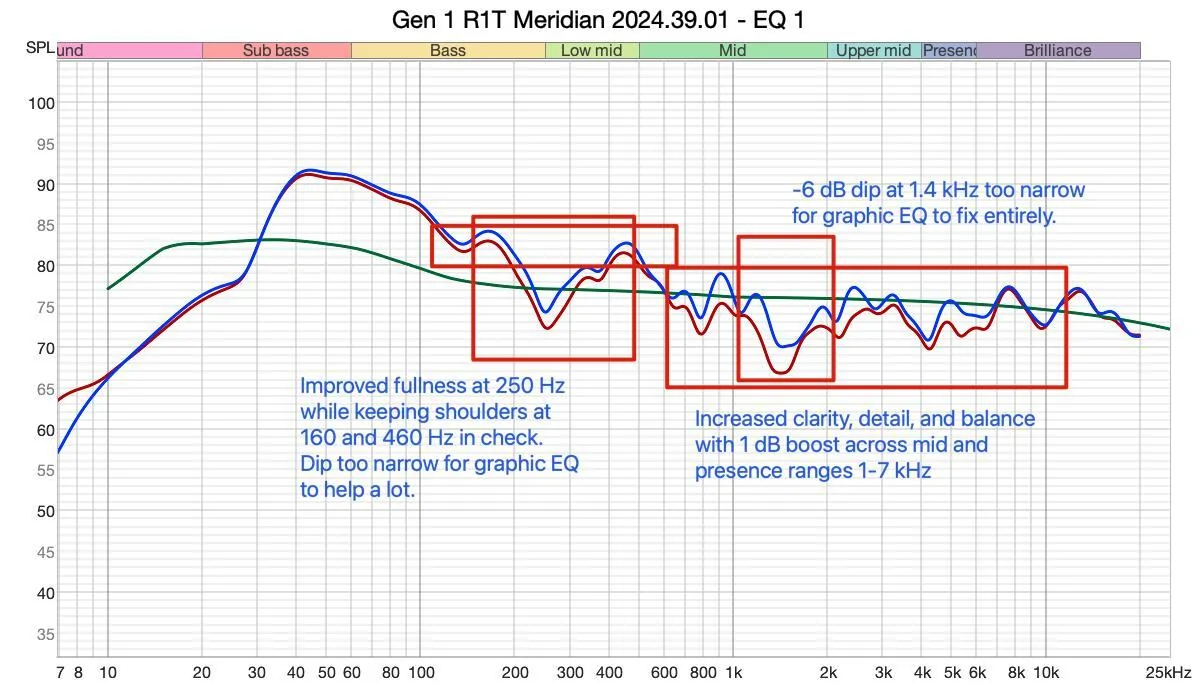
250 Hz +1 filled out a little hollowness I didn’t actually hear until I saw it in the frequency response graph. Though the 250 Hz dip sharp and deep, the Rivian’s graphic EQ is broad and can only do so much precision surgery (i.e., none). I found that boosting 250 Hz more than +1 began to muffle instrument bodies and vocal chestiness because of the tall shoulders at 160 and 460 Hz that were boosted along with it.
1 kHz +1, 2 kHz +1, 4 kHz +1 brought back detail and balance. Vocals were much clearer, reverb tails were audible for longer, increasing sound staging. While I would have preferred +2 to bring back even more detail, +2 got harsh quickly because it boosted some bands too much. There was just too much variance in the frequency response for a graphic EQ to tackle with precision.
8 kHz +1 improves detail even more but may be bright for some. RivianBowerBird felt 8 kHz +1 was too pointy for acoustic guitar in Sarah Jarosz’s House of Mercy. I agreed it was a little hot, especially for sibilants. I wish the EQ gave us +/-0.5 dB controls. I left RivianBowerBird’s 8 kHz at 0. Choose what works for you.
RivianBowerBird said, “It’s amazing how much of a difference small changes can make.”
This graph compares the measured frequency response of a flat EQ (red) with my changes (blue).
Adele’s Send My Love
Vocal clarity and detail from the picked guitar improved. The acoustic guitar’s body was warmer and fuller. We sat back and enjoyed Adele’s vocal mastery.
Billie Eilish’s Bad Guy
Vocal clarity improved, especially the phased accompaniment in the stanzas. Snaps and high hat balanced. Bass solid. This track sounded great with these settings.
Avi Kaplan’s Change on the Rise
Detail and clarity improved. 4 kHz +1 might be a little hot on this mix. But 0 sounded a little less lively.
Habitaat’s Infrasound
This track is one of my favorites to listen to for enjoyment. The bass was solid and punchy. I had nothing to complain about other than the driver-side door rattle, which RivianBowerBird attenuated using an umbrella pushed in between the door panel and the driver’s seat. The flute sounded nice and airy. I’d have liked a little more detail in the lip articulation, but that was probably more of a limitation of imaging, which is already severely compromised in a car system like this.
Can I use the stereo EQ settings as a baseline for Atmos?
Yes! With previous OTAs on different configurations, many folks—including me—reported needing to tweak EQ settings to make Atmos tracks sound their best. I didn’t find the need to do that with the Gen 1 R1T Meridian 2024.39.01. What a relief because it means you don’t have to ride the EQ, settle for making either stereo or Atmos sound best, or compromise both!
How does Atmos sound?
Atmos sounded great and as expected. RivianBowerBird’s R1T didn’t require an Infotainment reset to resolve any Atmos rendering issues.
Bad Guy thumped and wrapped around. 8 kHz +1 created a little more space but might be too bright for some folks.
Tiesto Boom: Whipped around our heads and did what it advertised—boomed. It’s a go-to Atmos music demo track for a reason.
Judeline’s mangata sounded fabulous, the best I’ve heard it in a car. Try this one in yours.
I did want wider sound staging and sharper imaging from an Atmos system, but a car’s physical layout and our seating positions resitrict that on a physical level. Not much to be done about it except pan around with Fader/Balance control to see what you like.
Do I still hear a quality difference between the Meridian and the Elevation?
Yes. The R1T Meridian system with 2024.39.01 sounds better than my R1S Elevation with the same OTA. The primary differences are the Meridian has better imaging, sound staging, and mid-range resolution to my ears. Many things could be responsible for that but my best guess is better amplification and improved DSP tuning.
Something’s Wrong with TIDAL
As I moved through listening and EQ tests, I realized that TIDAL sounded like it was streaming with diminished resolution. I’m so accustomed to TIDAL being the highest quality source available in the Rivian that I took for granted that was case. My suspicion grew when I put on Sine Ira by Kisnou, a track full of high-frequency content. It grew further when I put on Yosi Horikawa’s Fluid, an exemplar of sound design using binaural microphone techniques and high-frequency material to create immersive imaging effects. Both tracks sounded like they were coated with Vaseline. We hypothesized Connet+ was bandwidth-limiting streaming bitrate so we connected to my house’s Wifi. That changed nothing. We performed an Infotainment reset. Same result.
Then I remembered I experienced something similar in @skyote ’s R1S Meridian. I wrote in that analysis:
“The Meridian system's lack of apparent resolution puzzled me. My working theory is that TIDAL streamed at a lower bit rate than it should have—320 kpbs instead of at CD+ quality (44.1 kHz, 16-bit), even when using the Master Quality setting. So while these EQ settings improved the frequency response balance to my ears, I didn't hear the detail from my reference tracks I was accustomed to hearing. Apple Music might have given a different result, but I didn't think about it since I don't have a subscription to it and don't use it.”
We switched to Apple Music and played Sine Ira again. Then Fluid. What a difference. They sounded as they were meant to sound: open, detailed, transparent. RivianBowerBird heard the improved resolution of Adele’s voice as soon as she said, “Just the guitar, ok.”
To both our ears, Apple Music was streaming at a much higher resolution/bitrate than TIDAL. Based on a sample size of 2 (RivianBowerbird's and skyote's Merdian systems), TIDAL appears to be streaming at a low bit rate after the 2024.39.01 update.
Fortunately, all of the EQ adjustments I made listening to TIDAL translated well to Apple Music, which wasn’t a surprise, but it was a worry. I didn’t want to redo everything!
Future Improvements
Each time I do an analysis, I find things to improve. Here’s what I plan to improve next time.
If you found this post beneficial, consider buying me a cup of sake. I'd appreciate it. Kanpai!
https://buymeacoffee.com/tedmanasa
Thanks to all of you forum members who generously donated in the past, RivianBowerBird and I enjoyed one of my favorite bottles—a Sōto, a stupendously bright and clean junmai daiginjo—to celebrate good work and a new friendship. Seriously, connecting with fellow Rivian owners in this way is what makes all this work worth it.
If this post helps you, please consider donating a cup!
https://buymeacoffee.com/tedmanasa
Kanpai, RivianForums!

Let’s get into it.
TL;DR:
Rivian did a great job with 2024.39.01 on the Gen 1 R1T Meridian. It’s the best I’ve heard music in a Rivian sound thus far in both stereo and Atmos. However, the update seems to have degraded TIDAL’s resolution in Meridian systems. I don’t hear the same low-bitrate problem in my Elevation system. Apple Music streams with the resolution I expect to hear on the Meridian. I consider Apple Music the best streaming service for Meridians right now, particularly since it defaults to Atmos when an Atmos mix is available. TIDAL doesn’t do that.
- Flatten your EQ by using the “Default” setting or the reset icon.
- Set 3D Surround Sound to Off.
- Set Fade and Balance to default.
- Set Soundstage Center to default.
- Set Dynamic Sound Adjustment to Off.
- Use these EQ settings: 63 Hz 0, 125 Hz 0, 250 Hz +1, 500 Hz 0, 1 kHz +1, 2 kHz +1, 4 kHz +1, 8 Khz 0/+1, 16 kHz 0.
- Use Apple Music at the highest streaming bitrate to get the most out of the Meridian system. TIDAL and Spotify are the second best. Avoid Bluetooth for music playback.
- Start with your volume set to 14.
- Listen to a song you know well.
- Adjust EQ to taste.
Tip: Listen to the new setting for a while using familiar songs at low volume and higher-than-average volume. Your ears/brain may take a bit to get accustomed to the new balance. What should happen is that you hear instruments/sounds more clearly because overtly emphasized frequency ranges aren't drawing attention away from others. Then tweak to taste.
[Note to Admin: Please use this image as the post's title image if you feature it.]
Objectives, Methodology, and Tests
Objectives
Here are the questions I set out to answer.
- How does 2024.39.01 compare to 2024.07* on the Gen 1 R1T Meridian?
- What EQ settings sound best for stereo?
- What EQ settings sound best for Atmos?
- Can I use the stereo EQ settings as a baseline for Atmos?
- How does Atmos behave?
- Do I still hear a quality difference between the Meridian and the Elevation?
I updated my methodology to include Atmos testing.
- Flatten EQ.
- Set 3D Surround Sound to Off.
- Set Fade and Balance to default.
- Set Soundstage Center to default.
- Set Dynamic Sound Adjustment to Off.
- Using TIDAL at the highest bitrate, listen to 3 stereo and 3 Atmos tracks and analyze. (I ended up switching to Apple Music for the reasons I detail below.)
- Measure and see how the measurements line up with what I heard.
- Modify EQ based on what I heard and what the measurements record.
- Audition the same stereo and Atmos tracks and others.
- Compare stereo and Atmos mixes of the same tracks using the same EQ settings where possible.
A quick note about Atmos: I listened to Atmos mixes in my Gen 1 R1S Elevation 2024.39.01 to prepare for my listening tests in RivianBowerBird’s R1T. I immediately recognized that the Atmos renderer—or some related component—was broken. Lyrics were altogether missing from some songs.
- Tiesto’s Boom: According to Genius.com, “boom” is said 69 times in the first 0:42 seconds, before the second stanza starts. In the Atmos track, “boom” was only audible ~23 times. The first line, “Bring that ass back,” was gone.
- Queen’s Bohemian Rhapsody (2011 remaster): The lead line, “Oh escape from reality” was gone. Only the main harmony remained. The backing harmonies “I’m just a poor boy, I need no sympathy,” were gone. Segments of the backing vocal “Easy come, easy go, _______, little low,” were gone.
Baseline Listening Tests
I do baseline listening tests to understand the strengths and weaknesses of a sound system. I use songs I’ve auditioned hundreds of times on numerous low- to high-end systems. Because I know their acoustic properties very well, those songs quickly reveal what a system is missing or overemphasizes. For my baseline listening tests, I flattened all the EQ and enhancement settings, set the volume to 14, and used TIDAL streaming at the highest bit rate. I later switched to Apple Music for reasons I’ll get to later.
Adele’s Send My Love
I started my listening tests with Adele’s Send My Love. This track is well-engineered, mixed neutrally (if not a touch warmly), contains enough instruments to hit the most important frequency bands while being simple enough to differentiate them, and is enjoyable to listen to repeatedly. I use this track to understand how well the system delivers vocal and instrument clarity and imaging.
Vocal clarity was quite good out of the box. The lower registers of the acoustic guitar were slightly boomy, but not nearly as bad as I remember previous OTA versions in the Gen 1 R1T Meridion. The bass rattled bits of the driver’s door paneling, but not as much as before. The system separated instruments decently but lacked definition. Overall imaging and staging were good relative to what one can expect in a car. The clarity of the acoustic guitar was decent, but the picking lacked definition.
Billie Eilish’s Bad Guy
Billie Eilish’s music is famously well-engineered thanks to her and her talented brother, Finneas. Bad Guy steps up compositional complexity compared to Send My Love and adds a sub-bass layer. I use this track to understand how well the system delivers vocal clarity, bass impact and depth, and imaging.
Vocal clarity was good but lacked clarity, which was more evident given that Eilish’s style comprises subvocalization and whispers. The bass lines were surprisingly well-balanced compared to what I remember the R1T Meridian doing and even though they rattled the driver door paneling a lot. Staging was a bit narrow, possibly due to a lack of vocal and instrumental detail. But overall frequency response was quite balanced out of the box.
Avi Kaplan’s Change on the Rise
Avi Kaplan’s deep baritone voice does a great job revealing deficiencies in low-mid- and mid-range frequency reproduction. Change on the Rise blends Kaplan’s dulcet tones with powerful kickdrum hits and room reverb to make it a good reference track for male vocal clarity and sound staging.
Vocal clarity was solid—chesty, warm, and deep. Solid thump. The response was largely balanced, though there was a slight boominess and lack of low-end resolution in the grumbly bass line during the stanza. But respectable and non-distracting. The lowest bass notes didn’t overload the sub as I recall it doing. The Meridian system was living up to its promise of being the best Rivian system with this track.
With a good idea of the Meridian’s baseline performance, I took objective measurements to see what I couldn’t hear. I set the volume to 10, which produced a 75 dB reference level using pink noise, and ran driver-position sweeps.
Measurements, Analysis, and Recommendations
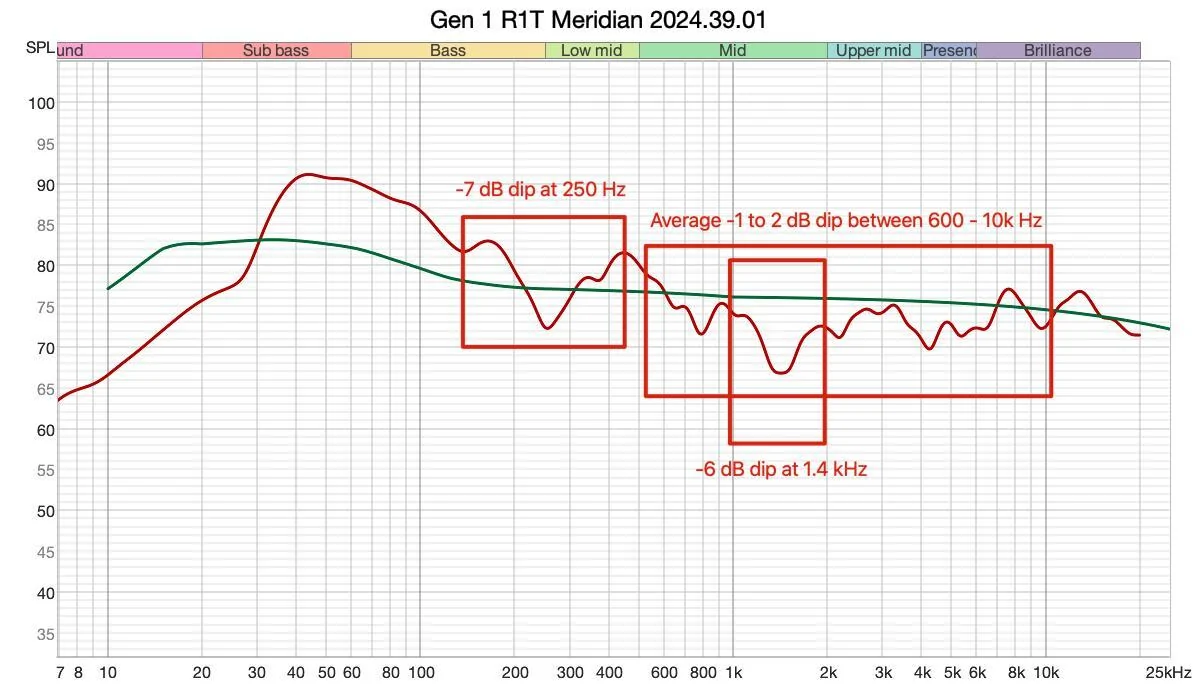
With this data, we’ll answer each question one by one.
How does 2024.39.01 compare to 2024.07.* on the Gen 1 R1T Meridian?
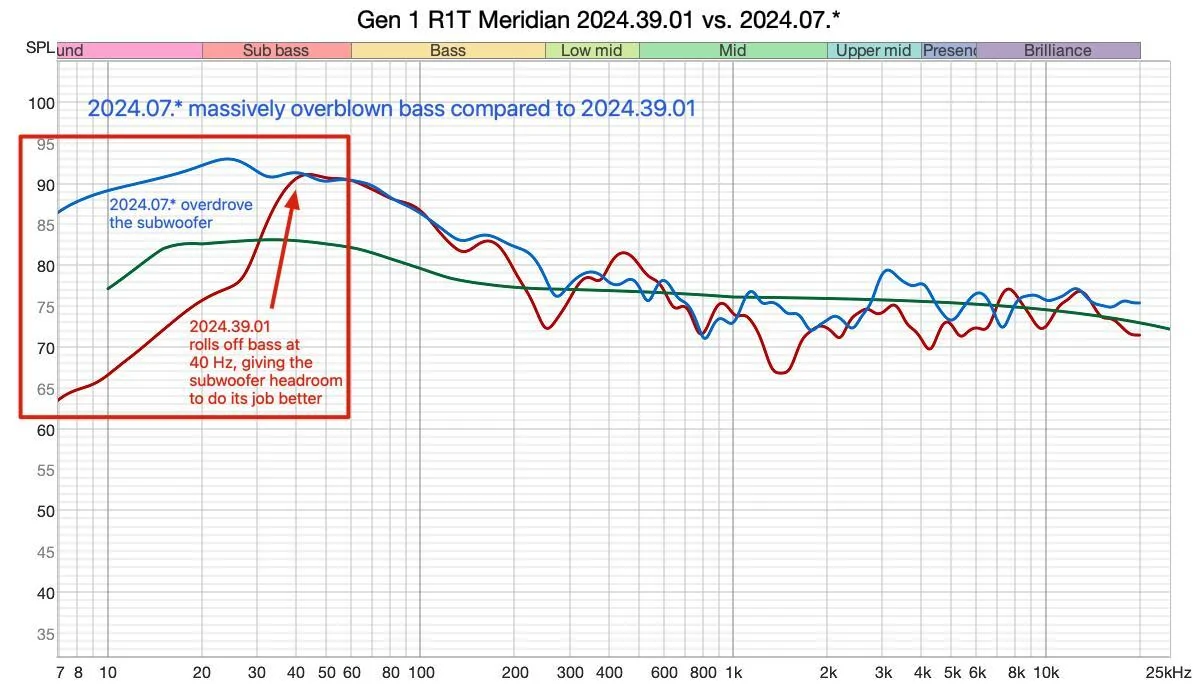
This Meridian system has come a long way since March 2024 when it ran OTA 2024.07.* and overblew its bass so badly it needed massive cuts to get it under control. With 2024.39.01, the Meridian system’s resolution, bass output, and overall frequency response are much closer to what I’d expect from a properly engineered, higher-end car system. Now that the bass rolls off at 40 hZ with a filter slope of about 15 dB per octave, much of the mud and boomy ringing disappeared. When that much energy is no longer used to move the subwoofer cone in ways it physically could not without distorting significantly, the subwoofer could produce tighter, more dynamic bass. Add to that the introduction of Atmos and it’s even better. (We’ll get into more detail about Atmos later.) The Meridian system’s speaker, amplifier, and DSP complement began to show what they could do. The vaunted Gen 1 audio system finally started living up to Rivian’s promise of a premium aural experience when they announced the R1 years ago. After small EQ adjustments, the Gen 1 R1T Meridian is the best-sounding system of any Rivian I’ve tested thus far. If you have an R1T Meridian, enjoy!
What EQ settings sound best for stereo?
Using my ears and measurement, here’s where I landed with EQ adjustments to get the best balance of boom, thump, dynamics, and detail. I think RivianBowerBird said it best when he said, “The last time you adjusted my system, the sliders were all over the place. The fact that you’re only moving them by only 1 step says a lot about how much better it is now.” He was right.
- 63 Hz 0
- 125 Hz 0
- 250 Hz +1
- 500 Hz 0
- 1 kHz + 1
- 2 kHz +1
- 4 kHz +1
- 8 kHz 0/+1
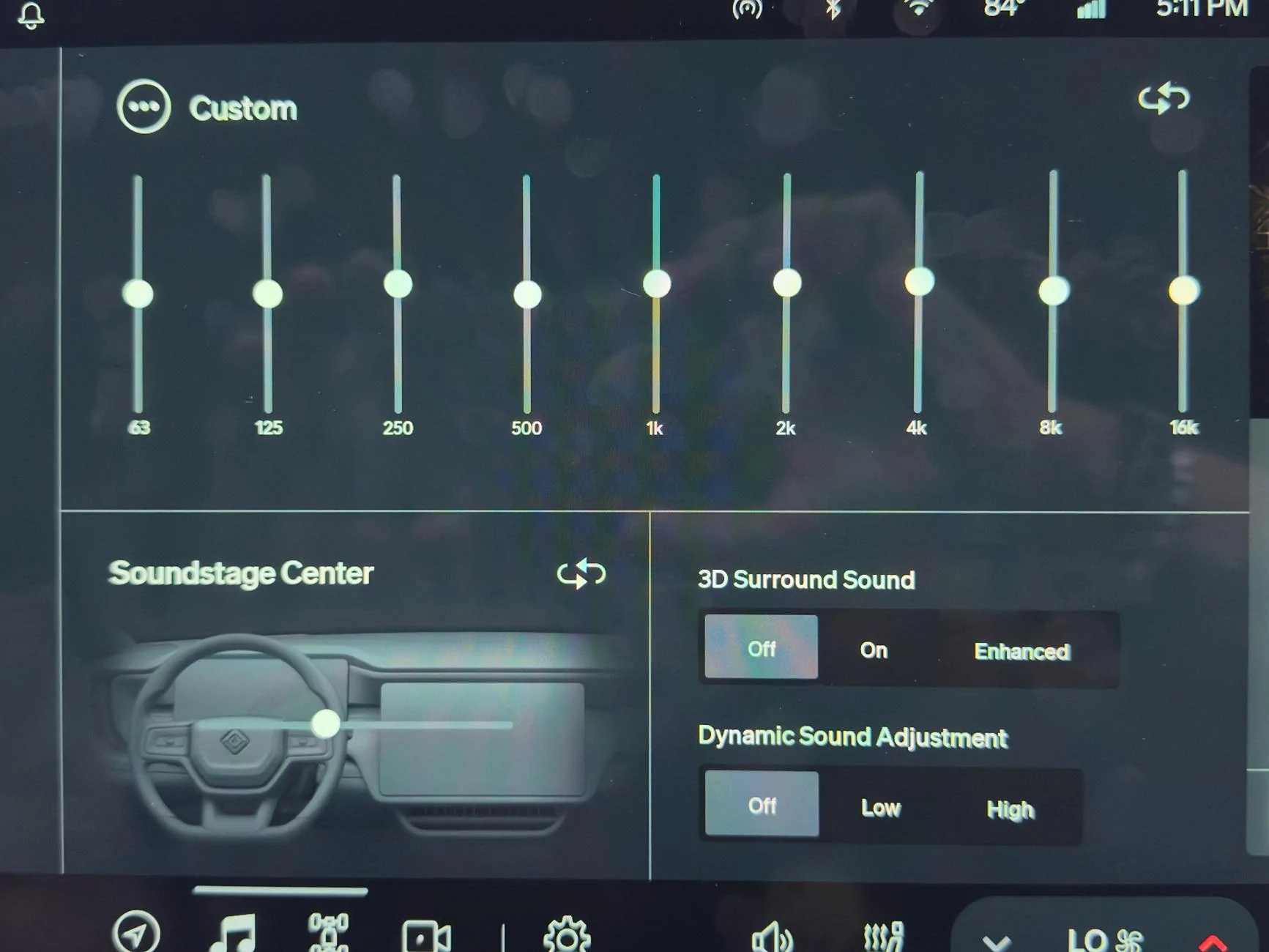
63 Hz at 0 sat the bass well. Rivian did a great job leveling out the bass in the R1T Meridian. Those wanting a little less bump can cut 63 Hz down to -2—but what fun would that be?
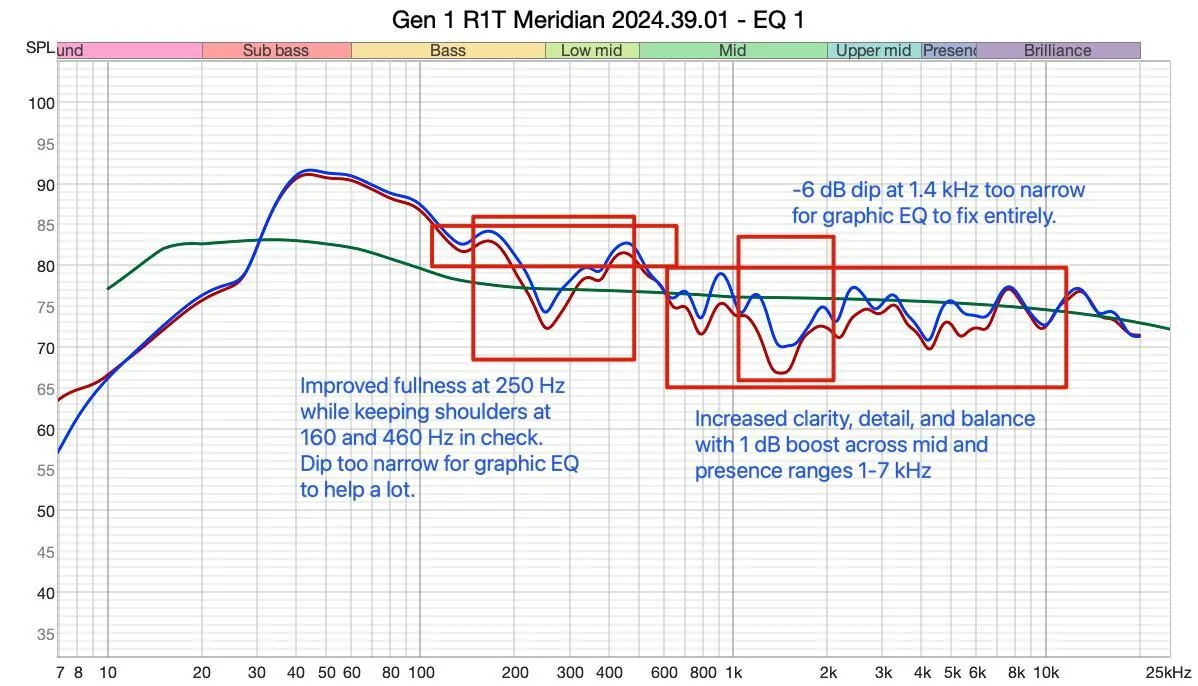
250 Hz +1 filled out a little hollowness I didn’t actually hear until I saw it in the frequency response graph. Though the 250 Hz dip sharp and deep, the Rivian’s graphic EQ is broad and can only do so much precision surgery (i.e., none). I found that boosting 250 Hz more than +1 began to muffle instrument bodies and vocal chestiness because of the tall shoulders at 160 and 460 Hz that were boosted along with it.
1 kHz +1, 2 kHz +1, 4 kHz +1 brought back detail and balance. Vocals were much clearer, reverb tails were audible for longer, increasing sound staging. While I would have preferred +2 to bring back even more detail, +2 got harsh quickly because it boosted some bands too much. There was just too much variance in the frequency response for a graphic EQ to tackle with precision.
8 kHz +1 improves detail even more but may be bright for some. RivianBowerBird felt 8 kHz +1 was too pointy for acoustic guitar in Sarah Jarosz’s House of Mercy. I agreed it was a little hot, especially for sibilants. I wish the EQ gave us +/-0.5 dB controls. I left RivianBowerBird’s 8 kHz at 0. Choose what works for you.
RivianBowerBird said, “It’s amazing how much of a difference small changes can make.”
This graph compares the measured frequency response of a flat EQ (red) with my changes (blue).
Adele’s Send My Love
Vocal clarity and detail from the picked guitar improved. The acoustic guitar’s body was warmer and fuller. We sat back and enjoyed Adele’s vocal mastery.
Billie Eilish’s Bad Guy
Vocal clarity improved, especially the phased accompaniment in the stanzas. Snaps and high hat balanced. Bass solid. This track sounded great with these settings.
Avi Kaplan’s Change on the Rise
Detail and clarity improved. 4 kHz +1 might be a little hot on this mix. But 0 sounded a little less lively.
Habitaat’s Infrasound
This track is one of my favorites to listen to for enjoyment. The bass was solid and punchy. I had nothing to complain about other than the driver-side door rattle, which RivianBowerBird attenuated using an umbrella pushed in between the door panel and the driver’s seat. The flute sounded nice and airy. I’d have liked a little more detail in the lip articulation, but that was probably more of a limitation of imaging, which is already severely compromised in a car system like this.
Can I use the stereo EQ settings as a baseline for Atmos?
Yes! With previous OTAs on different configurations, many folks—including me—reported needing to tweak EQ settings to make Atmos tracks sound their best. I didn’t find the need to do that with the Gen 1 R1T Meridian 2024.39.01. What a relief because it means you don’t have to ride the EQ, settle for making either stereo or Atmos sound best, or compromise both!
How does Atmos sound?
Atmos sounded great and as expected. RivianBowerBird’s R1T didn’t require an Infotainment reset to resolve any Atmos rendering issues.
Bad Guy thumped and wrapped around. 8 kHz +1 created a little more space but might be too bright for some folks.
Tiesto Boom: Whipped around our heads and did what it advertised—boomed. It’s a go-to Atmos music demo track for a reason.
Judeline’s mangata sounded fabulous, the best I’ve heard it in a car. Try this one in yours.
I did want wider sound staging and sharper imaging from an Atmos system, but a car’s physical layout and our seating positions resitrict that on a physical level. Not much to be done about it except pan around with Fader/Balance control to see what you like.
Do I still hear a quality difference between the Meridian and the Elevation?
Yes. The R1T Meridian system with 2024.39.01 sounds better than my R1S Elevation with the same OTA. The primary differences are the Meridian has better imaging, sound staging, and mid-range resolution to my ears. Many things could be responsible for that but my best guess is better amplification and improved DSP tuning.
Something’s Wrong with TIDAL
As I moved through listening and EQ tests, I realized that TIDAL sounded like it was streaming with diminished resolution. I’m so accustomed to TIDAL being the highest quality source available in the Rivian that I took for granted that was case. My suspicion grew when I put on Sine Ira by Kisnou, a track full of high-frequency content. It grew further when I put on Yosi Horikawa’s Fluid, an exemplar of sound design using binaural microphone techniques and high-frequency material to create immersive imaging effects. Both tracks sounded like they were coated with Vaseline. We hypothesized Connet+ was bandwidth-limiting streaming bitrate so we connected to my house’s Wifi. That changed nothing. We performed an Infotainment reset. Same result.
Then I remembered I experienced something similar in @skyote ’s R1S Meridian. I wrote in that analysis:
“The Meridian system's lack of apparent resolution puzzled me. My working theory is that TIDAL streamed at a lower bit rate than it should have—320 kpbs instead of at CD+ quality (44.1 kHz, 16-bit), even when using the Master Quality setting. So while these EQ settings improved the frequency response balance to my ears, I didn't hear the detail from my reference tracks I was accustomed to hearing. Apple Music might have given a different result, but I didn't think about it since I don't have a subscription to it and don't use it.”
We switched to Apple Music and played Sine Ira again. Then Fluid. What a difference. They sounded as they were meant to sound: open, detailed, transparent. RivianBowerBird heard the improved resolution of Adele’s voice as soon as she said, “Just the guitar, ok.”
To both our ears, Apple Music was streaming at a much higher resolution/bitrate than TIDAL. Based on a sample size of 2 (RivianBowerbird's and skyote's Merdian systems), TIDAL appears to be streaming at a low bit rate after the 2024.39.01 update.
Fortunately, all of the EQ adjustments I made listening to TIDAL translated well to Apple Music, which wasn’t a surprise, but it was a worry. I didn’t want to redo everything!
Future Improvements
Each time I do an analysis, I find things to improve. Here’s what I plan to improve next time.
- Ensure the streaming source is streaming at the highest available bitrate. Compare the same track on different sources to confirm.
- Switch from single-position sweep measurement to either a moving-mic RTA or a multi-mic array to get better frequency response accuracy and consistency in the stocahstic zone above the Schroeder transition frequency (e.g., 800 Hz +).
If you found this post beneficial, consider buying me a cup of sake. I'd appreciate it. Kanpai!
https://buymeacoffee.com/tedmanasa
Sponsored
Last edited: