Sponsored

Rivian in last place (and I don't care) in EV efficiency comparison

Scott

Well-Known Member
First Name
Scott
Joined
Sep 16, 2021
Threads
7
Messages
363
Reaction score
744
Location
Portland, OR
Vehicles
Subaru Forester, VW ID.4, R1S on preorder
Clubs
 
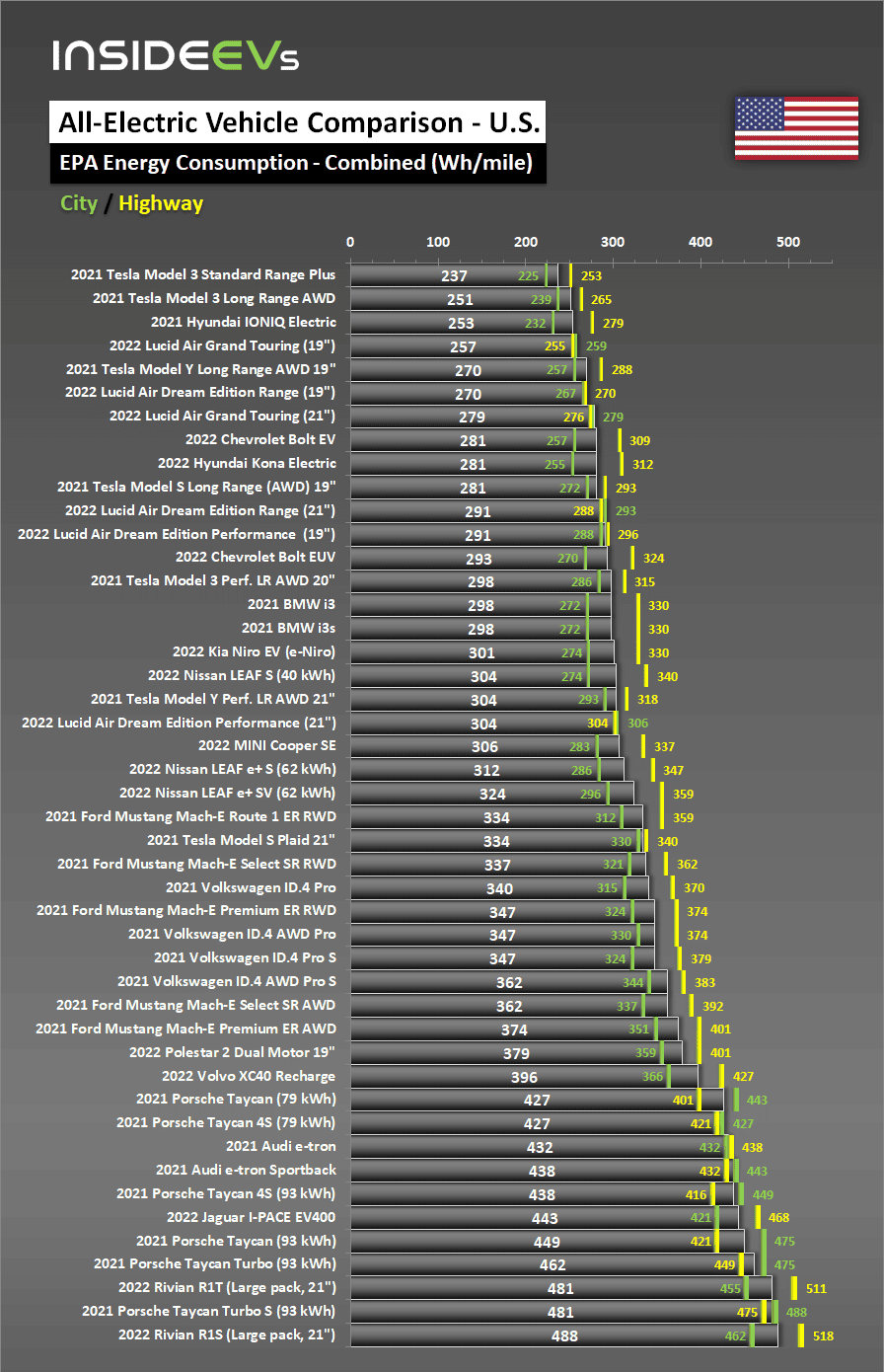
100%. Looking at the Taycan Turbo S and comparing it to the Tesla Model S Plaid and the Lucid Air Dream Edition Performance is a head-scratcher. I know Porsche purposely took a very conservative evaluation and many owners see really significantly better results but I still think it shows that the big automakers are struggling, at least for now, against the EV-specific builders.

Take a look at https://www.edmunds.com/car-news/electric-car-range-and-consumption-epa-vs-edmunds.html

2020 Porsche Taycan 4S: 32.3 kWh/ 100 mi in real world testing

2021 Tesla Model S Plaid: 32.1 kWh/ 100 mi in real world testing

That site doesn't have the turbo S, but the Porsche they did test bested EPA estimates by 34%. Tesla's cars are definitely efficient, but the real world lead is not as big as the EPA numbers make them out to be. For most consumers it likely will not factor in to decision making.
Sponsored

 
Last edited:

DucRider

Well-Known Member
First Name
Gary
Joined
Oct 21, 2019
Threads
17
Messages
1,691
Reaction score
3,188
Location
ORegon
Vehicles
Polestar 2, Ioniq, R1S
I know Porsche purposely took a very conservative evaluation
This is a common misconception (unless you can point to some evidence as yet not revealed).

The Taycan just doesn't do well on the EPA 2-cycle test (as compared to real world results). I personally think this is due (at least in part) to the 2 speed differential on the rear motor.

If Porsche elected to use the 5 cycle test, they could provide data justifying a lower derating than the standard 30%.

Rivian used the 5 cycle test and had enough real world data to support 28% for the R1T. They either didn't have enough testing data or it didn't support less than the default 30% for the R1S.
 

Scott

Well-Known Member
First Name
Scott
Joined
Sep 16, 2021
Threads
7
Messages
363
Reaction score
744
Location
Portland, OR
Vehicles
Subaru Forester, VW ID.4, R1S on preorder
Clubs
 
This is a common misconception (unless you can point to some evidence as yet not revealed).

The Taycan just doesn't do well on the EPA 2-cycle test (as compared to real world results). I personally think this is due (at least in part) to the 2 speed differential on the rear motor.

If Porsche elected to use the 5 cycle test, they could provide data justifying a lower derating than the standard 30%.

Rivian used the 5 cycle test and had enough real world data to support 28% for the R1T. They either didn't have enough testing data or it didn't support less than the default 30% for the R1S.

I am fairy ignorant here. Do you have a good link that explains 2 vs 5 cycle tests and what the derating is? I have never heard of a standard 30% there before. I am curious and my google search either turned up fluff that was useless or extremely long pdfs I wasn't willing to read :)
 

Richbot

Member
Joined
Sep 20, 2021
Threads
0
Messages
15
Reaction score
17
Location
STL
Vehicles
Model X
100%. Looking at the Taycan Turbo S and comparing it to the Tesla Model S Plaid and the Lucid Air Dream Edition Performance is a head-scratcher. I know Porsche purposely took a very conservative evaluation and many owners see really significantly better results but I still think it shows that the big automakers are struggling, at least for now, against the EV-specific builders.
Big wheels and tires on the Porsche in particular cause their ratings to be off IMO. The 19"-equipped base Taycan just did 280 miles on Car and Driver's 75mph constant-speed test. The base 19's on the "slow" trims use a 225/275 setup, the rest it's like 265 front 305 rear...way more wheel and tire under the Turbo and Turbo S by default and I don't believe the 19's will even fit on the Turbo S; believe the Turbo comes with the same base brake setup as 4S which might mean the 19's fit but it's not a factory option in any event.

Lots of variables but the big one is aero and rolling resistance. Rivian has none of the first one and a lot of the second one. Oh well, big vehicles gonna be big. Still better than a tahoe.

In my case I'm driving the X instead of the Tundra most of the time (which we still own for towing/beater duty) and our other vehicles get 17-18 mpg as well. The Model X has had 13000 miles at 90mpge we would have otherwise driven at 18mpg. And we didn't resell anything, sequestering those gas guzzlers in our garage, lol
 

DucRider

Well-Known Member
First Name
Gary
Joined
Oct 21, 2019
Threads
17
Messages
1,691
Reaction score
3,188
Location
ORegon
Vehicles
Polestar 2, Ioniq, R1S
I am fairy ignorant here. Do you have a good link that explains 2 vs 5 cycle tests and what the derating is? I have never heard of a standard 30% there before. I am curious and my google search either turned up fluff that was useless or extremely long pdfs I wasn't willing to read :)
https://www.fueleconomy.gov/feg/fe_test_schedules.shtml
Or:
https://www.fueleconomy.gov/feg/pdfs/EPA test procedure for EVs-PHEVs-11-14-2017.pdf
Electric Vehicle - Adjustment Procedure used to Derive FE Label (Window Sticker) Estimates - EPA regulations require fuel economy, energy consumption, CO2 and driving range values listed on the FE Label (window sticker) to be adjusted to more accurately reflect the values that customers can expect to achieve in the real world. EPA currently allows fuel economy, energy consumption, CO2 values, and range values listed on the FE Label (window sticker) for electric vehicles to be adjusted using one of the following methods:
  • by multiplying city/highway fuel economy and range values by 0.7 and dividing city/highway energy consumption and CO2 values by 0.7;
  • using the derived 5-cycle method described in 40 CFR 600.210-12(a)(2) and EPA guidance letter CD-15- 15, June 22, 2015 (available at https://www3.epa.gov/otaq/cert/dearmfr/dearmfr.htm);
  • using a method which is equivalent to the vehicle specific 5-cycle method described in 40 CFR 600.210- 12(a)(1) (with prior EPA approval) such as the method provided in Appendix B of SAE J1634 July 2017
  • Recommended Practice; using adjustment factors which are based on in-use data (with prior EPA approval).
 

Sponsored

Scott

Well-Known Member
First Name
Scott
Joined
Sep 16, 2021
Threads
7
Messages
363
Reaction score
744
Location
Portland, OR
Vehicles
Subaru Forester, VW ID.4, R1S on preorder
Clubs
 
https://www.fueleconomy.gov/feg/fe_test_schedules.shtml
Or:
https://www.fueleconomy.gov/feg/pdfs/EPA test procedure for EVs-PHEVs-11-14-2017.pdf
Electric Vehicle - Adjustment Procedure used to Derive FE Label (Window Sticker) Estimates - EPA regulations require fuel economy, energy consumption, CO2 and driving range values listed on the FE Label (window sticker) to be adjusted to more accurately reflect the values that customers can expect to achieve in the real world. EPA currently allows fuel economy, energy consumption, CO2 values, and range values listed on the FE Label (window sticker) for electric vehicles to be adjusted using one of the following methods:
  • by multiplying city/highway fuel economy and range values by 0.7 and dividing city/highway energy consumption and CO2 values by 0.7;
  • using the derived 5-cycle method described in 40 CFR 600.210-12(a)(2) and EPA guidance letter CD-15- 15, June 22, 2015 (available at https://www3.epa.gov/otaq/cert/dearmfr/dearmfr.htm);
  • using a method which is equivalent to the vehicle specific 5-cycle method described in 40 CFR 600.210- 12(a)(1) (with prior EPA approval) such as the method provided in Appendix B of SAE J1634 July 2017
  • Recommended Practice; using adjustment factors which are based on in-use data (with prior EPA approval).
Awesome, thanks. Interesting that I did not realize the numbers from the EPA account are not based on battery capacity, but instead based on amount of energy provided to recharge after performing the test. That makes sense as it is something they can measure, and it helps include a measurement of the actual efficiency of the onboard charger.
 

jjswan33

Well-Known Member
First Name
Joshua
Joined
Sep 17, 2021
Threads
135
Messages
4,455
Reaction score
9,880
Location
Sandy, OR
Vehicles
Rivian R1T LE, Hyundai Ioniq 5 Limited
Occupation
Engineer
Clubs
 
Those are literally all small cars including the model X in my opinion just wait till the F150 and the Hummer EV hit the board. this is a lifted off-road vehicle compare it to the Tacoma 4 door or the jeep gladiator. oh except they don't have 835hp.
Maybe I am missing it but I don’t even see the Model X on here.
 

intimidator

Well-Known Member
First Name
TJ
Joined
Nov 27, 2020
Threads
1
Messages
172
Reaction score
149
Location
Virginia
Vehicles
Ford F150, BMW 3GT
Occupation
Business owner

Scott

Well-Known Member
First Name
Scott
Joined
Sep 16, 2021
Threads
7
Messages
363
Reaction score
744
Location
Portland, OR
Vehicles
Subaru Forester, VW ID.4, R1S on preorder
Clubs
 
The Lucid vehicles did well in that comparison/chart. It does kinda suck the R1T Large pack is so "inefficient". I wonder where the MAX PACK will fall on that chart?
Likely worse. Same shape, more mass to move. Better range, but worse efficiency
 

Autolycus

Well-Known Member
Joined
May 2, 2021
Threads
15
Messages
2,234
Reaction score
3,430
Location
ATL
Vehicles
ICE only :(
The Lucid vehicles did well in that comparison/chart. It does kinda suck the R1T Large pack is so "inefficient". I wonder where the MAX PACK will fall on that chart?
Since it should use the same motors, wheels, etc. it will probably be very slightly less efficient because of the weight.
 

Sponsored

Blur1t

Well-Known Member
First Name
Andy
Joined
Nov 25, 2020
Threads
4
Messages
259
Reaction score
252
Location
Mason
Vehicles
R1T Launch, Subaru Cross trek
Occupation
Enrolled Agent
https://www.fueleconomy.gov/feg/fe_test_schedules.shtml
Or:
https://www.fueleconomy.gov/feg/pdfs/EPA test procedure for EVs-PHEVs-11-14-2017.pdf
Electric Vehicle - Adjustment Procedure used to Derive FE Label (Window Sticker) Estimates - EPA regulations require fuel economy, energy consumption, CO2 and driving range values listed on the FE Label (window sticker) to be adjusted to more accurately reflect the values that customers can expect to achieve in the real world. EPA currently allows fuel economy, energy consumption, CO2 values, and range values listed on the FE Label (window sticker) for electric vehicles to be adjusted using one of the following methods:
  • by multiplying city/highway fuel economy and range values by 0.7 and dividing city/highway energy consumption and CO2 values by 0.7;
  • using the derived 5-cycle method described in 40 CFR 600.210-12(a)(2) and EPA guidance letter CD-15- 15, June 22, 2015 (available at https://www3.epa.gov/otaq/cert/dearmfr/dearmfr.htm);
  • using a method which is equivalent to the vehicle specific 5-cycle method described in 40 CFR 600.210- 12(a)(1) (with prior EPA approval) such as the method provided in Appendix B of SAE J1634 July 2017
  • Recommended Practice; using adjustment factors which are based on in-use data (with prior EPA approval).
Thanks, I did not fully understand how it was calculated either!
 

Blueassassin

Well-Known Member
First Name
Allen
Joined
Apr 5, 2021
Threads
36
Messages
1,646
Reaction score
3,050
Location
il
Vehicles
LE R1T, Hummer H1, Lotus Elise
Occupation
Equipment Manager
Clubs
 
Maybe I am missing it but I don’t even see the Model X on here.
Sorry I keep seeing people compare it to a Model X just assumed it was on the list but it isn't.
 

linkwpc

Well-Known Member
First Name
Dave
Joined
Sep 7, 2021
Threads
9
Messages
175
Reaction score
295
Location
Torrance, CA
Vehicles
2023 R1S, 2016 CMax, 2001 Saleen, 2002 GS300
Clubs
 
I have a V8 F150 now... R1T is going to be better that!
Sponsored


Top