
SenatorSteak
Active Member
- First Name
- Ron
- Joined
- May 24, 2026
- Threads
- 7
- Messages
- 37
- Reaction score
- 64
- Location
- Atlanta, GA
- Vehicles
- 2026 R1T Tri-Motor
- Thread starter
- #1
Total cost: ~$1,100. After a few weekends of hauling, cutting, and splitting logs at the mountain house, I finally got a hitch-mounted winch system dialed in on the R1T that I'm happy with. Figured I'd share the full build in case it helps anyone else.
The Biggest Hurdle: Power
Rivian doesn't give you any onboard power source that can handle winch-level amperage, so this had to be a fully independent power unit — battery, charger, fusing, and disconnects, all self-contained and removable.
The Setup
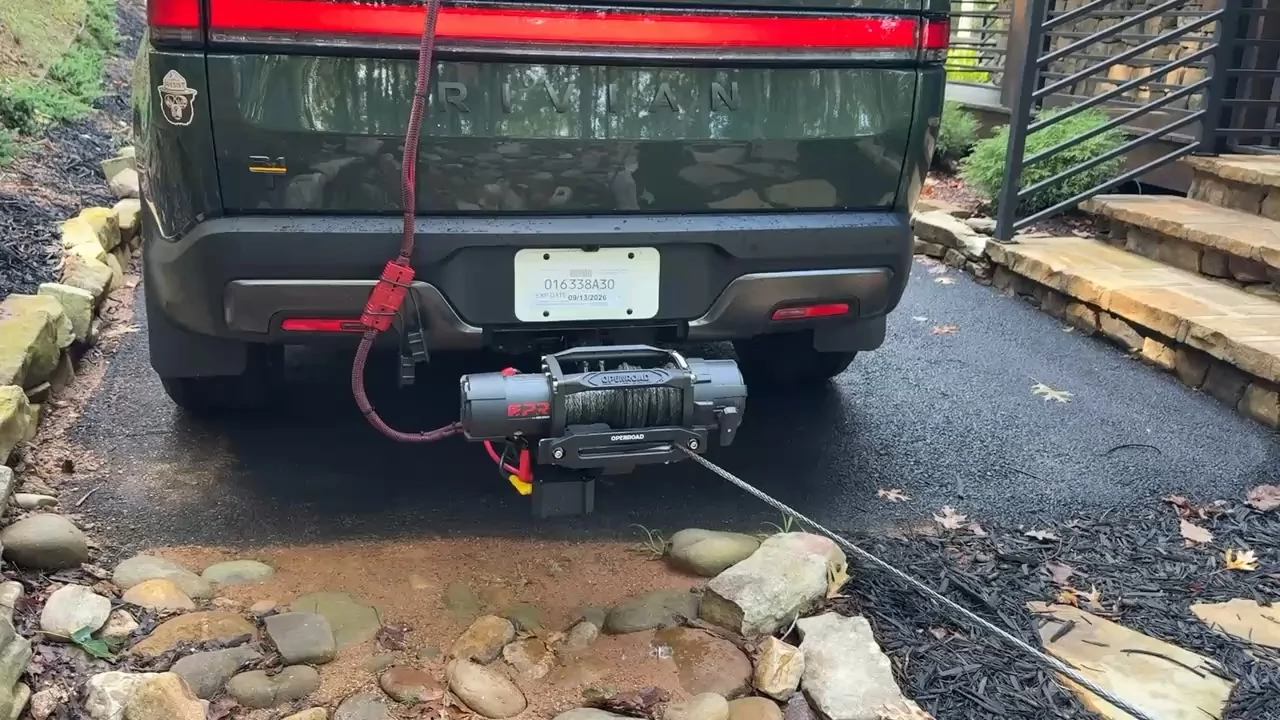
Winch: OpenRoad 12,000 lb Panther Series 3S (synthetic rope, 2 wireless remotes)
Power unit:
Charger connects to the battery. 2-gauge cable runs from the battery to the quick disconnect. Quick disconnect mates up to the winch at the hitch. Simple as that on paper — the details below are where it got interesting.
Mounting the Battery
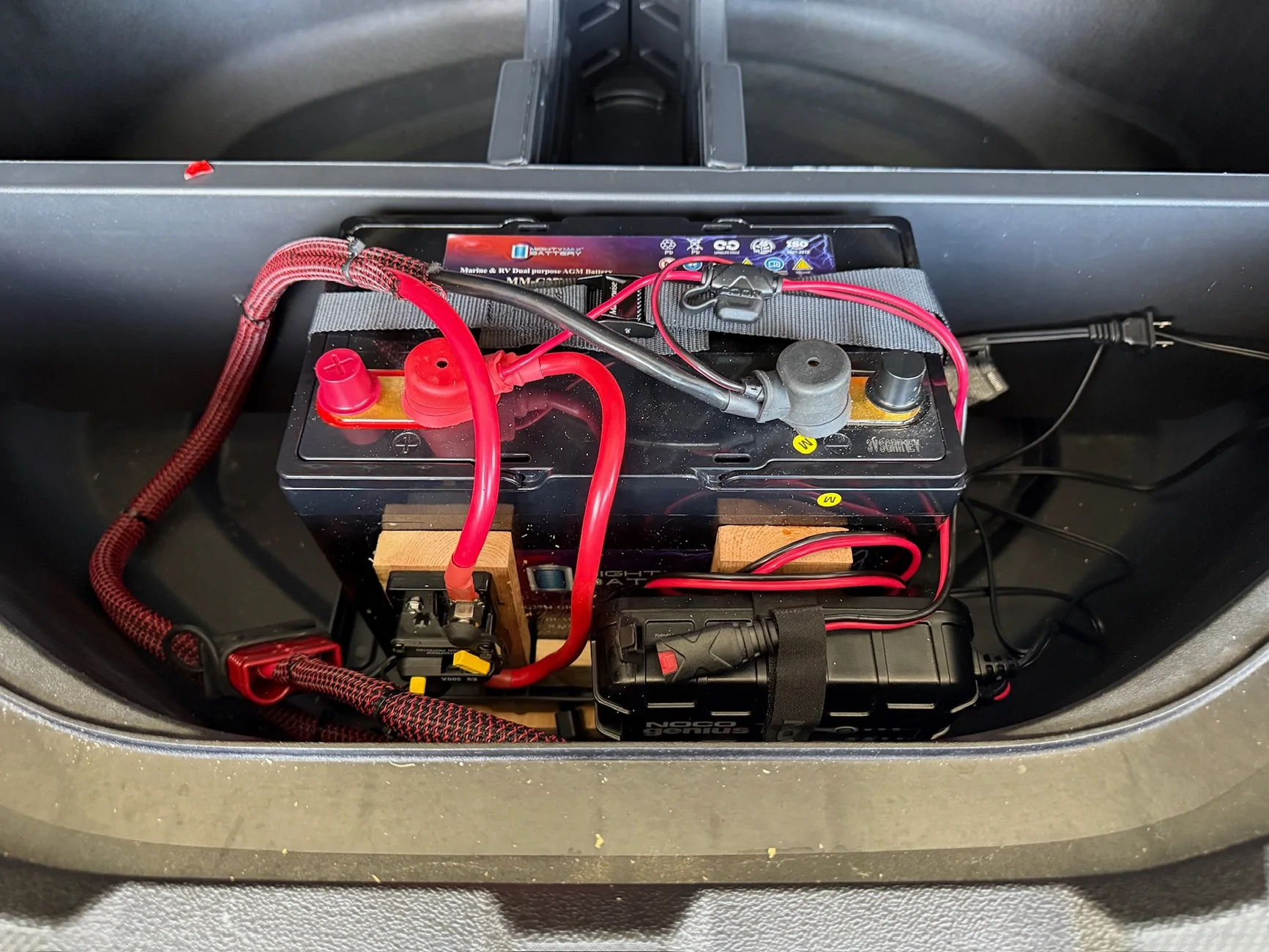
I mounted everything on the R1T's lower bed storage shelf (extra tire compartment). Used the center mounting bolt as the anchor point, laid down a piece of marine plywood, and secured a battery holder to that. There's a layer of foam under the plywood so nothing shifts around while driving — it's solid, no rattling or movement even on rough roads.
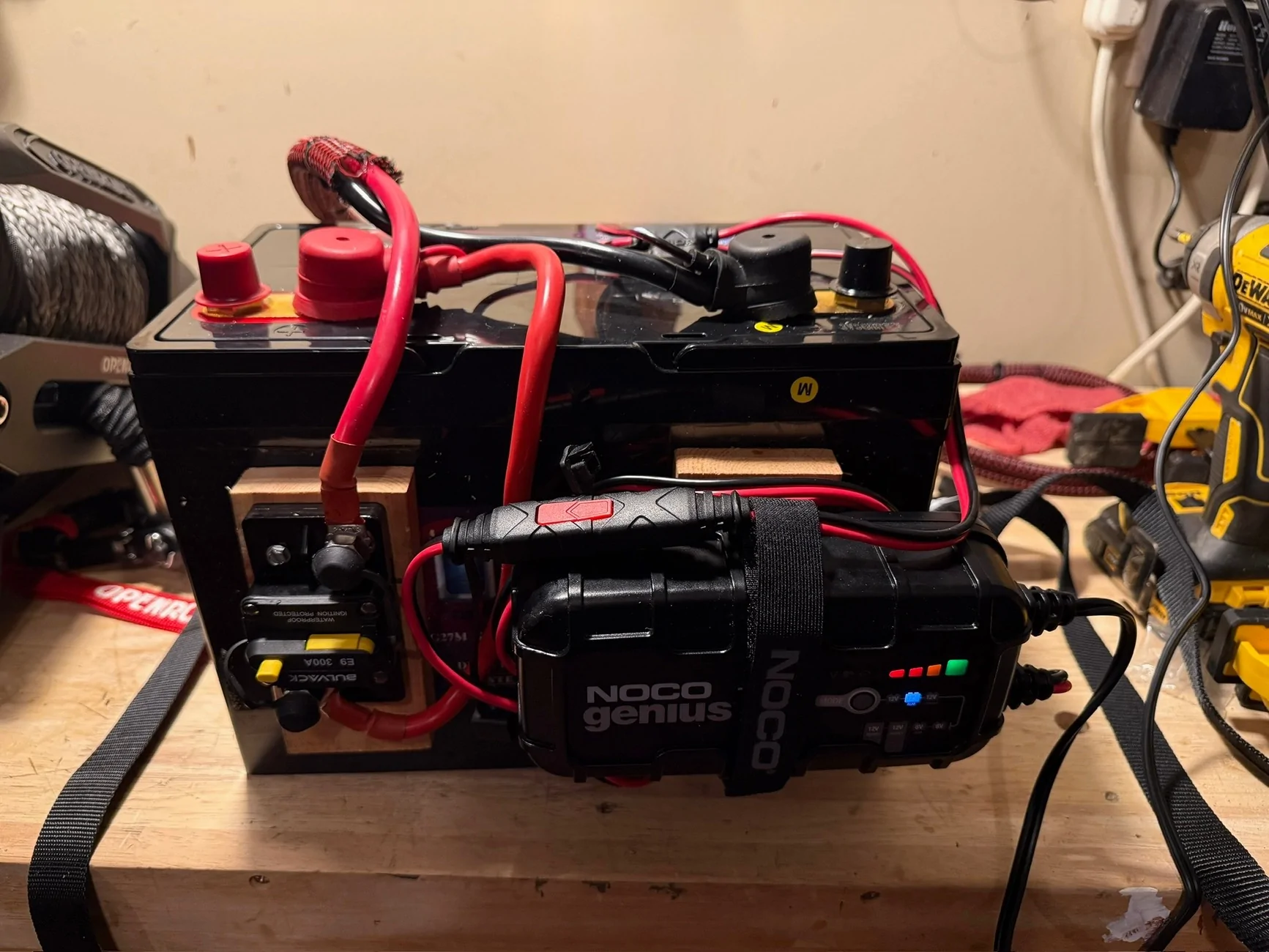
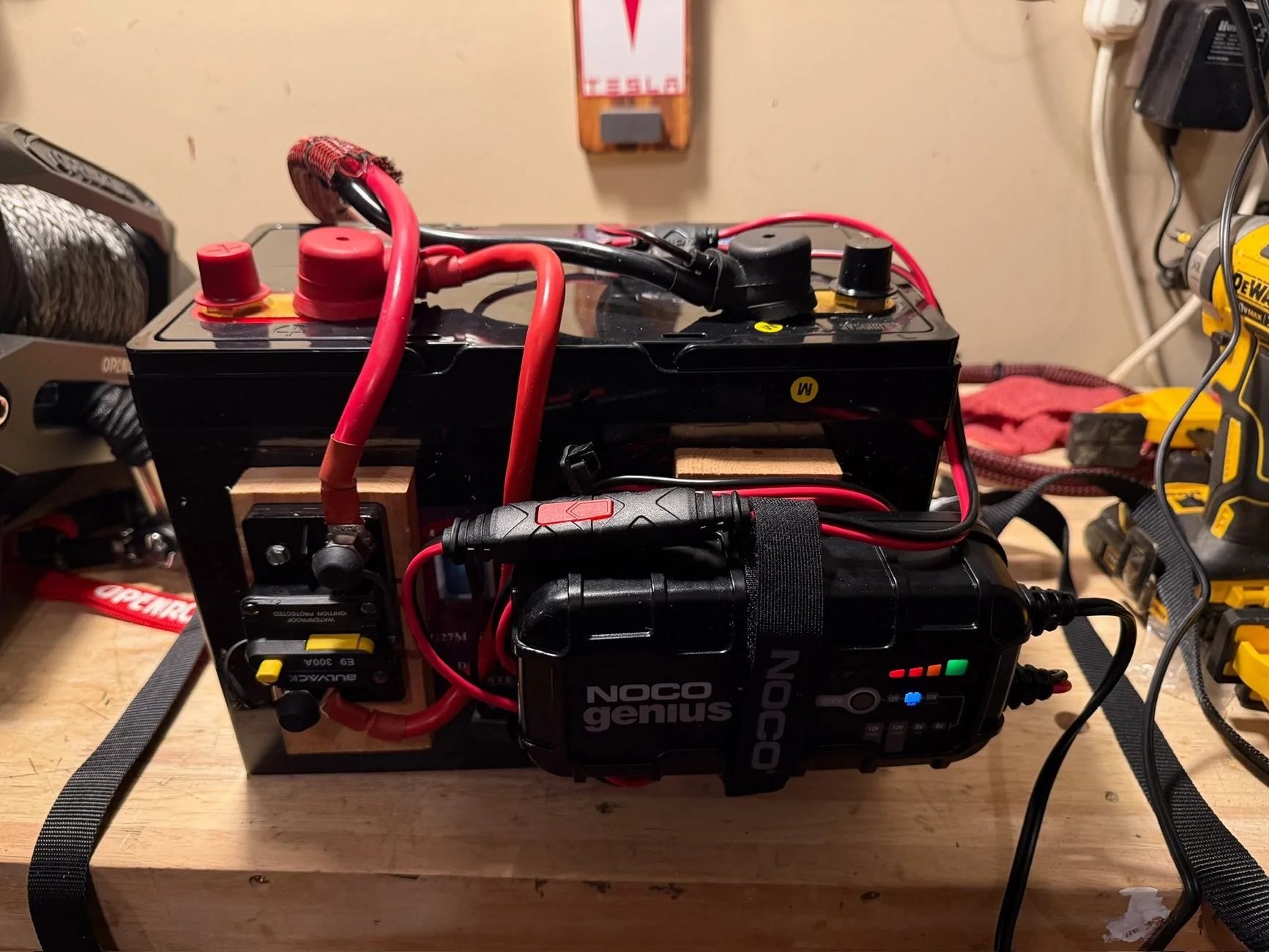
The fuse and the NOCO charger are both mounted to a separate piece of wood glued to the battery casing, so the whole thing — battery, fuse, charger — comes out of the truck as one self-contained unit if I ever need to pull it for cleaning or storage. When it's not in use, I charge it in place with the NOCO using the bed outlets — no need to pull it just to top it off.

Recharging the Battery
I'm using a NOCO Genius10 (10A) to recharge the auxiliary battery. The battery I'm using is a Mighty Max MM-G27M — 12V, 100Ah, Group 27M deep-cycle AGM marine battery.
If I use roughly half the battery's capacity during a day of winching, that's about 50Ah that needs to go back in. At 10 amps, that's theoretically about 5 hours of charging, although realistically it'll take a little longer as the charging current tapers off near full.
The nice thing is I don't have to worry about charging it separately. I just plug the NOCO into one of the R1T's 120V bed outlets at the end of the day and let it charge overnight. The R1T's bed outlets are rated for 15 amps at 120V (1,500W), so the NOCO is barely asking anything of the truck's AC system.
So the setup is basically:
Winch all day → auxiliary AGM battery gets depleted → plug NOCO into the R1T bed outlet → charge overnight → ready for the next day.
That actually makes the auxiliary battery setup pretty painless for me.
What I Had to Modify
A couple of things didn't fit right out of the box:
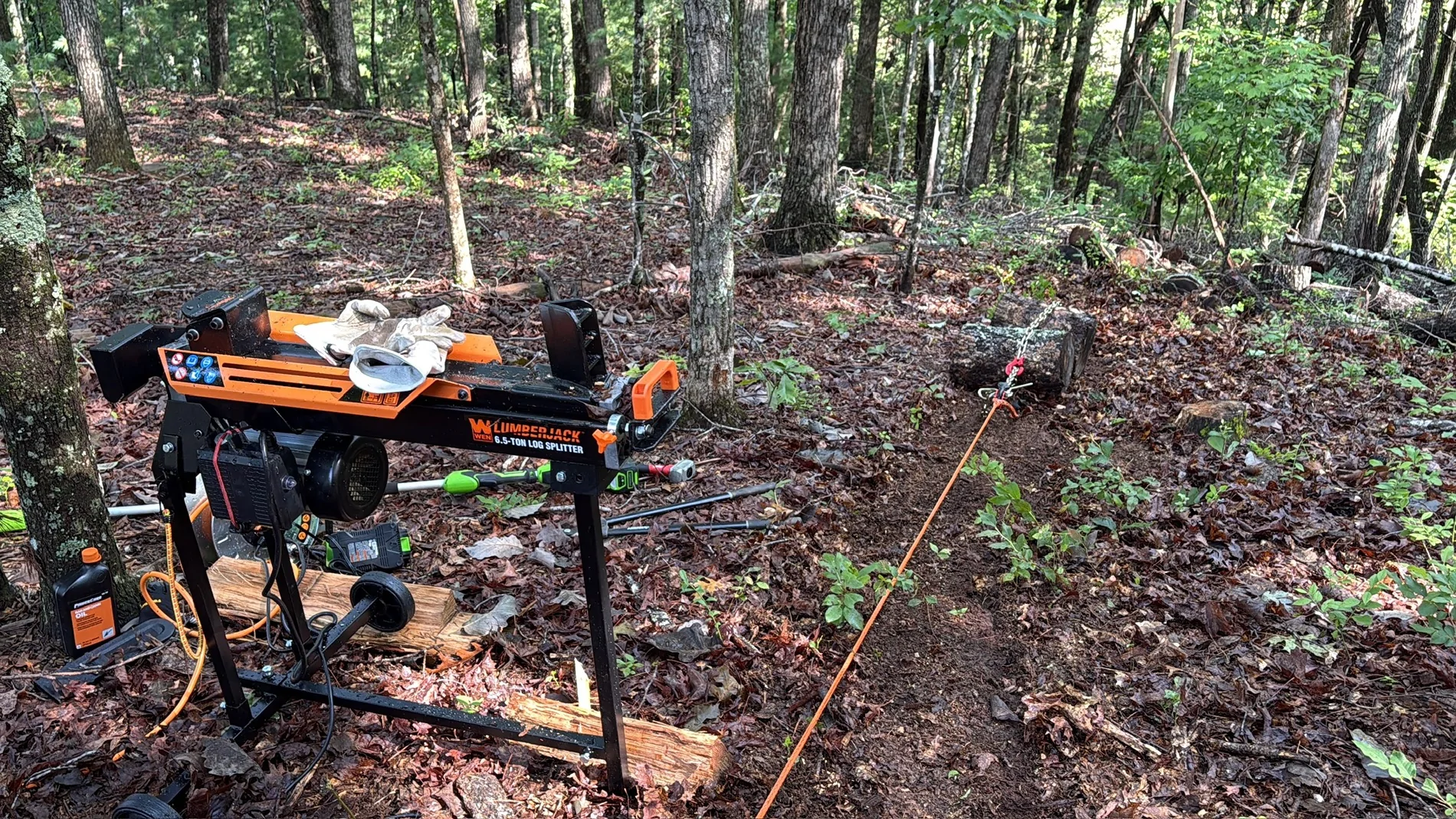
Put this through 3 days of log hauling, cutting, and splitting. Used the winch somewhere around 40 times a day and the battery only dropped to about 50% by the end — plenty of headroom. The wireless remotes reached about 100 ft into the woods without issue, which was more than enough range for what I needed.
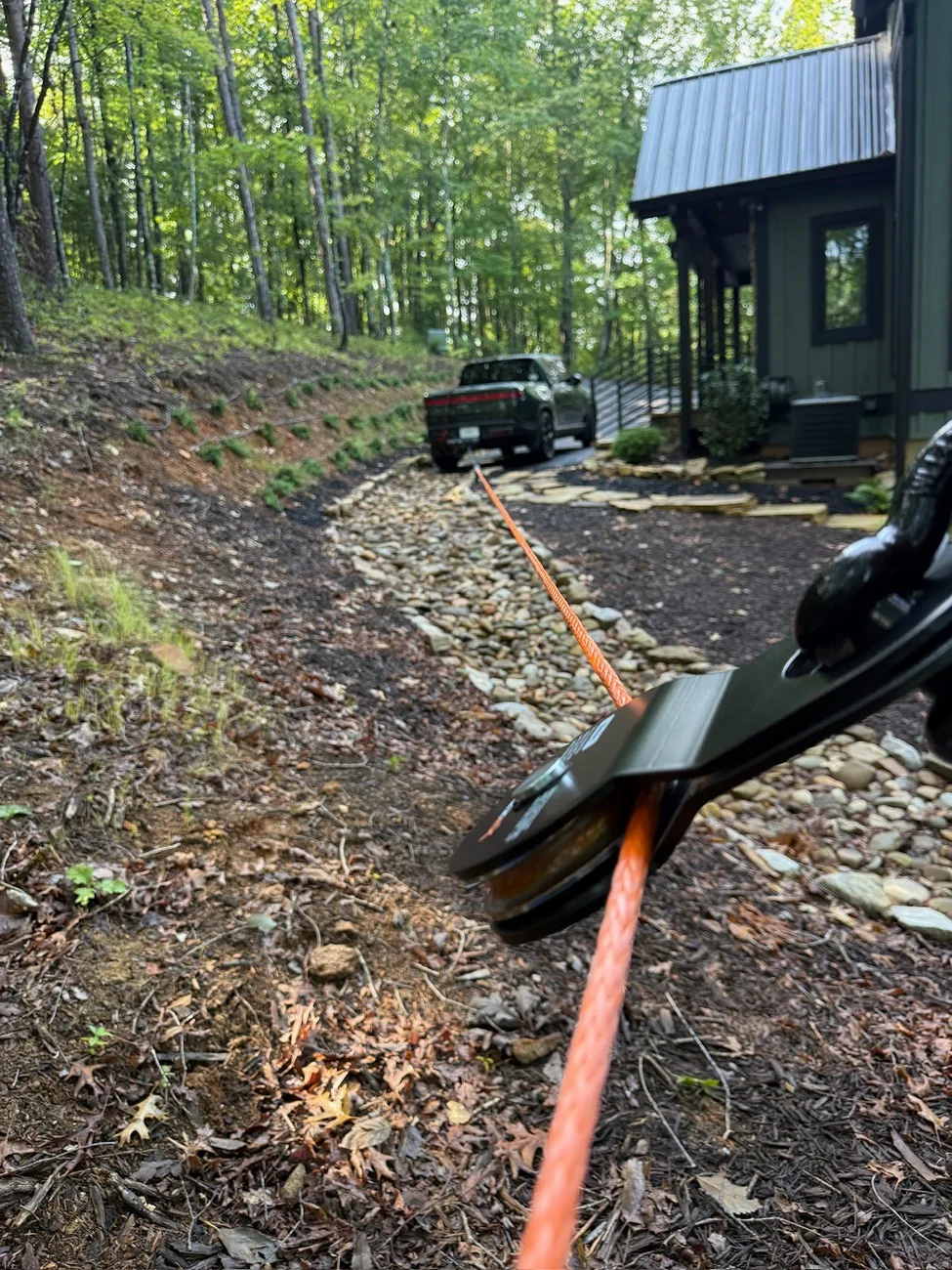
The tree saver strap and snatch block combo worked great as an anchor/redirect point — let me get the line into the woods while leaving the truck parked on the driveway instead of trying to drive it into rough terrain.

Bottom Line
This setup works great for hauling and dragging loads. It's not designed for vehicle-to-vehicle recovery off the rear, but I'd guess it would probably work if needed — I just haven't tried it. Realistically, I never pushed it past a few hundred pounds even though the cables and winch are rated well past 10,000 lbs, so there's a lot of headroom I haven't tapped into. Overall I'm happy with the remote's range and how the winch has performed.
Happy to answer questions if anyone's thinking about doing something similar on their R1T.

Full parts list:

For Rivian (Maybe on the Gen 3 R1T)
If any Rivian engineers are looking for a worthwhile product improvement, please consider adding a high-amperage 12V power outlet at the tow hitch (and probably the front for those who want the front winch) —something in the 250A–500A range. It would be incredibly useful for powering winches and other accessories, and it would save owners from having to spend a few hundred dollars adding their own dedicated power supply.
The Biggest Hurdle: Power
Rivian doesn't give you any onboard power source that can handle winch-level amperage, so this had to be a fully independent power unit — battery, charger, fusing, and disconnects, all self-contained and removable.
The Setup
Winch: OpenRoad 12,000 lb Panther Series 3S (synthetic rope, 2 wireless remotes)
Power unit:
- Mighty Max MM-G27M 12V 100Ah Group 27M deep-cycle marine AGM battery
- E9 300A manual-reset circuit breaker (3/8" studs, waterproof IP67)
- NOCO GENIUS10 smart charger (works for lead-acid and LiFePO4, so it'll charge whatever battery you're running)
- TKDMR 1/0 AWG copper lugs w/ heat shrink for the terminations
- Rough Country quick disconnect winch power cable, 7 ft, 2-gauge
- DACK universal hitch cradle mount plate, 15,000 lb capacity, 2" receiver
- TOPTOW 64122 hitch extension riser (solid shank, 10,000 lb capacity)
- OMT locking hitch pins (x2, keyed alike)
- Kolvoii 3/8" x 92 ft synthetic rope extension
- Off-road recovery kit — tree saver strap, snatch block, D-ring shackles
- Winch choker chain (5/16" x 7 ft) for log work specifically
- Oxford cloth winch cover
- Hammer lug crimper (8 AWG – 4/0 AWG)
Charger connects to the battery. 2-gauge cable runs from the battery to the quick disconnect. Quick disconnect mates up to the winch at the hitch. Simple as that on paper — the details below are where it got interesting.
Mounting the Battery
I mounted everything on the R1T's lower bed storage shelf (extra tire compartment). Used the center mounting bolt as the anchor point, laid down a piece of marine plywood, and secured a battery holder to that. There's a layer of foam under the plywood so nothing shifts around while driving — it's solid, no rattling or movement even on rough roads.
The fuse and the NOCO charger are both mounted to a separate piece of wood glued to the battery casing, so the whole thing — battery, fuse, charger — comes out of the truck as one self-contained unit if I ever need to pull it for cleaning or storage. When it's not in use, I charge it in place with the NOCO using the bed outlets — no need to pull it just to top it off.
Recharging the Battery
I'm using a NOCO Genius10 (10A) to recharge the auxiliary battery. The battery I'm using is a Mighty Max MM-G27M — 12V, 100Ah, Group 27M deep-cycle AGM marine battery.
If I use roughly half the battery's capacity during a day of winching, that's about 50Ah that needs to go back in. At 10 amps, that's theoretically about 5 hours of charging, although realistically it'll take a little longer as the charging current tapers off near full.
The nice thing is I don't have to worry about charging it separately. I just plug the NOCO into one of the R1T's 120V bed outlets at the end of the day and let it charge overnight. The R1T's bed outlets are rated for 15 amps at 120V (1,500W), so the NOCO is barely asking anything of the truck's AC system.
So the setup is basically:
Winch all day → auxiliary AGM battery gets depleted → plug NOCO into the R1T bed outlet → charge overnight → ready for the next day.
That actually makes the auxiliary battery setup pretty painless for me.
What I Had to Modify
A couple of things didn't fit right out of the box:
- Mount plate: Had to drill the holes on the DACK mount plate slightly larger to get the winch's mounting bolts through.
- Hitch shank: The tailgate hit the winch no matter what I did with a standard hitch setup — ended up needing a solid-shank lowering extension to solve it.
- Solenoid/clutch position: Moved the winch's solenoid box to the bottom and rotated the clutch to point down instead of up. That, combined with the extension, finally got the tailgate clearing the winch completely.
Put this through 3 days of log hauling, cutting, and splitting. Used the winch somewhere around 40 times a day and the battery only dropped to about 50% by the end — plenty of headroom. The wireless remotes reached about 100 ft into the woods without issue, which was more than enough range for what I needed.
The tree saver strap and snatch block combo worked great as an anchor/redirect point — let me get the line into the woods while leaving the truck parked on the driveway instead of trying to drive it into rough terrain.
Bottom Line
This setup works great for hauling and dragging loads. It's not designed for vehicle-to-vehicle recovery off the rear, but I'd guess it would probably work if needed — I just haven't tried it. Realistically, I never pushed it past a few hundred pounds even though the cables and winch are rated well past 10,000 lbs, so there's a lot of headroom I haven't tapped into. Overall I'm happy with the remote's range and how the winch has performed.
Happy to answer questions if anyone's thinking about doing something similar on their R1T.
Full parts list:
- OpenRoad 12,000 lb Panther Series 3S Winch
- Mighty Max MM-G27M 12V 100Ah AGM Battery
- E9 300A Circuit Breaker
- NOCO GENIUS10 Charger
- TKDMR Battery Cable Lugs
- Rough Country Quick Disconnect Power Cable
- DACK Universal Hitch Cradle Mount Plate
- TOPTOW 64122 Hitch Extension Riser
- OMT Locking Hitch Pin Set
- Kolvoii Synthetic Winch Rope Extension
- Off-Road Recovery Kit
- Winch Choker Chain
- Oxford Cloth Winch Cover
- Hammer Lug Crimper Tool
For Rivian (Maybe on the Gen 3 R1T)
If any Rivian engineers are looking for a worthwhile product improvement, please consider adding a high-amperage 12V power outlet at the tow hitch (and probably the front for those who want the front winch) —something in the 250A–500A range. It would be incredibly useful for powering winches and other accessories, and it would save owners from having to spend a few hundred dollars adding their own dedicated power supply.
Sponsored
Last edited: