Zorg
Well-Known Member
- Joined
- Nov 1, 2022
- Threads
- 9
- Messages
- 1,054
- Reaction score
- 1,297
- Location
- SF bay area
- Vehicles
- 22 R1T 25 R1S
With a 110KWh battery, it would please just about everyone. I know I enjoy our max pack R1
Sponsored
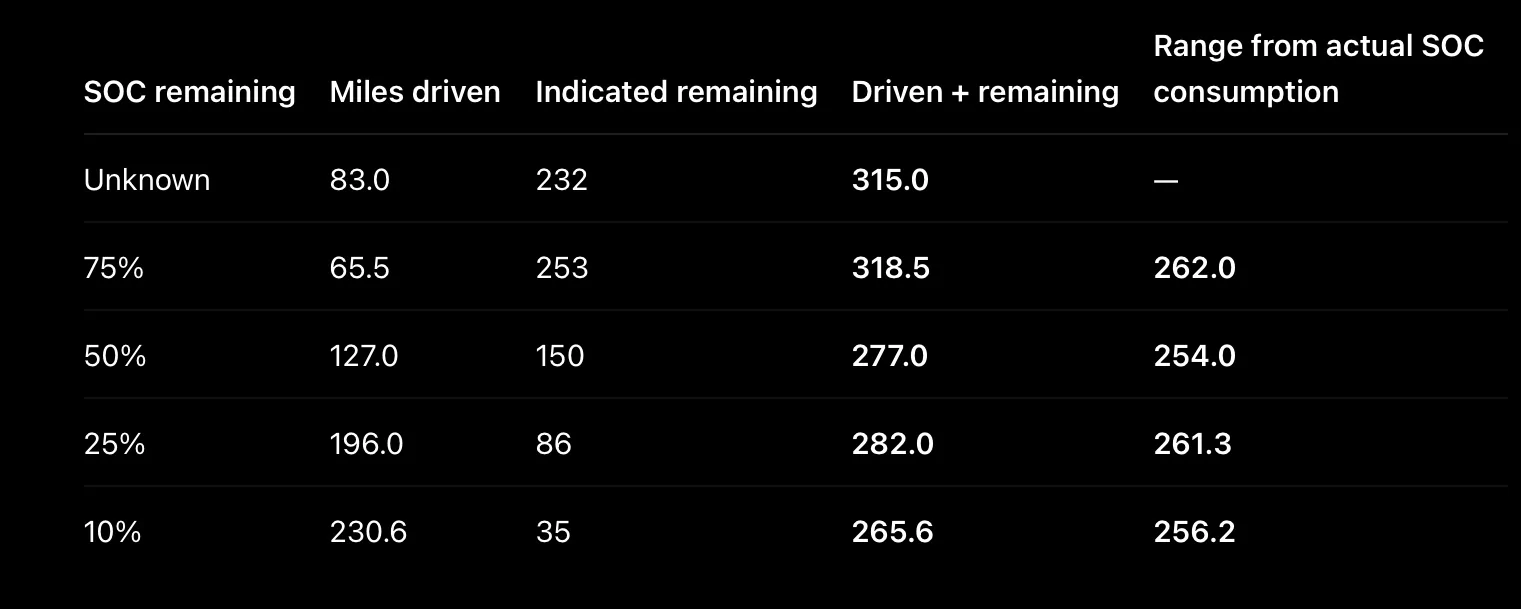
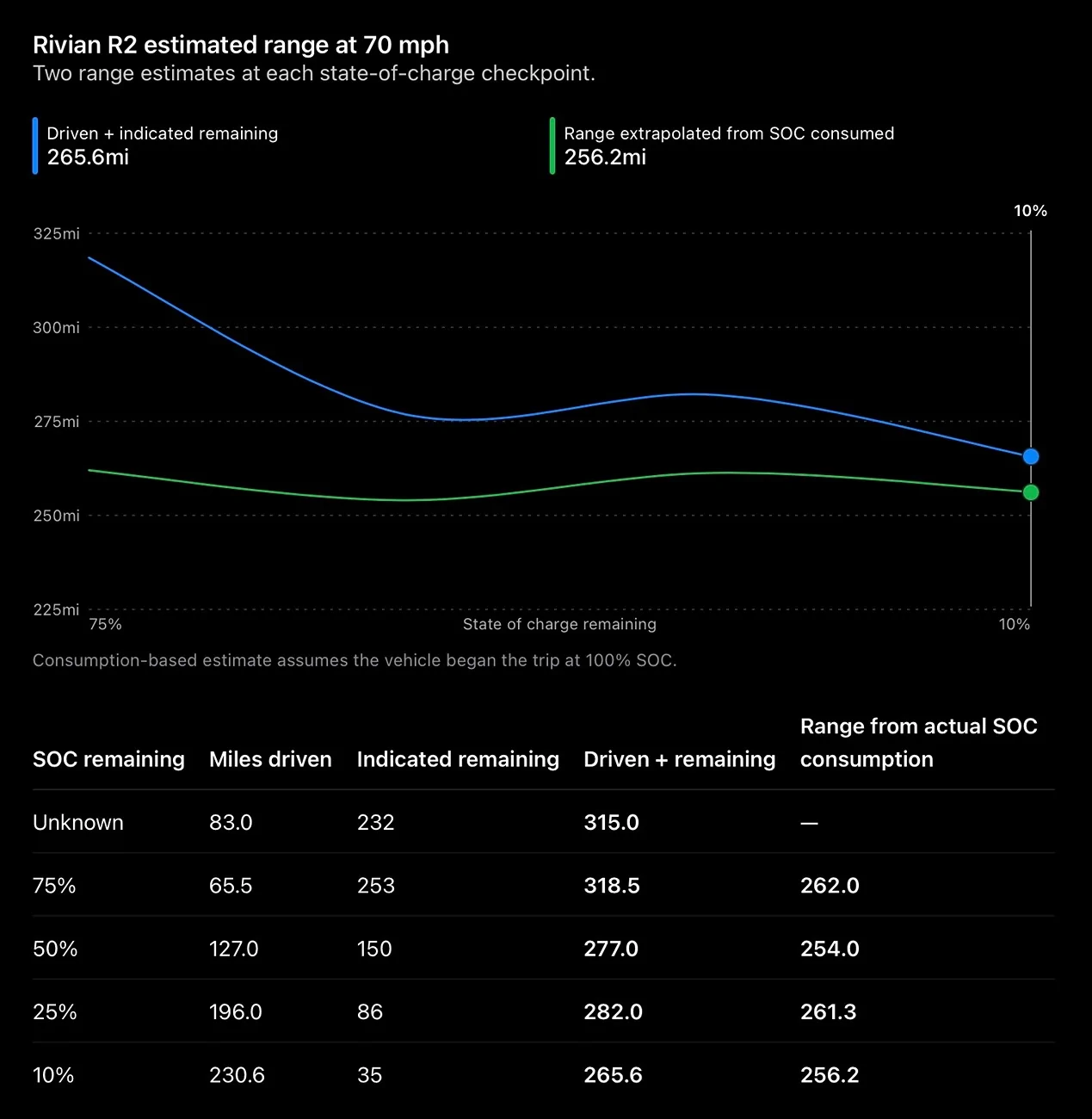
The question I really have is, WHY does the CAR think it can go so much farther? The EPA games and inaccuracies aside, I’d like the IN CAR experience to at least be close to accurate.. but if we look at the data reported, distance travelled, for the first 75% nearly of SOC the R2 THOUGHT it could go ~ 300 mile at least.. heck at 75% SOC the car had already travelled 65.5 MILES and the in dash display STILL listed 253 miles of range?
Is the RANGE estimate an estimate of the TOTAL range in TOTAL? I would think that the in dash RANGE estimate is still the REMAINING range available?
At 50%, they had travelled 128 miles, and the in car display still showed 150 miles of “range”.. just simple maths would make me think that CAR at least would have/can travel 300 miles? And yet, the car was only able to manage 80% of that remaining 150 miles indicated at most. Till DEAD?
For you Rivian owners, is this the expectation of the capability of the in car real range reporting? Does one always have to 2nd guess things?
As a Tesla M3LR owner, getting whatever range one is going to get is a moving target, but, BUT the IN CAR reporting remaining available distance is usually in the end within about 1-2%, and yes it takes a little time at speed on highways for the car to adjust with where it’s going and how you are driving, but the adjusted IN CAR indicators are at least accurate.

As a Tesla owner you should also know to immediately switch your display from miles to percent - the range miles is rarely even close.The question I really have is, WHY does the CAR think it can go so much farther? The EPA games and inaccuracies aside, I’d like the IN CAR experience to at least be close to accurate.. but if we look at the data reported, distance travelled, for the first 75% nearly of SOC the R2 THOUGHT it could go ~ 300 mile at least.. heck at 75% SOC the car had already travelled 65.5 MILES and the in dash display STILL listed 253 miles of range?
Is the RANGE estimate an estimate of the TOTAL range in TOTAL? I would think that the in dash RANGE estimate is still the REMAINING range available?
At 50%, they had travelled 128 miles, and the in car display still showed 150 miles of “range”.. just simple maths would make me think that CAR at least would have/can travel 300 miles? And yet, the car was only able to manage 80% of that remaining 150 miles indicated at most. Till DEAD?
For you Rivian owners, is this the expectation of the capability of the in car real range reporting? Does one always have to 2nd guess things?
As a Tesla M3LR owner, getting whatever range one is going to get is a moving target, but, BUT the IN CAR reporting remaining available distance is usually in the end within about 1-2%, and yes it takes a little time at speed on highways for the car to adjust with where it’s going and how you are driving, but the adjusted IN CAR indicators are at least accurate.
The charging isn't unrealistic at all. That's like saying 800v charging is unrealistic bc you have to use 800v chargers. Walmart, IONNA, and Rivian are all 600 amp capable. Additionally, the quoted 29 minutes doesn't require 600 amps. 600 amps is required if you want better than the 29 minute quoted time.And putting my cards on the table, I hoped I was wrong but knew I wasn't. Like most folks here, I am a Rivian fan (a 3-time buyer) and I have been really irritated to see what I thought was a strategic misstep by RJ in choosing the 400V and then a second error in choosing a single sized pack for the R2. It was clear long before launch (as my April model showed) that this was going to come in at 250 miles or so (basic math). It was also clear that the 29 minute charging time was going to be under some pretty optimistic (and unrealistic) scenarios (it requires 600A+ chargers!). R2 had the potential to be a new benchmark for EVs. I am afraid it is instead an also-ran that will appeal to a certain demographic but nowhere near enough to hit the sales numbers they need. I'm genuinely sad about that.
100 kWh would've been totally fine too, which is only 10 kWh or about $1,000 more in their cost. That would be 30 more miles on the OOO test and totally good.With a 110KWh battery, it would please just about everyone. I know I enjoy our max pack R1

Yup. One test. One that has since been picked up and repeated across several news and blog sites with words like “disappoints” and “falls short” in their titles. And, as the masses are sheep… a win for other higher range vehicles whether their numbers are accurate or not. I’m very interested to see similar real world cases from the iX3 and EX60.Guys, it's one test.
As some have pointed out, State of Charge did a test on ATs in hilly gusty conditions and went further.
Everyone will still buy it for the same reason it isn't super efficient: It looks like an SUV instead of a tall car and can go off road.
Tbf those titles would not be wrong nor inaccurate.Yup. One test. One that has since been picked up and repeated across several news and blog sites with words like “disappoints” and “falls short” in their titles. And, as the masses are sheep… a win for other higher range vehicles whether their numbers are accurate or not. I’m very interested to see similar real world cases from the iX3 and EX60.
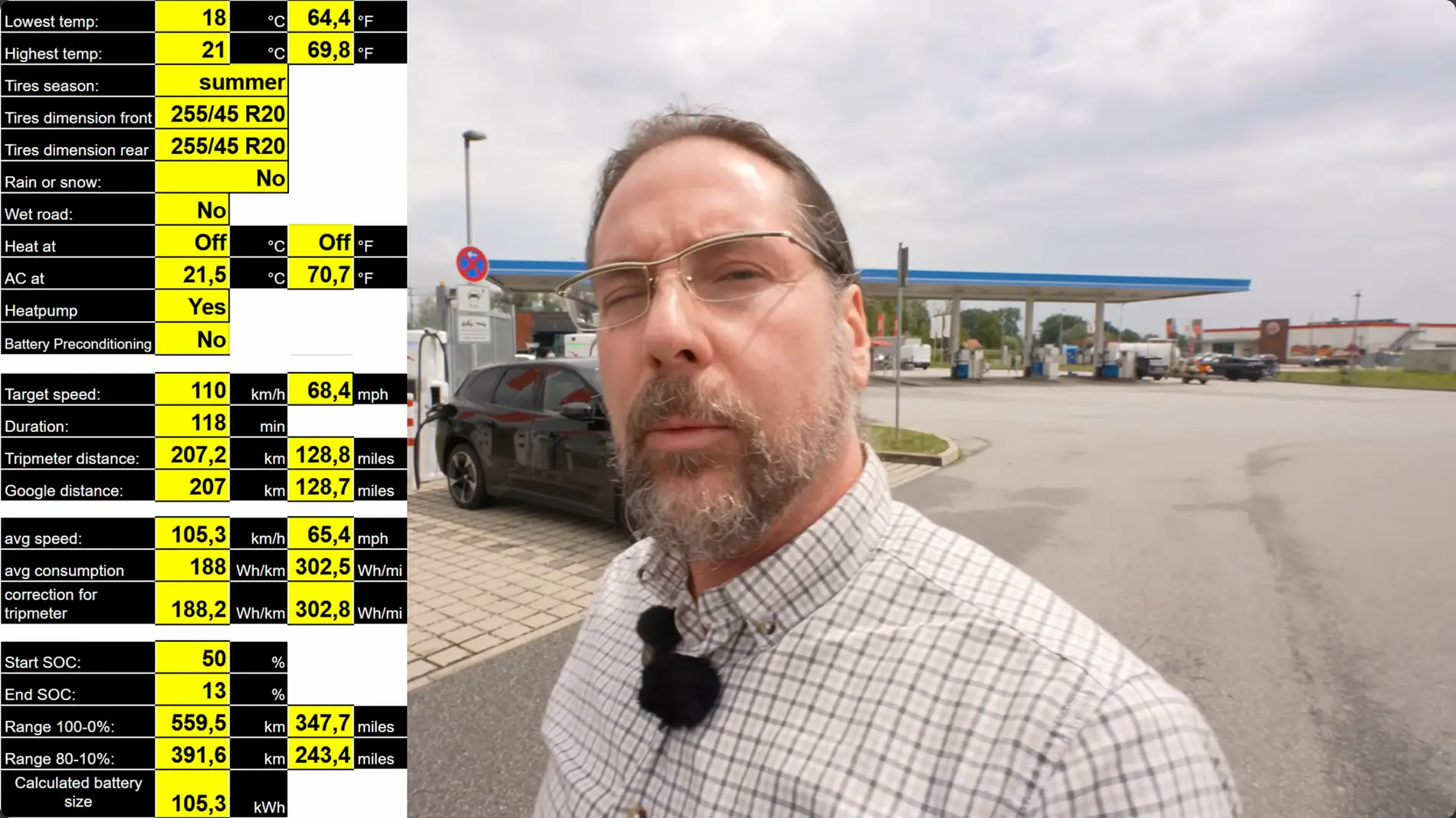
Using Bjorn Nylands 120km/hr (74.5mph) test, I have the iX3 at 2.9mi/kWh and 317mi of range. I think that more or less agrees with the results here.For those comparing to the new IX3, it fell short on range tests as well by about 86 miles at 110km/hr (68mph). So goes back to certification tests not reflecting real world conditions. Only 1 person so far has done a real world test thus far.
Of note, the iX3 was initially touted as 400 miles of range, but was since recertified as 434 miles of range by BMW. Real world range was 348 miles.
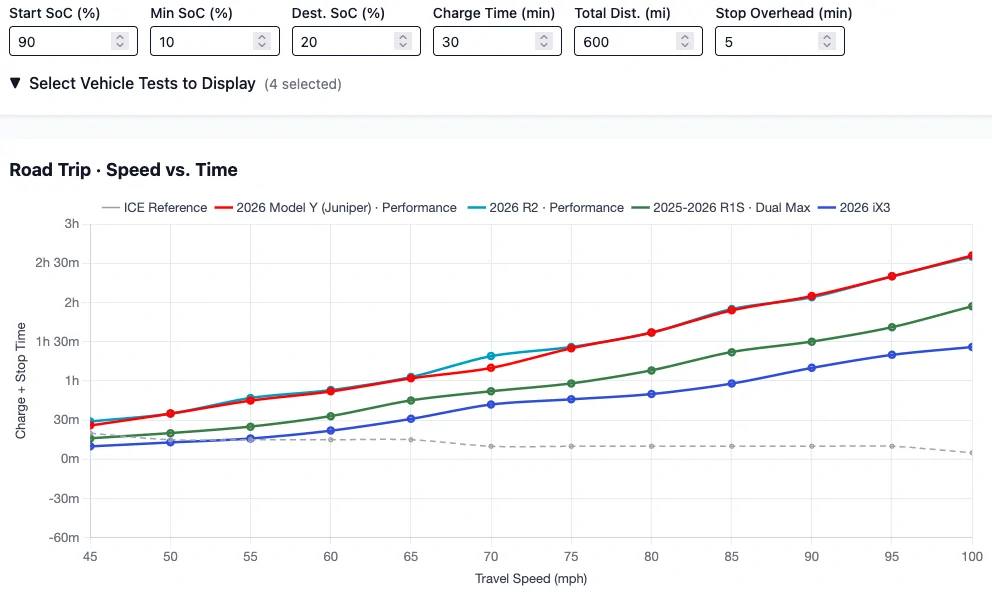
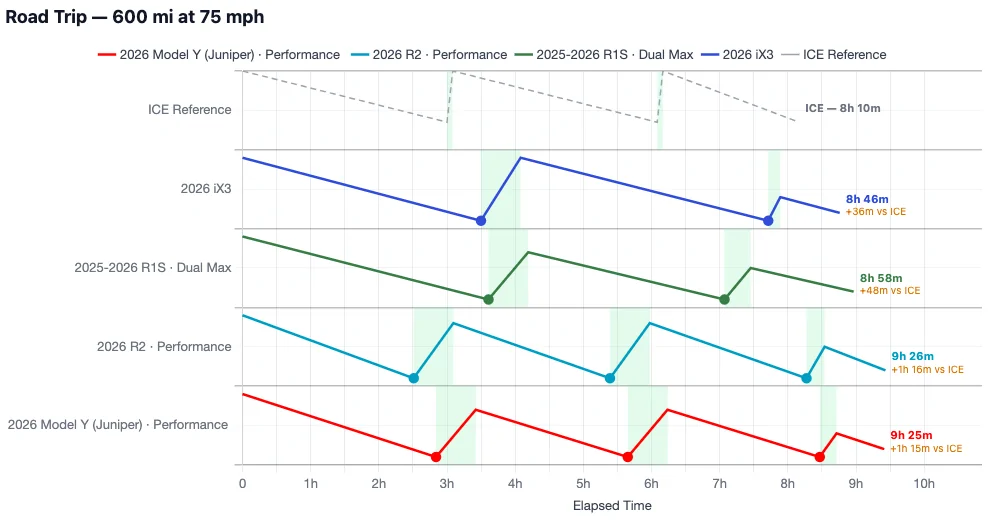
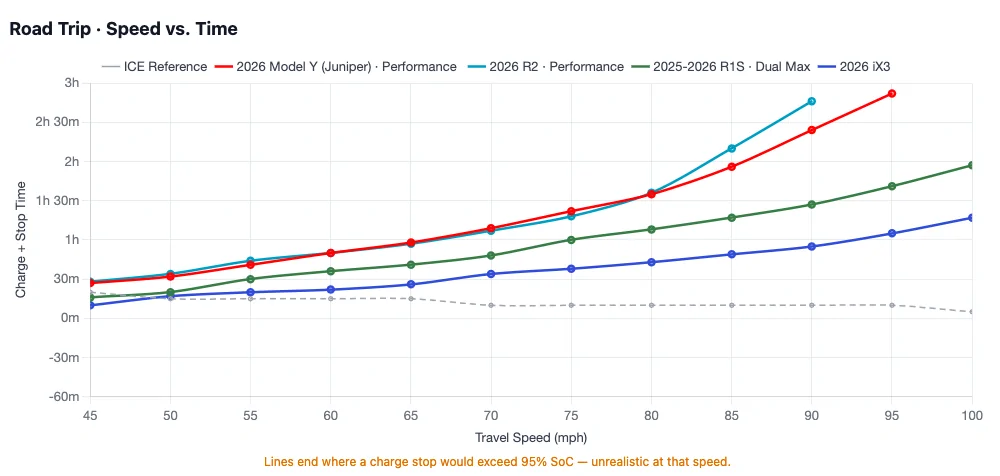
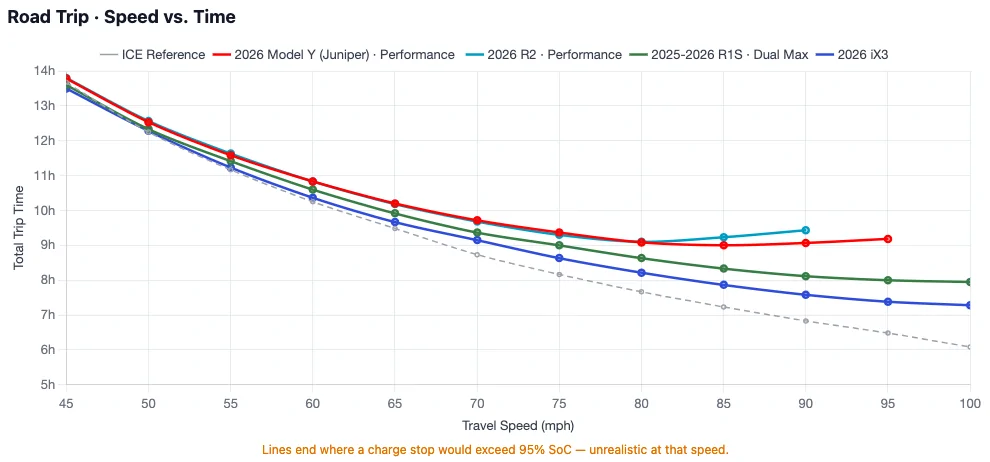
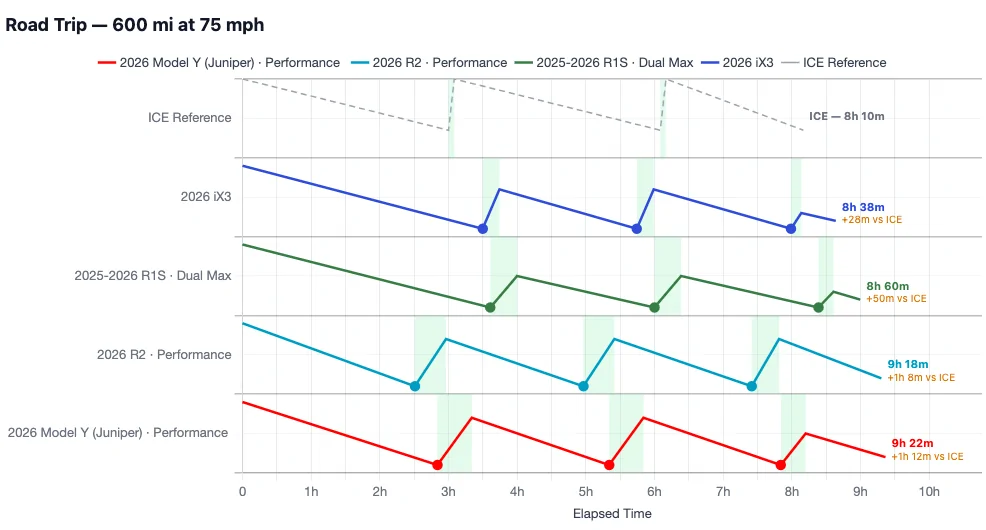
Using todays OoS testing (and the State of Charge charging curve), here's what a 600mi road trip, stopping every 150mi with a 20% destination SoC looks like:Agree and my point is just that when you look at the compounding effect of real-world range (mostly aero) and faster charging and bigger battery you get a total charging time that is literally more than twice as long with the R2 than the BMW even when using the pessimistic 348 mile range number.


The "miles to empty" reading is typically a simple % of battery left and average consuption calculation, so depending on your "mix" of driving it's probably going to be off when you're in highway cruising. When you use navigation however, it adjust for driving speed and other factors and generally gives a much more accurate anticipated battery remaining at destination.The question I really have is, WHY does the CAR think it can go so much farther? The EPA games and inaccuracies aside, I’d like the IN CAR experience to at least be close to accurate.. but if we look at the data reported, distance travelled, for the first 75% nearly of SOC the R2 THOUGHT it could go ~ 300 mile at least.. heck at 75% SOC the car had already travelled 65.5 MILES and the in dash display STILL listed 253 miles of range?
Is the RANGE estimate an estimate of the TOTAL range in TOTAL? I would think that the in dash RANGE estimate is still the REMAINING range available?
At 50%, they had travelled 128 miles, and the in car display still showed 150 miles of “range”.. just simple maths would make me think that CAR at least would have/can travel 300 miles? And yet, the car was only able to manage 80% of that remaining 150 miles indicated at most. Till DEAD?
For you Rivian owners, is this the expectation of the capability of the in car real range reporting? Does one always have to 2nd guess things?
As a Tesla M3LR owner, getting whatever range one is going to get is a moving target, but, BUT the IN CAR reporting remaining available distance is usually in the end within about 1-2%, and yes it takes a little time at speed on highways for the car to adjust with where it’s going and how you are driving, but the adjusted IN CAR indicators are at least accurate.
I’ll say after 8 years now the miles is very very close at least in my car. It’s a moving target of course, but when I’m traveling on a highway doing 80-83, and the car says I have 128 miles range available and I’m heading south on the I5, but before the grapevine and heading the Kettleman City or Maybe Harris Ranch, and it says I’ll get there with ~ 7% remaining, and it’s still 110 miles away - it’s pretty spot on.As a Tesla owner you should also know to immediately switch your display from miles to percent - the range miles is rarely even close.
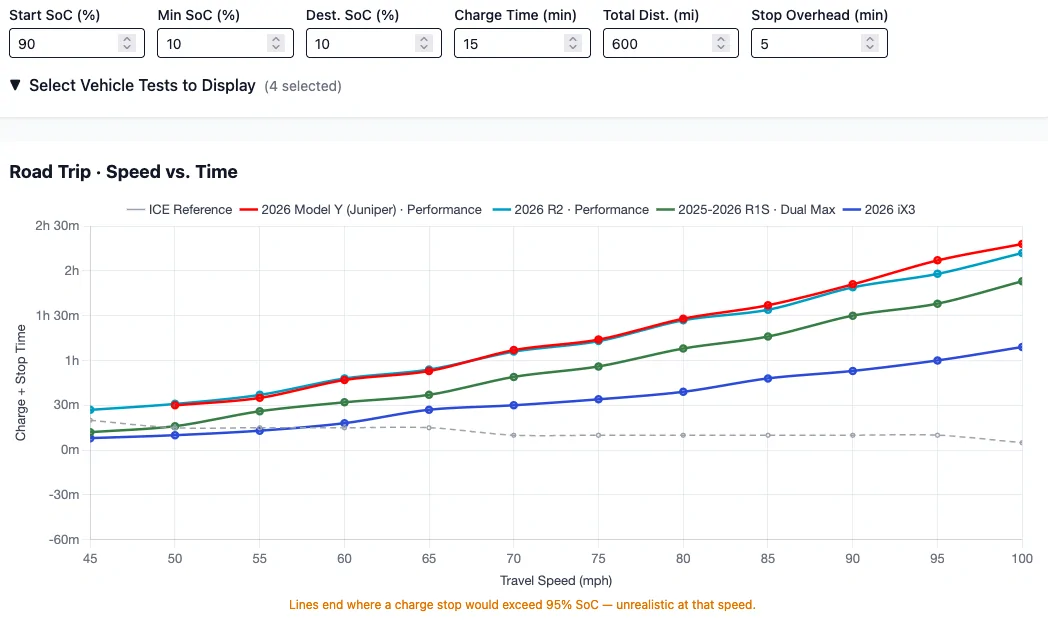
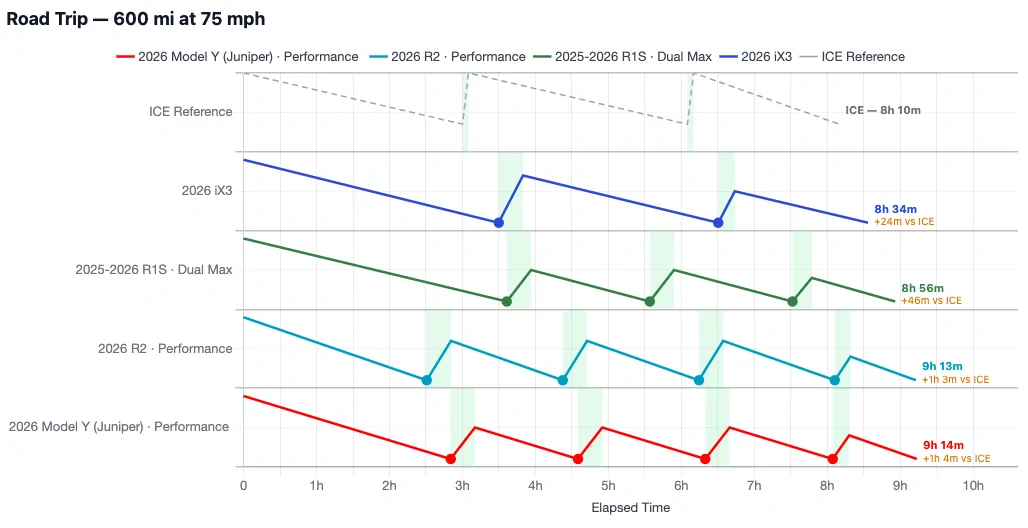
Can these be optimized for only stopping when at 10% SOC? Better charging is generally only realized if utilizing the lower end of the pack.Using Bjorn Nylands 120km/hr (74.5mph) test, I have the iX3 at 2.9mi/kWh and 317mi of range. I think that more or less agrees with the results here.
Using todays OoS testing (and the State of Charge charging curve), here's what a 600mi road trip, stopping every 150mi with a 20% destination SoC looks like:
First, total charging time at various speeds:
Total trip time at various speeds:

And some charging sessions/stops at 75mph:

I'll add the actual settings to the post. That's already what it is doing. I just think showing up at a destination with 10% sucks unless it's your own home.Can these be optimized for only stopping when at 10% SOC? Better charging is generally only realized if utilizing the lower end of the pack.

I'm thrown off by the miles between charges. The cars won't be at 10% after only 150 miles, no?I'll add the actual settings to the post.

It charges for however long it takes to add 150 miles of range at the prescribed speed. Thats why the lines in the first 2 line graphs cut off at 90 and 95mph - the cars can't do 150mi at 90mph even from 95%I'm thrown off by the miles between charges. The cars won't be at 10% after only 150 miles, no?