Sponsored

2026 Gen 2 R1S battery capacity drop due to cold - what’s normal?

tmbm50

Well-Known Member
Joined
Dec 31, 2025
Threads
3
Messages
67
Reaction score
108
Location
USA
Vehicles
2026 R1T Quad
It does, it just take a crap ton of energy to heat such a large thermal mass and Gen 2 just doesn't have a lot of thermal capacity to actually do that. This was evidenced by not having full regen until I am 30 minutes into a drive.

The HVAC system in Gen 2 is quite weak, I assume in the name of efficiency. Sadly, it can't deal with high charging and colder climates as well.
Fair enough. I may run a test next weekend, let it pre-warm for 2-3 hours and see what the heating curve actually is. I may need to get creative and keep changing the schedule pre-warm to keep it going so long.

I'm pretty sure the S/X use an embedded heater in addition from pulling from the system hvac. Not sure if thats how most do it.
Sponsored

 
Last edited:

Rivian Roamer

Well-Known Member
Joined
Jul 18, 2024
Threads
2
Messages
473
Reaction score
661
Location
Seattle, WA
Website
rivianroamer.com
Vehicles
2024 R1S Quad Large, 2025 R1T Tri Max
Occupation
Adventurer
Fair enough. I may run a test next weekend, let it pre-warm for 2-3 hours and see what the heating curve actually is. I may need to get creative and keep changing the schedule pre-warm to keep it going so long.

I'm pretty sure the S/X use an embedded heater in addition from pulling from the system hvac. Not sure if thats how most do it.
Let me know what you find. I've been begging Rivian to add battery temp to the API.

This thread has inspired me to add some features to the dashboard for Rivian Roamer.

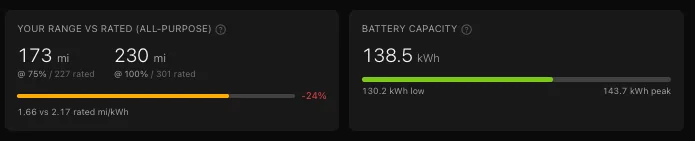
Here's my Gen 1 Large
Rivian R1T R1S 2026 Gen 2 R1S battery capacity drop due to cold - what’s normal? Screenshot 2026-01-26 at 3.14.44 PM


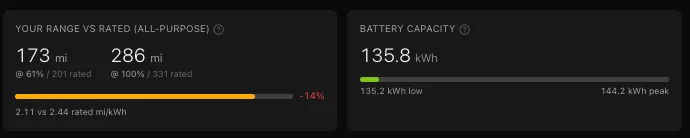
Gen 2 Tri Max R1T
Rivian R1T R1S 2026 Gen 2 R1S battery capacity drop due to cold - what’s normal? Screenshot 2026-01-26 at 3.16.07 PM


Gen 2 Tri Max R1S
Rivian R1T R1S 2026 Gen 2 R1S battery capacity drop due to cold - what’s normal? Screenshot 2026-01-26 at 3.16.21 PM
 
OP
OP

hmw

Active Member
First Name
h
Joined
Sep 19, 2025
Threads
3
Messages
31
Reaction score
26
Location
NJ
Vehicles
r1s
Let me know what you find. I've been begging Rivian to add battery temp to the API.

This thread has inspired me to add some features to the dashboard for Rivian Roamer.

Here's my Gen 1 Large
Screenshot 2026-01-26 at 3.14.44 PM.webp


Gen 2 Tri Max R1T
Screenshot 2026-01-26 at 3.16.07 PM.webp


Gen 2 Tri Max R1S
Screenshot 2026-01-26 at 3.16.21 PM.webp
awesome 👏
 

mkhuffman

Well-Known Member
First Name
Mike
Joined
Nov 9, 2020
Threads
14
Messages
2,885
Reaction score
3,235
Location
Virginia
Vehicles
2025 R1T Tri-Max, Jeep GC-L, VW Jetta
Is a 30% drop normal? Does it go even lower ?

Would the capacity bounce back when driving ?
The simple answers are: yes, yes and maybe (probably not).

RR has the right responses.

I think you shouldn't be worried about the loss. For a LFP, or even NMC, cold temperature reduces battery capacity significantly. It's how it works. What you are describing sounds normal to me.
 

Rivian Roamer

Well-Known Member
Joined
Jul 18, 2024
Threads
2
Messages
473
Reaction score
661
Location
Seattle, WA
Website
rivianroamer.com
Vehicles
2024 R1S Quad Large, 2025 R1T Tri Max
Occupation
Adventurer
The simple answers are: yes, yes and maybe (probably not).

RR has the right responses.

I think you shouldn't be worried about the loss. For a LFP, or even NMC, cold temperature reduces battery capacity significantly. It's how it works. What you are describing sounds normal to me.
The bigger issue is how Rivian makes this opaque. They try to shield the customer and all they do is cause more confusion. Tesla handles this better.
 

Sponsored

bfilippo

Well-Known Member
First Name
Benjamin
Joined
Sep 16, 2024
Threads
39
Messages
682
Reaction score
694
Location
Downeast Maine
Vehicles
2022 Launch Edition R1S Limestone, 2026 Gen2 R1T Tri Max AT, Storm Blue
Occupation
Consultant
The bigger issue is how Rivian makes this opaque. They try to shield the customer and all they do is cause more confusion. Tesla handles this better.
Agreed. I had one of the 1st Gen2 LFP R1T's delivered in the Northeast in September 24' and the team at Rivian did not have any real awareness of the major drops in range in cold temps and at that time we didn't even have climate schedule yet! When I had an issue with the truck (no fault of the truck per my recent post), the replacement team did finally accept that perhaps the standard pack was not sufficient for downeast Maine, and I should likely just get the Max pack. This is unfortunate, as a significant population for potential Rivian buyers outside of CA is the Northeast and Canada. If the Standard pack loses 30%+ for 40% of the year, and you are getting an average of 175mi at 100% charge, that starts being worse than a Chevy Bolt from 7 years ago. This on top of the update issue that just occurred in the middle of winter where the standard pack could not calibrate under 20% properly, leading to many threads on here of frustration.

I am really glad that Rivian started offering a lower cost model, and as Kyle from OOS points out helpfully in his video, the Dual Standard is an amazing vehicle and offers enough for the vast majority of drivers out there. Unfortunately, the lack of clarity and refinement (and arguably the only major component still being sourced by a 3rd party based in China) for the standard battery pack makes the offering less compelling compared to similarly priced options...
 

cthelan

Well-Known Member
Joined
Mar 13, 2023
Threads
2
Messages
91
Reaction score
84
Location
Oregon
Vehicles
GEN 1 R1T QUAD, GEN 2 R1S STANDARD
Agreed. I had one of the 1st Gen2 LFP R1T's delivered in the Northeast in September 24' and the team at Rivian did not have any real awareness of the major drops in range in cold temps and at that time we didn't even have climate schedule yet! When I had an issue with the truck (no fault of the truck per my recent post), the replacement team did finally accept that perhaps the standard pack was not sufficient for downeast Maine, and I should likely just get the Max pack. This is unfortunate, as a significant population for potential Rivian buyers outside of CA is the Northeast and Canada. If the Standard pack loses 30%+ for 40% of the year, and you are getting an average of 175mi at 100% charge, that starts being worse than a Chevy Bolt from 7 years ago. This on top of the update issue that just occurred in the middle of winter where the standard pack could not calibrate under 20% properly, leading to many threads on here of frustration.

I am really glad that Rivian started offering a lower cost model, and as Kyle from OOS points out helpfully in his video, the Dual Standard is an amazing vehicle and offers enough for the vast majority of drivers out there. Unfortunately, the lack of clarity and refinement (and arguably the only major component still being sourced by a 3rd party based in China) for the standard battery pack makes the offering less compelling compared to similarly priced options...
Having the same issue. On paper the LFP sounds pretty reasonable. After a great experience with our Gen1, we decided to get the Standard to replace our other car and go all EV and all Rivian. The LFP experience this winter has been terrible. Going out and running basic errands around town drains 40% of the battery even with being garaged and preheated. Forget taking it on any kind of trip in the winter. Had we known it was going to be this bad, we would have considered other options.
 

mkhuffman

Well-Known Member
First Name
Mike
Joined
Nov 9, 2020
Threads
14
Messages
2,885
Reaction score
3,235
Location
Virginia
Vehicles
2025 R1T Tri-Max, Jeep GC-L, VW Jetta
Just want to point out that the cold weather range hit is not just a Rivian issue. It is a BEV issue. My previous BEV was a Ford Mustang Mach-e, and it also took a very significant range hit in the winter. The EPA rating is 280, and I was lucky to get 180 on the highway in the winter. And that is with keeping the cabin cold and starting in a warm garage. I bet the LFP Mach-e is even worse.

The poor highway range (especially in the winter) is one of the big reasons why I replaced it with the R1T Tri Max.


Having the same issue. On paper the LFP sounds pretty reasonable. After a great experience with our Gen1, we decided to get the Standard to replace our other car and go all EV and all Rivian. The LFP experience this winter has been terrible. Going out and running basic errands around town drains 40% of the battery even with being garaged and preheated. Forget taking it on any kind of trip in the winter. Had we known it was going to be this bad, we would have considered other options.
This really sucks. I am sorry you were not aware of this.

The sales staff definitely should have warned you and explained the pros and cons of winter use. Some people drive less than 20 or 30 miles a day and can charge in their warm garage. For them it might not matter. But a buyer should know what they are getting, and obviously you were not properly informed.

When it comes to batteries in a battery powered vehicle, bigger is always better. IMO. Nobody ever complains about having too much range.
 

bfilippo

Well-Known Member
First Name
Benjamin
Joined
Sep 16, 2024
Threads
39
Messages
682
Reaction score
694
Location
Downeast Maine
Vehicles
2022 Launch Edition R1S Limestone, 2026 Gen2 R1T Tri Max AT, Storm Blue
Occupation
Consultant
Having the same issue. On paper the LFP sounds pretty reasonable. After a great experience with our Gen1, we decided to get the Standard to replace our other car and go all EV and all Rivian. The LFP experience this winter has been terrible. Going out and running basic errands around town drains 40% of the battery even with being garaged and preheated. Forget taking it on any kind of trip in the winter. Had we known it was going to be this bad, we would have considered other options.
Frustrating for sure. I do know that Tesla faced similar issues with their initial LFP offerings, but have refined them over the past 2 years more than Rivian at this point. Additionally, Tesla enhanced the pre-heating capabilities of superchargers in cold climates to accomodate their LFP vehicles in winter. Obviously still not a "solution", but I do hope Rivian after this latest blunder on calibration under 20% can find a good pathway to continue any incentive on the Standard pack, otherwise, I fear they may need to find a new supplier for the battery.
 

Rivian Roamer

Well-Known Member
Joined
Jul 18, 2024
Threads
2
Messages
473
Reaction score
661
Location
Seattle, WA
Website
rivianroamer.com
Vehicles
2024 R1S Quad Large, 2025 R1T Tri Max
Occupation
Adventurer
Just want to point out that the cold weather range hit is not just a Rivian issue. It is a BEV issue. My previous BEV was a Ford Mustang Mach-e, and it also took a very significant range hit in the winter. The EPA rating is 280, and I was lucky to get 180 on the highway in the winter. And that is with keeping the cabin cold and starting in a warm garage. I bet the LFP Mach-e is even worse.

The poor highway range (especially in the winter) is one of the big reasons why I replaced it with the R1T Tri Max.


This really sucks. I am sorry you were not aware of this.

The sales staff definitely should have warned you and explained the pros and cons of winter use. Some people drive less than 20 or 30 miles a day and can charge in their warm garage. For them it might not matter. But a buyer should know what they are getting, and obviously you were not properly informed.

When it comes to batteries in a battery powered vehicle, bigger is always better. IMO. Nobody ever complains about having too much range.
The issue is how Rivian communicates it. Right now it's done via an opaque process.

1. Rivian lowers net battery capacity to reserve for thermal management, none of which can a customer see
2. Driving in the winter is just less efficient

I think you're talking about #2, but #1 is still happening.
 

Sponsored

cthelan

Well-Known Member
Joined
Mar 13, 2023
Threads
2
Messages
91
Reaction score
84
Location
Oregon
Vehicles
GEN 1 R1T QUAD, GEN 2 R1S STANDARD
Just want to point out that the cold weather range hit is not just a Rivian issue. It is a BEV issue. My previous BEV was a Ford Mustang Mach-e, and it also took a very significant range hit in the winter. The EPA rating is 280, and I was lucky to get 180 on the highway in the winter. And that is with keeping the cabin cold and starting in a warm garage. I bet the LFP Mach-e is even worse.

The poor highway range (especially in the winter) is one of the big reasons why I replaced it with the R1T Tri Max.


This really sucks. I am sorry you were not aware of this.

The sales staff definitely should have warned you and explained the pros and cons of winter use. Some people drive less than 20 or 30 miles a day and can charge in their warm garage. For them it might not matter. But a buyer should know what they are getting, and obviously you were not properly informed.

When it comes to batteries in a battery powered vehicle, bigger is always better. IMO. Nobody ever complains about having too much range.
We also have a Gen1 and do not experience dramatic range loss in the cold. We were fully aware of the lower capacity and LFP cold behavior being worse. But over 2x worse is unacceptable. There’s also the matter of LFP calibration which Rivian has yet to solve. LFP simply isn’t the right choice for a 3 row $80k vehicle. Rivian is doing a disservice to its brand by offering it.
 

mkhuffman

Well-Known Member
First Name
Mike
Joined
Nov 9, 2020
Threads
14
Messages
2,885
Reaction score
3,235
Location
Virginia
Vehicles
2025 R1T Tri-Max, Jeep GC-L, VW Jetta
The issue is how Rivian communicates it. Right now it's done via an opaque process.

1. Rivian lowers net battery capacity to reserve for thermal management, none of which can a customer see
2. Driving in the winter is just less efficient

I think you're talking about #2, but #1 is still happening.
I think what I am noticing may be #1.

I thought it was very strange to have the horrible efficiency I got yesterday during the two hour drive up here. In the summer I can average 2.4 mi/kWh on that same drive. Yesterday, it was 1.9 mi/kWh. And I didn't even use the heat. And the truck's battery never dropped below 58 degrees.

Do you think it is because of item #1? I should mention that the roads were a little wet from the melting snow, so I did expect an efficiency hit. Just not that much. It definitely does a lot better on wet roads in the summer.
 

Rivian Roamer

Well-Known Member
Joined
Jul 18, 2024
Threads
2
Messages
473
Reaction score
661
Location
Seattle, WA
Website
rivianroamer.com
Vehicles
2024 R1S Quad Large, 2025 R1T Tri Max
Occupation
Adventurer
I think what I am noticing may be #1.

I thought it was very strange to have the horrible efficiency I got yesterday during the two hour drive up here. In the summer I can average 2.4 mi/kWh on that same drive. Yesterday, it was 1.9 mi/kWh. And I didn't even use the heat. And the truck's battery never dropped below 58 degrees.

Do you think it is because of item #1? I should mention that the roads were a little wet from the melting snow, so I did expect an efficiency hit. Just not that much. It definitely does a lot better on wet roads in the summer.
That's definitely #2.

A few factors play a role in this.

It takes a lot of energy to heat a cabin, which is often a product of waste heat. If you don't precondition the cabin well before you head out, you're now putting that work on the drivetrain/battery. Batteries themselves also as overall just less efficient in the cold.

I've noticed if I precondition my vehicle 30 minutes before heading out I'll get 2.15 mi/KWh pretty routinely on my Dune R1S with Sports. If I don't, it can be as low as 1.4 mi/kWh.

The other factor is less regen capability. When the battery is cold it can't take in as much energy and you'll either need to use friction brakes yourself or the brake blending will. Causing you to not recoup that energy back into the battery.
 

mkhuffman

Well-Known Member
First Name
Mike
Joined
Nov 9, 2020
Threads
14
Messages
2,885
Reaction score
3,235
Location
Virginia
Vehicles
2025 R1T Tri-Max, Jeep GC-L, VW Jetta
That's definitely #2.

A few factors play a role in this.

It takes a lot of energy to heat a cabin, which is often a product of waste heat. If you don't precondition the cabin well before you head out, you're now putting that work on the drivetrain/battery. Batteries themselves also as overall just less efficient in the cold.

I've noticed if I precondition my vehicle 30 minutes before heading out I'll get 2.15 mi/KWh pretty routinely on my Dune R1S with Sports. If I don't, it can be as low as 1.4 mi/kWh.

The other factor is less regen capability. When the battery is cold it can't take in as much energy and you'll either need to use friction brakes yourself or the brake blending will. Causing you to not recoup that energy back into the battery.
I understand all that, but I did not use cabin heat and the battery temp started at 60, and never dropped below 58. So the battery was not cold, and there was zero energy used to heat the cabin.
 

Rivian Roamer

Well-Known Member
Joined
Jul 18, 2024
Threads
2
Messages
473
Reaction score
661
Location
Seattle, WA
Website
rivianroamer.com
Vehicles
2024 R1S Quad Large, 2025 R1T Tri Max
Occupation
Adventurer
I understand all that, but I did not use cabin heat and the battery temp started at 60, and never dropped below 58. So the battery was not cold, and there was zero energy used to heat the cabin.
Much of what makes EVs efficient is regenerative braking. If they can’t regen they’re much less efficient. Do you have brake blending on?
Sponsored


Top