Sponsored

What's the future of the Electric Truck/SUV market?

SlaterGS

Well-Known Member
Joined
Oct 14, 2019
Threads
9
Messages
621
Reaction score
1,131
Location
Ohio
Vehicles
R1S, Nissan Leaf, Hyundai Ioniq 9
Clubs
 
I don't see the electric truck market taking off frankly. The big manufacturers are going to have a tough time and will stall as long as possible. ICE trucks have huge profit margins typically, and to cover that profit margin, the huge legacy debt burdens they carry, and the much-increased cost of electric, their pricing will simply be too high to convince the average Joe to purchase one. With most of my customers/contractors parking their gigantic trucks outside because they won't fit in the average garage, charging and temperatures will also be issues. These guys use their trucks. They use them on job sites, they use them to tow, they use them to take the family on vacations. Most drive 200+ miles a day in all conditions.

With all of that said, I think Rivian is really smart for NOT trying to court those customers, and is targeting the perfect group for electric trucks. As the legacy automakers ramp up EV truck production, and vehicle prices skyrocket, I think truck sales will decline from their current peak. If they're not making the profit off of them, there's no financial incentive to build them. I think the same applies to the Tahoes, Explorers, Suburbans, Expeditions, etc.
I both completely agree and disagree with this opinion ?

Where I live in Ohio, I'd say 3/4ths of the trucks aren't used for much of anything than a perceived cool factor or for the "what ifs" and we have a TON of industry in our area where trucks are being used for work. That means there are a lot of trucks in general around here.
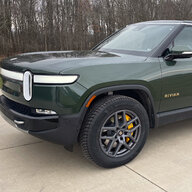
Exhibit A of the "cool factor" idiot below.

Rivian R1T R1S What's the future of the Electric Truck/SUV market? 1638458426719


Unfortunately that means the rolling coal owners wouldn't go for an EV so you have some left over percentage of the "what if" market that still may shy away because of playing out towing scenarios even though they do it once a year.
Parking outside the garage and charging is a non issue beside perception.

I think a Maverick sized EV could have a lot of potential for a segment of buyers that could go between a mid-size SUV and small truck. IE it's market would be bigger because it would cannibalize from the other.

We are in a transition period. EV margins will continue to improve and as the market begins to adjust expectations and perceptions it will continue to improve the truck/suv market.
As far as SUV's go I see this market as HUGE and prime for EV, so agree to disagree :)
Sponsored


Dbeglor

Well-Known Member
Joined
Sep 20, 2021
Threads
1
Messages
511
Reaction score
828
Location
TX
Vehicles
Yes
I'm struggling to believe that 1/3 of EV owners will pay that much for FSD....
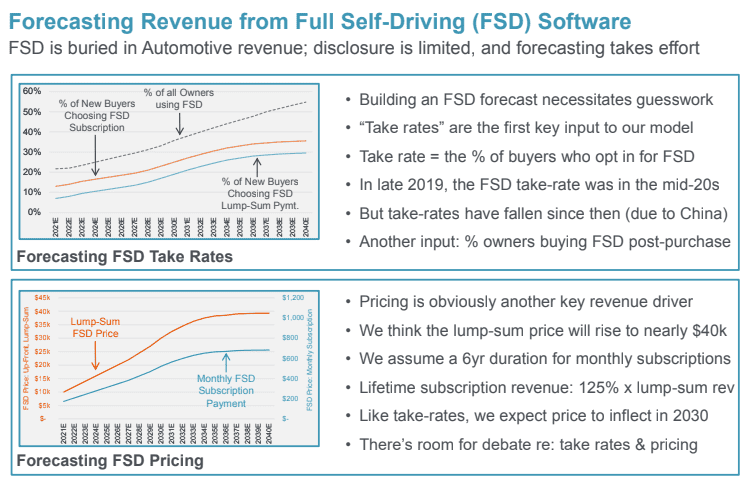
Yeah, agreed, although apparently about 25% opted for it in 2019 at $10k with limited functionality. I misquoted, it's projected to be $30k in 2030, rising to $40k by 2040 (but also take rate increasing to over 50%). This all leads to a forecast of software revenue exceeding auto sales revenue (and with 85% gross margins, so most of their net margins), which is why they are being valued as a tech company rather than an automaker. Piper Sandler is the source.

That being said, I have to imagine that at that price it has to come with ability to make money by renting your vehicle out for ride sharing while you don't need it, so that it actually offsets a lot of the cost.

Rivian R1T R1S What's the future of the Electric Truck/SUV market? 1638459606874
 

Attachments

Speedrye

Well-Known Member
Joined
Sep 17, 2021
Threads
1
Messages
484
Reaction score
821
Location
NC
Vehicles
Commodore, Supra, FJ Cruiser
I'm not sure if your argument is supply or demand based, but I'll try a counter. Regardless of the margins on ICE trucks (or any vehicle) they are potentially higher on an EV version (as Tesla has proven). Especially in the case of the Lightning, where they didn't do much to the rest of the vehicle beyond the battery and drivetrain. EV's are less expensive to produce once you figure it out (including renegotiating union contracts for the big three, EVs require 30% less labor).

As for demand, the biggest hurdle for EV trucks, and one that doesn't have a short-term solution, is towing. The fact remains that if you need to tow regularly over long distance, an EV is not for you. That being said, there is close to zero reason a contractor should buy an ICE F150 over the Lightning, even today. They don't need extensive range but still drive a lot of miles, and they would benefit from the much lower operating costs (a Lightning would save someone driving 15k mi/year about $15k over five years vs. an ICE truck). The same goes for the rest of truck owners who don't tow. There is actually a second large hurdle that may take some time, which is psychological and the perceived loss of the man card by going EV. However, the economics and experience will soon tip that over. Large SUVs are similar, the economic advantage of EVs is largest there too. Their biggest need is range because they are the family hauler for longer trips, but that will take care of itself (it's already sufficient for most people once they research it).

Home chargers can easily be installed outdoors (or run outdoors with the 25ft cables), so that's not an issue. The upfront cost net of tax incentives is already close to parity and is expected to cross below before 2025 when everyone is ramped up. Adjusted for inflation, EVs will be cheaper in 2030 than they are today as the effects of cost reductions in batteries, manufacturing and competition take hold. On the other hand, the cost of ICE vehicles will continue to climb as their scale declines. The combination of those two will make for a rather swift last ~25%-50% of the market transitioning to electric.

The two biggest parts I'm skeptical of in the long term is the actual daily savings of electric over fuel and whether battery/motor prices will indeed drop.

Currently, EV owners enjoy cheap electricity because they're a vast minority. The government won't give up their tax revenue, so once those gas taxes are passed off to electricity, the savings of going EV will be reduced. Further, that electricity, even pre-tax will be much more expensive before long for a number of reasons, unless we can get these next-gen nuke plants online. Natural gas generation won't be as viable as the oil industry declines, coal is already on the way out, and then there are the costs of upgrading pretty much every power line, substation, etc across the whole country to handle the upcoming surge in electrons. When power is 4x or 5x the cost of current rates, using cheaper operating costs as a convincing factor gets tougher. You will save on oil changes though!

I'm really hoping battery/motor pricing drops like flat-screen TVs have, but I'm skeptical as the current infrastructure isn't yet in place to handle that production on the massive scale predicted. Building out a whole new mining industry and infrastructure won't be cheap. As new technologies evolve using different rare earths, different metals, etc, you have to start all of that mining over in a new location that's more suitable for the technology of the time. Start throwing additional environmental regulations on this mining, and I don't see prices dropping.

I'm generally a very optimistic person, but I'm watching this EV transition with very skeptical thoughts as to the actual benefits of society and the environment. I'm here for 800+ horsepower and 4wd.
 

kurtlikevonnegut

Well-Known Member
Joined
Sep 1, 2021
Threads
27
Messages
2,727
Reaction score
7,552
Location
SC/TX
Vehicles
2023 R1S DM, Honda Odyssey
Clubs
 
I'm not sure if your argument is supply or demand based, but I'll try a counter. Regardless of the margins on ICE trucks (or any vehicle) they are potentially higher on an EV version (as Tesla has proven). Especially in the case of the Lightning, where they didn't do much to the rest of the vehicle beyond the battery and drivetrain. EV's are less expensive to produce once you figure it out (including renegotiating union contracts for the big three, EVs require 30% less labor).
The labor aspect is a huge hurdle that seems to be largely ignored but I think it looms large for the legacy automakers who are inextricably tied to the large unions. Regardless of your personal opinions on unions, they historically have not given concessions even when it involves the preservation of the employer. The significant reduction in labor related to EV production combined with the increasing costs associated with pensions due to current US population statistics are a massive cliff that the Big 3 are going to have to navigate and I'm not sure that they can.

To that end, I have seen a coming schism within the Progressive movement between traditional labor driven progressives who will want to preserve labor interests and the modern environmental progressives who want to drive a move towards electrification of the transportation sector at all costs. These are two very large and powerful blocs within the same political party, roughly aligned by geography, that are heading for a massive power struggle. It will be interesting to see how it plays out, but in the short term it puts companies like Tesla and Rivian at a significant advantage since they do not have those pre-existing relationships.
 

Sponsored

Dbeglor

Well-Known Member
Joined
Sep 20, 2021
Threads
1
Messages
511
Reaction score
828
Location
TX
Vehicles
Yes
The two biggest parts I'm skeptical of in the long term is the actual daily savings of electric over fuel and whether battery/motor prices will indeed drop.

Currently, EV owners enjoy cheap electricity because they're a vast minority. The government won't give up their tax revenue, so once those gas taxes are passed off to electricity, the savings of going EV will be reduced. Further, that electricity, even pre-tax will be much more expensive before long for a number of reasons, unless we can get these next-gen nuke plants online. Natural gas generation won't be as viable as the oil industry declines, coal is already on the way out, and then there are the costs of upgrading pretty much every power line, substation, etc across the whole country to handle the upcoming surge in electrons. When power is 4x or 5x the cost of current rates, using cheaper operating costs as a convincing factor gets tougher. You will save on oil changes though!

I'm really hoping battery/motor pricing drops like flat-screen TVs have, but I'm skeptical as the current infrastructure isn't yet in place to handle that production on the massive scale predicted. Building out a whole new mining industry and infrastructure won't be cheap. As new technologies evolve using different rare earths, different metals, etc, you have to start all of that mining over in a new location that's more suitable for the technology of the time. Start throwing additional environmental regulations on this mining, and I don't see prices dropping.

I'm generally a very optimistic person, but I'm watching this EV transition with very skeptical thoughts as to the actual benefits of society and the environment. I'm here for 800+ horsepower and 4wd.
I have no concerns that electricity will get more expensive, and if anything will get cheaper as continued advancements in solar, nuclear and other renewables take hold. A full transition to EVs is only estimated to increase total electricity demand by 25%. By 2030 a significant share of that increase can be supplied by local generation through home solar/battery.

On batteries, the consensus of experts who understand all of these things still predict battery costs to fall by half by 2030 despite (actually because of) increased demand, and that is just lithium ion and does not assume solid state.

One estimate is that that the average electric car in 2030 will cost about $27k, whereas the average new car today is about $45k.
 

Speedrye

Well-Known Member
Joined
Sep 17, 2021
Threads
1
Messages
484
Reaction score
821
Location
NC
Vehicles
Commodore, Supra, FJ Cruiser
Survey says:

https://www.barrons.com/articles/rivian-stock-electric-pickup-trucks-51638455929

A lot of people seem to want electric trucks, and at least claim they are willing to pay for them.

" A Citigroup survey, published Wednesday, showed that all U.S. electric-vehicle buyers are interested in electric pickup trucks—whether they drive a truck now or not. "


So, they surveyed EV owners specifically and 85% of the ones that also owned trucks wouldn't consider an EV pickup. Those are people already accepting of electric vehicles generally, and that many wouldn't buy an EV truck. That's huge to me.
 

Zoidz

Well-Known Member
First Name
Gil
Joined
Feb 28, 2021
Threads
226
Messages
5,204
Reaction score
11,705
Location
PA
Vehicles
23 R1S Adv, Avalanche, BMWs-X3,330cic,K1200RS bike
Occupation
Engineer
Yeah, agreed, although apparently about 25% opted for it in 2019 at $10k with limited functionality. I misquoted, it's projected to be $30k in 2030, rising to $40k by 2040 (but also take rate increasing to over 50%). This all leads to a forecast of software revenue exceeding auto sales revenue (and with 85% gross margins, so most of their net margins), which is why they are being valued as a tech company rather than an automaker. Piper Sandler is the source.

That being said, I have to imagine that at that price it has to come with ability to make money by renting your vehicle out for ride sharing while you don't need it, so that it actually offsets a lot of the cost.

1638459606874.png
Interesting data. I like how it says "Building an FSD forecast necessitates guesswork". I think there's A LOT of guesswork in this forecast.

It seems to me that at this time, the current FSD subscription data cnanot be realistically used to forcast future trends. WHy? Because the vast majority of vehicles available with FSD capabilities are premium vehicles purchased by people with relatively high income, who want to be early adopters, etc. and the cost is a minimal factor. The average buyer of an EV in 2030 is going to be middle income making budgetary decisions, and they are not going to pay $400 - $800 a month for FSD. I can easily afford that, but I won't do it, based on my driving needs, lifestyle and general preferences. I'd rather use that money each year for another vacation trip, etc. If it was $100 a month, sure, but I don't need it for $700 a month.

Now, I will agree that there are payback applications or lifestyle gains that make it worthwhile for some people. Ride share rental, the ability to work in the car and generate direct income while FSD, people with disabilities, elderly, come to mind, but I don't see 1/3 of all owners wanting/needing/affording this.
 

Dbeglor

Well-Known Member
Joined
Sep 20, 2021
Threads
1
Messages
511
Reaction score
828
Location
TX
Vehicles
Yes
Interesting data. I like how it says "Building an FSD forecast necessitates guesswork". I think there's A LOT of guesswork in this forecast.

It seems to me that at this time, the current FSD subscription data cnanot be realistically used to forcast future trends. WHy? Because the vast majority of vehicles available with FSD capabilities are premium vehicles purchased by people with relatively high income, who want to be early adopters, etc. and the cost is a minimal factor. The average buyer of an EV in 2030 is going to be middle income making budgetary decisions, and they are not going to pay $400 - $800 a month for FSD. I can easily afford that, but I won't do it, based on my driving needs, lifestyle and general preferences. I'd rather use that money each year for another vacation trip, etc. If it was $100 a month, sure, but I don't need it for $700 a month.

Now, I will agree that there are payback applications or lifestyle gains that make it worthwhile for some people. Ride share rental, the ability to work in the car and generate direct income while FSD, people with disabilities, elderly, come to mind, but I don't see 1/3 of all owners wanting/needing/affording this.
Agreed, I'm just providing it for a glimpse as to what others (admittedly educated and know as much as most about the company and industry, though on the more bullish end of spectrum) assume. Any forecast 10-20 years out is guesswork and will never be completely accurate.

Also worth noting that the same group also projects the majority of Tesla's sales will be in China/Europe by then (only 25% or so US).
 

ChrissyOne

Well-Known Member
First Name
Chrissy
Joined
Dec 1, 2021
Threads
5
Messages
163
Reaction score
361
Location
Port Orchard WA
Vehicles
Lexus RX350, R1T Pre-order
Occupation
Creative Production Manager at Wizards of the Coast
FSD is not going to be a major factor if it’s $400 per month or more. At least among American truck buyers. Americans actually like to drive. They’re going to pay that much not to? Really?
 

Sponsored

ChrissyOne

Well-Known Member
First Name
Chrissy
Joined
Dec 1, 2021
Threads
5
Messages
163
Reaction score
361
Location
Port Orchard WA
Vehicles
Lexus RX350, R1T Pre-order
Occupation
Creative Production Manager at Wizards of the Coast
So, they surveyed EV owners specifically and 85% of the ones that also owned trucks wouldn't consider an EV pickup. Those are people already accepting of electric vehicles generally, and that many wouldn't buy an EV truck. That's huge to me.
I think you need to read that again. They surveyed EV *buyers*, not current owners. And 15% of those who owned pickups would buy and EV pickup.
 

Speedrye

Well-Known Member
Joined
Sep 17, 2021
Threads
1
Messages
484
Reaction score
821
Location
NC
Vehicles
Commodore, Supra, FJ Cruiser
I think you need to read that again. They surveyed EV *buyers*, not current owners. And 15% of those who owned pickups would buy and EV pickup.
That'll teach me to multitask with work and forum stuff. I need to cut back on the work!

Edit: Wait, if they're buyers, they've already purchased, so they are owners. Then they go on to mention shoppers instead, so they just used the wrong word and threw me off. Journalism is dead, I swear.
 
Last edited:

Dbeglor

Well-Known Member
Joined
Sep 20, 2021
Threads
1
Messages
511
Reaction score
828
Location
TX
Vehicles
Yes
That'll teach me to multitask with work and forum stuff. I need to cut back on the work!
I think you need to read that again. They surveyed EV *buyers*, not current owners. And 15% of those who owned pickups would buy and EV pickup.
Both need to read it again. The survey was of 1,200 vehicle buyers, regardless of what they currently own.

Citi automotive analyst Itay Michaeli surveyed about 1,200 consumers planning to buy a vehicle.

- Of those 1,200, an unknown amount currently own a pickup (by default it is ICE). Of those, 15% said they would buy an EV pickup the next time they buy. If the 1,200 was representative of the population, I'm guessing this group was about 200-250 people to start, of which 15% would buy electric.

- Of the remainder of the 1,200 (non-pick up owners, unknown mix of EV and ICE), about 30% indicated they would buy an EV pickup.

So, the takeaway was that EV pickups were likely to bring in additional truck sales. The question is where those go. My thesis is that the incremental market will be dominated by Rivian and Tesla - pickups for people that haven't wanted one before - not because they weren't electric but because they didn't suit them (includes me). People that didn't buy a truck before bc it was too big, low tech, awful driving dynamics, etc. People that want a truck to be a truck 10% of the time, but be fun to drive the other 90%.
 

ChrissyOne

Well-Known Member
First Name
Chrissy
Joined
Dec 1, 2021
Threads
5
Messages
163
Reaction score
361
Location
Port Orchard WA
Vehicles
Lexus RX350, R1T Pre-order
Occupation
Creative Production Manager at Wizards of the Coast
Both need to read it again. The survey was of 1,200 vehicle buyers, regardless of what they currently own.

"About 15% of existing pickup truck owners said they would buy an EV pickup the next time they purchased a vehicle." is accurate.
 

DuckTruck

Well-Known Member
First Name
Duck
Joined
Dec 23, 2020
Threads
36
Messages
2,352
Reaction score
6,287
Location
PNW
Vehicles
Corvair, BMW325, Acura Legend, XC60, '16 Caddy ELR
Clubs
 
Ford will sell Lightnings to people who already buy F-150s, which is a lot of people, but I don't see them expanding their market, it will just gradually replace their ICE truck sales.
Cybertruck (if it ever exists, which I suspect it won't) will appeal to Musk fans who don't know anything about Trucks. I think they'll sell like VHS copies of Ishtar.
I think the best chance to Rivian to gain market share is among Toyota buyers, since they seem to be falling on their face with EVs overall. If they don't have an EV Tundra and Land Cruiser before Rivian gets ramped up, they're going to suffer. Rivian might also appeal to people who didn't necessarily drive trucks and SUVs before. But that depends on how fast the rest of the industry moves.
Chrissy,

Your comment about Rivian appealing to neglected Toyota loyalists may very well pan out. After jumping into the electrification world early with "strong" hybrids, Toyota seems to have gone silent on EV's while tumbling down the hydrogen rabbit hole. I think during their climb out, they happened upon a Badger prototype or two. Luckily, with no real components inside, they were easy to push aside.

At first, I was offended by your comment about CyberTrucks selling "like VHS copies of Ishtar". I then went to my movie rack and found that at least I was smart enough to buy mine in SuperBeta Hi-Fi. Oddly, the original plastic wrap is still intact. Go figure....

That said, no longer offended. We're all good...
???
Sponsored


Top