Sponsored

20 degrees cooler inside (roof / windshield tint/film)

the long way downunder

Well-Known Member
First Name
Adam
Joined
Jan 15, 2021
Threads
3
Messages
944
Reaction score
998
Location
charging
Vehicles
Tesla
Occupation
WFH
But it's not needed, the sun hitting the roof doesn't heat up the cabin to any appreciable amount that can be measured without the aid of sensitive high tech equipment. Parking it in direct sunlight is the equivalent of parking it in a completely shaded area.
Sorry, what?
I don't understand anything of what you've written.
Sponsored
 

photontorque

Well-Known Member
Joined
Aug 29, 2020
Threads
9
Messages
163
Reaction score
223
Location
Colorado
Vehicles
2004 Old Reliable
The untinted vehicle was black and the tinted vehicle was blue. So the ~1 degree difference may be partly down to the color.
Thanks for more details! If I had to guess, and just a guess, because both cars are dark colors the mere 1 deg difference is small enough that there could be other, very minor factors at play. Oh, to have a bunch of cash to burn. We could buy Teslas (and Rivians!) of different color combinations and isolate variables. But that is unnecessary because your simple yet powerful experiment already demonstrated a key lack of correlation.

I can't wait for the winter threads about how to get MORE heat into the cabin... :)
HA! Exactly. How to stay cool in the summer and warm in the winter.

Waiting on one the forum scientists (professional or otherwise) to do something fancy with a spectrometer or UV camera or oven thermometer (along the lines of the charging curve analyses).

Some suggest that the roof is the source of the heat and others say it’s negligible. Some say it’s the windshield and the front windows. Some say tint the top of the roof, others say bottom. There’s existing tint on roof glass and rear windows but unclear of the specs of the existing materials (ceramic?)

Surely science can come to the rescue? ? ? ??☀⏱
Go science! The spectrometer measurements elsewhere in this thread and others is a start, for sure. It turns out, at least to me as a newcomer to this topic, that this problem is more "rich in complexity" than I originally expected. At a very high level there is: (1) the input from the Sun, (2) how the input from the Sun is modulated by the vehicle glass and whatever coatings/films get added, (3) how the interior material absorbs and re-radiates what solar flux gets through the glass, and (4) how the glass transmits -- or not! -- that re-radiation from the vehicle's interior.

Each of these things apply to each "window aperture" in the vehicle. All else being equal, then, other major factors are surface area, and how the Sun enters through a given window, and by that I mean the orientation of the Sun relative to the window.

Obviously more surface area lets in more Sun. Door windows and rear windows are approximately vertical, so (assuming summer time with the Sun overhead around noon) they let in the most light in the morning and late afternoon, when the Sun is lower in the sky and the flux passes through a lot more atmosphere before it gets to your car. This decreases the direct flux passing into your vehicle at those times of day. In comparison, the windshield is sloped, and lets in direct Sunlight throughout the day, including the hottest times from midday through midafternoon. The roof, of course, faces up, meaning it doesn't really let in direct Sun in the morning or afternoon, but does let in direct Sun during the hottest time of day.

All of this means, I think, that the two biggest heat-threats are the windshield and the roof. In the case of the roof, Rivian has added significant tinting to cut down the incident flux when the Sun is high, which should greatly improve heat-mitigation performance relative to an untreated roof. That's not to say, however, that additional tinting won't help. But after knocking down the flux through the roof by a lot, the last, biggest, thermal bully in this scenario is direct Sun through the windshield.

My speculation -- again, I'm new to the tinting world so take this with a grain of salt -- is that if you do only one thing to improve heat mitigation for the Rivian, the biggest bang for the buck would be the windshield. But if you want to really attack the problem, do both the windshield and the roof, because those are the two biggest surface areas, and even though Rivian already tints the roof, the roof provides the noon-time Sun (the period of maximum solar flux during the day) direct access to the interior of the vehicle, so the more you cut that out the cooler the interior will be.

It gets somewhat complicated to understand the details of which coating works best and whether the coating should be on the outside vs. inside because (i) the energy flux across UV, VIS, and near-IR is not uniform, (ii) the different layers in the glass and coatings variously reflect, absorb, or transmit different wavelengths in different ways, (iii) the more interfaces you add to the layered "glass stack" is another opportunity for a photon to be either reflected or transmitted, and (iv) the absorption and reradiation of photons in the interior materials will be different regardless of what coating you add to the windows, so some things will just naturally heat up more than others.

Thanks for indulging wild speculation.

But, you can skip the details of all the transmission stuff if, as @Aroohoo did, you just measure the flux on the outside and just inside the glass. Maybe if we ask really nicely @Aroohoo could do this with each window, or at least each window type (i.e. front, side, back, top)?

I don't know why this is so difficult. IR is what transmits heat, not UV. Yes, you want to block UV to protect materials from fading ad degradation, but IR is what's important if you want to block heat.
I would riff on what you say -- UV, visible, and IR wavelengths are all dumping energy into the vehicle. Because the flux from visible light dominates the flux from UV and near-IR, it's the absorption of visible and reradiation of that energy in the thermal IR that generates the most heat. I think cutting down on visible flux reduces interior heating the most, though cutting down on the incident thermal IR flux helps too.
 

Mark_AZR1T

Well-Known Member
Site Sponsor
First Name
Mark
Joined
May 28, 2021
Threads
43
Messages
2,232
Reaction score
3,875
Location
Gilbert, AZ
Website
jackpucks.com
Vehicles
R1T Launch, R1S Canyon Red
Clubs
 
I wear polarized sun glasses (various brands) all the time and I haven't seen a front windshield tint or ceramic coated window film that doesn't produce mild rainbow aberrations, especially at certain sun angles. All XPEL absolutely does.......I would love to tint the windshield, but need to find a ceramic that doesn't have that polarized rainbow effect.....
 

Sponsored

zefram47

Well-Known Member
First Name
Aaron
Joined
Feb 6, 2022
Threads
18
Messages
2,753
Reaction score
4,516
Location
Denver, CO
Vehicles
Rivian R1T, Alfa Romeo 4C
Occupation
Software Engineer
I would riff on what you say -- UV, visible, and IR wavelengths are all dumping energy into the vehicle. Because the flux from visible light dominates the flux from UV and near-IR, it's the absorption of visible and reradiation of that energy in the thermal IR that generates the most heat. I think cutting down on visible flux reduces interior heating the most, though cutting down on the incident thermal IR flux helps too.
Just to counter the dark tint thing a bit. My Corvette has some obscenely dark (non-ceramic) tint on the side windows and hatch and I use a shade on the windshield. It still gets stupidly hot on a sunny day. It's bad enough I thought about getting it removed and doing ceramic instead but never bothered.
 

kneebuster

Well-Known Member
First Name
Joel
Joined
Apr 12, 2021
Threads
7
Messages
246
Reaction score
480
Location
Golden, Colorado
Vehicles
'22 Hyundai Tucson Plug-in Hybrid
Occupation
Professor
Nice! What bed rack do you have installed?
Xtrusion Overland. I picked it up used from an F150 owner, cut it down, and figured out how to mount it to the R1T. I'm trying to work with them to see if they are interested in a bolt-on solution.
 

kneebuster

Well-Known Member
First Name
Joel
Joined
Apr 12, 2021
Threads
7
Messages
246
Reaction score
480
Location
Golden, Colorado
Vehicles
'22 Hyundai Tucson Plug-in Hybrid
Occupation
Professor
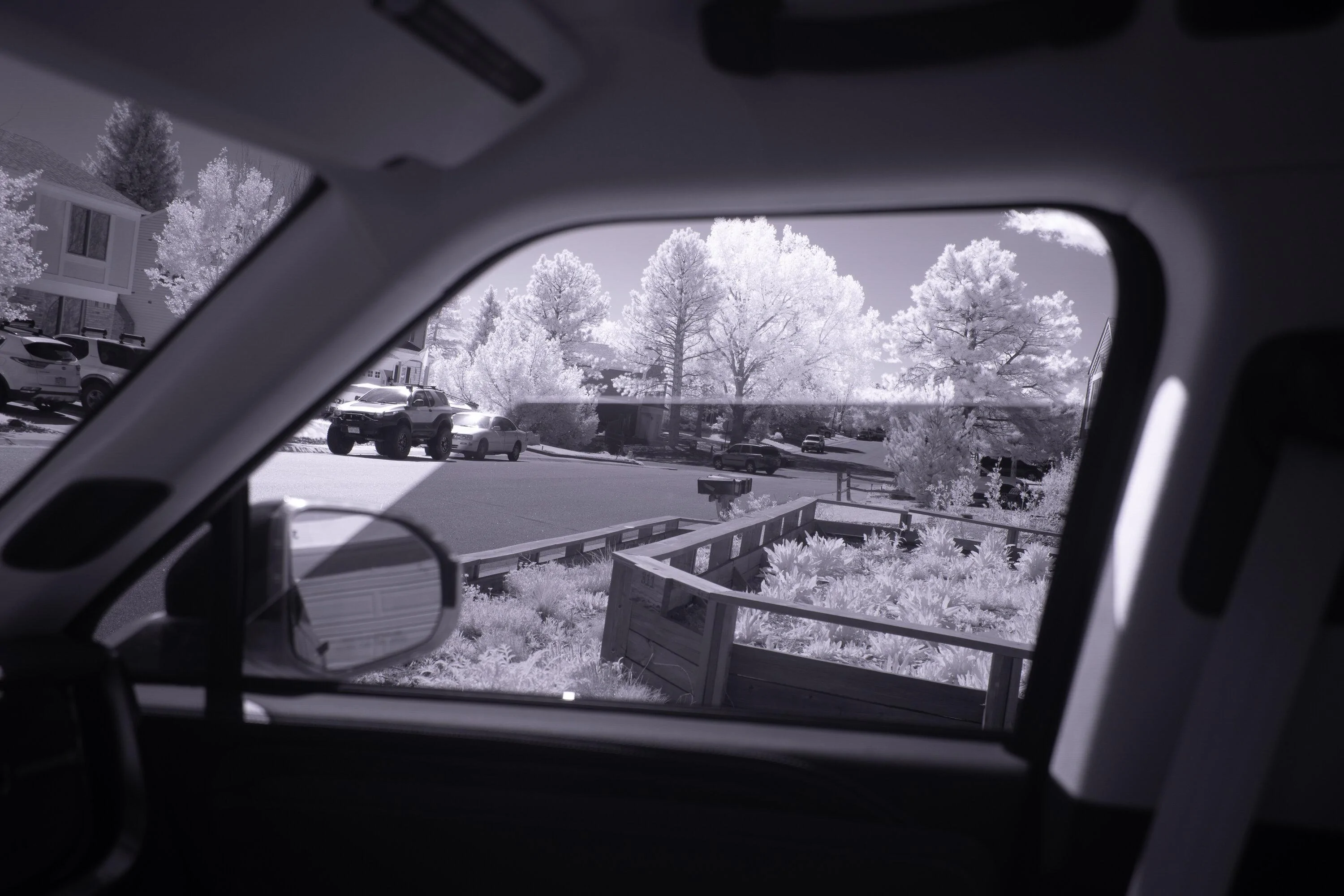
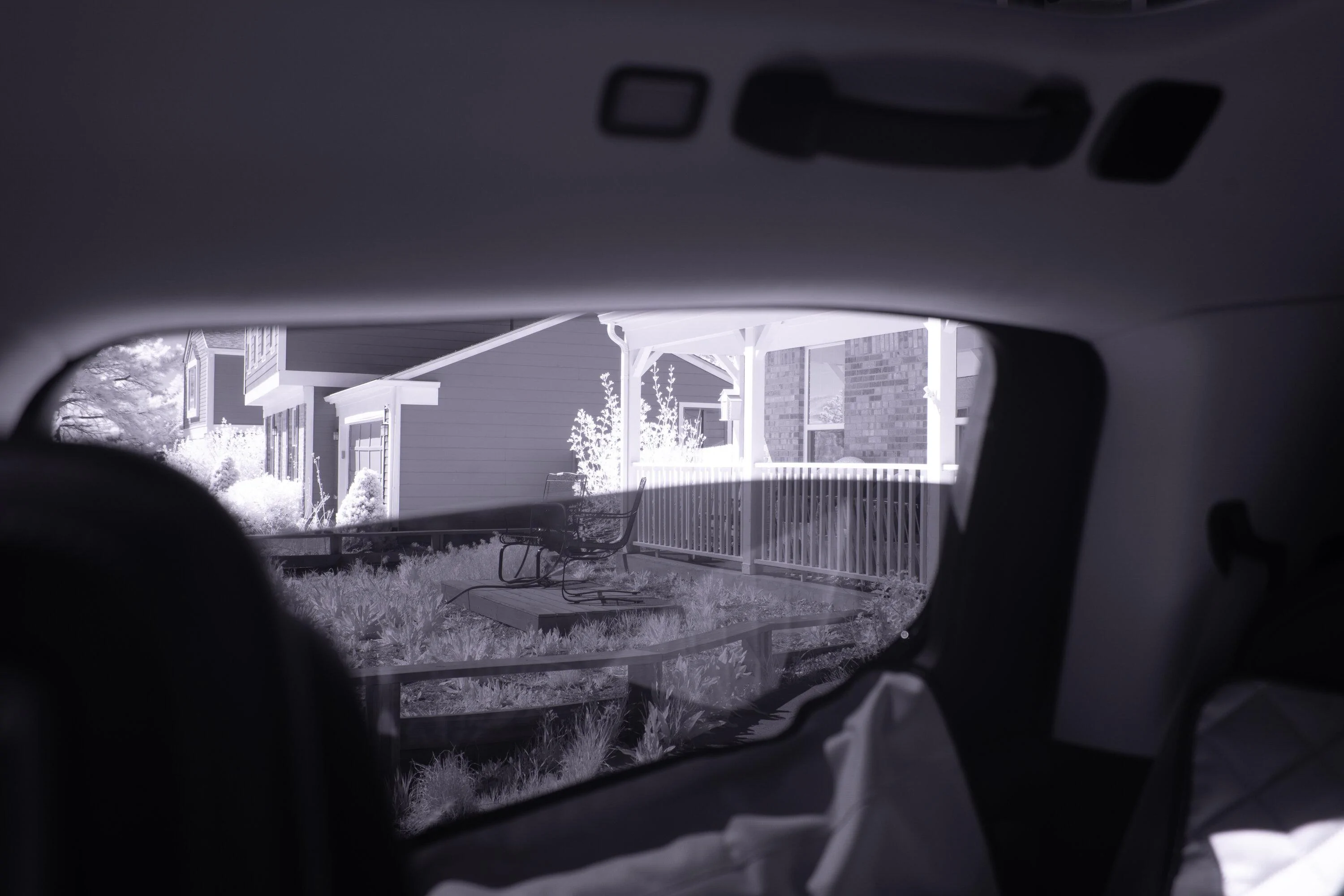
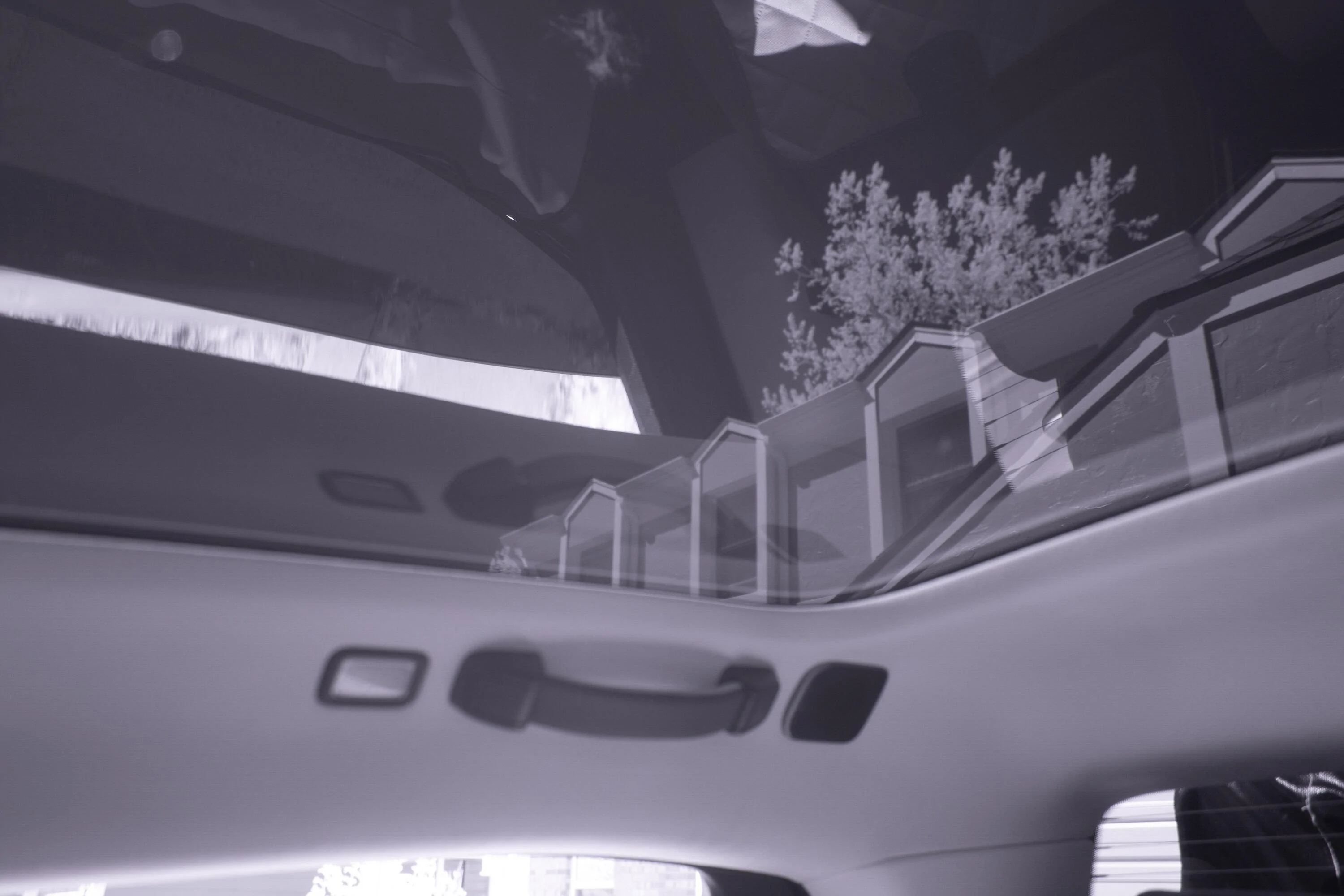
I have an full-spectrum converted Sony A7R IV. That means it can photograph infrared and ultraviolet, as well as visible light (most cameras have filters on the sensor that block UV and IR). I often run an infrared filter at 850nm to filter out all the UV and visible wavelengths. I took some pics from inside my R1T before applying any tint. What you'll notice from these is that through the open window, the foliage looks bright white. In the pic through the roof it is gray. What this means is that much less IR is getting through compared to the open window.

Rivian R1T R1S 20 degrees cooler inside (roof / windshield tint/film) 2022-05-13 Rivian _TAI1368

Through the partially open front window (before I applied the 25% tint) there is some IR filtering, but not very much. You can also see a little through the windshield and that there is a little IR filtering.

Rivian R1T R1S 20 degrees cooler inside (roof / windshield tint/film) 2022-05-13 Rivian _TAI1369

Through the partially open back window, which has factory tint, you can see more significant IR filtering.

Rivian R1T R1S 20 degrees cooler inside (roof / windshield tint/film) 2022-05-13 Rivian _TAI1370
There's obviously no way to have a partially open roof glass, but you can see effective IR filtering in that the foliage is much less bright. What's also interesting is you can see a slice of reflection from a partially open side window, and that the glass reflects the IR.

I've not repeated this since applying the PPF tint to the roof, nor the tint to the windshield, or remaining windows. The best test would be to take pics through my roof and those of an R1T without the tinted PPF.

Before anyone asks, the camera settings were manual, so there were no automatic changes between shots.
 

Surferdude

Well-Known Member
Joined
Aug 10, 2020
Threads
15
Messages
245
Reaction score
277
Location
Hawaii
Vehicles
Tesla
Rivian says their roof glass reflects quite a lot of UV. If I recall correctly their number was 98% or 99% of UV. So you may not want to do this. As others have said in this thread above, the roof glass does not appear to be the problem, but rather the windshield.
Highly reflective mirrored tint will reject most of the heat that would normally enter the vehicle through the roof. The UV benefit will likely be minimal as you noted the glass already performs well in that area. But UV isn't what is heating up the cabin.

I do also plan on legally tinting the front windshield as well. I have done so on all my vehicles. Unfortunately any legal tint film cannot be reflective/mirrored or dark so the heat rejecting benefit of the front windshield tint will not be very effective. But anything will help.
 
Last edited:

iansriv

Well-Known Member
Joined
Feb 12, 2022
Threads
20
Messages
2,803
Reaction score
3,816
Location
US
Vehicles
R1S
I wear polarized sun glasses (various brands) all the time and I haven't seen a front windshield tint or ceramic coated window film that doesn't produce mild rainbow aberrations, especially at certain sun angles. All XPEL absolutely does.......I would love to tint the windshield, but need to find a ceramic that doesn't have that polarized rainbow effect.....
I'm very close to putting ceramic on my windshield, but this gives me pause.
 

Sponsored

OP
OP
kizamybute'

kizamybute'

Well-Known Member
Joined
Oct 17, 2021
Threads
84
Messages
1,195
Reaction score
2,034
Location
Los Angeles
Vehicles
This one, that one and the other one.
Clubs
 
I wear polarized sun glasses (various brands) all the time and I haven't seen a front windshield tint or ceramic coated window film that doesn't produce mild rainbow aberrations, especially at certain sun angles. All XPEL absolutely does.......I would love to tint the windshield, but need to find a ceramic that doesn't have that polarized rainbow effect.....
This was exactly my concern with doing it as well. The tinter said, yes, it is a side-effect of wearing polarized sunglasses, which most sunglasses are. I can say however, it's not nearly as bad as it was on my Tesla which actually had the 3M material. Don't know if it has anything to do with the fact that mine is not 3M material, or the angle difference in the windshield between the Rivian and a Tesla. But, now, only at certain angles, do I get more of purplish hint. It's there. The rainbow effect is a thing, but, not as bad as I expected personally. 20 degrees cooler inside, well worth the sacrifice for me personally. Most of the time, I don't see the rainbow.

One other benefit for me personally, my eyes have always been sensitive to the sun. I have to wear sunglasses on bright days, especially bright cloudy days due to the light grey glare that comes from a thin layer of clouds covering the entire sky. I've taken off my sunglasses and with the tint, my eyes aren't bothered by the bright sunlight nearly as much as they typically are. Haven't had a cloudy day yet to determine if there will be any impact in those lighting conditions. But, the tint/clear film seems to serve a similar purpose to wearing sunglasses.
 

photontorque

Well-Known Member
Joined
Aug 29, 2020
Threads
9
Messages
163
Reaction score
223
Location
Colorado
Vehicles
2004 Old Reliable
Just to counter the dark tint thing a bit. My Corvette has some obscenely dark (non-ceramic) tint on the side windows and hatch and I use a shade on the windshield. It still gets stupidly hot on a sunny day. It's bad enough I thought about getting it removed and doing ceramic instead but never bothered.
Nothing like empirical observations to blow a hole in a theory! Thanks for the observation.

What may be happening in this case is that the roof is absorbing sunlight (uv, vis, IR) and reradiating. Some of that reradiation goes up, away from the vehicle, but some goes into the vehicle as well. Over time, that will heat up the interior.

One difference with a glass roof (Rivian or otherwise) is the opportunity for sunlight to pass into the vehicle through the roof, and heat up the interior of the car by directly heating up seats, dashboard, etc. (This is in addition to the glass roof itself heating up, just like a traditional roof.) Coatings and film can cut back on the incoming flux through the roof, but I expect the interior of a glass-roofed vehicle will heat up faster than the interior of a traditionally-roofed vehicle.

There are probably a few other factors, like interior materials (how they respond to the incoming flux) and interior volume (smaller heats up faster, bigger takes longer to heat up), that come into play as well, so to test this out in the most apples-to-apples way it would be best to have the same make, model, and color of car, one with a traditional roof and one with a glass roof. Maybe someday if Rivian ever releases a traditional roof option it would be possible to test this out.

Anyway, I think your description illustrates an important point, which is no matter what we do, the interior of a vehicle is going to get hot on a sunny day when exposed to direct sunlight. The best we can do is slow that process down – but we can’t stop it.
 

Mbxmikey

Well-Known Member
First Name
Mike
Joined
May 11, 2021
Threads
4
Messages
47
Reaction score
52
Location
Carpinteria
Vehicles
R1T White with 22s
Occupation
Construction
I use a "real" heatshield fitted sun shield on my truck, works great and makes a very significant difference. The heat shield cost about 60$ don't want to put any tint/films etc on my glass.

Just another data point.

G
Can I ask where you got the shade please. Would love to try one. Thanks
 
OP
OP
kizamybute'

kizamybute'

Well-Known Member
Joined
Oct 17, 2021
Threads
84
Messages
1,195
Reaction score
2,034
Location
Los Angeles
Vehicles
This one, that one and the other one.
Clubs
 
What I will say I notice now that I've thought of it, is that I don't burn my hands touching the wheel or trim pieces anymore, prior to tinting the roof and windshield together, the steering wheel and metal trim pieces got so hot that I literally couldn't keep my hands on them. I kind of forgot about it since, because I haven't had that problem since doing the tint.
 

GEON

Active Member
First Name
GEON
Joined
Jul 3, 2020
Threads
0
Messages
32
Reaction score
15
Location
Left Coast
Vehicles
Tesla Model S, Honda Ridgeline
Occupation
Technology Executive


Top