
Sponsored

Tax Credit for Dummies - Need Advice!

njcoach24

Well-Known Member
First Name
John
Joined
Mar 3, 2021
Threads
13
Messages
100
Reaction score
75
Location
Cape May, NJ
Vehicles
Lincoln MKC
I’ve been having a tax credit discussion with my brother-in-law and we’ve read various descriptions of how the credit works…we differ on each of our interpretations.

So when it comes to $7,500 ev tax credit, does it apply to my gross federal taxable liability or to the unsettled amount of my tax liability?…eg tax filing refund or supplemental tax payment.

Can someone help/explain?
Sponsored

 

timf

Well-Known Member
First Name
Tim
Joined
May 3, 2019
Threads
7
Messages
711
Reaction score
1,122
Location
Novi, MI
Vehicles
Rivian R1S
Clubs
 
Hopefully you've found the answer already, but just in case:

The tax credit is based on your gross tax liability. This must be over $7,500 for you to benefit from the full tax credit. You do not need to change your withholdings to owe this amount when you file your taxes. Say you had $10,000 withheld throughout the year and are due a $2,500 refund pre-credit - you would still get the full $7,500 credit in addition since that was your tax liability. You could also choose to have your withholdings reduced by $7,500 over the course of the year in anticipation of the credit, so you would receive the benefit of the tax credit on every paycheck rather than as a lump sum when you file.
 
OP
OP
njcoach24

njcoach24

Well-Known Member
First Name
John
Joined
Mar 3, 2021
Threads
13
Messages
100
Reaction score
75
Location
Cape May, NJ
Vehicles
Lincoln MKC
Hopefully you've found the answer already, but just in case:

The tax credit is based on your gross tax liability. This must be over $7,500 for you to benefit from the full tax credit. You do not need to change your withholdings to owe this amount when you file your taxes. Say you had $10,000 withheld throughout the year and are due a $2,500 refund pre-credit - you would still get the full $7,500 credit in addition since that was your tax liability. You could also choose to have your withholdings reduced by $7,500 over the course of the year in anticipation of the credit, so you would receive the benefit of the tax credit on every paycheck rather than as a lump sum when you file.
Thanks for the reply. I did find the answer, tax season helped.
 

EVTrucking

Well-Known Member
Joined
Jun 3, 2021
Threads
15
Messages
626
Reaction score
789
Location
Unknown
Vehicles
Unknown
Clubs
 
I am still a bit confused on the tax credit. Suppose I owe $8000 in fed taxes and I have paid in $9000 and claim the $7500 EV credit. Do I get a refund check for $1000+$7500 or $8500?

The way I read it the EV credit only applies to the unpaid tax In the above example I would only get the $1000. Is this correct?
 

stynes

Well-Known Member
Joined
Oct 6, 2021
Threads
9
Messages
419
Reaction score
773
Location
Atlanta, GA
Vehicles
2022 R1S LE
Clubs
 
I am still a bit confused on the tax credit. Suppose I owe $8000 in fed taxes and I have paid in $9000 and claim the $7500 EV credit. Do I get a refund check for $1000+$7500 or $8500?

The way I read it the EV credit only applies to the unpaid tax In the above example I would only get the $1000. Is this correct?
Yes. It's a tax credit. So in that scenario, you'd get a check back for $8500.
 

Sponsored

Craigins

Well-Known Member
Joined
Jun 10, 2021
Threads
2
Messages
1,571
Reaction score
2,397
Location
Chicago Suburbs
Vehicles
Rivian R1T
Occupation
Software engineer
Clubs
 
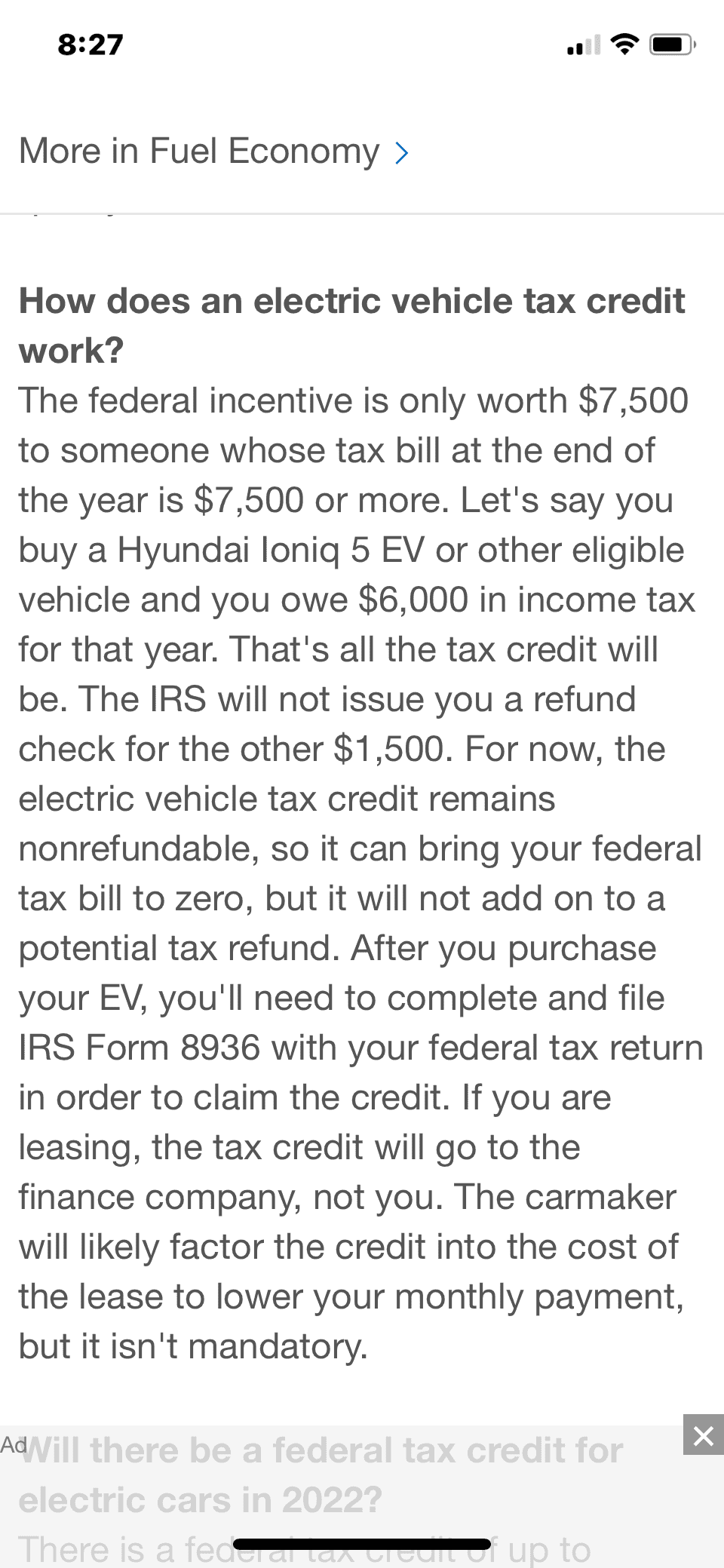
WhenI read this:

BDDE9966-D4EF-40D2-97E7-C35DEA49BA10.png

I read this to mean that when you have completed your taxes you need to owe $7500 in unpaid taxes in order to get the full $7500 EV tax credit.
You're misreading the refund statement.

Most people buying a rivian will have paid over $7500 in taxes.

That quote means if you only paid 6000 in taxes over the year, the IRS isn't going to cut you a check for the additional 1500.

You're essentially getting your 7500 back from what they took out in federal income tax over the course of the year.
 

stynes

Well-Known Member
Joined
Oct 6, 2021
Threads
9
Messages
419
Reaction score
773
Location
Atlanta, GA
Vehicles
2022 R1S LE
Clubs
 
WhenI read this:

BDDE9966-D4EF-40D2-97E7-C35DEA49BA10.png

I read this to mean that when you have completed your taxes you need to owe $7500 in unpaid taxes in order to get the full $7500 EV tax credit.
That's not accurate. When you "owe" taxes is not only what you have due at the end of the year, it's what you owe over the course of the year. The person that wouldn't get the full $7500 is someone who's "tax burden" for the year is <$7500 regardless of what they "owe" at the end of the year.
 

stynes

Well-Known Member
Joined
Oct 6, 2021
Threads
9
Messages
419
Reaction score
773
Location
Atlanta, GA
Vehicles
2022 R1S LE
Clubs
 
You're misreading the refund statement.

Most people buying a rivian will have paid over $7500 in taxes.

That quote means if you only paid 6000 in taxes over the year, the IRS isn't going to cut you a check for the additional 1500.

You're essentially getting your 7500 back from what they took out in federal income tax over the course of the year.
☝ This. The break even to get the full $7500 is about $92K annually after any deductions, etc.
 

astonius

Well-Known Member
Joined
Oct 5, 2021
Threads
53
Messages
1,434
Reaction score
3,070
Location
US
Vehicles
Cars
Simply put, disregard what you're paying throughout the year.

What matters is your total tax liability for the year. So long as that number is $7500 or greater you will reap the full benefit.
 

Sponsored

Autolycus

Well-Known Member
Joined
May 2, 2021
Threads
15
Messages
2,234
Reaction score
3,430
Location
ATL
Vehicles
ICE only :(
I am still a bit confused on the tax credit. Suppose I owe $8000 in fed taxes and I have paid in $9000 and claim the $7500 EV credit. Do I get a refund check for $1000+$7500 or $8500?

The way I read it the EV credit only applies to the unpaid tax In the above example I would only get the $1000. Is this correct?
You'd get a "refund" of $8500.

One term that seems to confuse a lot of the issue is that the EV credit, like many other credits, is called a "nonrefundable credit". It's an entirely misleading term because you can, in fact, get a refund for that amount in a scenario like what you described. What it actually means is that if you have $0 in withholdings/payments and a total tax liability of $3500 before accounting for the EV credit, you will owe nothing but you won't get anything from Treasury either. So "nonrefundable credit" really means that the government won't pay you money based on this credit if you owe less than the credit.
 

timesinks

Well-Known Member
Joined
Sep 20, 2020
Threads
6
Messages
570
Reaction score
1,851
Location
Seattle
Vehicles
R1T, ID.4, Sprinter
It's not all that crazy to follow along with the 1040 in front of you...

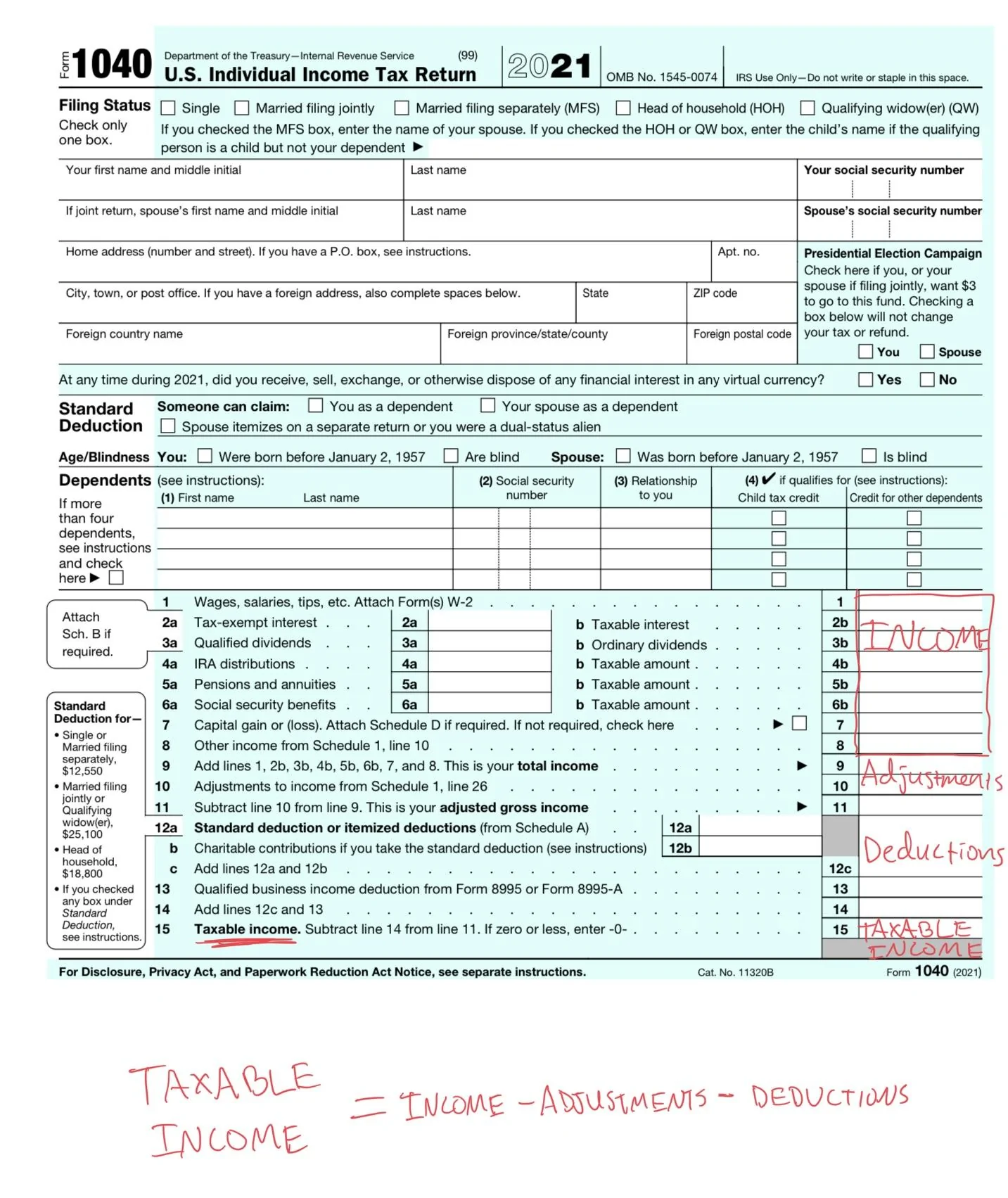
Yes, it's complicated, and there are hundreds of additional pages you can get into for the supporting calculation of this that or the other thing. But at an overview level, just reading through the 1040 can help you understand some of the basic structure.

On page one, you determine your taxable income by adding up all your income (resulting in gross income), removing any adjustments (resulting in adjusted gross income), then subtracting your deductions (resulting in taxable income).

Rivian R1T R1S Tax Credit for Dummies - Need Advice! AEDC04AB-EE0D-46E6-83E7-CFB1125448BB


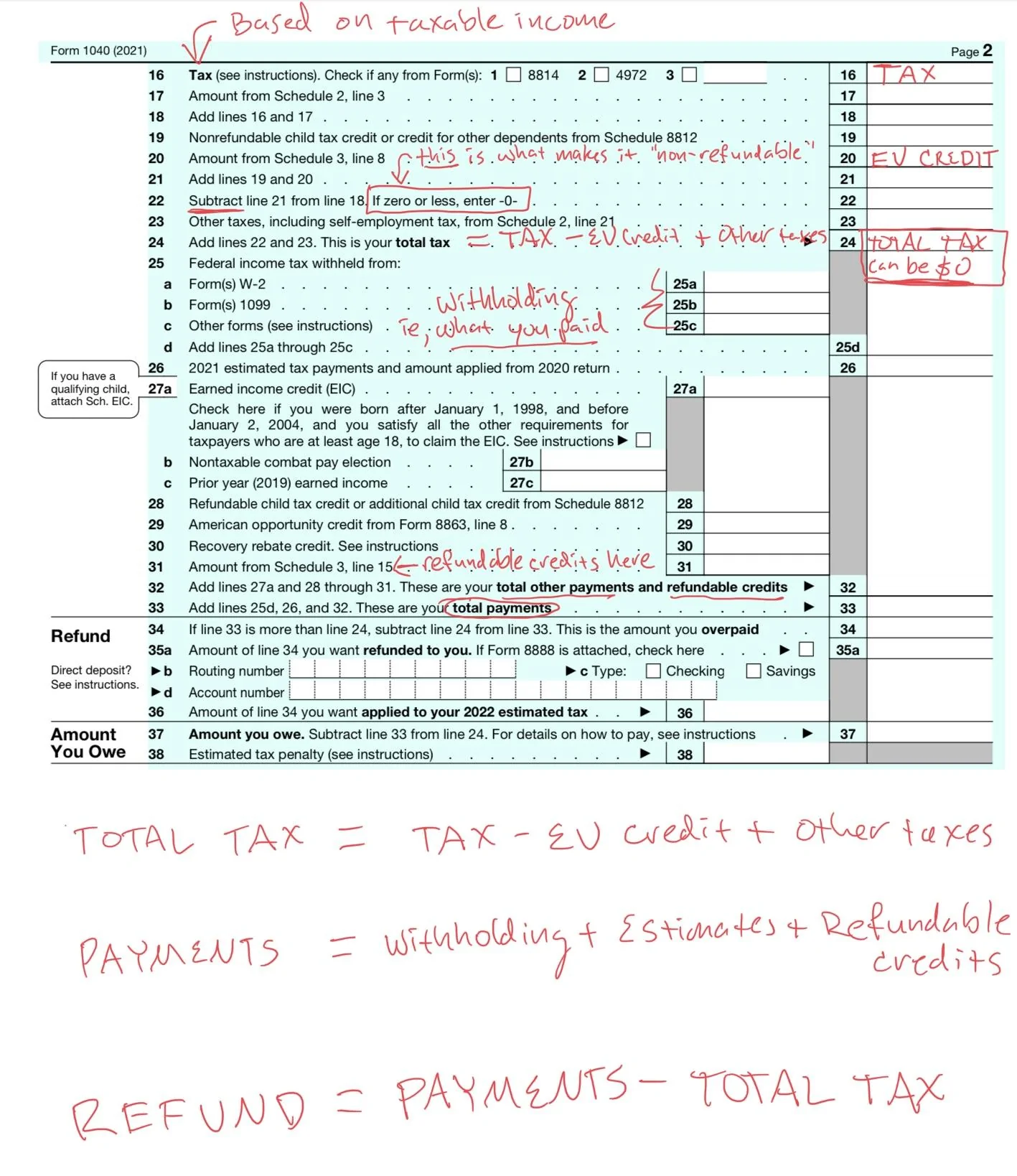
The first thing you do on page 2 is calculate your Tax (or, more specifically, your Income Tax). This can be quite complicated because of not just the progressive brackets, but the different brackets for capital gains, the special rates for collectibles or unrecaptured section 1250 gains (selling rental real estate), yada yada. But this line entitled TAX (it's #16 on the 2021 form), is the crux of it.

Skim down to line 20, and that's where the $7500 for buying your EV goes (and maybe up to $1000 for installing your EVSE in 2021).

Line 22 is where the magic happens. The encircled instruction, "If zero or less, enter -0-" is what makes it a "non-refundable" credit. If Line 20 (credit) is bigger than Line 16 (tax), the leftover goes poof gone right on this step. But this has nothing to do with payments or withholding, which come later on the form. This is just TAX - CREDITS so far.

That's how we arrive at Line 24, Total Tax: after you subtract credits (but not below $0), you add in various other taxes like self employment, net investment income, additional medicare, and others. That's your Total Tax.

Then we get on to calculating payments. This is how much you paid toward your tax bill throughout the year. For most people, most of this will be your payroll withholding. It might also be other sources of withholding or estimated payments you made.

This section (payments) is also where refundable credits go. What makes it a refundable credit is it is treated as though you paid that amount to the government from your own paycheck and can get it back if you over paid.

See how the non-refundable EV credit disappears if TAX isn't big enough? But the refundable credit on this line just gets added into your total payments. None of it disappears no matter how small TAX is.

Total payments = withholding + estimated payments + refundable credits

Refund = Total payments - Total tax

Rivian R1T R1S Tax Credit for Dummies - Need Advice! F031399B-5244-42AB-8DF9-946EAE1AACAF


Play with it. If you leave your total payments alone (don't change payroll withholding), but you claim a $7500 EV credit, what happens?

If TAX > $7500, total tax gets reduced the full $7500, payments stay the same, and refund increases $7500.

If TAX is $3000, total tax gets reduced only $3000, payments stay the same, and refund increases $3000.

If your TAX > $7500 but you want your money sooner, go reduce your payroll withholdings with a revised W-4 for the rest of the year. Total tax gets reduced the full $7500, payments get reduced $7500, refund stays the same as it would have, but you pocket $7500 over the course of the year that your employer isn't remitting to the IRS.

So if you want to know if your situation would get the full value of the credit, go grab your own tax return and look at what $7500 on line 20 changes for you. If you have anything at all on line 16, it will do something -- regardless of whether you got a refund or made a payment.
 

stynes

Well-Known Member
Joined
Oct 6, 2021
Threads
9
Messages
419
Reaction score
773
Location
Atlanta, GA
Vehicles
2022 R1S LE
Clubs
 
It's not all that crazy to follow along with the 1040 in front of you...

Yes, it's complicated, and there are hundreds of additional pages you can get into for the supporting calculation of this that or the other thing. But at an overview level, just reading through the 1040 can help you understand some of the basic structure.

On page one, you determine your taxable income by adding up all your income (resulting in gross income), removing any adjustments (resulting in adjusted gross income), then subtracting your deductions (resulting in taxable income).

AEDC04AB-EE0D-46E6-83E7-CFB1125448BB.jpeg


The first thing you do on page 2 is calculate your Tax (or, more specifically, your Income Tax). This can be quite complicated because of not just the progressive brackets, but the different brackets for capital gains, the special rates for collectibles or unrecaptured section 1250 gains (selling rental real estate), yada yada. But this line entitled TAX (it's #16 on the 2021 form), is the crux of it.

Skim down to line 20, and that's where the $7500 for buying your EV goes (and maybe up to $1000 for installing your EVSE in 2021).

Line 22 is where the magic happens. The encircled instruction, "If zero or less, enter -0-" is what makes it a "non-refundable" credit. If Line 20 (credit) is bigger than Line 16 (tax), the leftover goes poof gone right on this step. But this has nothing to do with payments or withholding, which come later on the form. This is just TAX - CREDITS so far.

That's how we arrive at Line 24, Total Tax: after you subtract credits (but not below $0), you add in various other taxes like self employment, net investment income, additional medicare, and others. That's your Total Tax.

Then we get on to calculating payments. This is how much you paid toward your tax bill throughout the year. For most people, most of this will be your payroll withholding. It might also be other sources of withholding or estimated payments you made.

This section (payments) is also where refundable credits go. What makes it a refundable credit is it is treated as though you paid that amount to the government from your own paycheck and can get it back if you over paid.

See how the non-refundable EV credit disappears if TAX isn't big enough? But the refundable credit on this line just gets added into your total payments. None of it disappears no matter how small TAX is.

Total payments = withholding + estimated payments + refundable credits

Refund = Total payments - Total tax

F031399B-5244-42AB-8DF9-946EAE1AACAF.jpeg


Play with it. If you leave your total payments alone (don't change payroll withholding), but you claim a $7500 EV credit, what happens?

If TAX > $7500, total tax gets reduced the full $7500, payments stay the same, and refund increases $7500.

If TAX is $3000, total tax gets reduced only $3000, payments stay the same, and refund increases $3000.

If your TAX > $7500 but you want your money sooner, go reduce your payroll withholdings with a revised W-4 for the rest of the year. Total tax gets reduced the full $7500, payments get reduced $7500, refund stays the same as it would have, but you pocket $7500 over the course of the year that your employer isn't remitting to the IRS.

So if you want to know if your situation would get the full value of the credit, go grab your own tax return and look at what $7500 on line 20 changes for you. If you have anything at all on line 16, it will do something -- regardless of whether you got a refund or made a payment.
I hereby nominate this post has the most detailed response to anything on this forum. Ever.
 

SunDevil2213

Well-Known Member
First Name
Ryan
Joined
Apr 25, 2022
Threads
4
Messages
133
Reaction score
276
Location
Mesa, AZ
Vehicles
2022 Rivian R1T
Occupation
Construction Cost Consultant
I don't know all the tax jargon, but having bought my first EV last year, and having completed my taxes, and now having received my refund, yes, you do in fact get a "check" (direct deposit in my case) back for your tax credit minus any liabilities. My refund this year was around $6,500 - meaning I technically owed the IRS $1000, but the $7500 EV tax credit offset that liability and I was issued a refund for the difference. I also learned from my accountant that this tax credit is PER EV, not PER lifetime. I.e. you can re-qualify for this tax credit again and again, assuming the manufacturer hasn't reached their limit of available credits. Also, yes, this assumes that you paid more than $7500 last (or this) year in taxes. If you make enough money to buy a Rivian, then there's a pretty high probability you will have paid enough in taxes to actually have a refund, assuming you don't have any other huge tax events that increase your tax liability.

PS: I'm also a dummy when it comes to taxes - so maybe we can get together and break something ¯\ _(ツ)_/¯
 
Last edited:

TyrusRex

Member
First Name
Tyrus
Joined
Feb 15, 2020
Threads
0
Messages
15
Reaction score
34
Location
Dallas, Texas
Vehicles
Rivian R1T
This has been a great thread so thanks to everyone that has contributed!

I just made initial contact with my guide this morning and it looks my purchase price will be $75,800.

I remember a few months ago reading about an IRS limit on purchase price of $75,000 in order to take advantage of the tax credit, but now that it' time to sign I can't find that information anywhere.

Does the purchase price of the vehicle affect whether or not I'll be able to take advantage of the full tax credit?

Thank you.
Sponsored


Top