
Sponsored

EV Efficiency Variable: Tire Mass Matters

OP
OP
ksurfier

ksurfier

Well-Known Member
First Name
Ken
Joined
Aug 23, 2022
Threads
49
Messages
1,124
Reaction score
1,031
Location
CA
Vehicles
R1S, Tesla
Occupation
Fake Science Lead
Clubs
 
This is all fine and not wrong. But

1. Efficiency matters the most for steady speed highway situations, where the difference in tire weight has essentially zero impact.

2. Difference in tire compound and tread design (rolling resistance) matters much more than weight.

3. Let's see real world tests and numbers before we get too worked up.
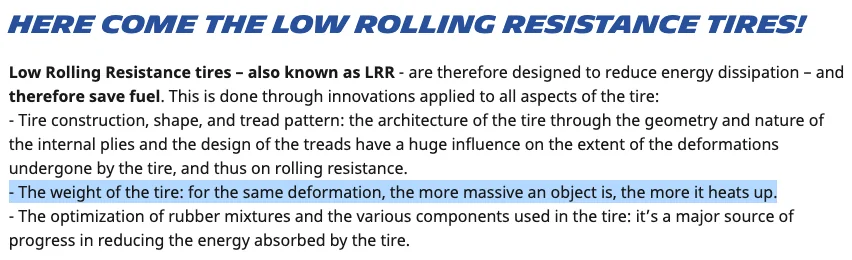
Rolling resistance is largely the mechanical expression of repeated viscoelastic hysteresis losses in the tire’s deforming rubber volume. As a tire rotates, the tread, sidewall, and internal belt package are continuously compressed, flexed, and released through the contact patch. Because rubber does not rebound perfectly, a portion of that deformation energy is lost as heat during each cycle. By a wide margin, tire weight is one of the strongest practical indicators of how much material must be repeatedly deformed; all else being equal, a heavier tire contains more rubber and structural mass that must flex with every rotation. More deforming material generally means greater hysteresis loss, more heat generation, and therefore higher rolling resistance.

One important caveat is that LT tires can offset some of this penalty when they are operated at substantially higher internal pressure, such as up to 80 psi in appropriate applications. Higher inflation pressure reduces tire deflection, shortens and stiffens the contact patch, and limits the amount of sidewall and tread deformation occurring with each rotation. That can reduce hysteresis losses and partially counteract the rolling-resistance penalty of the tire’s added mass. However, this does not erase the weight penalty entirely: LT tires are typically heavier, stiffer, and more heavily reinforced, so their rolling resistance depends on the balance between added material, casing construction, compound hysteresis, load, and actual operating pressure.
Sponsored


 

usulio

Well-Known Member
Joined
Jun 2, 2023
Threads
8
Messages
1,056
Reaction score
1,306
Location
CO
Vehicles
R1S
Clubs
 
Rolling resistance is largely the mechanical expression of repeated viscoelastic hysteresis losses in the tire’s deforming rubber volume. As a tire rotates, the tread, sidewall, and internal belt package are continuously compressed, flexed, and released through the contact patch. Because rubber does not rebound perfectly, a portion of that deformation energy is lost as heat during each cycle. By a wide margin, tire weight is one of the strongest practical indicators of how much material must be repeatedly deformed; all else being equal, a heavier tire contains more rubber and structural mass that must flex with every rotation. More deforming material generally means greater hysteresis loss, more heat generation, and therefore higher rolling resistance.

One important caveat is that LT tires can offset some of this penalty when they are operated at substantially higher internal pressure, such as up to 80 psi in appropriate applications. Higher inflation pressure reduces tire deflection, shortens and stiffens the contact patch, and limits the amount of sidewall and tread deformation occurring with each rotation. That can reduce hysteresis losses and partially counteract the rolling-resistance penalty of the tire’s added mass. However, this does not erase the weight penalty entirely: LT tires are typically heavier, stiffer, and more heavily reinforced, so their rolling resistance depends on the balance between added material, casing construction, compound hysteresis, load, and actual operating pressure.
(a) I have my own LLM, thank you (b) generally disbelieve most of this.
 

Carscott

Well-Known Member
First Name
Christopher
Joined
Oct 13, 2023
Threads
16
Messages
130
Reaction score
73
Location
Canada
Vehicles
Honda odyssey toyota Prius v
Clubs
 
OP - can you just tell me if I made a mistake getting Hankook ION HT instead of the OEM scorpion Verde 275/55/r21 for my dual motor R1S?
 

Sponsored

OP
OP
ksurfier

ksurfier

Well-Known Member
First Name
Ken
Joined
Aug 23, 2022
Threads
49
Messages
1,124
Reaction score
1,031
Location
CA
Vehicles
R1S, Tesla
Occupation
Fake Science Lead
Clubs
 
OP - can you just tell me if I made a mistake getting Hankook ION HT instead of the OEM scorpion Verde 275/55/r21 for my dual motor R1S?
I generally avoid 21-inch tires***, but for you I’ll make an exception.

I’m seeing five realistic options, ranging from about $300 to $500 per tire. I’d focus on the top three:

The Pirelli is attractive on paper because it’s light at about 37 lb, but it only has 10/32” tread depth and a 600 UTQG rating. For me, that makes it hard to justify unless maximum efficiency is the only priority.

The Michelin Defender looks like the safest overall pick: about 39 lb, 11/32” tread depth, and an 820 UTQG rating. It also has a long history of being one of the best all-season tires, which gives it a lot of credibility.

I’d normally put the Bridgestone next, but since you already have the Hankooks, I’d mostly set that option aside for now.

The Hankook iON is interesting because it has a 900 UTQG rating, so it may last forever, and it starts with 12/32” tread depth. The downside is weight: around 43 lb. I’d want to run them for at least 800–1,000 miles before making a final judgment, because new tires can be noticeably less efficient at first and often improve after break-in.

Very rough efficiency guess, all else equal: the Defender may be around 5% less efficient than the Pirelli, while the Hankook iON could be around 15% less efficient, at least early on.

For me, I’d stay far, far away from the Pirelli. I’d call it close to a tie between the Michelin Defender and the Hankook iON, with maybe a slight edge to the Defender because it has such a strong track record as a top all-season tire.

*** - The pricing penalty of 21” tires means you can get a set of hyper efficient Atomic Wheels 20” rims and then pair it with a super light tire like the General Grabber HTS 60 and achieve better MPK all while saving money in the long term. If your cost per kWh is super low then this shouldn’t be an overwhelming factor, just pick the tires you want and have a nice day!

Also honorable mention for the 40 lb Yokohamas w/ 70k mileage warranty:

Rivian R1T R1S EV Efficiency Variable: Tire Mass Matters IMG_7437
 
Last edited:

DuoRivians

Well-Known Member
Joined
Dec 30, 2022
Threads
260
Messages
3,892
Reaction score
9,236
Location
California
Vehicles
R1T, R1S
For the 22” wheels, I personally like the Nokian One HT tires. They perform great and they’re unbeatable in price. Walmart was (may even now) running a special for $800 for a full set
 
OP
OP
ksurfier

ksurfier

Well-Known Member
First Name
Ken
Joined
Aug 23, 2022
Threads
49
Messages
1,124
Reaction score
1,031
Location
CA
Vehicles
R1S, Tesla
Occupation
Fake Science Lead
Clubs
 
For the 22” wheels, I personally like the Nokian One HT tires. They perform great and they’re unbeatable in price. Walmart was (may even now) running a special for $800 for a full set
For some reason, I still tend to think of Nokian primarily as a snow/ice tire brand. For daily-driver use on a Rivian, my instinct is that there are probably at least 3–5 manufacturers better positioned overall, especially when balancing efficiency, wet/dry braking, tread life, road noise, availability, and EV/load-rated fitments.

I’m not saying Nokian makes bad tires—they clearly have strong offerings, especially in winter and all-weather categories; but they would not be my default first choice for a heavy EV unless the use case strongly favored snow, ice, or severe-weather capability. The past credibility issue with test tires also lowers my trust level a bit when interpreting reviews, rankings, or manufacturer-backed claims, so I’d want to lean more heavily on recent independent testing and real-world Rivian/EV owner feedback.
 

DuoRivians

Well-Known Member
Joined
Dec 30, 2022
Threads
260
Messages
3,892
Reaction score
9,236
Location
California
Vehicles
R1T, R1S
For some reason, I still tend to think of Nokian primarily as a snow/ice tire brand. For daily-driver use on a Rivian, my instinct is that there are probably at least 3–5 manufacturers better positioned overall, especially when balancing efficiency, wet/dry braking, tread life, road noise, availability, and EV/load-rated fitments.

I’m not saying Nokian makes bad tires—they clearly have strong offerings, especially in winter and all-weather categories; but they would not be my default first choice for a heavy EV unless the use case strongly favored snow, ice, or severe-weather capability. The past credibility issue with test tires also lowers my trust level a bit when interpreting reviews, rankings, or manufacturer-backed claims, so I’d want to lean more heavily on recent independent testing and real-world Rivian/EV owner feedback.
The ONEs are quite popular and does well with Rivian owners. I suggest keeping an open mind on them.
 

Indy avocado

Well-Known Member
First Name
Greg
Joined
Dec 17, 2022
Threads
3
Messages
215
Reaction score
276
Location
Indiana
Vehicles
'22 R1T, '17 Macan S, '11 Mustang GT
1. Efficiency matters the most for steady speed highway situations, where the difference in tire weight has essentially zero impact.

2. Difference in tire compound and tread design (rolling resistance) matters much more than weight.
This exactly.

Rolling resistance is largely the mechanical expression of repeated viscoelastic hysteresis losses in the tire’s deforming rubber volume. As a tire rotates, the tread, sidewall, and internal belt package are continuously compressed, flexed, and released through the contact patch. Because rubber does not rebound perfectly, a portion of that deformation energy is lost as heat during each cycle. By a wide margin, tire weight is one of the strongest practical indicators of how much material must be repeatedly deformed; all else being equal, a heavier tire contains more rubber and structural mass that must flex with every rotation. More deforming material generally means greater hysteresis loss, more heat generation, and therefore higher rolling resistance.

One important caveat is that LT tires can offset some of this penalty when they are operated at substantially higher internal pressure, such as up to 80 psi in appropriate applications. Higher inflation pressure reduces tire deflection, shortens and stiffens the contact patch, and limits the amount of sidewall and tread deformation occurring with each rotation. That can reduce hysteresis losses and partially counteract the rolling-resistance penalty of the tire’s added mass. However, this does not erase the weight penalty entirely: LT tires are typically heavier, stiffer, and more heavily reinforced, so their rolling resistance depends on the balance between added material, casing construction, compound hysteresis, load, and actual operating pressure.
(a) I have my own LLM, thank you (b) generally disbelieve most of this.
While it can be patronizing to get a LLM response, you disbelieve the robot that has a far broader "knowledge" than any human in the world? What is your rationale or evidence dismiss it? Clue us in.

As a tire nerd (both cars and bikes), the explanation is *perfectly* accurate.
 

Sponsored

usulio

Well-Known Member
Joined
Jun 2, 2023
Threads
8
Messages
1,056
Reaction score
1,306
Location
CO
Vehicles
R1S
Clubs
 
While it can be patronizing to get a LLM response, you disbelieve the robot that has a far broader "knowledge" than any human in the world? What is your rationale or evidence dismiss it? Clue us in.

As a tire nerd (both cars and bikes), the explanation is *perfectly* accurate.
Really? Please defend this: "By a wide margin, tire weight is one of the strongest practical indicators of how much material must be repeatedly deformed"

Compare to other "practical indicators": overall vehicle weight, tire compound and construction, and tire pressure.

The robots do ingest a lot of knowledge but they are also expert BSers as we can see in this case. In fact if you go to wikipedia pages or reputable search results like these[1][2] you will find that tire weight is not even listed among top factors into rolling resistance compared to the ones I listed above. [1] https://www.continental-tires.com/a...lated-use-phase-emissions/rolling-resistance/ [2] https://tirecalculatorhub.com/guides/rolling-resistance-guide
 

Indy avocado

Well-Known Member
First Name
Greg
Joined
Dec 17, 2022
Threads
3
Messages
215
Reaction score
276
Location
Indiana
Vehicles
'22 R1T, '17 Macan S, '11 Mustang GT
Really? Please defend this: "By a wide margin, tire weight is one of the strongest practical indicators of how much material must be repeatedly deformed"

Compare to other "practical indicators": overall vehicle weight, tire compound and construction, and tire pressure.

The robots do ingest a lot of knowledge but they are also expert BSers as we can see in this case. In fact if you go to wikipedia pages or reputable search results like these[1][2] you will find that tire weight is not even listed among top factors into rolling resistance compared to the ones I listed above. [1] https://www.continental-tires.com/a...lated-use-phase-emissions/rolling-resistance/ [2] https://tirecalculatorhub.com/guides/rolling-resistance-guide
That doesn't contradict the statements.
From Michelin:
https://www.michelin.com.ph/auto/advice/tire-basics/rolling-resistance
Rivian R1T R1S EV Efficiency Variable: Tire Mass Matters 1783592039567-1
 

Carscott

Well-Known Member
First Name
Christopher
Joined
Oct 13, 2023
Threads
16
Messages
130
Reaction score
73
Location
Canada
Vehicles
Honda odyssey toyota Prius v
Clubs
 
I generally avoid 21-inch tires***, but for you I’ll make an exception.

I’m seeing five realistic options, ranging from about $300 to $500 per tire. I’d focus on the top three:

The Pirelli is attractive on paper because it’s light at about 37 lb, but it only has 10/32” tread depth and a 600 UTQG rating. For me, that makes it hard to justify unless maximum efficiency is the only priority.

The Michelin Defender looks like the safest overall pick: about 39 lb, 11/32” tread depth, and an 820 UTQG rating. It also has a long history of being one of the best all-season tires, which gives it a lot of credibility.

I’d normally put the Bridgestone next, but since you already have the Hankooks, I’d mostly set that option aside for now.

The Hankook iON is interesting because it has a 900 UTQG rating, so it may last forever, and it starts with 12/32” tread depth. The downside is weight: around 43 lb. I’d want to run them for at least 800–1,000 miles before making a final judgment, because new tires can be noticeably less efficient at first and often improve after break-in.

Very rough efficiency guess, all else equal: the Defender may be around 5% less efficient than the Pirelli, while the Hankook iON could be around 15% less efficient, at least early on.

For me, I’d stay far, far away from the Pirelli. I’d call it close to a tie between the Michelin Defender and the Hankook iON, with maybe a slight edge to the Defender because it has such a strong track record as a top all-season tire.

*** - The pricing penalty of 21” tires means you can get a set of hyper efficient Atomic Wheels 20” rims and then pair it with a super light tire like the General Grabber HTS 60 and achieve better MPK all while saving money in the long term. If your cost per kWh is super low then this shouldn’t be an overwhelming factor, just pick the tires you want and have a nice day!

Also honorable mention for the 40 lb Yokohamas w/ 70k mileage warranty:

IMG_7437.webp


I have no idea if it’s right but Gemini is telling me that the rolling efficiency benefit of the Hankook ION HT far exceeds the penalty of its weight. And by its calculations it will slightly perform better than Pirelli OEM.

Here was my instruction to Gemini after informing it of the tire models to compare.

“Can you review this same tire comparison however look at the relationship between rolling resistance and overall tire weight and calculate the impact of the weight and rolling resistance on acceleration and impacts to range.”

I’m hoping Gemini is right.
 

mkhuffman

Well-Known Member
First Name
Mike
Joined
Nov 9, 2020
Threads
14
Messages
2,997
Reaction score
3,413
Location
Virginia
Vehicles
2025 R1T Tri-Max, Jeep GC-L, VW Jetta
That seems completely backwards, and looks like a great use for my temporary access to Fable 5. So let's ask. Meanwhile, the reason I think it's backwards is that EVs will at least capture PART of that energy back, assuming a proper regen setting and no usage of the friction brake. ICE will lose all of it unless you're just coasting to stops every time. Tire FRICTION and other dynamics would still affect an EV more, for the reasons you cited. So that all said, let's ask Claude/Fable.


The claim is mostly correct, and the core mechanism it identifies — visibility of losses rather than different physics — is exactly right. But it conflates two things ("tire weight" vs. "tire choice/rolling resistance") in a way worth untangling, because the data shows one matters far more than the other.

The part that's solidly supported

The energy-share argument checks out. EVs use approximately 87–91% of the energy from the battery and regenerative braking to propel the vehicle, while gasoline vehicles only convert about 16–25% of the energy from gasoline into movement (EPA/DOE). Since tire losses at the contact patch are the same absolute physics either way, the denominator shrinks dramatically for EVs and the tire's share balloons. The tire industry's own numbers quantify this directly: Michelin claims that while about 5% of an ICE vehicle's energy goes to the tires, this figure rises to approximately 16% for EVs, and Pirelli estimates tires influence an EV's range by 20–40%, compared to 15–20% for ICE vehicles. Michelin's framing matches the claim's language almost word for word: EVs don't waste a lot of energy through heat loss and engine friction, so the relatively small amount of energy lost to rolling resistance takes on a much more significant role in overall efficiency. Independent test-lab commentary agrees: rolling resistance represents a significantly higher portion of total driving resistance in EVs because their efficient motors and simplified drivetrains mean the tire accounts for a larger percentage of the force required to move the vehicle. US EPA + 3


The regen caveat is accurate. The industry consensus is that regen recovers roughly 60–70% of kinetic energy in round-trip terms — accounting for losses in recovery, conversion, battery storage, extraction, and re-conversion to tractive energy. On the EPA combined cycle, net regenerative braking recovers about 22% of the energy budget. So "some but not all" is exactly right. Store-dotU.S. Department of Energy


Heavy EVs amplify it. All things being equal, the more weight a tire must support, the greater the energy loss of the tire — rolling resistance force is Crr × normal load, so a 7,000 lb R1T pays proportionally more per point of Crr than a 3,200 lb Model 3. Michelin Man

The part that needs a correction

The claim's headline variable — tire weight — is actually the weakest lever in the chain. Empirically, when people isolate variables:


  • In tests where only the rims are changed, it's only about a 1% efficiency difference for a very large weight change; the ~10% efficiency improvement Car and Driver measured in a tire swap was almost entirely due to the tires' rolling resistance, not the weight difference. Allev
  • The physics reason: rotating mass only costs extra energy during acceleration (roughly, mass on the wheels takes around 1.6× more energy to move than mass on the body, because it's both translating and rotating). At steady highway speed — where range anxiety actually lives — kinetic energy isn't changing, so rotational inertia contributes ~nothing; you're paying only for Crr and aero. L2SFBC
  • And here's the ironic twist the claim gets backwards: regen makes rotating mass matter less in an EV than in an ICE vehicle. The energy spent spinning up heavier tires is kinetic energy, and an EV recovers 60–70% of it on deceleration, whereas an ICE vehicle throws 100% of it away as brake heat. If tire mass were the mechanism, EVs would be the more forgiving platform.

So the accurate restatement is: tire choice (rolling resistance coefficient, tread aggressiveness, compound, and to a lesser degree width/aero) is one of the biggest range decisions on an EV; tire weight per se mostly affects drivability — unsprung mass, suspension compliance, steering feel — where lower unsprung and rotational weight lets the springs and shocks control wheel movement more effectively. Weight correlates with high Crr (an A/T with heavy lugs is both heavy and draggy), which is why the folk claim survives, but the causal variable is hysteresis in the rubber, not grams. Teslasiliconvalley

Practical numbers for your situation

For an R1T specifically the effect sizes are large and well documented anecdotally: going from the OEM Pirelli Scorpion AS (EV-spec, low Crr) to a conventional all-terrain typically costs Rivian owners 10–15% of range, and the effect scales with the ~2.4 Wh/mi-per-Crr-point sensitivity of a 7,000 lb truck. The rule of thumb from the ICE era — 10% Crr reduction ≈ 1–2% fuel savings — roughly triples for EVs because of the share effect above, which is the quantitative core of the claim.


Verdict: the conclusion (tire selection is a first-order range decision on a heavy EV, driven by loss visibility rather than new physics) is correct and well-sourced. The mechanism attribution to weight should be reassigned to rolling resistance, and the regen point, while factually true, actually cuts against the weight argument rather than supporting it.


Key sources: EPA – Electric Vehicle Myths, DOE FOTW #1360, Michelin – How tires impact EV range, Recurrent – EV Efficiency, AllEV – Does Wheel Weight Matter?, StoreDot – Regen efficiency.
Your LLM is smarter than the OP's.

Rolling resistance due to the rubber compound (edit - and tire design) is more important than weight. And at steady speed on the highway, the aerodynamics of the wheel matter more than weight.

Weight is the least important factor. Rolling resistance is the most important factor.

You can't use weight of the wheel to determine the efficiency of the wheel, especially when it comes to highway range. And highway range is when range is most important because that is the type of driving that is most likely going to be taking you too far to charge at home.

@ksurfier, I know you are trying to make selecting the most efficient tire as easy as possible by focusing on one aspect, weight, but it is more complex than that. Weight alone is not the most important factor, so if you only focus on weight in your decision process, you will get bad results.

First look for low rolling resistance tires - tires that are designed to improve efficiency. They might be heavier (maybe due to sound reduction filling like the Hankooks) but they almost certainly will be more efficient than a equivalent tire that is lighter and not designed for low rolling resistance.

And if you are replacing the rim, pick one designed for good aerodynamics. It will be hard to beat what Rivian has designed, but you might find something similar or slightly better. Maybe. But if you pick a rim that is extremely light but wide open (common with light wheels), your highway range will be noticeably worse due to the poor aerodynamics.

Weight matters but it is the least important factor. And I don't need a hallucinating LLM to tell me that. It is a fact.
 
Last edited:

mkhuffman

Well-Known Member
First Name
Mike
Joined
Nov 9, 2020
Threads
14
Messages
2,997
Reaction score
3,413
Location
Virginia
Vehicles
2025 R1T Tri-Max, Jeep GC-L, VW Jetta


Top