

Sponsored

Home Wall Charger

emroch

Well-Known Member
First Name
Eric
Joined
Jun 9, 2026
Threads
2
Messages
57
Reaction score
94
Location
Austin, TX
Vehicles
Nissan Altima, Chevy Equinox
No no no no no. They charge at the same rate in kW. Don't use "miles" as a unit, you're not filling your battery with miles.

The different range achieved with the same number of kWh is because different models have different efficiencies, so unless you actually know the efficiency number and actually do the math, you can't compare "miles".
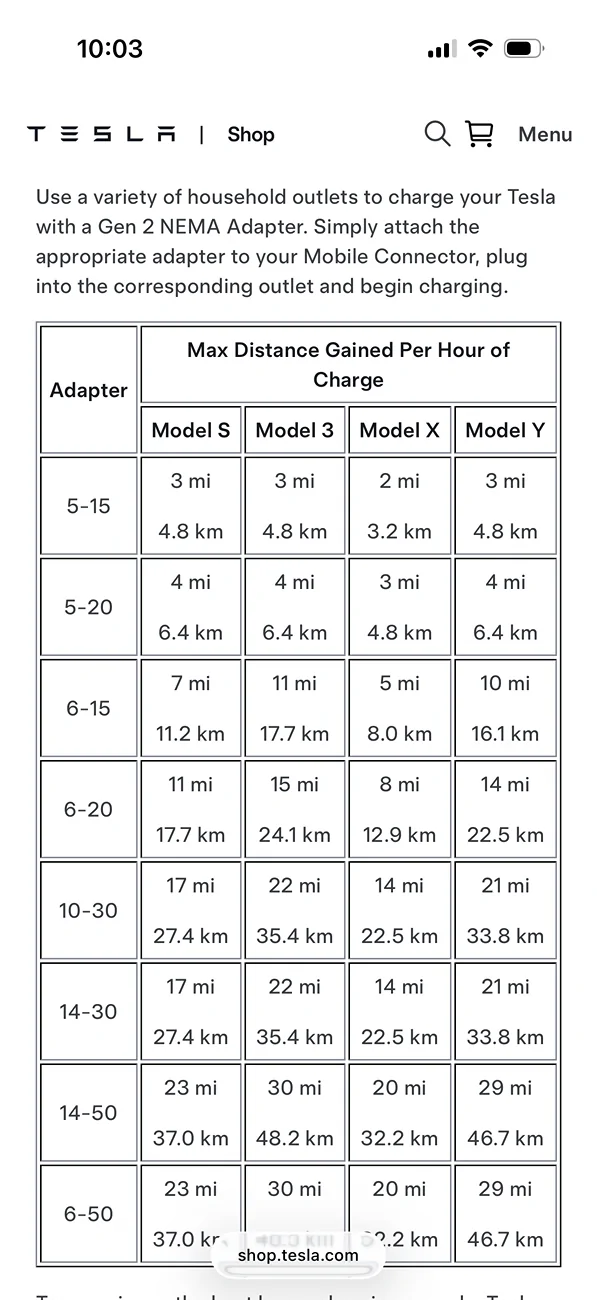
I'm just quoting what Tesla posted on the product page...

And the 5-15 vs 5-20 will not charge at the same rate in kW, as the available amperage is different. This is supported by the fact that the 5-20 adds 33% more range per hour (on the same vehicle) than the 5-15.

I agree that mph is not a great unit for charging speed, kind of like measuring intergalactic trade runs in parsecs, but retconned or not both have reasonable explanations. MPH is useful for personal charging where you want to know "I have X minutes available to charge right now, how much range can I add in this time?" If you only think in kW, you're probably doing another conversion in your head anyway, eg mi/kWh, which is just an extra step.

Benchmarking and real-world use are different beasts, and a unit that doesn't make sense for one can work for the other just fine.
Rivian R1T R1S Home Wall Charger IMG_9970
Sponsored


Bullwinkle

Well-Known Member
First Name
Jim
Joined
Aug 12, 2022
Threads
3
Messages
284
Reaction score
258
Location
Minnesota
Vehicles
2023 Rivian RS1, 2026 BMW X5 50e
Occupation
Retired
Yes, I have this setup at my parents house. You need the Tesla mobile connector and you can buy all the different plugs for $35 each I think.

6-20 is 240 volts at 16 amps, or 3.8 kW. Works great and is a very underrated setup.

5-20 is 16 amps at 120 volts so not as good, but better than a household outlet. Tesla sells the adapter for that too.

5-15 is a normal household outlet and won’t pull more than 12 amps on the charger.

So interestingly, the Tesla with a 5-20 pigtail is almost twice as fast because some of the amperage is used for
I'm just quoting what Tesla posted on the product page...

And the 5-15 vs 5-20 will not charge at the same rate in kW, as the available amperage is different. This is supported by the fact that the 5-20 adds 33% more range per hour (on the same vehicle) than the 5-15.

I agree that mph is not a great unit for charging speed, kind of like measuring intergalactic trade runs in parsecs, but retconned or not both have reasonable explanations. MPH is useful for personal charging where you want to know "I have X minutes available to charge right now, how much range can I add in this time?" If you only think in kW, you're probably doing another conversion in your head anyway, eg mi/kWh, which is just an extra step.

Benchmarking and real-world use are different beasts, and a unit that doesn't make sense for one can work for the other just fine.

IMG_9970.webp

It may be closer to twice as fast!
 

emroch

Well-Known Member
First Name
Eric
Joined
Jun 9, 2026
Threads
2
Messages
57
Reaction score
94
Location
Austin, TX
Vehicles
Nissan Altima, Chevy Equinox
Actually there is an argument for a smart level 2 EVSE. My house has a 100 amp panel which means I have to limit charging to 32 amps. My R2 can pull 48 amps. So my gen 3 Tesla EVSE allows me to keep things safe by throttling current.
You don't necessarily need a smart/connected EVSE for this, some models have internal switches you can configure to cap the current draw based on the circuit you have. So an 80A EVSE might be configured to draw 32A max, which means you don't have to worry about making sure the car is properly configured. This would be a headache if you ever use multiple chargers (and want to charge faster on the other charger), or have multiple vehicles/guests using your charger at home.
 

emroch

Well-Known Member
First Name
Eric
Joined
Jun 9, 2026
Threads
2
Messages
57
Reaction score
94
Location
Austin, TX
Vehicles
Nissan Altima, Chevy Equinox

So interestingly, the Tesla with a 5-20 pigtail is almost twice as fast because some of the amperage is used for


It may be closer to twice as fast!
That's very interesting and makes some sense. But for 5-20 to be twice as fast as 5-15 (16A vs 12A), there would have to be 8A of overhead (leaving 8A vs 4A for charging). At 120V, that is 960W for the following:
  • Battery management (charge controller, thermal management, etc)
  • AC/DC conversion losses
  • Onboard computer systems (likely very small)
My gut reaction was that ~1kW overhead seems high, but maybe keeping the battery cool and accounting for conversion losses could eat up that margin?
 

Bullwinkle

Well-Known Member
First Name
Jim
Joined
Aug 12, 2022
Threads
3
Messages
284
Reaction score
258
Location
Minnesota
Vehicles
2023 Rivian RS1, 2026 BMW X5 50e
Occupation
Retired
That's very interesting and makes some sense. But for 5-20 to be twice as fast as 5-15 (16A vs 12A), there would have to be 8A of overhead (leaving 8A vs 4A for charging). At 120V, that is 960W for the following:
  • Battery management (charge controller, thermal management, etc)
  • AC/DC conversion losses
  • Onboard computer systems (likely very small)
My gut reaction was that ~1kW overhead seems high, but maybe keeping the battery cool and accounting for conversion losses could eat up that margin?
I agree, it seems unlikely, but it makes sense that the increased speed may be noticeably higher than 12amp to 16amp would suggest.
 

emroch

Well-Known Member
First Name
Eric
Joined
Jun 9, 2026
Threads
2
Messages
57
Reaction score
94
Location
Austin, TX
Vehicles
Nissan Altima, Chevy Equinox
Hmm, this is an interesting data point: https://www.rivianforums.com/forum/...ging-session-at-a-tesla-sc.60729/post-1032450

The panel on the right shows that of the 52.3 kWh consumed during the charge, 51.8 went to the battery, 0.3 to the vehicle (?) and 0.2 to climate. Over a 21 minute charge, that 0.5 kWh that wasn't used for charging is about 1500W sustained, so maybe ~1kW overhead is about right.

A 5-15 would then give about 0.4kW to the battery while a 5-20 gives 0.9kW, which is a much bigger boost than the 15->20A jump implies.
Sponsored


Top