
Sponsored

EV Efficiency Variables: Key Factors That Affect Range / Efficiency in Real-World Driving

ksurfier

Well-Known Member
First Name
Ken
Joined
Aug 23, 2022
Threads
46
Messages
1,105
Reaction score
1,005
Location
CA
Vehicles
R1SQM, Tesla
Occupation
Fake Science Lead
Clubs
 
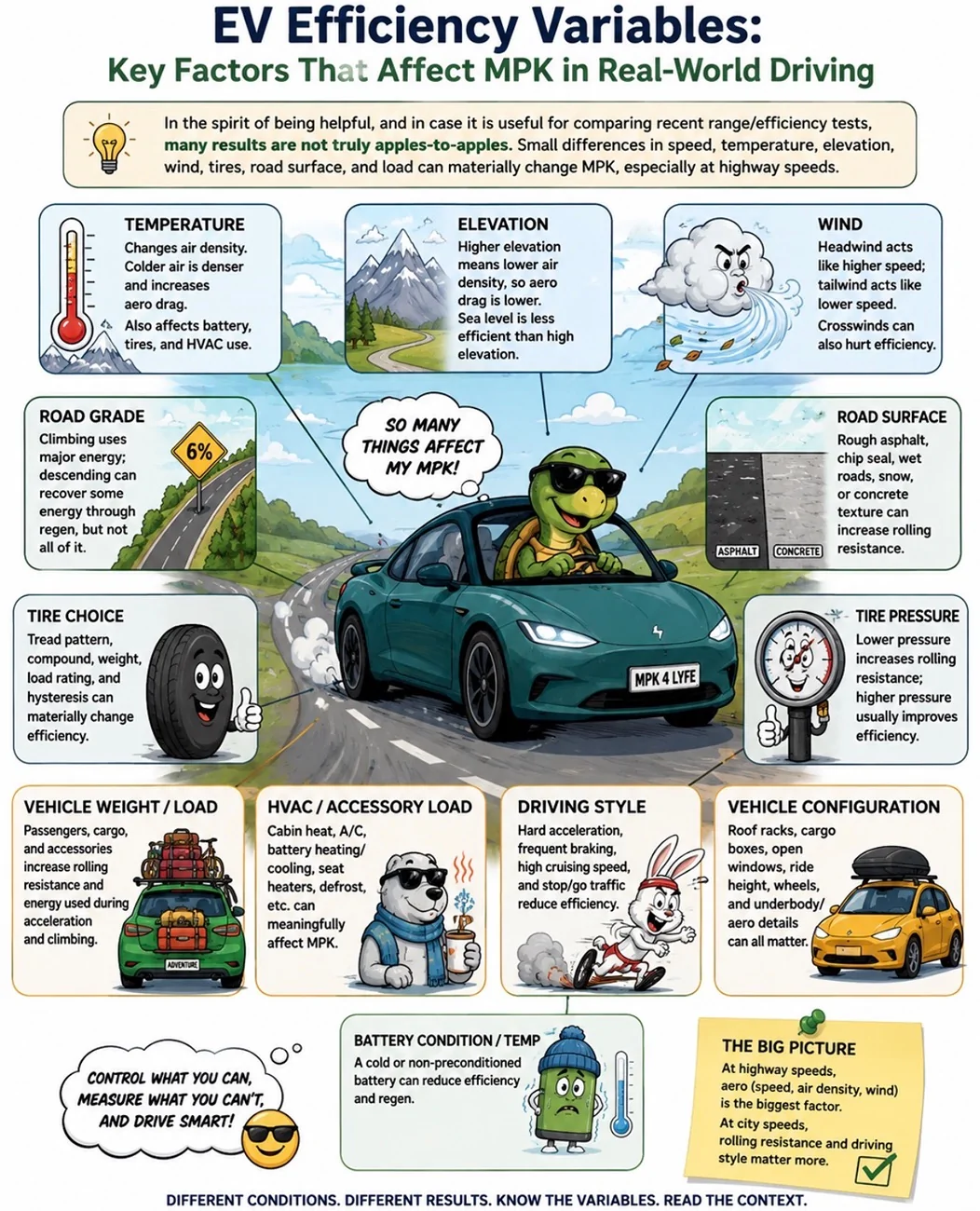
Simple efficiency reminders: Key variables that affect MPK

In the spirit of being helpful, and in case it is useful for comparing recent range/efficiency tests, many results are not truly apples-to-apples. Small differences in speed, temperature, elevation, wind, tires, road surface, and load can materially change MPK, especially at highway speeds.

* Speed — biggest driver; aero drag rises roughly with speed squared, and power demand rises roughly with speed cubed.

* Temperature — changes air density; colder air is denser and increases aero drag. Also affects battery, tires, and HVAC use.

* Elevation — higher elevation means lower air density, so aero drag is lower; sea level is less efficient than high elevation.

* Wind — headwind acts like higher speed; tailwind acts like lower speed. Crosswinds can also hurt efficiency.

* Road grade — climbing uses major energy; descending can recover some energy through regen, but not all of it.

* Road surface — rough asphalt, chip seal, wet roads, snow, or concrete texture can increase rolling resistance.
* Tire choice — tread pattern, compound, weight, load rating, and hysteresis can materially change efficiency.

* Tire pressure — lower pressure increases rolling resistance; higher pressure usually improves efficiency but can affect comfort/traction.

* Vehicle weight/load — passengers, cargo, and accessories increase rolling resistance and energy used during acceleration/climbing.

* HVAC/accessory load — cabin heat, A/C, battery heating/cooling, seat heaters, defrost, etc. can meaningfully affect MPK.

* Driving style — hard acceleration, frequent braking, high cruising speed, and stop/go traffic reduce efficiency.

* Vehicle configuration — roof racks, cargo boxes, open windows, ride height, wheels, and underbody/aero details can all matter.

* Battery condition/temp — a cold or non-preconditioned battery can reduce efficiency and regen.

Rivian R1T R1S EV Efficiency Variables: Key Factors That Affect Range / Efficiency in Real-World Driving IMG_7411
Sponsored

 
Last edited:
OP
OP
ksurfier

ksurfier

Well-Known Member
First Name
Ken
Joined
Aug 23, 2022
Threads
46
Messages
1,105
Reaction score
1,005
Location
CA
Vehicles
R1SQM, Tesla
Occupation
Fake Science Lead
Clubs
 
You mean, the exact same things that affect MPG? (Excepting only the battery condition/state bullet point?)

Is this news to anyone? If so, I'd like to hear about that cave you've been living in.
Eggxactly!
 

UnsungZero_OldTimeAdMan

Well-Known Member
First Name
Barnum
Joined
Mar 20, 2023
Threads
69
Messages
8,899
Reaction score
12,258
Location
SoCal
Vehicles
'23 GW Quad-Large R1T "Ghost"
Occupation
Advertising Circus
You mean, the exact same things that affect MPG? (Excepting only the battery condition/state bullet point?)

Is this news to anyone? If so, I'd like to hear about that cave you've been living in.
By the amount of handwringing and arguing over factory wheel/tire options… apparently new to some. I’m more amused that range anxiety is still a thing for some who aren’t new to EVs (or just assume nothing could possibly be as efficient as a Tesla? which is irrational).
 

VSG

Well-Known Member
Joined
Oct 3, 2022
Threads
4
Messages
3,327
Reaction score
6,273
Location
WA
Vehicles
R1T LE/RB/OC/20
One thing I'm constantly seeing is this whole narrative about how EVs are so very different than ICE vehicles, and that you have to know hundreds of new things in order to drive an EV.

That's really offputting to EV adoption. We all know about the "learning curve", especially when applied to technology, and that's enough in and of itself to discourage people from upgrading their phone, from trying a new app, even from getting a new TV remote. We stick with the things we know will work, because it's easier than learning new things, and we don't have enough mental bandwidth to deal with changes to everything all the time. Learning something once and building on that knowledge is far more efficient than re-learning how to do the same thing a different way time and time again. EVs don't require re-learning for the most part, just building on what everyone already knows from ICE vehicles.

Another aspect of this "too complex" narrative is the whole one-pedal driving angst-fest. OPD is slightly different, but it doesn't require a PhD in order to use it. And because you use it every single time you drive you very quickly become familiar with it without having to read the manual or study for a test. But the amount of "controversy" you will encounter every time it is mentioned is enough to turn people off of EVs entirely. And don't get me started on "range" - that's a number that automakers rarely even published two decades ago. This extreme focus on range for EVs makes people hesitant to even consider an EV even if they only commute a typical 100 miles a week.

The inflection point for EV adoption isn't going to come as long as the general public perceives a "learning cliff" for switching to an EV. Trying to explain everything in detail to demystify EVs doesn't help either, it just makes it sound like there is too much one has to learn in order to own an EV.
 

Sponsored

OP
OP
ksurfier

ksurfier

Well-Known Member
First Name
Ken
Joined
Aug 23, 2022
Threads
46
Messages
1,105
Reaction score
1,005
Location
CA
Vehicles
R1SQM, Tesla
Occupation
Fake Science Lead
Clubs
 
It’s very very different. The impact of extreme temperature for example plays out very differently for an EV vs ICE vehicle:

For a 500 mile trip in cold winter conditions (0 F). The ice might see a range reduction from 325 miles to 275 miles. The EV on the other hand might drop from 250 miles to 125 miles.
The net effect is the ICE stops to refill once (10 minutes) but the EV needs to stop for 45-60 minutes every 1.5 hours.

The ICE vehicle makes the trip in under 8 hours but the EV requires more than 12 hours for the same trip…
 

VSG

Well-Known Member
Joined
Oct 3, 2022
Threads
4
Messages
3,327
Reaction score
6,273
Location
WA
Vehicles
R1T LE/RB/OC/20
It’s very very different. The impact of extreme temperature for example plays out very differently for an EV vs ICE vehicle:

For a 500 mile trip in cold winter conditions (0 F). The ice might see a range reduction from 325 miles to 275 miles. The EV on the other hand might drop from 250 miles to 125 miles.
The net effect is the ICE stops to refill once (10 minutes) but the EV needs to stop for 45-60 minutes every 1.5 hours.

The ICE vehicle makes the trip in under 8 hours but the EV requires more than 12 hours for the same trip…
And my point is that to illustrate the difference you have to choose an extreme edge case. Which is just not that relevant.

While I have lived in and traveled (commuted) in 0 degrees snowy weather often in my life, I think I have taken a >8 hour non-stop drive in snowy 0 degrees weather only once, which was memorable for many reasons. The car I purchased back then was absolutely not chosen for its ability to handle that situation, yet it did a reasonable job (besides that one place where there was a >30 car accident we barely avoided when everyone including me spun out on an icy downhill on the interstate). I don't even remember refueling on that trip, although I must have because it was 800 miles and my ICE vehicle only had a range of ~300 miles. However I am pretty sure that I welcomed the stops and even stopped sometimes not to refuel but just to take a break. Likewise, I'm sure most EVs will get through just as well as most ICE vehicles - no reason to choose a vehicle just for this situation which most people will never encounter.

This is just a variation on the "road trip" comparison. 95% of most people's usage is NOT road trips (5% of 365 is 2 and a half weeks of road trip driving!). So the argument that charging an EV makes road trips a lot longer is really not relevant to the 95% of the other time where you NEVER have to spend ANY time charging. (And incidentally, the way I take road trips, my EV does not add ANY extra time to my driving. Although I'm sure you can contrive an edge case where this is not the case.)

I also disagree with your characterization of cold weather performance. But I'm not going to argue it. In my experience it's the overhead of cold weather driving, not the driving itself, which accounts for most of the loss of efficiency. If you pre-warm the vehicle (battery, cabin) from the charger, then the overhead isn't taken from the battery, and the trip itself does not suffer a drastic efficiency loss. This is also similar to the ICE case, which is why block heaters are a thing and why remote start is a thing and why you see cars in the street "warming up" for an hour or more on a snowy winter day in Chicago.
Sponsored


Top