
Sponsored

Budman

Well-Known Member
First Name
Rick
Joined
Oct 22, 2021
Threads
58
Messages
820
Reaction score
2,522
Location
Minnesota
Vehicles
Honda CRV
Clubs
 
This trip/efficiency report will be mostly pictures and graphs and short on words. The graphs are pretty darn good and tell the story better than words could.

We drove our R1T Quad Motor with 21" road tires from Minneapolis to Sedona to do some hiking by way of Des Moines, Omaha, Denver, Sante Fe. Took 4 days on the way out with over night stops in western Nebraska, Colorado Springs, Sante Fe. The way out was kinda cold and snowy so followed a very conservative charging plan with short stints and keeping the battery pretty full. Spend 1 week in Sedona enjoying the hiking then did the return trip in 3 days with stops in Sante Fe and western Nebraska again.

Used mostly Electrify America with no issues except for an ice covered plug in Trinidad, CO that would not engage. Moved to another charger and it worked fine. Overall a very uneventful trip charging wise. As many have noted previously, a long road trip with an EV is actually enjoyable when you can take regular mental and physical breaks at the charging stops vs hammering with non-stop driving in an ICE. We enjoyed the trip and would absolutely to it again in the Rivian. In fact, we are planning an even longer trip to British Columbia this summer.

We took a lot of efficiency data during the trip. Every 50 miles we reset the trip meter and recorded consumption, efficiency, air temperature, wind speed, starting and ending elevation, and average speed. We only did this while on the freeway traveling at 75 mph. Anytime we were in a metro area like Denver with slower speed limits we did not collect data. So we have 52 individual data points from these 52 50-mile segments. Very detailed graphs and correlations to temperature and elevation change below; From Minneapolis to Colorado Springs I was in Conserve Mode but in the mountainous area between Colorado Springs and Sedona I was in All Purpose. But before we get to the data and graphs.......

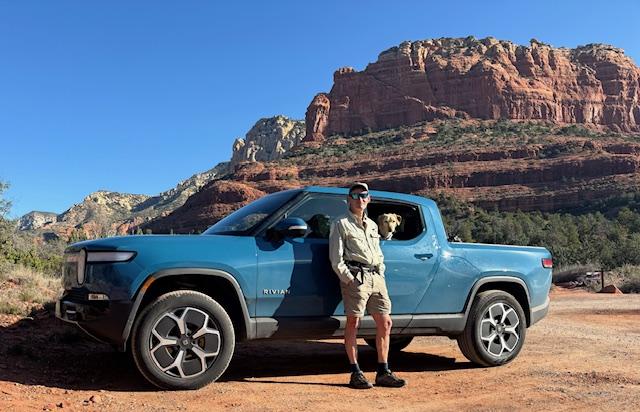
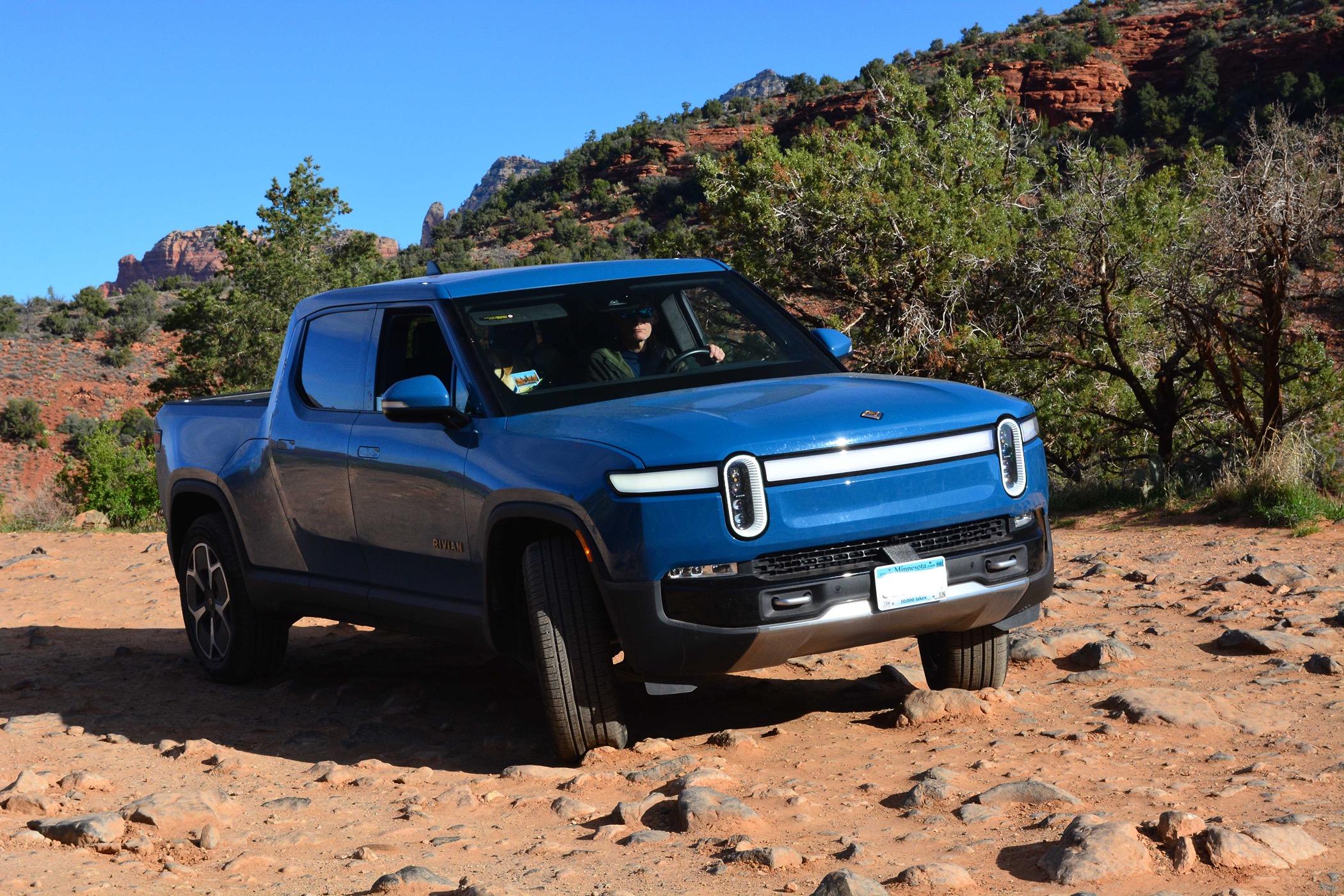
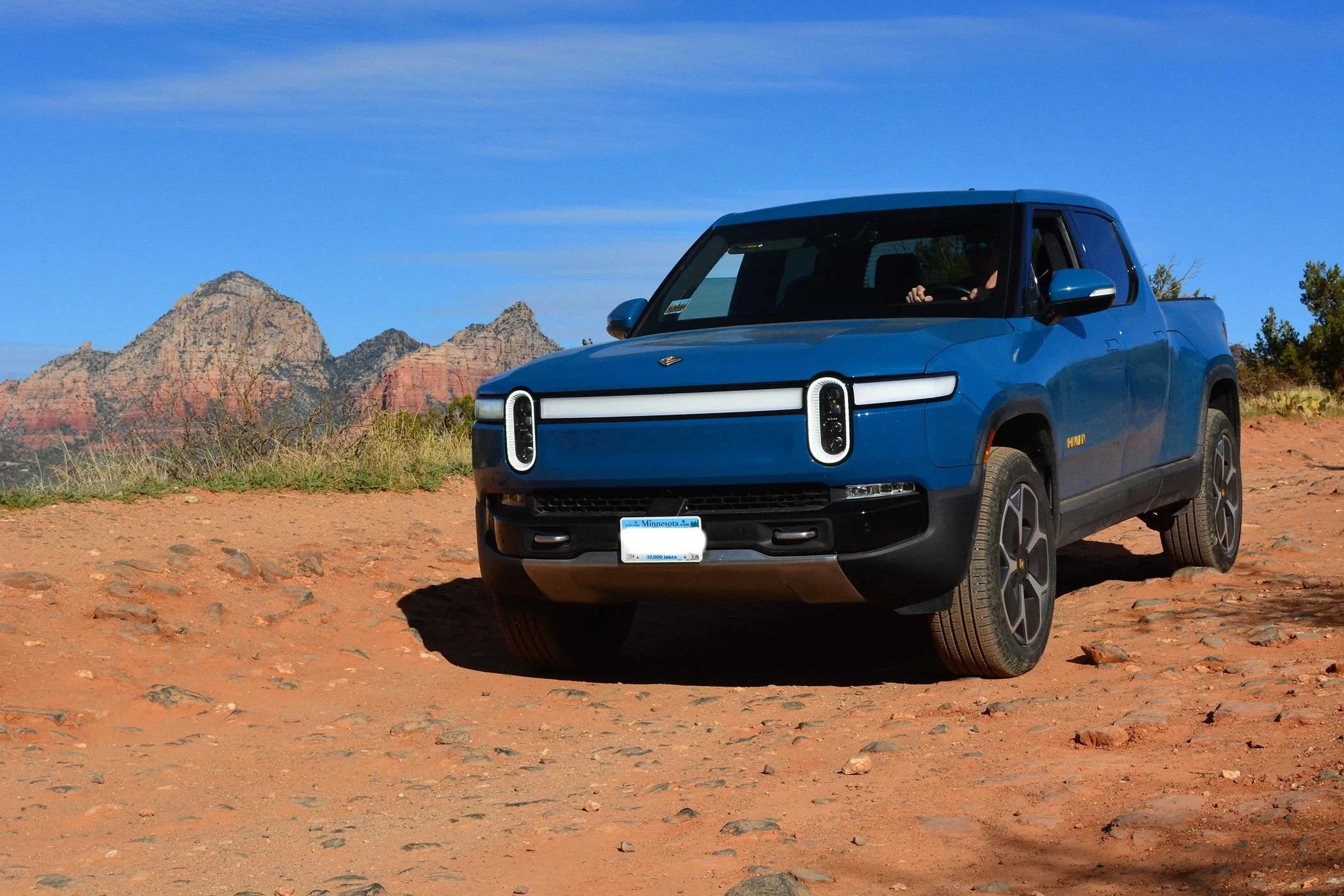
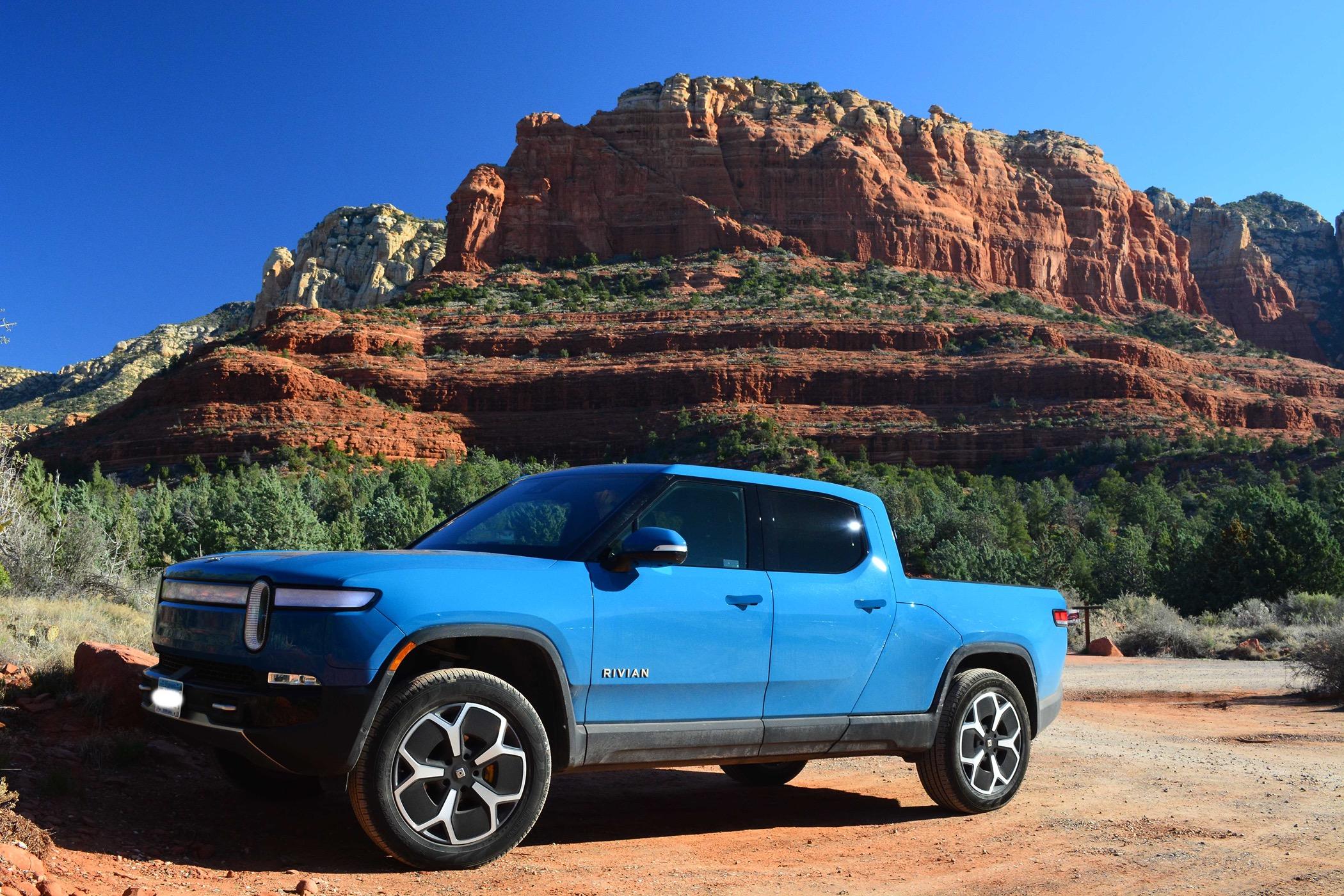
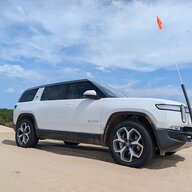
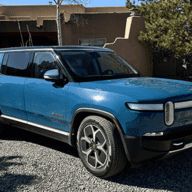
The Obligatory Rivian Eye Candy Photos;
Me, Luna and Vivian. Diana, who gets tons of credit for being the Rivian systems engineer, navigator and data collection officer as well as photographer is not pictured.....
Rivian R1T R1S The Ultimate Efficiency Report: MN to Sedona and Back in R1T IMG_3277

Rivian R1T R1S The Ultimate Efficiency Report: MN to Sedona and Back in R1T R1T 2

Rivian R1T R1S The Ultimate Efficiency Report: MN to Sedona and Back in R1T R1T 1

Rivian R1T R1S The Ultimate Efficiency Report: MN to Sedona and Back in R1T R1T 3


Now, on to the data.


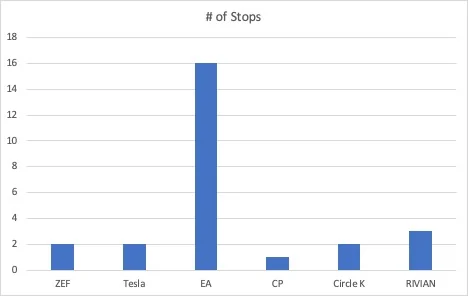
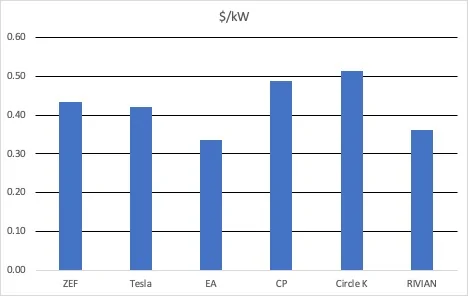
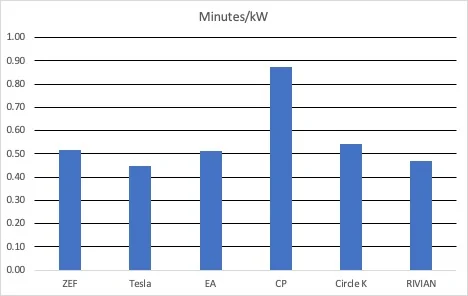
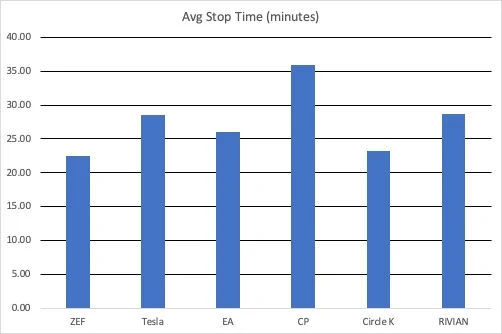
CHARGING DATA: As noted above, charging was very uneventful. Electrify America was reliable, fast and inexpensive.
Chart 1). Number of stops at each network over the whole out and back trip (EA=Electrify America, CP=Charge Point).
Chart 2). Average cost in kWh/$ (I used the EA membership discount)
Chart 3). Average charging rate in kWh/min
Chart 4). Average time charging at each network
Rivian R1T R1S The Ultimate Efficiency Report: MN to Sedona and Back in R1T Chart 1

Rivian R1T R1S The Ultimate Efficiency Report: MN to Sedona and Back in R1T Chart 2

Rivian R1T R1S The Ultimate Efficiency Report: MN to Sedona and Back in R1T Chart 3

Rivian R1T R1S The Ultimate Efficiency Report: MN to Sedona and Back in R1T Chart 4


Repeating this paragraph from above for clarity on the data collection:
We took a lot of efficiency data during the trip. Every 50 miles we reset the trip meter and recorded consumption, efficiency, air temperature, wind speed, starting and ending elevation, and average speed. We only did this while on the freeway traveling at 75 mph. Anytime we were in a metro area like Denver with slower speed limits we did not collect data. So we have 52 individual data points from these 52 50-mile segments. Very detailed graphs and correlations to temperature and elevation change below; From Minneapolis to Colorado Spring I was in Conserve Mode but in the mountainous area between Colorado Springs and Sedona I was in All Purpose.

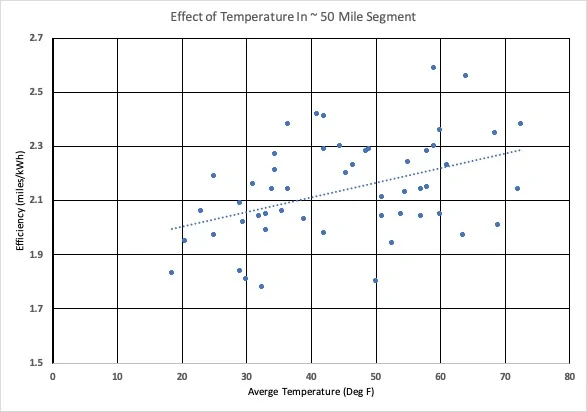
Correlation between temperature and Efficiency (wind was a major factor on this trip and clouds the temperature/elevation correlations)
Rivian R1T R1S The Ultimate Efficiency Report: MN to Sedona and Back in R1T Chart 6

We had temperatures between 15 and 73 degrees so a nice wide spread in temperature. The trend is as expected but the correlation is weak due to the effects of wind and elevation change. Overall our efficiency average around 2.2 miles/kWh at an average temperature of 45 degrees.


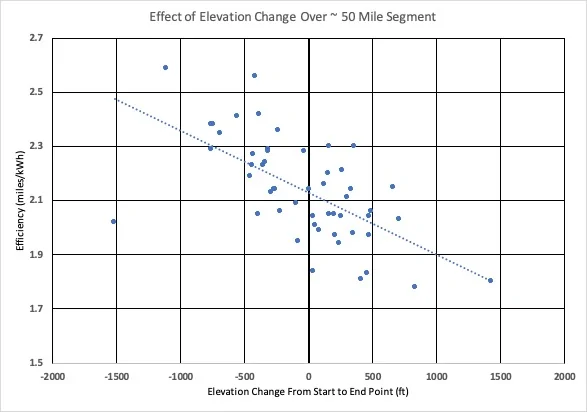
Correlation between Elevation Change over the 50 mile segment and Efficiency (wind was a major factor and clouds the data)
Rivian R1T R1S The Ultimate Efficiency Report: MN to Sedona and Back in R1T Chart 5

The correlation with elevation change is pretty strong. We started at around 800 feet in Minnesota and peaked at just under 8000 feet. Detailed elevation data in each segment can be found in the charts that follow.

Wind was a major factor and I made no attempt to graph it correlation it because it's pretty darn hard. But I'm pretty convinced cross winds are as impactful and headwinds on reducing efficiency. Even read quartering winds are more harmful than helpful. The effect of wind can be teased out in the following graphs.

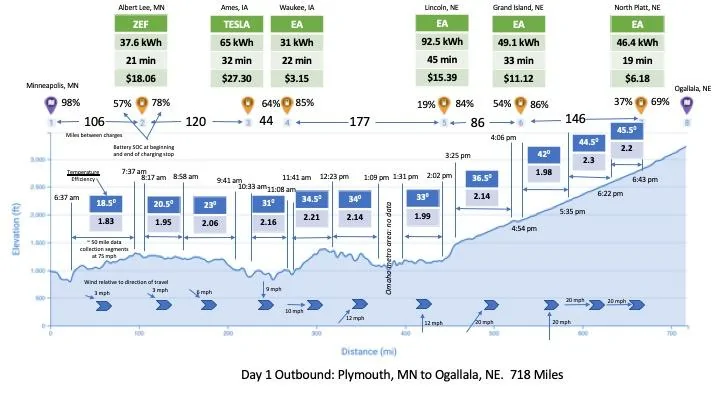
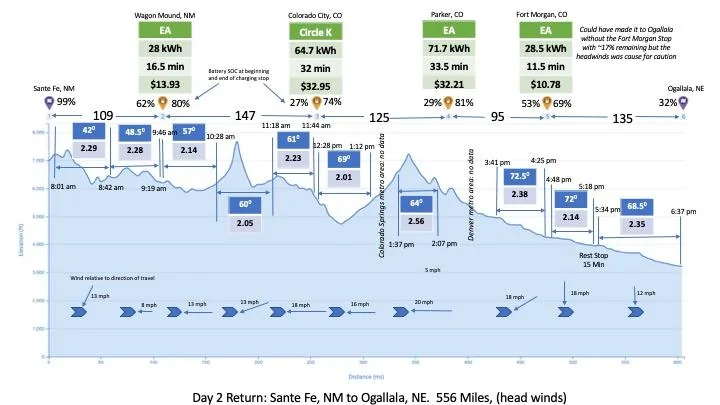
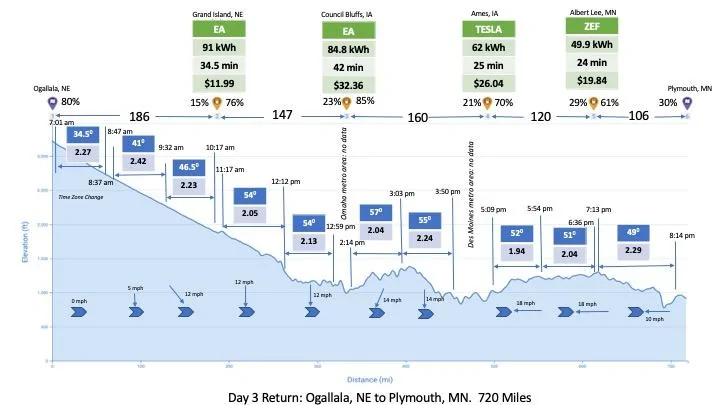
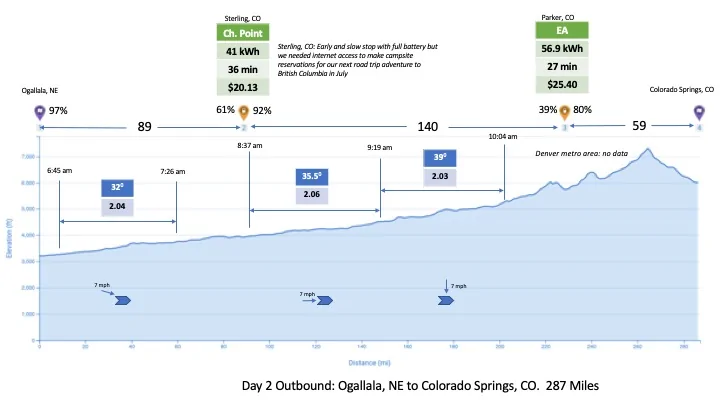
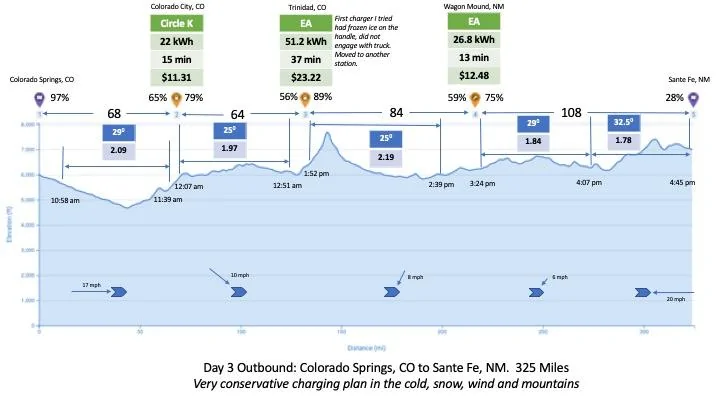
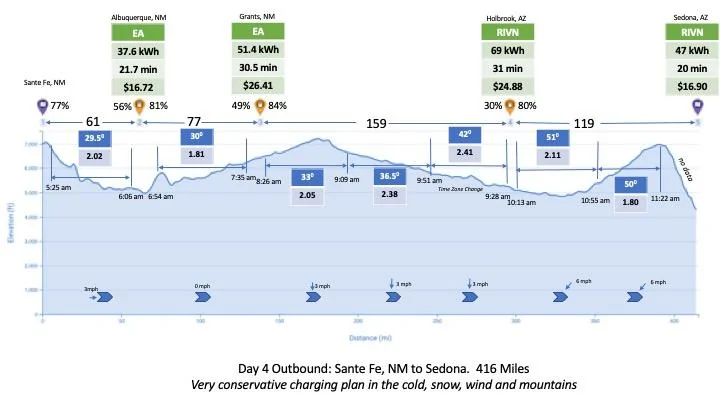
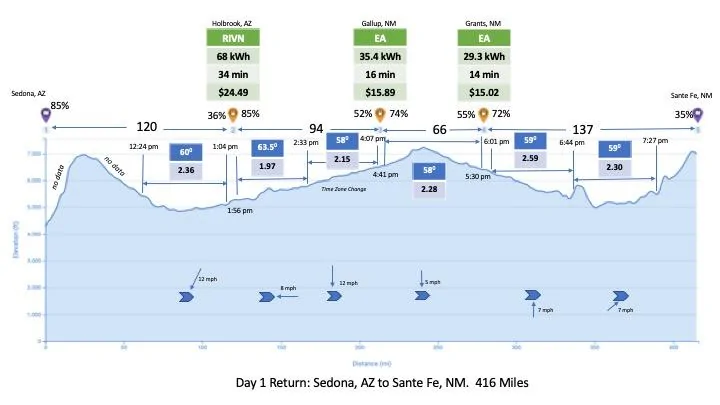
Ok, I'm kinda proud of these next graphs. They show pretty much everything. The main blue line and shaded area is the elevation vs trip distance from the PlugShare maps. In addition it shows; charging network used and key charging metrics, Distance between charging stops, battery state of charge at start and end of charging. Temperature and efficiency data in each 50 mile segment. Time and elevation at each segment. Wind speed relative to the direction of travel in each segment.

There is one graph for each driving day. This is day one, 718 miles from MN to western Nebraska. Temperature is in the dark blue box and efficiency in the light blue boxes.
Rivian R1T R1S The Ultimate Efficiency Report: MN to Sedona and Back in R1T Slide 1

Day 2, short day to Colorado Springs to do some hiking.
Rivian R1T R1S The Ultimate Efficiency Report: MN to Sedona and Back in R1T Slide 2


Day 3, another short day to Sante Fe for another hiking stop. Followed a very conservative charging plan in the mountains with falling snow.
Rivian R1T R1S The Ultimate Efficiency Report: MN to Sedona and Back in R1T Slide 3


Day 4 from Sante Fe to Sedona, Played it conservative again with the sparse charging availability across New Mexico and Arizona.
Rivian R1T R1S The Ultimate Efficiency Report: MN to Sedona and Back in R1T Slide 4


Return trip data: With the warmer weather and some confidence on what the charging situation was like we did some longer stints on the way home.

Day 1: Sedona to Sante Fe
Rivian R1T R1S The Ultimate Efficiency Report: MN to Sedona and Back in R1T Slide 5


Day 2: Sante Fe to Ogallala NE.
Rivian R1T R1S The Ultimate Efficiency Report: MN to Sedona and Back in R1T Slide 6


Day 3: Ogallala NE to home
Rivian R1T R1S The Ultimate Efficiency Report: MN to Sedona and Back in R1T Slide 7


It was a great trip. Would not want to do it with any other vehicle I've owned. The R1T is quiet, powerful, comfortable and just a joy. Looking forward to the British Columbia trip which will be really easy charging wise with excellent Tesla charging stations along the way.
Sponsored


Billofaustin2

Well-Known Member
First Name
Bill
Joined
Dec 22, 2023
Threads
26
Messages
80
Reaction score
54
Location
Austin
Vehicles
R1t
Occupation
Retired
This trip/efficiency report will be mostly pictures and graphs and short on words. The graphs are pretty darn good and tell the story better than words could.

We drove our R1T Quad Motor with 21" road tires from Minneapolis to Sedona to do some hiking by way of Des Moines, Omaha, Denver, Sante Fe. Took 4 days on the way out with over night stops in western Nebraska, Colorado Springs, Sante Fe. The way out was kinda cold and snowy so followed a very conservative charging plan with short stints and keeping the battery pretty full. Spend 1 week in Sedona enjoying the hiking then did the return trip in 3 days with stops in Sante Fe and western Nebraska again.

Used mostly Electrify America with no issues except for an ice covered plug in Trinidad, CO that would not engage. Moved to another charger and it worked fine. Overall a very uneventful trip charging wise. As many have noted previously, a long road trip with an EV is actually enjoyable when you can take regular mental and physical breaks at the charging stops vs hammering with non-stop driving in an ICE. We enjoyed the trip and would absolutely to it again in the Rivian. In fact, we are planning an even longer trip to British Columbia this summer.

We took a lot of efficiency data during the trip. Every 50 miles we reset the trip meter and recorded consumption, efficiency, air temperature, wind speed, starting and ending elevation, and average speed. We only did this while on the freeway traveling at 75 mph. Anytime we were in a metro area like Denver with slower speed limits we did not collect data. So we have 52 individual data points from these 52 50-mile segments. Very detailed graphs and correlations to temperature and elevation change below; From Minneapolis to Colorado Springs I was in Conserve Mode but in the mountainous area between Colorado Springs and Sedona I was in All Purpose. But before we get to the data and graphs.......

The Obligatory Rivian Eye Candy Photos;
Me, Luna and Vivian. Diana, who gets tons of credit for being the Rivian systems engineer, navigator and data collection officer as well as photographer is not pictured.....
IMG_3277.jpg

R1T 2.jpg

R1T 1.jpg

R1T 3.jpg


Now, on to the data.


CHARGING DATA: As noted above, charging was very uneventful. Electrify America was reliable, fast and inexpensive.
Chart 1). Number of stops at each network over the whole out and back trip (EA=Electrify America, CP=Charge Point).
Chart 2). Average cost in kWh/$ (I used the EA membership discount)
Chart 3). Average charging rate in kWh/min
Chart 4). Average time charging at each network
Chart 1.jpg

Chart 2.jpg

Chart 3.jpg

Chart 4.jpg


Repeating this paragraph from above for clarity on the data collection:
We took a lot of efficiency data during the trip. Every 50 miles we reset the trip meter and recorded consumption, efficiency, air temperature, wind speed, starting and ending elevation, and average speed. We only did this while on the freeway traveling at 75 mph. Anytime we were in a metro area like Denver with slower speed limits we did not collect data. So we have 52 individual data points from these 52 50-mile segments. Very detailed graphs and correlations to temperature and elevation change below; From Minneapolis to Colorado Spring I was in Conserve Mode but in the mountainous area between Colorado Springs and Sedona I was in All Purpose.

Correlation between temperature and Efficiency (wind was a major factor on this trip and clouds the temperature/elevation correlations)
Chart 6.jpg

We had temperatures between 15 and 73 degrees so a nice wide spread in temperature. The trend is as expected but the correlation is weak due to the effects of wind and elevation change. Overall our efficiency average around 2.2 miles/kWh at an average temperature of 45 degrees.


Correlation between Elevation Change over the 50 mile segment and Efficiency (wind was a major factor and clouds the data)
Chart 5.jpg

The correlation with elevation change is pretty strong. We started at around 800 feet in Minnesota and peaked at just under 8000 feet. Detailed elevation data in each segment can be found in the charts that follow.

Wind was a major factor and I made no attempt to graph it correlation it because it's pretty darn hard. But I'm pretty convinced cross winds are as impactful and headwinds on reducing efficiency. Even read quartering winds are more harmful than helpful. The effect of wind can be teased out in the following graphs.

Ok, I'm kinda proud of these next graphs. They show pretty much everything. The main blue line and shaded area is the elevation vs trip distance from the PlugShare maps. In addition it shows; charging network used and key charging metrics, Distance between charging stops, battery state of charge at start and end of charging. Temperature and efficiency data in each 50 mile segment. Time and elevation at each segment. Wind speed relative to the direction of travel in each segment.

There is one graph for each driving day. This is day one, 718 miles from MN to western Nebraska. Temperature is in the dark blue box and efficiency in the light blue boxes.
Slide 1.jpg

Day 2, short day to Colorado Springs to do some hiking.
Slide 2.jpg


Day 3, another short day to Sante Fe for another hiking stop. Followed a very conservative charging plan in the mountains with falling snow.
Slide 3.jpg


Day 4 from Sante Fe to Sedona, Played it conservative again with the sparse charging availability across New Mexico and Arizona.
Slide 4.jpg


Return trip data: With the warmer weather and some confidence on what the charging situation was like we did some longer stints on the way home.

Day 1: Sedona to Sante Fe
Slide 5.jpg


Day 2: Sante Fe to Ogallala NE.
Slide 6.jpg


Day 3: Ogallala NE to home
Slide 7.jpg


It was a great trip. Would not want to do it with any other vehicle I've owned. The R1T is quiet, powerful, comfortable and just a joy. Looking forward to the British Columbia trip which will be really easy charging wise with excellent Tesla charging stations along the way.
Ive never seen So many metrics for a road trip. You win.
 

COdogman

Well-Known Member
First Name
Brian
Joined
Jan 21, 2022
Threads
33
Messages
11,641
Reaction score
34,494
Location
CO
Vehicles
2023 R1T
Occupation
Cyber defender
Clubs
 
Now THAT is a trip report! Thank you as always!
 

Sponsored

R1 EVY

Well-Known Member
First Name
Darren
Joined
Dec 26, 2023
Threads
25
Messages
346
Reaction score
496
Location
Milwaukee
Vehicles
2023 R1S
Occupation
Entrepreneur
Clubs
 
This trip/efficiency report will be mostly pictures and graphs and short on words. The graphs are pretty darn good and tell the story better than words could.

We drove our R1T Quad Motor with 21" road tires from Minneapolis to Sedona to do some hiking by way of Des Moines, Omaha, Denver, Sante Fe. Took 4 days on the way out with over night stops in western Nebraska, Colorado Springs, Sante Fe. The way out was kinda cold and snowy so followed a very conservative charging plan with short stints and keeping the battery pretty full. Spend 1 week in Sedona enjoying the hiking then did the return trip in 3 days with stops in Sante Fe and western Nebraska again.

Used mostly Electrify America with no issues except for an ice covered plug in Trinidad, CO that would not engage. Moved to another charger and it worked fine. Overall a very uneventful trip charging wise. As many have noted previously, a long road trip with an EV is actually enjoyable when you can take regular mental and physical breaks at the charging stops vs hammering with non-stop driving in an ICE. We enjoyed the trip and would absolutely to it again in the Rivian. In fact, we are planning an even longer trip to British Columbia this summer.

We took a lot of efficiency data during the trip. Every 50 miles we reset the trip meter and recorded consumption, efficiency, air temperature, wind speed, starting and ending elevation, and average speed. We only did this while on the freeway traveling at 75 mph. Anytime we were in a metro area like Denver with slower speed limits we did not collect data. So we have 52 individual data points from these 52 50-mile segments. Very detailed graphs and correlations to temperature and elevation change below; From Minneapolis to Colorado Springs I was in Conserve Mode but in the mountainous area between Colorado Springs and Sedona I was in All Purpose. But before we get to the data and graphs.......

The Obligatory Rivian Eye Candy Photos;
Me, Luna and Vivian. Diana, who gets tons of credit for being the Rivian systems engineer, navigator and data collection officer as well as photographer is not pictured.....
IMG_3277.jpg

R1T 2.jpg

R1T 1.jpg

R1T 3.jpg


Now, on to the data.


CHARGING DATA: As noted above, charging was very uneventful. Electrify America was reliable, fast and inexpensive.
Chart 1). Number of stops at each network over the whole out and back trip (EA=Electrify America, CP=Charge Point).
Chart 2). Average cost in kWh/$ (I used the EA membership discount)
Chart 3). Average charging rate in kWh/min
Chart 4). Average time charging at each network
Chart 1.jpg

Chart 2.jpg

Chart 3.jpg

Chart 4.jpg


Repeating this paragraph from above for clarity on the data collection:
We took a lot of efficiency data during the trip. Every 50 miles we reset the trip meter and recorded consumption, efficiency, air temperature, wind speed, starting and ending elevation, and average speed. We only did this while on the freeway traveling at 75 mph. Anytime we were in a metro area like Denver with slower speed limits we did not collect data. So we have 52 individual data points from these 52 50-mile segments. Very detailed graphs and correlations to temperature and elevation change below; From Minneapolis to Colorado Spring I was in Conserve Mode but in the mountainous area between Colorado Springs and Sedona I was in All Purpose.

Correlation between temperature and Efficiency (wind was a major factor on this trip and clouds the temperature/elevation correlations)
Chart 6.jpg

We had temperatures between 15 and 73 degrees so a nice wide spread in temperature. The trend is as expected but the correlation is weak due to the effects of wind and elevation change. Overall our efficiency average around 2.2 miles/kWh at an average temperature of 45 degrees.


Correlation between Elevation Change over the 50 mile segment and Efficiency (wind was a major factor and clouds the data)
Chart 5.jpg

The correlation with elevation change is pretty strong. We started at around 800 feet in Minnesota and peaked at just under 8000 feet. Detailed elevation data in each segment can be found in the charts that follow.

Wind was a major factor and I made no attempt to graph it correlation it because it's pretty darn hard. But I'm pretty convinced cross winds are as impactful and headwinds on reducing efficiency. Even read quartering winds are more harmful than helpful. The effect of wind can be teased out in the following graphs.

Ok, I'm kinda proud of these next graphs. They show pretty much everything. The main blue line and shaded area is the elevation vs trip distance from the PlugShare maps. In addition it shows; charging network used and key charging metrics, Distance between charging stops, battery state of charge at start and end of charging. Temperature and efficiency data in each 50 mile segment. Time and elevation at each segment. Wind speed relative to the direction of travel in each segment.

There is one graph for each driving day. This is day one, 718 miles from MN to western Nebraska. Temperature is in the dark blue box and efficiency in the light blue boxes.
Slide 1.jpg

Day 2, short day to Colorado Springs to do some hiking.
Slide 2.jpg


Day 3, another short day to Sante Fe for another hiking stop. Followed a very conservative charging plan in the mountains with falling snow.
Slide 3.jpg


Day 4 from Sante Fe to Sedona, Played it conservative again with the sparse charging availability across New Mexico and Arizona.
Slide 4.jpg


Return trip data: With the warmer weather and some confidence on what the charging situation was like we did some longer stints on the way home.

Day 1: Sedona to Sante Fe
Slide 5.jpg


Day 2: Sante Fe to Ogallala NE.
Slide 6.jpg


Day 3: Ogallala NE to home
Slide 7.jpg


It was a great trip. Would not want to do it with any other vehicle I've owned. The R1T is quiet, powerful, comfortable and just a joy. Looking forward to the British Columbia trip which will be really easy charging wise with excellent Tesla charging stations along the way.
May I be first to say that you're my #1 draft pick for our group project. I don't really care about the class or subject, you're first.
 
OP
OP
Budman

Budman

Well-Known Member
First Name
Rick
Joined
Oct 22, 2021
Threads
58
Messages
820
Reaction score
2,522
Location
Minnesota
Vehicles
Honda CRV
Clubs
 
Ah dang, you should have hit up the Arizona Rivian Club! We would have loved to meet you ◡̈ amazing report!
That would have been fun. I actually looked to see if there were any planned events in Sedona when we were there but did not see anything. Chatted with a few Rivian folks at the Sedona RAN charger which is a very pleasant location.
 

downranger12

Well-Known Member
First Name
Kent
Joined
Jun 22, 2020
Threads
0
Messages
139
Reaction score
110
Location
Dubuque Iowa
Vehicles
2012 Nissan Frontier Pro 4x, 2018 Toyota Prius
Occupation
retired optometrist
Ah dang, you should have hit up the Arizona Rivian Club! We would have loved to meet you ◡̈ amazing report!
Great report and agrees with my more casual ongoing data collection. Right now, the first set of tires was run on conserve and ended up through two winter seasons in Iowa at 2.34. Now have odometer A recording milage efficiency in daily driving on 21s and All Purpose, showing ten thousand miles at 1.92, averaging 34mph.
If anyone hasn't experienced the wonderful quiet of foam filled Scorpion OEMs, you don't know what you are missing.
Maybe i didn't see it, but what was the average cost per kwh for charging on the whole trip?
 

Sponsored

OP
OP
Budman

Budman

Well-Known Member
First Name
Rick
Joined
Oct 22, 2021
Threads
58
Messages
820
Reaction score
2,522
Location
Minnesota
Vehicles
Honda CRV
Clubs
 
Great report and agrees with my more casual ongoing data collection. Right now, the first set of tires was run on conserve and ended up through two winter seasons in Iowa at 2.34. Now have odometer A recording milage efficiency in daily driving on 21s and All Purpose, showing ten thousand miles at 1.92, averaging 34mph.
If anyone hasn't experienced the wonderful quiet of foam filled Scorpion OEMs, you don't know what you are missing.
Maybe i didn't see it, but what was the average cost per kwh for charging on the whole trip?
For the whole trip I spent $495 on fast charging (not counting a stop during our stay in Sedona for daily driving). I purchased 1,338 kWh of energy for an average cost of $0.37 per kWh. I also used hotel/B&B at no cost for 5 nights that added up to around 200 kWh so that was worth about $74 of fast charging I didn't have to pay for.

I agree on the 21's. I got 35k miles on my first set and have been happy with them. Decent performers on snow and ice too.
 

Doug

Well-Known Member
First Name
Doug
Joined
Jul 7, 2021
Threads
7
Messages
262
Reaction score
340
Location
Jackson, Minnesota
Vehicles
2021 Toyota Highlander Hybrid, 2002 Ford
Occupation
Business Owner
Excellent post. I love the graphs. It is helpful for me as I have not done a major trip yet with our R1T. I would probably try to do longer legs between charging stations if they are available but that is just our preference. Just curious why you did not use EA in Albert Lea, MN? I usually will avoid Zef if at all possible because they tend to be expensive and slow and a lot of them have a $5 hookup fee.. Also we have found they are more unreliable than some of the other charging companies. We tend to use EA a lot too and have had good success. Thank you for taking the time to do this project for the benefit of others!! You and your assistants are awesome!!
 
OP
OP
Budman

Budman

Well-Known Member
First Name
Rick
Joined
Oct 22, 2021
Threads
58
Messages
820
Reaction score
2,522
Location
Minnesota
Vehicles
Honda CRV
Clubs
 
Excellent post. I love the graphs. It is helpful for me as I have not done a major trip yet with our R1T. I would probably try to do longer legs between charging stations if they are available but that is just our preference. Just curious why you did not use EA in Albert Lea, MN? I usually will avoid Zef if at all possible because they tend to be expensive and slow and a lot of them have a $5 hookup fee.. Also we have found they are more unreliable than some of the other charging companies. We tend to use EA a lot too and have had good success. Thank you for taking the time to do this project for the benefit of others!! You and your assistants are awesome!!
Thanks for the kind words.

We used the ZEF charger in Albert Lee because it is by a Caribou Coffee shop at the nice travel center in Albert Lee vs the CASEY's by the EA station. That's the reason basically, a preferred refreshment option.

ZEF chargers are notoriously unreliable but the one in Albert Lee is different equipment than any other ZEF chargers I've seen. It's a KEMPOWER unit (a big sponsor of Out of Spec videos). It's a nice, fast, small, reliable unit.

I would also prefer to do longer stints between chargers but with the cold windy weather and sparse chargers along portions of this route I wanted to always have enough reserve to make the next one down the road if I needed to which meant stopping early sometimes.
 

TJM

Well-Known Member
First Name
Tom
Joined
Jul 29, 2020
Threads
3
Messages
67
Reaction score
79
Location
Santa Fe, NM
Vehicles
2024 R1S
Occupation
Retired
Terrific documentation! Quick question: when charging with Tesla chargers, did you use Rivian's Tesla-made adapter or a third party adapter?
 
OP
OP
Budman

Budman

Well-Known Member
First Name
Rick
Joined
Oct 22, 2021
Threads
58
Messages
820
Reaction score
2,522
Location
Minnesota
Vehicles
Honda CRV
Clubs
 
Terrific documentation! Quick question: when charging with Tesla chargers, did you use Rivian's Tesla-made adapter or a third party adapter?
I don't have the adaptor yet so could only use the station in Ames, IA which is one of the Magic Dock locations. Quick, easy, reliable. Looking forward to using more of the Tesla chargers.
Sponsored

 
  • Like
Reactions: TJM


Top