
ksurfier
Well-Known Member
- Thread starter
- #1
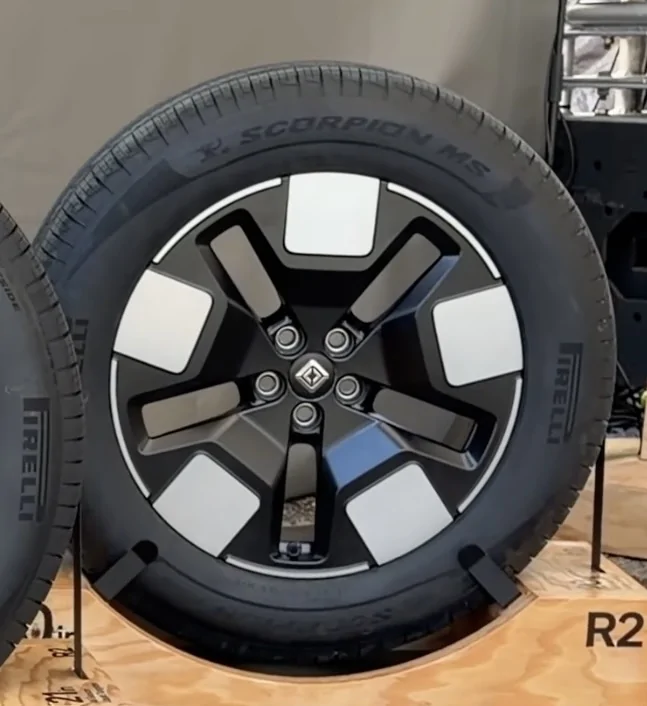
I’ve been digging into the two main R2 wheel/tire packages because there’s been a lot of discussion about efficiency, range, ride quality and whether the 20” all-terrain setup carries a meaningful penalty. Now that Rivian has published more specs—and we have real R2 road/fleet data—the comparison is getting much clearer.
The two factory setups
These are Rivian’s own published assembly specifications. The key surprise is that the 20” AT is not a conventional deep/heavy AT package: it has the same 8-mm starting tread depth as the 21 and weighs only 2 lb more per complete assembly. (Gear Shop - Rivian)
Size and sidewall
Although both tires are nominally 255 mm wide, the 20 has substantially more sidewall:
That’s about 9% more sidewall on the 20.
That should translate into better impact compliance, more wheel protection against potholes and rocks, and generally a more forgiving ride. The 21 should have somewhat less sidewall flex and potentially sharper initial steering response.
Because both packages remain approximately 32” in overall diameter, there is essentially no meaningful gearing, ride-height or speedometer difference.
Actual tread width is interesting
Nominal section width doesn’t tell the whole story.
Tire Rack lists the R2-specific BFG at approximately 7.5” tread width, versus 7.1” for the Pirelli. So despite both being labeled 255, the BFG puts roughly 0.4” / 5–6% more tread width across the road. (Tire Rack)
The BFG therefore carries 66 lb more rated load per tire, even though both are XL-rated V-speed tires. (Tire Rack)
Tread depth: mystery solved
There had been some speculation that the BFG might have conventional AT tread in the ~12–13/32” range.
It doesn’t.
Rivian specifies both R2 tires at 8 mm, which is essentially 10/32”. (Gear Shop - Rivian)
That’s significant. Reducing tread depth reduces tread-block squirm, weight and hysteresis losses—all things that can hurt rolling resistance.
So this appears to be a deliberately optimized RIV-spec BFG, rather than simply dropping an off-the-shelf AT tire onto the R2.
Tread design and intended use
This is where the tires differ much more substantially.
The Pirelli Scorpion MS is a road-focused crossover/SUV touring tire. Tire Rack identifies the RIV version as ELECT / electric-vehicle tuned, with a symmetric pattern engineered around efficiency, comfort, wet performance and low noise. (Tire Rack)
The BFGoodrich Trail-Terrain has visibly larger shoulder blocks, more aggressive voids and a much more trail-oriented tread architecture. Rivian specifically describes it as a custom all-terrain setup intended for both pavement and unpaved driving. (Gear Shop - Rivian)
Neither R2-specific tire is currently listed by Tire Rack as 3PMSF severe-snow rated. Both are M+S according to Rivian. (Tire Rack)
So think:
21” = highway/touring/range tire
20” = road-friendly AT with substantially more rough-road capability
—not a hardcore KO2-type tire. The BFG’s 520 treadwear number is encouraging for longevity. However, the Pirelli’s A traction / A temperature ratings are stronger than the BFG’s B/B ratings.
Important caveat: UTQG traction is primarily a standardized straight-line wet-braking test. It is not an overall wet/dry handling grade, and treadwear numbers are most useful within a manufacturer’s own tire family rather than as perfect cross-brand comparisons.
Warranty: potentially a major 20” advantage
This one surprised me.
Tire Rack lists BFGoodrich’s Trail-Terrain T/A+ warranty schedule at:
6 years / 65,000 miles, or
6 years / 50,000 miles for original-equipment sizes.
It also carries the standard workmanship/materials provisions and a 60-day satisfaction program. (Tire Rack)
The RIV Pirelli Scorpion MS has no mileage treadwear warranty listed, although it does carry a six-year workmanship/materials warranty. (Tire Rack)
I would still verify how BFG applies its mileage warranty specifically to factory-installed OE tires, rather than assuming every new R2 automatically receives a 50,000-mile mileage guarantee.
Replacement cost and availability
Here’s another potentially significant long-term advantage for the 20.
At the time of this post, Tire Rack lists the RIV-spec tires at approximately:
20” BFG: $275 each
21” Pirelli: $442 each
That’s roughly $1,100 vs. $1,770 for four tires, before installation—about a $670 difference per replacement set at today’s listed prices. (Tire Rack)
The 255/60R20 size also lives in a much larger SUV/truck tire ecosystem. That should give owners substantially more choice over time in highway, AT and winter replacements than the relatively unusual 255/55R21 size.
Complete assembly weight
This is another place where looking only at tire weight can be misleading.
The BFG tire itself is listed about 4 lb heavier than the Pirelli—36 vs. 32 lb. (Tire Rack)
But Rivian gives the complete assemblies as:
20”: 64 lb
21”: 62 lb
So once the forged wheels are included, the actual difference is just 2 lb/corner, or 8 lb for the entire vehicle. (Gear Shop - Rivian)
That’s a very small rotating-mass difference on a vehicle this size, especially during steady-state highway cruising.
What about efficiency?
On paper, you’d still expect the 21” Pirelli to win.
It has:
What’s fascinating is that a meaningful efficiency gap isn’t showing up in the real-world data we’ve gathered so far.
Across three R2 test drives, including sustained higher-speed testing approaching 80 mph, the 20s have performed remarkably close to the 21s. And the growing fleet dataset currently has the mature/high-mileage observations around roughly 2.78 mi/kWh for the 20s vs. ~2.73 for the 21s.
I would not interpret that as proof the BFG is inherently more efficient. The fleet sample isn’t a controlled A/B tire test, and differences of a few percent can easily come from routes, temperature, speed, wind, tire pressure and drivers.
But I think the evidence is now sufficient to say something narrower and more defensible:
There is currently no evidence of the large 20” efficiency penalty many of us expected.
A 0–2%-ish real-world difference looks considerably more plausible than something like 7–10%, based on the information available so far.
My take after looking at the tires themselves
The 21” remains the logical choice if your priorities are maximum theoretical efficiency, road handling and a more touring-oriented tire.
But the 20” package is turning out to be unusually compelling:
The most interesting part may be what Rivian and BFG did with the 20. It’s a 32” AT-looking tire with only 8 mm of tread, modest assembly weight, an ok treadwear rating and a Rivian-specific construction. In other words, it appears engineered specifically to retain much of the durability/ride advantage of a 20” AT while avoiding the efficiency penalty associated with a traditional truck AT.
For someone who likes the ride and additional sidewall of the 20s, the accumulating data makes it increasingly difficult to justify choosing the 21s solely out of fear of losing substantial highway range.


The 20" BFG Trail-Terrain T/A+ and 21" Pirelli Scorpion MS look dramatically different on the surface, but their internal construction is surprisingly similar. Both use a two-ply polyester casing, twin steel belts, and polyamide reinforcement. Based on the published construction alone, there is no obvious structural reason the Pirelli should have a major rolling-resistance advantage. The bigger differences appear to be in tread design, compound, dimensions, and how the tread deforms under load.
The 20" BFG uses a much more aggressive all-terrain pattern, with large interlocking blocks, substantial void space, open shoulders, and strong lateral channels. Intuitively, this looks like the less efficient tire, but its individual tread blocks are relatively large and stout. The 21" Pirelli uses a highway-oriented pattern with four large continuous circumferential channels, narrow longitudinal ribs, closed shoulders, and extensive fine siping. Visually, it looks much more like what we'd expect from an efficiency-focused tire.
However, that appearance doesn't necessarily translate directly into lower rolling resistance. The Pirelli's heavy siping divides its ribs into many smaller tread elements that can flex as they enter and leave the contact patch, while its large longitudinal channels create relatively narrow ribs that can also deform toward the grooves. Both mechanisms can generate hysteresis losses. Meanwhile, the BFG's large voids mean less continuous rubber contact, while its larger, more substantial blocks may be relatively resistant to small-scale deformation. Rubber compound and actual tire construction remain major unknowns, so the tread pattern alone cannot establish which tire has lower rolling resistance.
This makes the real-world R2 efficiency results particularly interesting. Despite the 21" Pirelli looking substantially more pavement- and efficiency-oriented, the available fleet data has not demonstrated a meaningful efficiency advantage over the aggressive 20" BFG. That doesn't prove the Pirelli's siping or longitudinal grooves are responsible, but it suggests the theoretical advantage of its highway tread may be getting offset by other characteristics—potentially tread deformation, compound hysteresis, tire dimensions, mass, or other construction details. The key question therefore becomes: why isn't the visually much more road-oriented 21" Pirelli producing the efficiency advantage its tread design would lead us to expect?
The two factory setups
| 20” All-Terrain | 21” All-Season | |
| Tire | BFGoodrich Trail-Terrain T/A | Pirelli Scorpion MS |
| Size | 255/60R20 | 255/55R21 |
| Rivian-specific | RIV | RIV / ELECT |
| Load/speed | 113V XL | 112V XL |
| Overall diameter | 32” | 32” |
| New tread depth | 8 mm (~10/32”) | 8 mm (~10/32”) |
| Wheel+tire weight | 64 lb | 62 lb |
| Rivian classification | All-Terrain | All-Season |
| Snow marking | M+S | M+S |
| Manufactered in: | USA | Mexico |
| Current Roamer fleet MPK | 2.80 | 2.74 |
| Implied Range (miles) | 246 | 240 |
These are Rivian’s own published assembly specifications. The key surprise is that the 20” AT is not a conventional deep/heavy AT package: it has the same 8-mm starting tread depth as the 21 and weighs only 2 lb more per complete assembly. (Gear Shop - Rivian)
Size and sidewall
Although both tires are nominally 255 mm wide, the 20 has substantially more sidewall:
| 20” | 21” | |
| Calculated sidewall | 153 mm / 6.02” | 140 mm / 5.52” |
| Difference | +12.75 mm / +0.50” |
That’s about 9% more sidewall on the 20.
That should translate into better impact compliance, more wheel protection against potholes and rocks, and generally a more forgiving ride. The 21 should have somewhat less sidewall flex and potentially sharper initial steering response.
Because both packages remain approximately 32” in overall diameter, there is essentially no meaningful gearing, ride-height or speedometer difference.
Actual tread width is interesting
Nominal section width doesn’t tell the whole story.
Tire Rack lists the R2-specific BFG at approximately 7.5” tread width, versus 7.1” for the Pirelli. So despite both being labeled 255, the BFG puts roughly 0.4” / 5–6% more tread width across the road. (Tire Rack)
| 20” BFG | 21” Pirelli | |
| Nominal width | 255 mm | 255 mm |
| Published tread width | 7.5” | 7.1” |
| Tire UTQG | 520 BB | 500 AA |
| Maximum load | 2,535 lb | 2,469 lb |
| Max pressure | 50 psi | 51 psi |
Tread depth: mystery solved
There had been some speculation that the BFG might have conventional AT tread in the ~12–13/32” range.
It doesn’t.
Rivian specifies both R2 tires at 8 mm, which is essentially 10/32”. (Gear Shop - Rivian)
That’s significant. Reducing tread depth reduces tread-block squirm, weight and hysteresis losses—all things that can hurt rolling resistance.
So this appears to be a deliberately optimized RIV-spec BFG, rather than simply dropping an off-the-shelf AT tire onto the R2.
Tread design and intended use
This is where the tires differ much more substantially.
The Pirelli Scorpion MS is a road-focused crossover/SUV touring tire. Tire Rack identifies the RIV version as ELECT / electric-vehicle tuned, with a symmetric pattern engineered around efficiency, comfort, wet performance and low noise. (Tire Rack)
The BFGoodrich Trail-Terrain has visibly larger shoulder blocks, more aggressive voids and a much more trail-oriented tread architecture. Rivian specifically describes it as a custom all-terrain setup intended for both pavement and unpaved driving. (Gear Shop - Rivian)
Neither R2-specific tire is currently listed by Tire Rack as 3PMSF severe-snow rated. Both are M+S according to Rivian. (Tire Rack)
So think:
21” = highway/touring/range tire
20” = road-friendly AT with substantially more rough-road capability
—not a hardcore KO2-type tire. The BFG’s 520 treadwear number is encouraging for longevity. However, the Pirelli’s A traction / A temperature ratings are stronger than the BFG’s B/B ratings.
Important caveat: UTQG traction is primarily a standardized straight-line wet-braking test. It is not an overall wet/dry handling grade, and treadwear numbers are most useful within a manufacturer’s own tire family rather than as perfect cross-brand comparisons.
Warranty: potentially a major 20” advantage
This one surprised me.
Tire Rack lists BFGoodrich’s Trail-Terrain T/A+ warranty schedule at:
6 years / 65,000 miles, or
6 years / 50,000 miles for original-equipment sizes.
It also carries the standard workmanship/materials provisions and a 60-day satisfaction program. (Tire Rack)
The RIV Pirelli Scorpion MS has no mileage treadwear warranty listed, although it does carry a six-year workmanship/materials warranty. (Tire Rack)
| Warranty | 20” BFG | 21” Pirelli |
| Mileage schedule | Up to 65k / 50k OE sizes | None |
| Workmanship/materials | 6 years | 6 years |
| Uniformity | 1 yr / first 2/32 |
I would still verify how BFG applies its mileage warranty specifically to factory-installed OE tires, rather than assuming every new R2 automatically receives a 50,000-mile mileage guarantee.
Replacement cost and availability
Here’s another potentially significant long-term advantage for the 20.
At the time of this post, Tire Rack lists the RIV-spec tires at approximately:
20” BFG: $275 each
21” Pirelli: $442 each
That’s roughly $1,100 vs. $1,770 for four tires, before installation—about a $670 difference per replacement set at today’s listed prices. (Tire Rack)
The 255/60R20 size also lives in a much larger SUV/truck tire ecosystem. That should give owners substantially more choice over time in highway, AT and winter replacements than the relatively unusual 255/55R21 size.
Complete assembly weight
This is another place where looking only at tire weight can be misleading.
The BFG tire itself is listed about 4 lb heavier than the Pirelli—36 vs. 32 lb. (Tire Rack)
But Rivian gives the complete assemblies as:
20”: 64 lb
21”: 62 lb
So once the forged wheels are included, the actual difference is just 2 lb/corner, or 8 lb for the entire vehicle. (Gear Shop - Rivian)
That’s a very small rotating-mass difference on a vehicle this size, especially during steady-state highway cruising.
What about efficiency?
On paper, you’d still expect the 21” Pirelli to win.
It has:
- road-focused tread
- narrower published tread width
- ELECT EV optimization
- 2-lb lighter assembly
- less aggressive shoulders
What’s fascinating is that a meaningful efficiency gap isn’t showing up in the real-world data we’ve gathered so far.
Across three R2 test drives, including sustained higher-speed testing approaching 80 mph, the 20s have performed remarkably close to the 21s. And the growing fleet dataset currently has the mature/high-mileage observations around roughly 2.78 mi/kWh for the 20s vs. ~2.73 for the 21s.
I would not interpret that as proof the BFG is inherently more efficient. The fleet sample isn’t a controlled A/B tire test, and differences of a few percent can easily come from routes, temperature, speed, wind, tire pressure and drivers.
But I think the evidence is now sufficient to say something narrower and more defensible:
There is currently no evidence of the large 20” efficiency penalty many of us expected.
A 0–2%-ish real-world difference looks considerably more plausible than something like 7–10%, based on the information available so far.
My take after looking at the tires themselves
The 21” remains the logical choice if your priorities are maximum theoretical efficiency, road handling and a more touring-oriented tire.
But the 20” package is turning out to be unusually compelling:
| Priority | Winner |
| Maximum theoretical range | 21 |
| More sidewall / wheel protection | 20 |
| Rough roads / dirt | 20 |
| Load capacity | 20 |
| Lower replacement-tire cost | 20 |
| Replacement-tire choices | 20 |
| Road-focused wet/handling ratings | 21 |
| Weight | 21slightly |
| Tread depth | Tie |
| Observed efficiency so far | Essentially a tie |
The most interesting part may be what Rivian and BFG did with the 20. It’s a 32” AT-looking tire with only 8 mm of tread, modest assembly weight, an ok treadwear rating and a Rivian-specific construction. In other words, it appears engineered specifically to retain much of the durability/ride advantage of a 20” AT while avoiding the efficiency penalty associated with a traditional truck AT.
For someone who likes the ride and additional sidewall of the 20s, the accumulating data makes it increasingly difficult to justify choosing the 21s solely out of fear of losing substantial highway range.
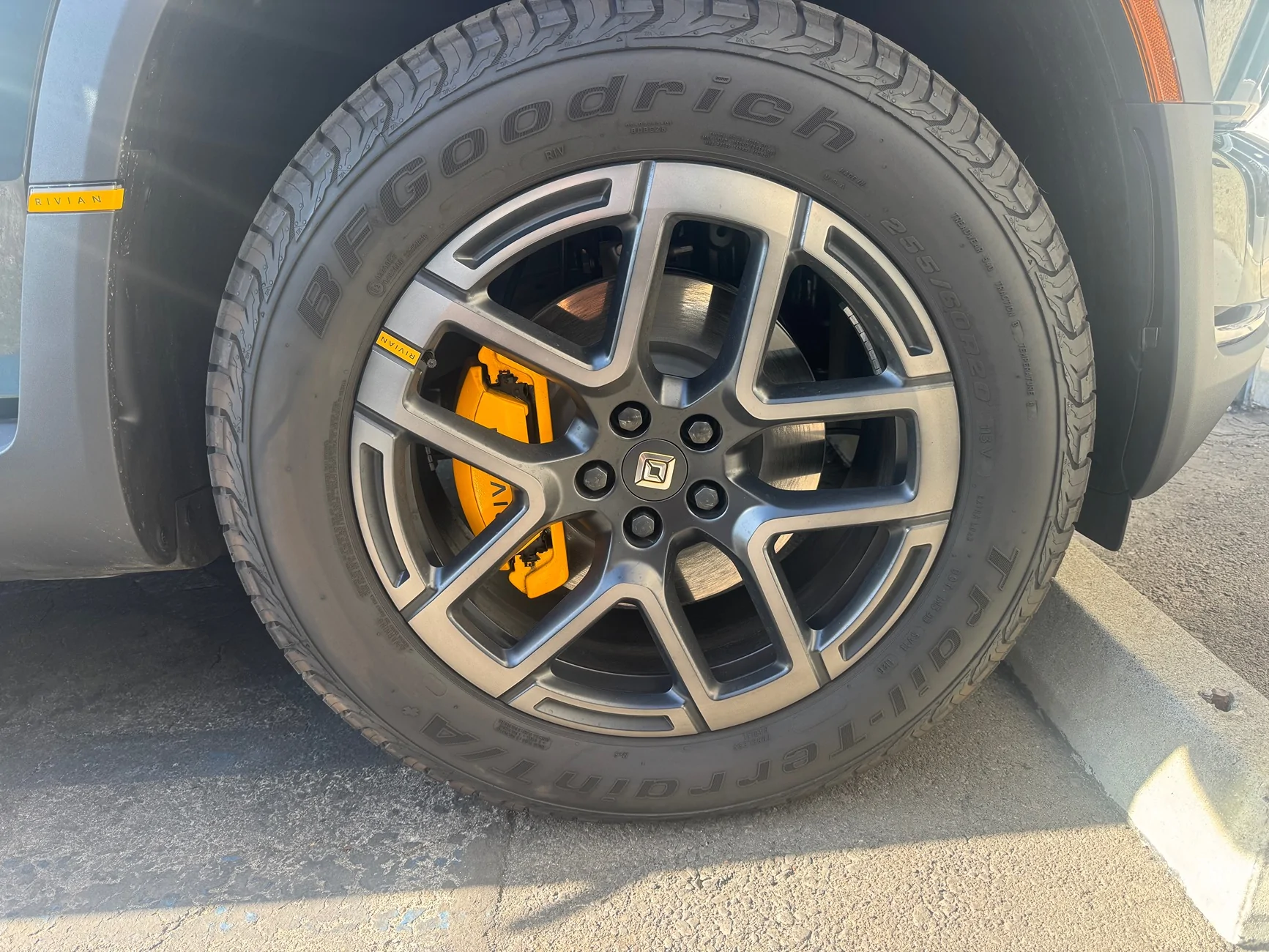
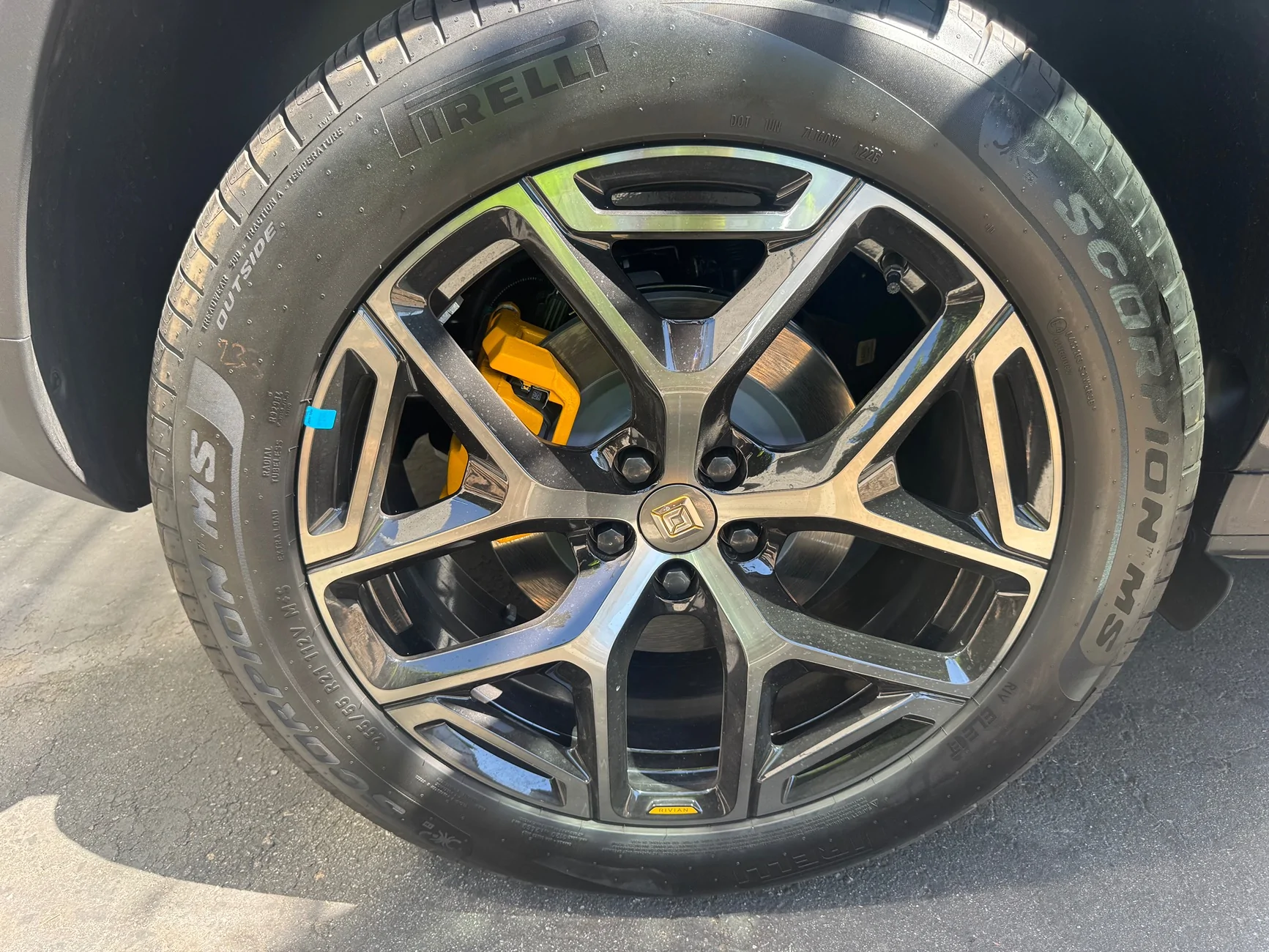
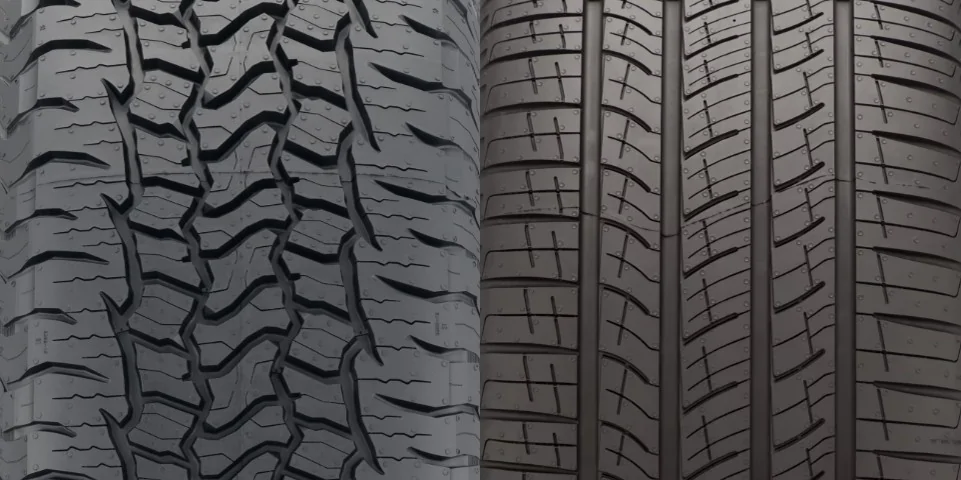
The 20" BFG Trail-Terrain T/A+ and 21" Pirelli Scorpion MS look dramatically different on the surface, but their internal construction is surprisingly similar. Both use a two-ply polyester casing, twin steel belts, and polyamide reinforcement. Based on the published construction alone, there is no obvious structural reason the Pirelli should have a major rolling-resistance advantage. The bigger differences appear to be in tread design, compound, dimensions, and how the tread deforms under load.
The 20" BFG uses a much more aggressive all-terrain pattern, with large interlocking blocks, substantial void space, open shoulders, and strong lateral channels. Intuitively, this looks like the less efficient tire, but its individual tread blocks are relatively large and stout. The 21" Pirelli uses a highway-oriented pattern with four large continuous circumferential channels, narrow longitudinal ribs, closed shoulders, and extensive fine siping. Visually, it looks much more like what we'd expect from an efficiency-focused tire.
However, that appearance doesn't necessarily translate directly into lower rolling resistance. The Pirelli's heavy siping divides its ribs into many smaller tread elements that can flex as they enter and leave the contact patch, while its large longitudinal channels create relatively narrow ribs that can also deform toward the grooves. Both mechanisms can generate hysteresis losses. Meanwhile, the BFG's large voids mean less continuous rubber contact, while its larger, more substantial blocks may be relatively resistant to small-scale deformation. Rubber compound and actual tire construction remain major unknowns, so the tread pattern alone cannot establish which tire has lower rolling resistance.
This makes the real-world R2 efficiency results particularly interesting. Despite the 21" Pirelli looking substantially more pavement- and efficiency-oriented, the available fleet data has not demonstrated a meaningful efficiency advantage over the aggressive 20" BFG. That doesn't prove the Pirelli's siping or longitudinal grooves are responsible, but it suggests the theoretical advantage of its highway tread may be getting offset by other characteristics—potentially tread deformation, compound hysteresis, tire dimensions, mass, or other construction details. The key question therefore becomes: why isn't the visually much more road-oriented 21" Pirelli producing the efficiency advantage its tread design would lead us to expect?
Sponsored
Last edited: