
-
👉 R2 Orders ➡ Add Your R2 Orders / VIN / Delivery Info 📊
Sponsored
The Rivian EPA Range Story: Why the R2’s 330-Mile Rating May Be Setting the Wrong Expectations


TexasBob
Well-Known Member
Option dash. Mac. ¯\_(ツ)_/¯I, too, appreciate the em dash and find it a crime against writing that AI gets to use then but we humans need thirteen fingers, an extended keyboard and twelve different keystroke permutations to avail ourselves of their parenthetical, emphatical dashy goodness.

Mos Eisley
Well-Known Member
Some programs/platforms it be all like:Option dash. Mac. ¯\_(ツ)_/¯

macb00kemdanno
Well-Known Member
- First Name
- Brandon
- Joined
- Feb 19, 2024
- Threads
- 14
- Messages
- 569
- Reaction score
- 1,594
- Location
- Garner, NC
- Vehicles
- R2 LE Reservation, 2024 Tesla Model 3, 2023 Tesla Model Y
Looks at thread title...


VSG
Well-Known Member
THEY DO.Seems like they should have separate city and highway ranges.
Part of the "problem" here seems to be that 50+ years after it was first introduced most people still apparently have no idea what the EPA number means and how their normal everyday driving patterns and conditions affect their range.
It seems to me that a lot of this range anxiety comes from people learning this information for the first time and thinking that this is EV-specific knowledge. It's not.
I don't think I've ever bought an ICE vehicle that advertised its range - just MPG. For example:
https://www.toyota.com/4runner/features/
You can see the MPG, but you have to drill down to find the gas tank size then do the multiplication to get the range. I'll bet most people don't even know their "official" ICE range - they just drive until they get the gas light and learn from experience how far that is (or more importantly learn how far they can get after the light goes on) - they never compare that to the "official" number and so have no idea if they're getting the (un)advertised range or not.
Sponsored
OP
OP

ksurfier
Well-Known Member
- Thread starter
- #21
How did they land on a “330-mile EPA range”?THEY DO.
Part of the "problem" here seems to be that 50+ years after it was first introduced most people still apparently have no idea what the EPA number means and how their normal everyday driving patterns and conditions affect their range.
It seems to me that a lot of this range anxiety comes from people learning this information for the first time and thinking that this is EV-specific knowledge. It's not.
I don't think I've ever bought an ICE vehicle that advertised its range - just MPG. For example:
https://www.toyota.com/4runner/features/
You can see the MPG, but you have to drill down to find the gas tank size then do the multiplication to get the range. I'll bet most people don't even know their "official" ICE range - they just drive until they get the gas light and learn from experience how far that is (or more importantly learn how far they can get after the light goes on) - they never compare that to the "official" number and so have no idea if they're getting the (un)advertised range or not.
defcon888
Well-Known Member
- First Name
- Keith
- Joined
- May 23, 2023
- Threads
- 6
- Messages
- 1,268
- Reaction score
- 973
- Location
- Auburn, Ca
- Vehicles
- 2023 R1T, 2021 Toyota RAV4 Prime
- Occupation
- Making money
When we first got our Large Pack R1T Gen1 back in 2023, it was advertised at 327 miles on a 100% charge. Ever since then the range has gone up and up with every OTA update.
When it is fully chargedto 100%, I get around 340 miles if I drive in consereve mode. When I drive in all-purpose mode (which I do 99.999% of the time, I will get about 315 miles.
I work with a lot of people that have the Teslas and I was surprised to hear that they get about 250 miles on a charge. I have no idea what battery packages they have but that seems low.
When it is fully chargedto 100%, I get around 340 miles if I drive in consereve mode. When I drive in all-purpose mode (which I do 99.999% of the time, I will get about 315 miles.
I work with a lot of people that have the Teslas and I was surprised to hear that they get about 250 miles on a charge. I have no idea what battery packages they have but that seems low.
VegasWeezy
Well-Known Member
- First Name
- Brian
- Joined
- Mar 7, 2024
- Threads
- 3
- Messages
- 178
- Reaction score
- 324
- Location
- Las Vegas, NV
- Vehicles
- 2027 R2 LE, 2022 Mach e
- Occupation
- Accountant
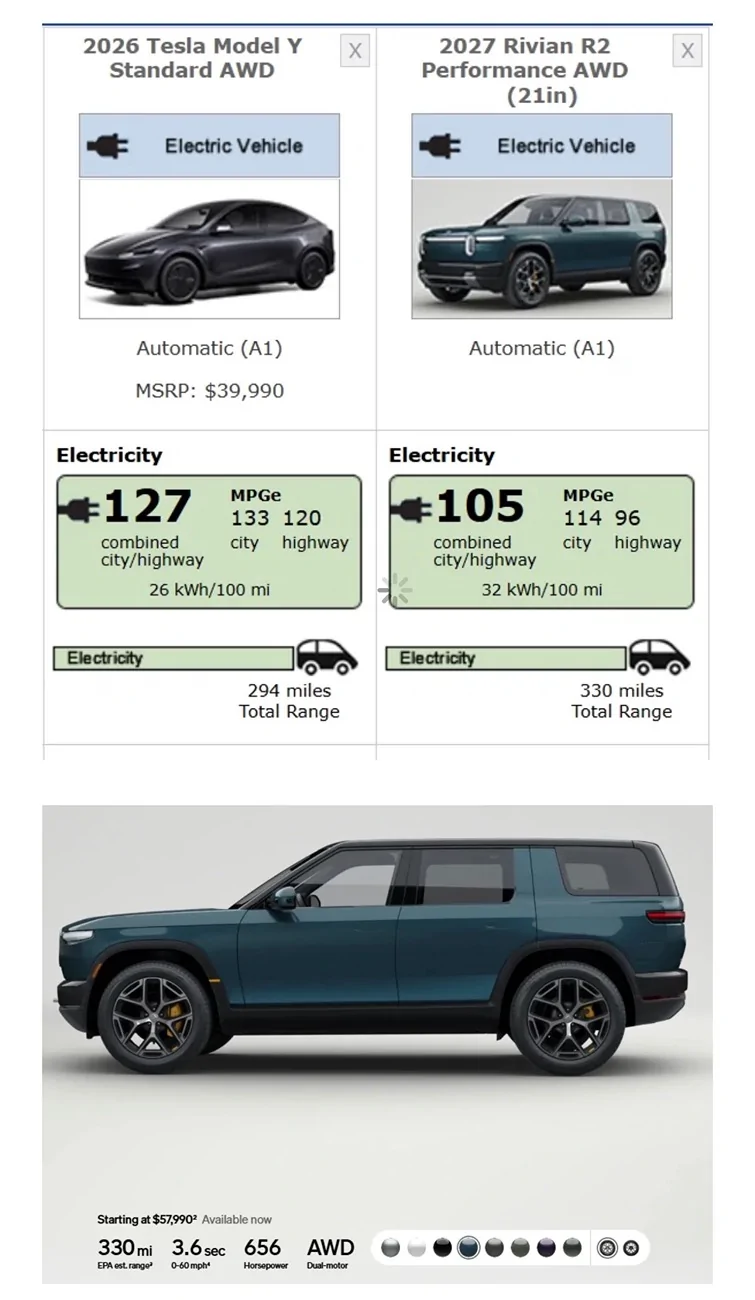
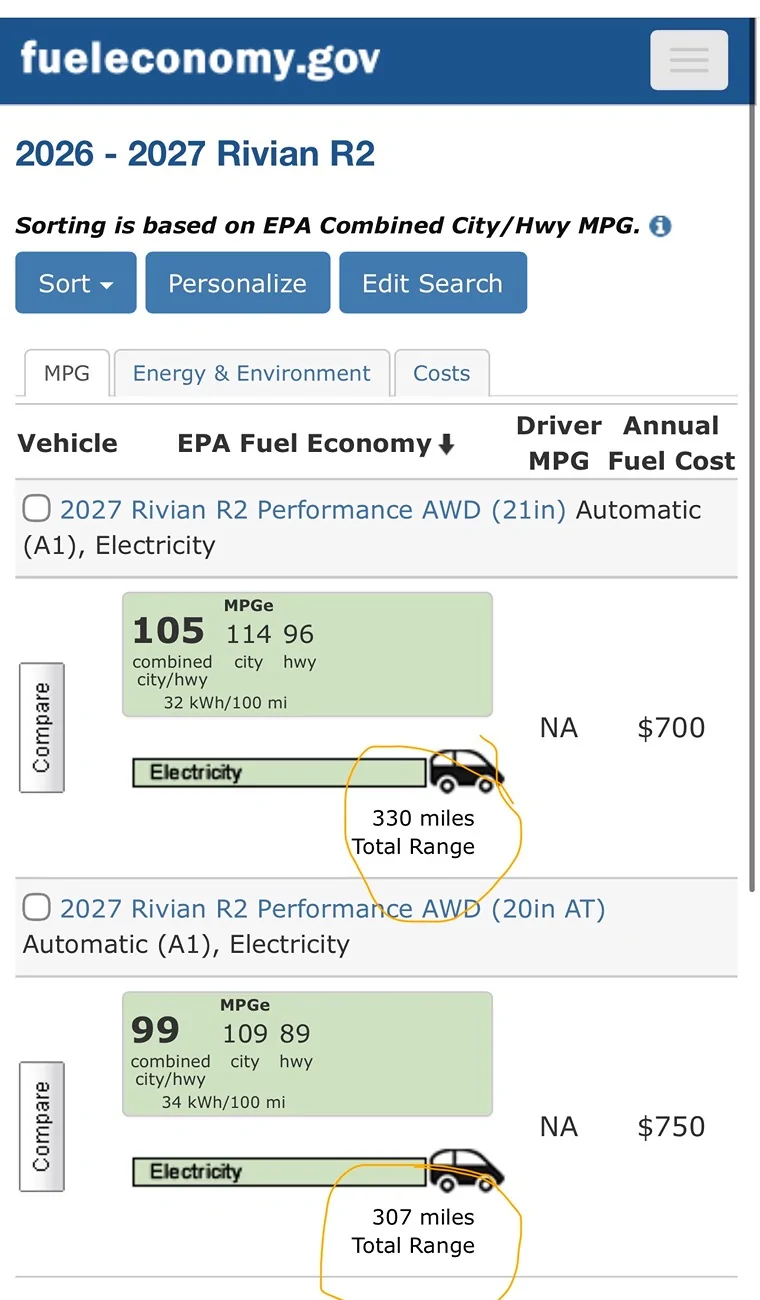
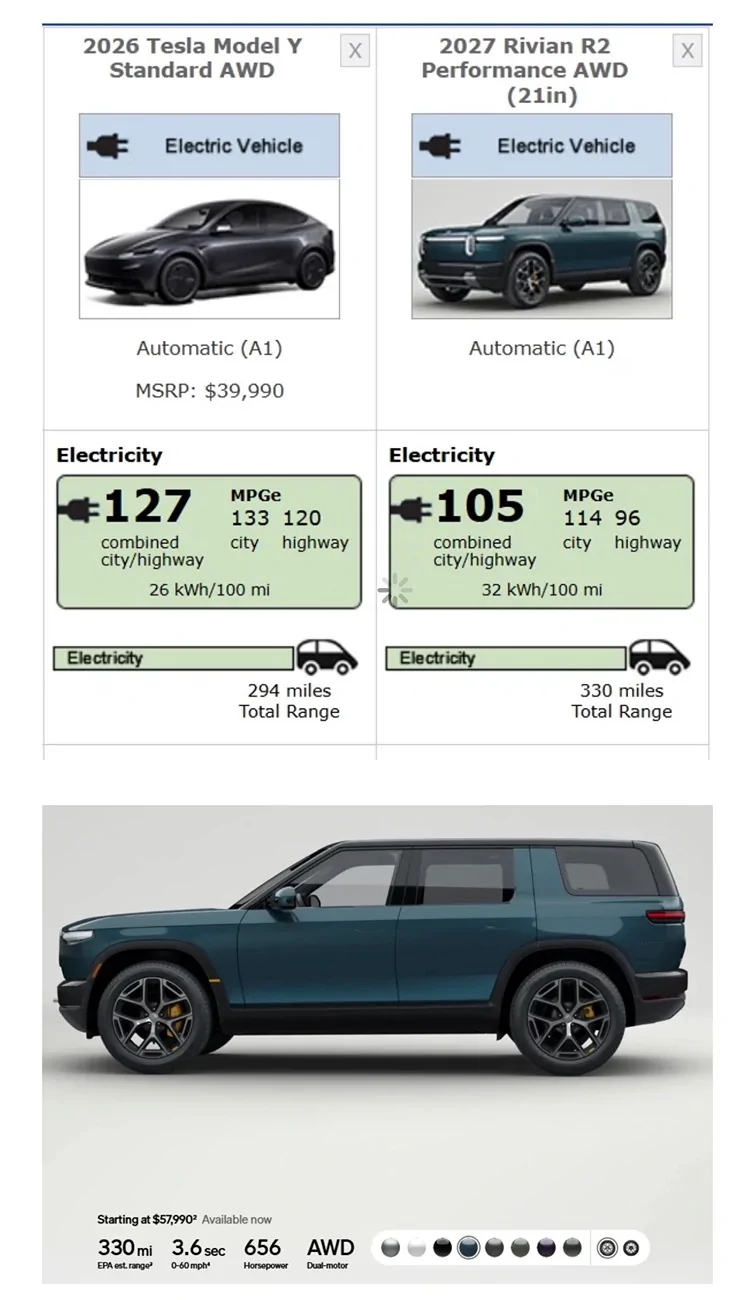
Do you not see the pictures on this thread or do any of your own research? They do provide separate MPGe figures for city and highway, as well as the combined figure.So, the EPA range is closer to how most people actually drive their vehicles instead of the one or two road trips per year. Seems like they should have separate city and highway ranges.
For the R2
114 MPGe - city
96 MPGe - highway
105 MPGe - combined
Effectively, the highway figure equates to roughly 300 miles of range. This is still an optimistic figure. But the point is, there are published values for city, highway and combined!
rvnxyz001
Well-Known Member
Why it is less efficient than Tesla even at lower speeds?For anyone expecting the R2 to deliver 330 miles in everyday driving, here’s the bigger picture.
The issue isn’t that the R2 is inefficient. It’s that EPA range ratings have changed significantly over the last few years, and those changes tend to favor vehicles whose efficiency drops rapidly at higher highway speeds—exactly what happens with taller, boxier SUVs like the R1 and R2.
The first-generation R1 used a much more conservative EPA certification approach that historically tracked real-world highway driving fairly well. Beginning with the refreshed Gen 2 R1, Rivian adopted a newer EPA methodology that produces substantially higher EPA numbers while doing little to change what owners actually experience at 70–80 mph.
The Numbers Tell the Story
Model Usable Battery (kWh) EPA Range (mi) EPA Efficiency (mi/kWh) Typical 70 mph Efficiency (mi/kWh) Approx. 70 mph Highway Range 2022-2023 R1S Quad (Gen 1) ~128 316 2.47 ~2.2-2.3 280-295 mi 2025-2026 R1S (Gen 2) ~109 ~315-320 ~2.9 ~2.2-2.3 240-255 mi 2027 R2 Dual Motor ~88 330 3.75 ~2.65-2.85 235-250 mi
What’s Changed?
On paper, Rivian appears to have improved efficiency dramatically:
That’s an apparent ~20% improvement from the original R1 to the Gen 2 R1.
- Gen 1 R1: ~2.47 EPA mi/kWh
- Gen 2 R1: ~2.9 EPA mi/kWh
- R2: 3.75 EPA mi/kWh
Yet real-world highway testing simply doesn’t support anything close to that magnitude of improvement.
The original R1 generally returns around 2.2–2.3 mi/kWh at 70 mph.
The refreshed Gen 2 R1 is…also around 2.2–2.3 mi/kWh.
The R2 appears somewhat better—roughly 2.65–2.85 mi/kWh based on early testing—but nowhere near the 3.75 mi/kWh implied by its EPA rating.
The Underlying Issue
The newer EPA certification approach places much greater emphasis on lower-speed driving and comparatively little emphasis on sustained freeway speeds above roughly 50–55 mph.
That matters because aerodynamic drag increases with the square of speed, while the power required to overcome it rises approximately with the cube of speed.
For vehicles with a relatively tall, upright profile—like the R1 and R2—energy consumption climbs rapidly once cruising speeds reach 65–80 mph.
As a result:
- Around town, the EPA numbers can be quite representative.
- On long interstate trips, those same vehicles lose efficiency much faster than the EPA rating suggests.
The Bottom Line
The R2 is likely to be an outstanding vehicle.
But buyers expecting 330 miles at normal interstate speeds may be disappointed.
Based on the available highway testing, a more realistic expectation appears to be:
The key takeaway isn’t that Rivian built an inefficient vehicle.
- ~235–250 miles at a steady 70 mph
- More at slower speeds.
- Less at 75–80 mph, in cold weather, or with headwinds and elevation gain.
It’s that the EPA rating system has evolved in a way that can overstate real-world highway range for aerodynamic SUVs, and the R2 appears to be the clearest example yet of that growing disconnect.


rvnxyz001
Well-Known Member
Battery degradation?I work with a lot of people that have the Teslas and I was surprised to hear that they get about 250 miles on a charge. I have no idea what battery packages they have but that seems low.
Sponsored
OP
OP
ksurfier
Well-Known Member
- Thread starter
- #26
Rivian started out using a more representative EPA 2-cycle test method for 2022-2023 vehicles where it removes 30%. However in 2024 they switched to 5-cycle where they get to pick the coefficients and do not need to remove 30%…they have also been using less and less battery, but trying to claim similar range and infer that the vehicles are more efficient…classic bait and switch.When we first got our Large Pack R1T Gen1 back in 2023, it was advertised at 327 miles on a 100% charge. Ever since then the range has gone up and up with every OTA update.
When it is fully chargedto 100%, I get around 340 miles if I drive in consereve mode. When I drive in all-purpose mode (which I do 99.999% of the time, I will get about 315 miles.
I work with a lot of people that have the Teslas and I was surprised to hear that they get about 250 miles on a charge. I have no idea what battery packages they have but that seems low.
Even at slower speeds the aero matters, the MY and R2 likely can reach the same slow speed range of ~300 miles or so…Why it is less efficient than Tesla even at lower speeds?
Last edited:
Tejkalra
Well-Known Member
I think rivian should have stick to bosch motors. They were much more efficient. Instead of increase in efficiency from Gen 1 to Gen 2 I found that efficiency went down 10 to 20%. Not only that, I also noticed that between Gen 1 and Gen2 on all purpose mode Gen 2 lacks power as well. I thinks it's only in launch mode where it is faster then Gen 1.For anyone expecting the R2 to deliver 330 miles in everyday driving, here’s the bigger picture.
The issue isn’t that the R2 is inefficient. It’s that EPA range ratings have changed significantly over the last few years, and those changes tend to favor vehicles whose efficiency drops rapidly at higher highway speeds—exactly what happens with taller, boxier SUVs like the R1 and R2.
The first-generation R1 used a much more conservative EPA certification approach that historically tracked real-world highway driving fairly well. Beginning with the refreshed Gen 2 R1, Rivian adopted a newer EPA methodology that produces substantially higher EPA numbers while doing little to change what owners actually experience at 70–80 mph.
The Numbers Tell the Story
Model Usable Battery (kWh) EPA Range (mi) EPA Efficiency (mi/kWh) Typical 70 mph Efficiency (mi/kWh) Approx. 70 mph Highway Range 2022-2023 R1S Quad (Gen 1) ~128 316 2.47 ~2.2-2.3 280-295 mi 2025-2026 R1S (Gen 2) ~109 ~315-320 ~2.9 ~2.2-2.3 240-255 mi 2027 R2 Dual Motor ~88 330 3.75 ~2.65-2.85 235-250 mi
What’s Changed?
On paper, Rivian appears to have improved efficiency dramatically:
That’s an apparent ~20% improvement from the original R1 to the Gen 2 R1.
- Gen 1 R1: ~2.47 EPA mi/kWh
- Gen 2 R1: ~2.9 EPA mi/kWh
- R2: 3.75 EPA mi/kWh
Yet real-world highway testing simply doesn’t support anything close to that magnitude of improvement.
The original R1 generally returns around 2.2–2.3 mi/kWh at 70 mph.
The refreshed Gen 2 R1 is…also around 2.2–2.3 mi/kWh.
The R2 appears somewhat better—roughly 2.65–2.85 mi/kWh based on early testing—but nowhere near the 3.75 mi/kWh implied by its EPA rating.
The Underlying Issue
The newer EPA certification approach places much greater emphasis on lower-speed driving and comparatively little emphasis on sustained freeway speeds above roughly 50–55 mph.
That matters because aerodynamic drag increases with the square of speed, while the power required to overcome it rises approximately with the cube of speed.
For vehicles with a relatively tall, upright profile—like the R1 and R2—energy consumption climbs rapidly once cruising speeds reach 65–80 mph.
As a result:
- Around town, the EPA numbers can be quite representative.
- On long interstate trips, those same vehicles lose efficiency much faster than the EPA rating suggests.
The Bottom Line
The R2 is likely to be an outstanding vehicle.
But buyers expecting 330 miles at normal interstate speeds may be disappointed.
Based on the available highway testing, a more realistic expectation appears to be:
The key takeaway isn’t that Rivian built an inefficient vehicle.
- ~235–250 miles at a steady 70 mph
- More at slower speeds.
- Less at 75–80 mph, in cold weather, or with headwinds and elevation gain.
It’s that the EPA rating system has evolved in a way that can overstate real-world highway range for aerodynamic SUVs, and the R2 appears to be the clearest example yet of that growing disconnect.

Dennisis
Well-Known Member
Some people don’t seem to be aware of how EV’s charge. The goal, at least with Tesla’s, is to get you from point A to Point B as quickly as possible. EVs charge more quickly in the middle of the range so unless there are no other chargers available (very rare) it will have you charge every 100-140 miles or so to a certain level, usually not exceeding 80%, and repeat until you reach your destination. And you can select the state of charge to arrive at your destination. It’s good practice to ensure the charger availability at your destination - if possible I stay at hotels with destination chargers so I can fill up for free overnight, or I at least check PlugShare for more remote locations to plan ahead. My point is, rarely (very rarely) will you be doing 200 mile plus stretches between charges, that is not the norm. And new chargers are being put in all the time in remote locations too. As I said, for more remote locations plan ahead a bit more for charger availability. I’ve done this all over the west for years on extended trips and it’s not hard. I find it enjoyable as do many others, but if you haven’t done it yet you tend to stress. Unnecessarily.
Sponsored
Similar threads
- Replies
- 440
- Views
- 61,501

- Replies
- 176
- Views
- 16,241


- Replies
- 403
- Views
- 41,277

- Replies
- 20
- Views
- 3,543