Sponsored

Jeremy3292

Well-Known Member
First Name
Jeremy
Joined
Apr 27, 2026
Threads
5
Messages
675
Reaction score
1,056
Location
South Carolina
Vehicles
R2
The difference here may be semantics, but the point being made wasn't about the C rate. It was that a bigger battery pack could still suck down more kilowatts for longer on account of its size alone. The C rate trends down as battery pack size increases in general so yeah, no surprises there. If I remember the gigantic one on the Silverado EV has a C value of around 1 despite its 800V charging. I would hope Rivian is incrementally doing better, but I think we'd need to see a post-R2 battery pack design for the R1.
You said R2 charging was "actually not quite as good as the R1" which I disagree with wholeheartedly. Of course a larger battery pack is going to suck up more kWh than a smaller battery pack. Of course a larger battery pack is going to avg higher kW than a smaller battery pack. That really goes without saying. But the C rate of the R2 is much better than the R1, which is the relevant metric that proves the R2 does charge better than R1. It proves the chemistry and thermals of the pack is better than R1. If we are just going to use "kWh gained" as a metric then a big battery is going to win every time, absent some awfully designed battery (like GM). That doesn't prove it charges better, that just proves it's a big battery.
Sponsored


electromage

Member
First Name
Matt
Joined
Apr 28, 2026
Threads
0
Messages
14
Reaction score
3
Location
Seattle, WA
Vehicles
R2 Reservation, Hyundai Ioniq 5, BMW 353i (E60), Jeep Cherokee (XJ)
I normally L1 charge my Ioniq 5, fine for how much I drive it. I've done some DC charging but I've only done a "10-80" once, took about 19 minutes.

I'm still not sure why Rivian couldn't just make the pack 192x4 instead of 96x8, just a different bus bar configuration, and they could use half as much copper wire everywhere else. Why was this a "budget" decision when Hyundai sells 800V cars for $35,000?

656HP is 489kW, so under load the battery has to supply ~1,500A, that's significant.
 

ksurfier

Well-Known Member
First Name
Ken
Joined
Aug 23, 2022
Threads
49
Messages
1,134
Reaction score
1,044
Location
CA
Vehicles
R1S, Tesla
Occupation
Fake Science Lead
Clubs
 
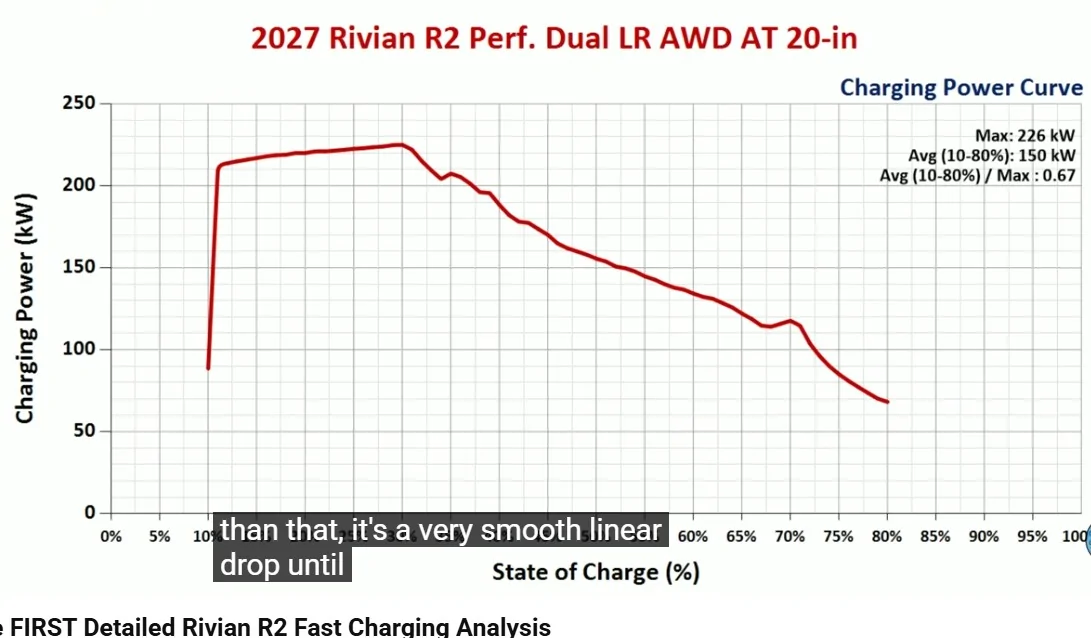
Per Rivian's ABRP app, the ideal charge appears to be from 10% to 70% (or slightly less than 70%). This translates to approx. 20 minutes charging. In some perfect world this translates into driving 2:38 (2 hrs 38 min), plug in for 20 minutes and rinse and repeat. Average overall speed of 57 mph and actual speed of 65 mph excluding charging. If increasing to 68 mph, 2:30 (2 hrs 30 min) and overall speed (including charging) of 59 mph. At 75 mph, can only go for 1:47 (1 hr 47 min) and overall average speed of 63 mph:
Ave speed1,000 mile trip duration
62 mph18:00 (eighteen hours)
65 mph17:30 (seventeen hours thirty min)
68 mph17:00 (seventeen hours)
75 mph16:00 (sixteen hours)
80 mph15:30 (fifteen hours thirty min)

Rivian R1T R1S R2 10-80% charge test (by State Of Charge) 2027R2
 
Last edited:

cwq93r

Well-Known Member
Joined
Jun 18, 2026
Threads
2
Messages
56
Reaction score
57
Location
Bay Area, CA
Vehicles
R2 on Order
I normally L1 charge my Ioniq 5, fine for how much I drive it. I've done some DC charging but I've only done a "10-80" once, took about 19 minutes.

I'm still not sure why Rivian couldn't just make the pack 192x4 instead of 96x8, just a different bus bar configuration, and they could use half as much copper wire everywhere else. Why was this a "budget" decision when Hyundai sells 800V cars for $35,000?

656HP is 489kW, so under load the battery has to supply ~1,500A, that's significant.
Not sure why you worry about 800v speeds if you L1 charge. Should be a non-issue. You are literally the target customer Rivian touts.
I also have an Ioniq 5 and I only fast charged for the 1st 2 years for the free EA deal. It was painful. Now I L2 charge at work twice a week. From my Ioniq 5 EA experience, I can tell you 10-80% rarely happened. And on road trips when it mattered most, the infrastructure in small towns could not reliably deliver.
And I don’t want an ICCU in my Rivian 😜 Never had that problem, but I don’t want that risk.

 

electromage

Member
First Name
Matt
Joined
Apr 28, 2026
Threads
0
Messages
14
Reaction score
3
Location
Seattle, WA
Vehicles
R2 Reservation, Hyundai Ioniq 5, BMW 353i (E60), Jeep Cherokee (XJ)
Not sure why you worry about 800v speeds if you L1 charge. Should be a non-issue. You are literally the target customer Rivian touts.
I also have an Ioniq 5 and I only fast charged for the 1st 2 years for the free EA deal. It was painful. Now I L2 charge at work twice a week. From my Ioniq 5 EA experience, I can tell you 10-80% rarely happened. And on road trips when it mattered most, the infrastructure in small towns could not reliably deliver.
And I don’t want an ICCU in my Rivian 😜 Never had that problem, but I don’t want that risk.

I'm not worried about the charging speeds, more about the weight and price of copper needed to carry the higher currents. Rivian has been selling 400V vehicles for years so I know they work fine.
 

Sponsored

VSG

Well-Known Member
Joined
Oct 3, 2022
Threads
4
Messages
3,349
Reaction score
6,304
Location
WA
Vehicles
R1T LE/RB/OC/20
Note, per the State of Charge testing, pushing 600A through a CCS adapter has shown thermal issues (melting). None of the adapters available on the market at this time are rated for 600A continuous.
Explain to me how a spec-compliant CCS charger can deliver 600A when the CCS specification states the maximum current is 500A?

What should happen, according to the protocol, is that the R2 asks for 600A but the CCS charger negotiates that down to the maximum it can deliver under the specification. There is no need for adapters to be rated >500A because they should never be subjected to >500 amps, by design.

Specifically, this is not a problem with the R2 or with the adapter - it is a failure of the charger to follow the CCS specifications.
 

Indy avocado

Well-Known Member
First Name
Greg
Joined
Dec 17, 2022
Threads
3
Messages
220
Reaction score
308
Location
Indiana
Vehicles
'22 R1T, '17 Macan S, '11 Mustang GT
Explain to me how a spec-compliant CCS charger can deliver 600A when the CCS specification states the maximum current is 500A?

What should happen, according to the protocol, is that the R2 asks for 600A but the CCS charger negotiates that down to the maximum it can deliver under the specification. There is no need for adapters to be rated >500A because they should never be subjected to >500 amps, by design.

Specifically, this is not a problem with the R2 or with the adapter - it is a failure of the charger to follow the CCS specifications.
I have looked numerous times for the 500A CCS limit in specifications.

As far as I can tell, it doesn't exist.

The whole handshake exists to figure this out.

The 600kW-1.2MW charging demos are using 600-900A.

Unfortunately, adapters were not part of the spec (including J3400) so there's no way for the adapter to "announce" it's limits.
 

VSG

Well-Known Member
Joined
Oct 3, 2022
Threads
4
Messages
3,349
Reaction score
6,304
Location
WA
Vehicles
R1T LE/RB/OC/20
I have looked numerous times for the 500A CCS limit in specifications.

As far as I can tell, it doesn't exist.

The whole handshake exists to figure this out.

The 600kW-1.2MW charging demos are using 600-900A.

Unfortunately, adapters were not part of the spec (including J3400) so there's no way for the adapter to "announce" it's limits.
As you probably know, most of these specifications are not free - you have to pay a hefty fee to get an official copy. The publicly available sources seem to be wrong about the limits though - they all say 500A but I dug a little deeper and if you look at some of the specs it says only 400A. Which kind of makes sense - you do see some 400kW chargers out there, but I've never seen a 500kW charger ...

For example, IEC 62196-3:2026 "Plugs, socket-outlets, vehicle connectors and vehicle inlets – Conductive charging of electric vehicles" shows 1000V/400A as the rating for the CCS1 connector we all know and love. Unfortunately I can't give you a link for that because it's not public data, but you can probably find a bootleg copy online somewhere.

Regardless, this has nothing to do with adapters or J3400. The charger knows that it's a CCS charger, and if a request comes in for a voltage or a current (or combination) that it can't supply or is out of spec, then it's supposed to counteroffer with what it can supply. This happens regardless of whether there's an adapter or a J3400 plug involved because that doesn't change anything about the protocol.

There is no need to "announce" limits. The vehicle asks for what it wants then the charger replies with what it can deliver. Which of course can be different and less than requested, but never more. For example the Rivian can ask for 220kW at start (actually it has to specify voltage and current separately) but if you're plugged into a 50kW charger you're obviously not going to get that - the charger is going to come back with a voltage and current that make 50kW. And if the vehicle asks for 400V the charger isn't going to deliver 800V even if the charger is capable of 800V. But if the vehicle asks for 800V and the charger can only give 400V, that's all the vehicle is going to get. The Rivian never knows what the capacity of the charger is, it only knows what the charger can deliver at that point in time.
 

Jeremy3292

Well-Known Member
First Name
Jeremy
Joined
Apr 27, 2026
Threads
5
Messages
675
Reaction score
1,056
Location
South Carolina
Vehicles
R2
I have looked numerous times for the 500A CCS limit in specifications.

As far as I can tell, it doesn't exist.

The whole handshake exists to figure this out.

The 600kW-1.2MW charging demos are using 600-900A.

Unfortunately, adapters were not part of the spec (including J3400) so there's no way for the adapter to "announce" it's limits.
The standard allows 500 amps to be exceeded provided the temperature limits of the connector are never exceeded. The thermodynamic limit engineers calculated at the time was 500 amps. So 500 amps was the practice limit in the engineering drawings but it was never official stated you could not exceed 500 amps.

Now enter liquid cooling. 500 amps was the limit years ago bc they didn’t have the engineering solved yet to exceed it and no CCS1 stations until recently put out more than 500 amps, so no adapters were made for a rating higher than that. Chicken and egg problem.

They revised the standard under IEC 62196-3:2022 to say the following as the technology evolved:

“The hardware is rated up to 1,500V and up to 800A, provided that the charging system utilizes an active thermal management system to ensure the vehicle coupling components never exceed the maximum operating temperature limits.”

Basically the pins can’t exceed 90 C and manufacturers certify this to UL during testing of their chargers and cables.
 
Last edited:

VSG

Well-Known Member
Joined
Oct 3, 2022
Threads
4
Messages
3,349
Reaction score
6,304
Location
WA
Vehicles
R1T LE/RB/OC/20
I don't see that statement in IEC 62196-3:2022-10, is there a more current version with that change?
 

Sponsored

mkhuffman

Well-Known Member
First Name
Mike
Joined
Nov 9, 2020
Threads
14
Messages
3,018
Reaction score
3,433
Location
Virginia
Vehicles
2025 R1T Tri-Max, Jeep GC-L, VW Jetta
I'm not worried about the charging speeds, more about the weight and price of copper needed to carry the higher currents. Rivian has been selling 400V vehicles for years so I know they work fine.
If cost is your concern, then you need to add in the extra cost of adapting to a 400V charger.

GM and the Cybertruck splits the pack, but you need additional hardware to accomplish that. I think Lucid and some others use the motor inverter, but that also requires additional hardware.

800V isn't cheaper long as you need good performance on 400V chargers.
 

Kaiju

Well-Known Member
Joined
Aug 18, 2024
Threads
2
Messages
140
Reaction score
257
Location
Texas
Vehicles
R1T
You said R2 charging was "actually not quite as good as the R1" which I disagree with wholeheartedly. Of course a larger battery pack is going to suck up more kWh than a smaller battery pack. Of course a larger battery pack is going to avg higher kW than a smaller battery pack. That really goes without saying. But the C rate of the R2 is much better than the R1, which is the relevant metric that proves the R2 does charge better than R1. It proves the chemistry and thermals of the pack is better than R1. If we are just going to use "kWh gained" as a metric then a big battery is going to win every time, absent some awfully designed battery (like GM). That doesn't prove it charges better, that just proves it's a big battery.
What I said was the average kW charge rate on the R2 is not as good as the R1. The R1 average charge rate is higher. On this we both agree. That is the extent of what was said in that regard, though. I did not impinge on the dignity of the R2's efficiency, though I put less weight on the C rate than you do. The C rate would be even better if the battery was much smaller, but that's most likely commercial suicide.

If you could straight up take an R1 battery and put it in an R2 you'd get the following:

~$12k more cost
More total range, enough to match or beat the BMW
More range added in any time interval on the DCFC charger because the bigger battery can accept more jiggawatts in the bottom of the pack.
A longer 10-80 time
A lower C rate

So if you're a consumer which of these things do you care about? Putting the most miles on in 20 minutes, or getting 70% of the pack charged regardless of how far that takes you? Do you throw down for huge range to able to go 450+ miles in a shot for R1 money so you can try to rely mostly on destination charging and not care about the uninspiring DCFC?

The BMW charging system will still be better, though I also think it's only as good as it is on paper in a minority of charging situations. It is not universally better at every charger or even most chargers. At a 225kW charger that high C rate is wasted. So are you doing the same thing relying on its long range to use destination chargers and then its DCFC rates don't matter?

Personally I don't think people would buy a $75k R2 that would have solid but uninspiring performance due to the extra weight and its present interior and options. It would feature creep right up into the R1 price range as people expected higher quality materials, fitting and more horsepower. People already complain the R1 amenities are unworthy of a '100k car'. I also think that consumers don't see the digits after the first in the range number, so 390 miles may as well be 310. This is one of the dangers inherent in spending $90k on an F-150. All of its functional bits are the same as a work truck version that costs half as much and outside badging it looks more or less identical. So they buy king ranch F-250s or F-350s instead.
 

Jeremy3292

Well-Known Member
First Name
Jeremy
Joined
Apr 27, 2026
Threads
5
Messages
675
Reaction score
1,056
Location
South Carolina
Vehicles
R2
What I said was the average kW charge rate on the R2 is not as good as the R1. The R1 average charge rate is higher. On this we both agree. That is the extent of what was said in that regard, though. I did not impinge on the dignity of the R2's efficiency, though I put less weight on the C rate than you do. The C rate would be even better if the battery was much smaller, but that's most likely commercial suicide.

If you could straight up take an R1 battery and put it in an R2 you'd get the following:

~$12k more cost
More total range, enough to match or beat the BMW
More range added in any time interval on the DCFC charger because the bigger battery can accept more jiggawatts in the bottom of the pack.
A longer 10-80 time
A lower C rate

So if you're a consumer which of these things do you care about? Putting the most miles on in 20 minutes, or getting 70% of the pack charged regardless of how far that takes you? Do you throw down for huge range to able to go 450+ miles in a shot for R1 money so you can try to rely mostly on destination charging and not care about the uninspiring DCFC?

The BMW charging system will still be better, though I also think it's only as good as it is on paper in a minority of charging situations. It is not universally better at every charger or even most chargers. At a 225kW charger that high C rate is wasted. So are you doing the same thing relying on its long range to use destination chargers and then its DCFC rates don't matter?

Personally I don't think people would buy a $75k R2 that would have solid but uninspiring performance due to the extra weight and its present interior and options. It would feature creep right up into the R1 price range as people expected higher quality materials, fitting and more horsepower. People already complain the R1 amenities are unworthy of a '100k car'. I also think that consumers don't see the digits after the first in the range number, so 390 miles may as well be 310. This is one of the dangers inherent in spending $90k on an F-150. All of its functional bits are the same as a work truck version that costs half as much and outside badging it looks more or less identical. So they buy king ranch F-250s or F-350s instead.
We agree on almost everything. I just would never say R1 has better charging than R2, which is what you said or what I read into that took me aback. R2 thermals and cell makeup is vastly superior to R1. Every review notes how poorly R1 charges and how thermally limited it is, although Rivian did try to update it last year and it did get a little better it seems. I've yet to see anyone say R1 has good or even great charging. It's poor by all metrics. That was really all I was getting at.
 

mkhuffman

Well-Known Member
First Name
Mike
Joined
Nov 9, 2020
Threads
14
Messages
3,018
Reaction score
3,433
Location
Virginia
Vehicles
2025 R1T Tri-Max, Jeep GC-L, VW Jetta
We agree on almost everything. I just would never say R1 has better charging than R2, which is what you said or what I read into that took me aback. R2 thermals and cell makeup is vastly superior to R1. Every review notes how poorly R1 charges and how thermally limited it is, although Rivian did try to update it last year and it did get a little better it seems. I've yet to see anyone say R1 has good or even great charging. It's poor by all metrics. That was really all I was getting at.
Not sure that is the case for the Gen2 R1.

This can be subjective, I guess, as certainly it isn't a 800V truck.

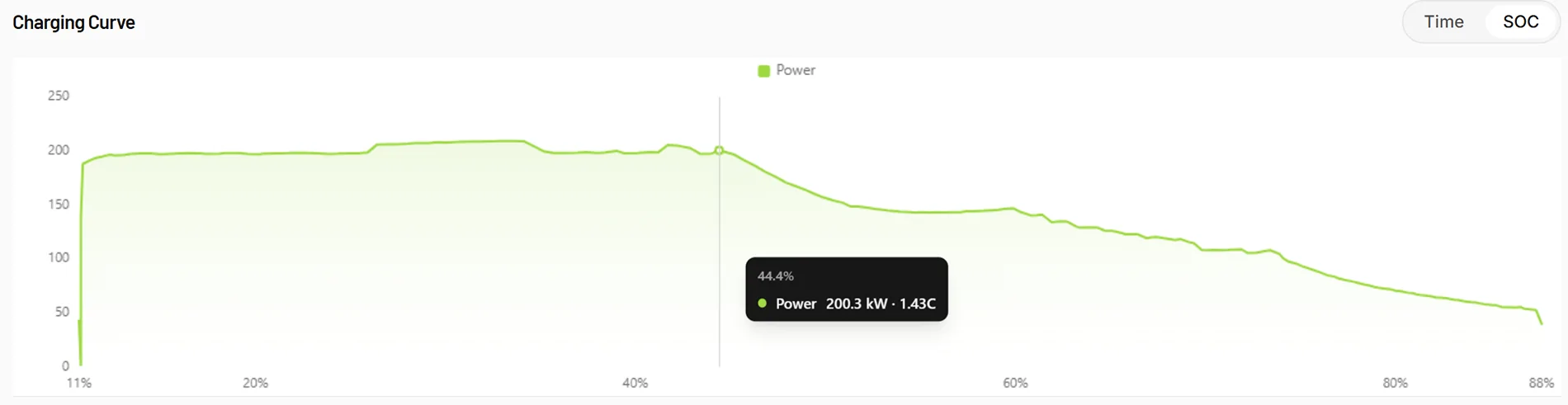
I was so frustrated with the horrible charging speed in my Mach-e, but my R1T is totally acceptable. I wish it would be faster, but I doubt it can be much faster and stay 400V.

Rivian R1T R1S R2 10-80% charge test (by State Of Charge) 1783699070700-8h


This is a recent charge I did on a RAN charger. The truck maintained over 200 kW until 45%.

Pretty decent charge curve, IMO.
 

Jeremy3292

Well-Known Member
First Name
Jeremy
Joined
Apr 27, 2026
Threads
5
Messages
675
Reaction score
1,056
Location
South Carolina
Vehicles
R2
Not sure that is the case for the Gen2 R1.

This can be subjective, I guess, as certainly it isn't a 800V truck.

I was so frustrated with the horrible charging speed in my Mach-e, but my R1T is totally acceptable. I wish it would be faster, but I doubt it can be much faster and stay 400V.

1783699070700-8h.webp


This is a recent charge I did on a RAN charger. The truck maintained over 200 kW until 45%.

Pretty decent charge curve, IMO.
Maintaining 200kW to 45% on a 141 kWh battery is the same as the R2 maintaining 125kW to 45%. It’s really not that impressive. I agree 400v is likely the limiting factor here, although CCS and NACS stations now can deliver 600+ amps. So in theory R1 can get better, but I imagine the thermals are too poor to be able to get much better. R1 is fine. R2 is better.

How long was your 10 to 70 and 10 to 80 on that charge?
Sponsored


Top