
Sponsored
OP
OP
superfluid

superfluid

Well-Known Member
Joined
Mar 29, 2021
Threads
20
Messages
290
Reaction score
923
Location
Austin, TX
Vehicles
Rivian R1S, Kia Telluride
Occupation
Tech and data
Clubs
 

Epzey

Well-Known Member
First Name
E
Joined
Aug 23, 2023
Threads
8
Messages
103
Reaction score
68
Location
Oregon
Vehicles
R1T
would foam speaker speaker rings not solve the issue of the rattles? Or did you decide it’s from the small gaps in the panel and the door card? I’ve been considering dynamating the doors anyway.

The fact that the sub rattles its own specific housing so much is a bit of a head scratcher odd corner to cut.

Thanks for taking the time to do these measurements.
 
OP
OP
superfluid

superfluid

Well-Known Member
Joined
Mar 29, 2021
Threads
20
Messages
290
Reaction score
923
Location
Austin, TX
Vehicles
Rivian R1S, Kia Telluride
Occupation
Tech and data
Clubs
 
[Cross posting from the R1S Elevation thread.]

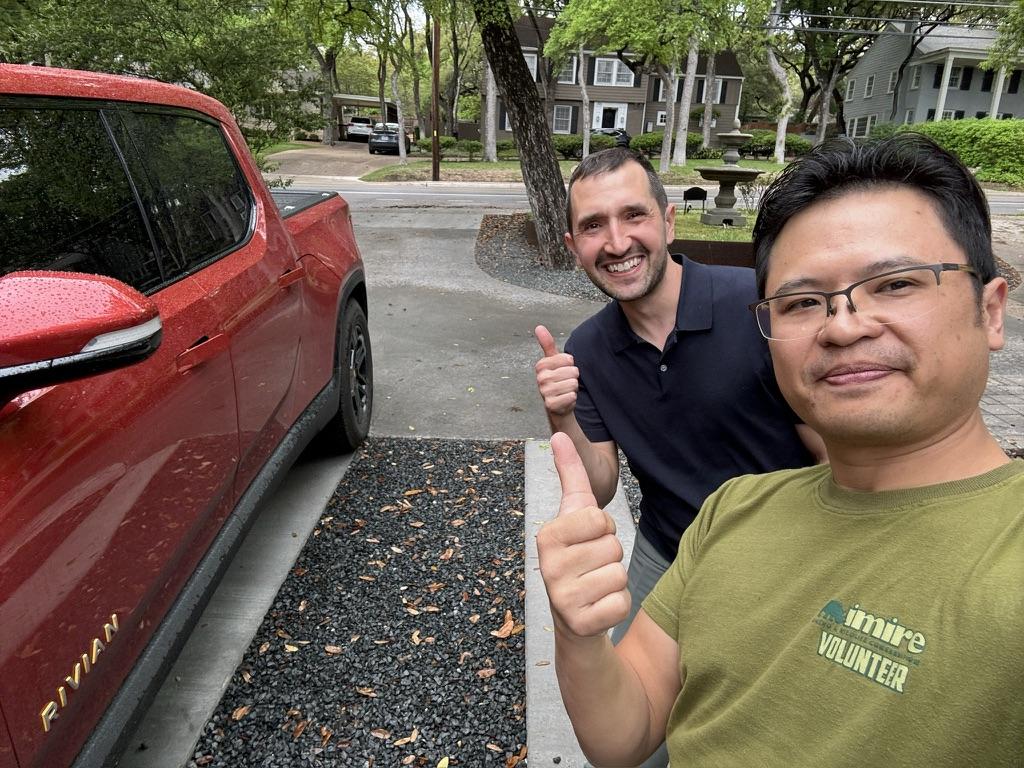
At long last, I got together with @skyote to measure his Gen 1 R1S Meridian. We met at the Austin Showroom where Skyler made it possible to measure the Gen 2 R1S Premium. It was hot out but we had a good time.

I'm going to post write-ups of both systems in 3-4 weeks after I get back from vacation, but suffice it to say I'm quite confident Rivian implemented the Gen 1 R1S Elevation system improperly after they swapped out the Meridian drivers and made whatever other changes. The Gen 1 R1S Meridian does not have the same major issue at 1 kHz, has more headroom (can get louder before it starts distorting), and generally sounds and measures better.

I can't imagine anyone preferring the Elevation system over the Meridian, despite what Rivian claims, unless Rivian deliberately worded the question to get that response. E.g., "Would you prefer the Elevation system over the Meridian if it cost $4,000 less and you'd get your vehicle sooner?" Surely, most people would have answered "yes" to that.

The Gen 2 R1S Premium sounds ok after some tweaks. Skyler and I ran short on time so I couldn't A/B the Gen 1 Meridian and Gen 2 Premium systems properly. However, from memory, the Gen 1 Meridian systems (both in the R1S and R1T) are the most enjoyable Rivian systems to my ears, especially after making a few EQ tweaks.

Skyler and I will try to use this data to chat with Rivian cabin engineering about possible improvements. If anyone has a contact over there, please DM us.

More to come.
 

UnsungZero_OldTimeAdMan

Well-Known Member
First Name
Barnum
Joined
Mar 20, 2023
Threads
68
Messages
8,697
Reaction score
11,936
Location
SoCal
Vehicles
'23 GW Quad-Large R1T "Ghost"
Occupation
Advertising Circus
[Cross posting from the R1S Elevation thread.]
...I'm going to post write-ups of both systems in 3-4 weeks after I get back from vacation, but suffice it to say I'm quite confident Rivian implemented the Gen 1 R1S Elevation system improperly after they swapped out the Meridian drivers and made whatever other changes...
Rivian's support page on product change is 404. But thanks to a post by Dark-Fx, this is what Rivian said:

Our in-house designed Rivian Elevation audio allows the R1T and R1S to use a common 1200 Watt, 18-channel amplifier. On both models, we've removed the rear passenger door midrange speakers, shifting this work across a tweeter and woofer for seamless frequency transitions.

The new Rivian Elevation audio system is lighter, more efficient and uses less rare-earth metals. Our testing has shown that listeners prefer the Rivian Elevation audio experience, and this update allows us to more easily tune our audio system based on owner feedback moving forward.
 

R1Tom

Well-Known Member
First Name
Tom
Joined
May 19, 2022
Threads
37
Messages
3,621
Reaction score
4,862
Location
Wisc
Vehicles
Riv R1T
Occupation
Sales
Rivian's support page on product change is 404. But thanks to a post by Dark-Fx, this is what Rivian said:
It's like promoting the standard battery pack with shortest range as using less batteries and all the components in them. That is how I see the less magnet argument.
 

Sponsored

OP
OP
superfluid

superfluid

Well-Known Member
Joined
Mar 29, 2021
Threads
20
Messages
290
Reaction score
923
Location
Austin, TX
Vehicles
Rivian R1S, Kia Telluride
Occupation
Tech and data
Clubs
 
Rivian's support page on product change is 404. But thanks to a post by Dark-Fx, this is what Rivian said:

Our testing has shown that listeners prefer the Rivian Elevation audio experience, and this update allows us to more easily tune our audio system based on owner feedback moving forward.
This is helpful, thanks. It's interesting that they said "the Rivian Elevation audio experience." I wonder what that means.

I'll try to put their "tune our audio system based on owner feedback moving forward" goal to the test.
 

UnsungZero_OldTimeAdMan

Well-Known Member
First Name
Barnum
Joined
Mar 20, 2023
Threads
68
Messages
8,697
Reaction score
11,936
Location
SoCal
Vehicles
'23 GW Quad-Large R1T "Ghost"
Occupation
Advertising Circus
It's like promoting the standard battery pack with shortest range as using less batteries and all the components in them. That is how I see the less magnet argument.
Professional writers are paid to spin. :)


This is helpful, thanks. It's interesting that they said "the Rivian Elevation audio experience." I wonder what that means.

I'll try to put their "tune our audio system based on owner feedback moving forward" goal to the test.
It must sound worse in the R1S than the R1T. But, it's a larger acoustic space and that makes sense. I can see drivers with smaller and/or less powerful magnets being more distortion-prone. And, making the now inferior woofer and tweeter drivers to cover what was originally delegated to the mid-range—i.e. asking them to do more work—makes matters even worse at higher volumes. I don't think my non-Meridian R1T's system is mind-blowing. It's decent. But, that satisfaction does fall apart whenever I crank it up (which I try to avoid).

Are the mounting points still there for the deleted mid-range drivers? I'm guessing it wouldn't be too difficult to improve by upgrading the speakers alone, with or without adding back the mids. Might also need to add physical crossovers, since there isn't access to software. There are a couple outfits that offer similar approach for BMWs (Bavsound and BimmerTech). There's definitely a business opportunity here.
 

madgrey

Well-Known Member
First Name
Allan
Joined
Feb 26, 2022
Threads
4
Messages
903
Reaction score
1,241
Location
Fidalgo Island, WA
Vehicles
2022 R1T, 2016 Miata, 2015 Viper
Occupation
Hardware Design Verification
That’s interesting. As I mentioned in my R1S Elevation post, I used a target curve designed for home theaters, which might explain why we want more bass boost in our cars than our theaters.

That said, I’m puzzled by Linus’s cuts at 2 and 4 kHz. That area definitely sounded recessed to me and benefited from a boost.

But try both and see which you like better. Do report back!
I've been running a slightly modified version of your settings for about 3 months:
Recommended
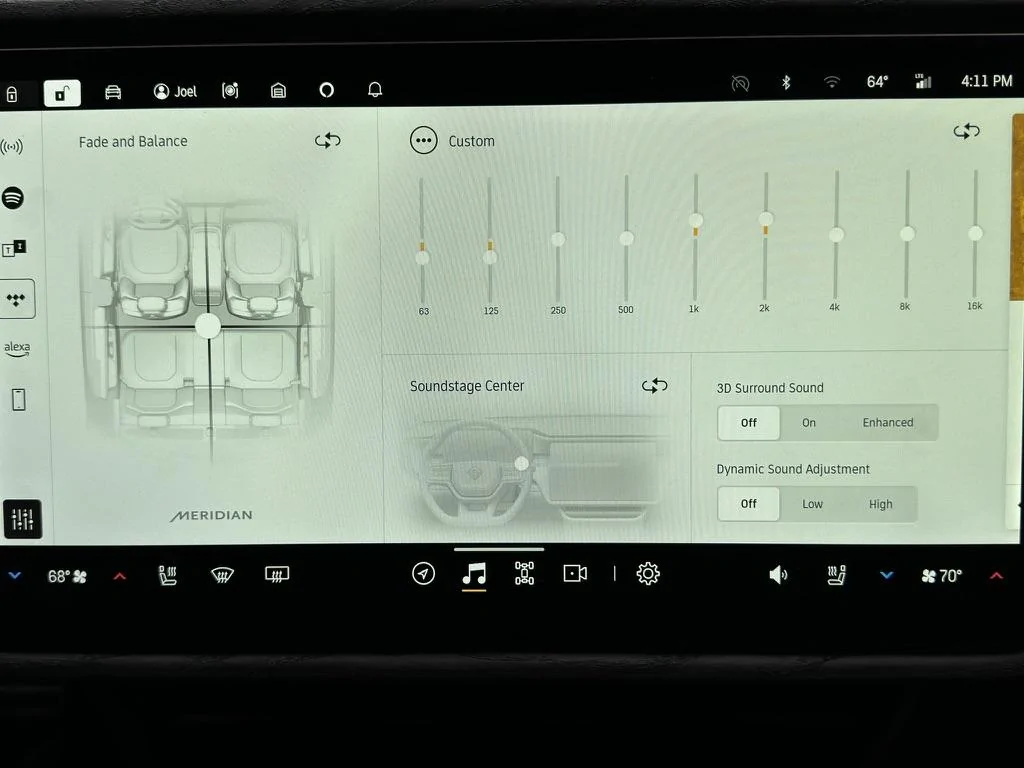
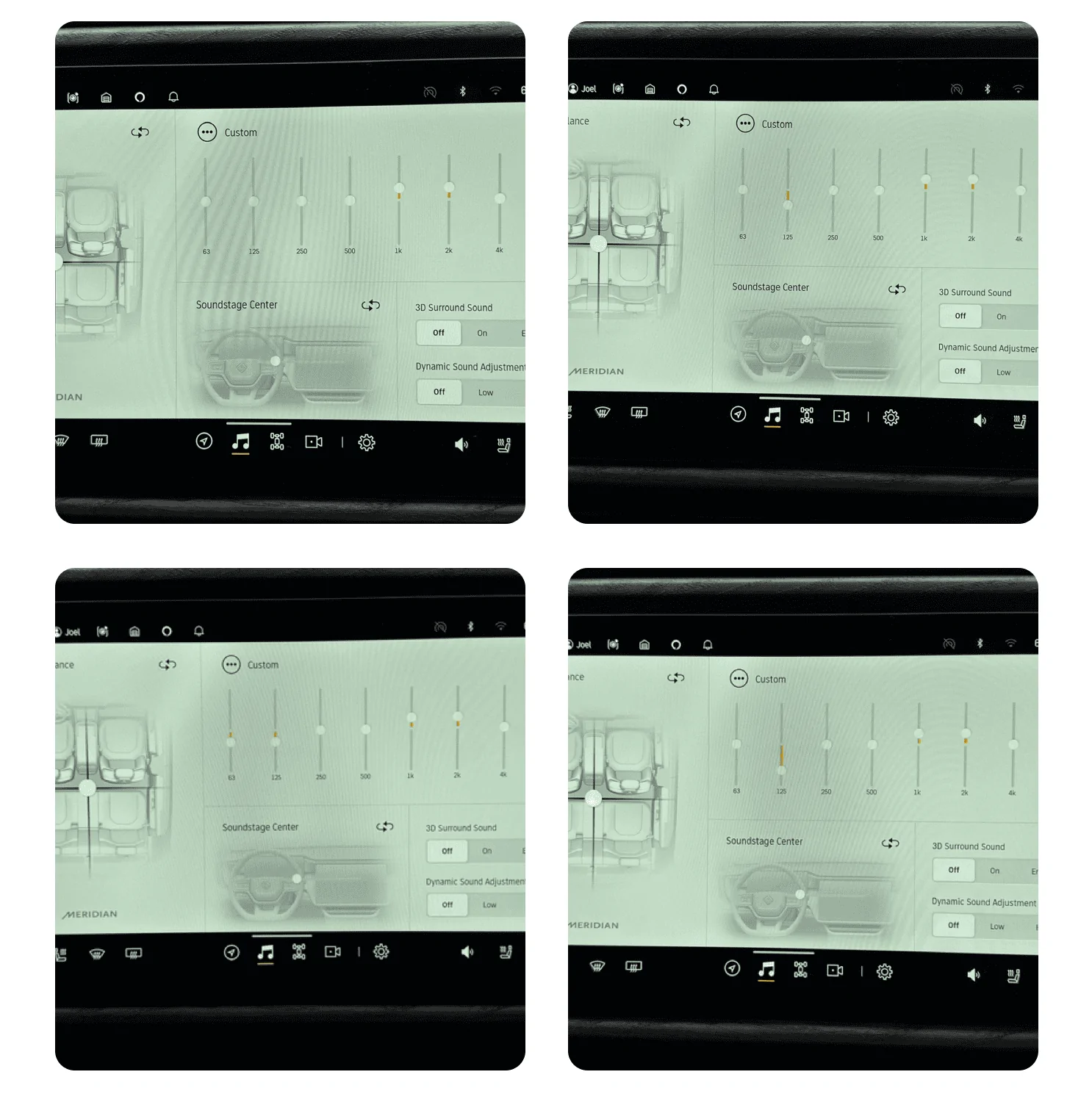
EQ settings: 63 Hz -3 notches, 125 Hz -3, 1 kHz +3, 2 kHz +3
madgrey
EQ settings: 63 Hz -3 notches, 125 Hz -3, 1 kHz +2, 2 kHz +2

I kept going back and forth between various recommendations but I'm very happy now. It does take a bit of time to retrain your ears and get out of the "more bass sounds better" mindset.
 

Alanparkcity

Well-Known Member
First Name
Alan
Joined
May 26, 2024
Threads
6
Messages
123
Reaction score
162
Location
Park City, Ut
Vehicles
Rivian T1T
Occupation
Retired
Clubs
 
This is a sister post to How to Improve a Rivian R1S’s Elevation Sound System With Simple EQ Changes.

TLDR;
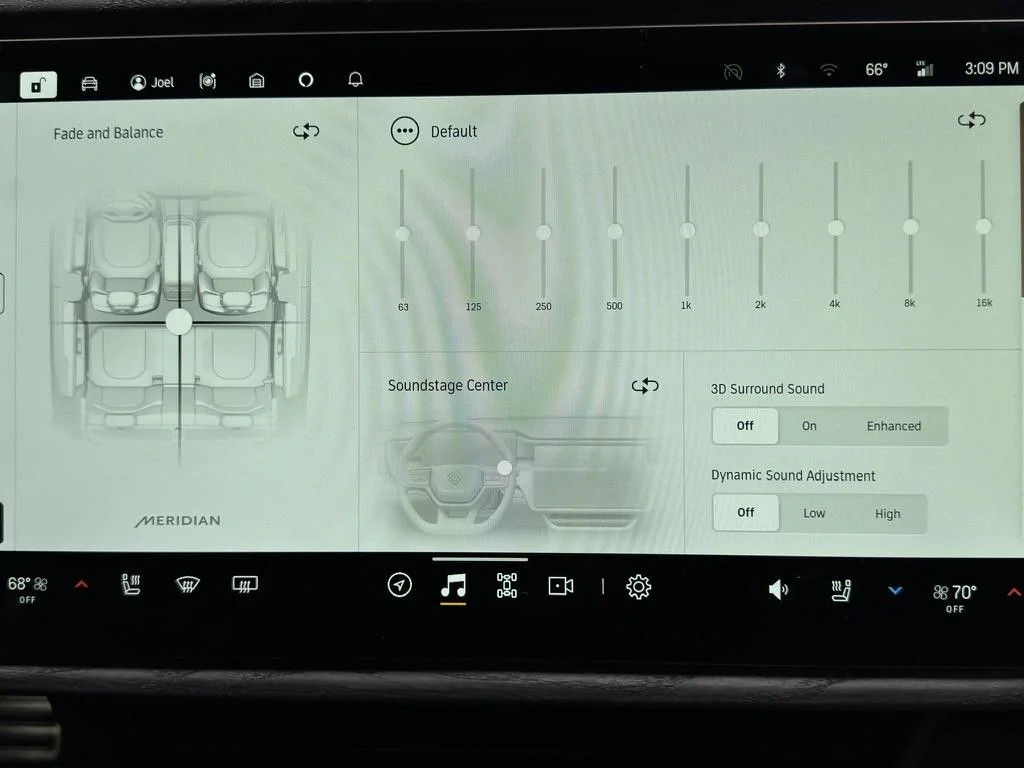
  1. Flatten your EQ by using the “Default” setting or the reset icon.
  2. Turn off 3D Surround Sound.
  3. Use these EQ settings: 63 Hz -3 notches, 125 Hz -3, 1 kHz +3, 2 kHz +3.
  4. Use Tidal or Spotify, ideally with a high-quality subscription tier. Avoid Bluetooth for music playback.
  5. Adjust to taste and enjoy better listening.
If you make this change, let me know how you think it sounds.

Tip: Listen to the new setting for a while using familiar songs at low volume and higher-than-average volume. Your ears/brain may take a bit to get accustomed to the new balance. What should happen is that you hear instruments/sounds more clearly because overtly emphasized frequency ranges aren't drawing attention away from them. Then tweak to taste.

AAC4B229-BF91-44E0-82CB-F91335E4F65E_1_105_c.jpeg


Many folks posted requests in the R1S Elevation thread for measurements and recommendations for a Meridian system. @RivianBowerbird generously offered his R1T Meridian and time to me to make measurements, do listening tests, and recommend some simple EQ improvements. To my ears, the Meridian system sounds noticeably better than the Elevation system out of the box, and the above changes helped it sound even better. I think RivianBowerbird would agree.

A few notes before getting into the details...

While I love audio, I enjoyed most spending an afternoon with a fellow Rivian owner sharing stories about our Rivians, talking sound and audio, and listening to all kinds of music on my home system with a fellow music enthusiast. @RivianBowerbird is an infinitely curious guy who loves understanding the fundamental science behind why things work the way they work. My kind of dude. It was such a pleasure to connect with someone with a shared passion through this community in person.

This post will be much shorter than the R1S Elevation post because I won't repeat explaining my background in audio or the acoustic and psychoacoustic science behind why things sound good or bad. If you're interested in those things or the basic science behind my analysis and recommendations, check out the R1S Elevation thread.

Objectives, Methodology, Tests, and Results

Objectives

  1. Understand the R1T Meridian audio system’s faults.
  2. Understand the system’s behavior.
  3. Determine what—if anything—I could do to improve its performance.
  4. Compare the R1T Meridian system's performance to the R1S Elevation's.
Methodology
  • Flattened the EQ using the Default setting.
  • Turned off 3D Surround Sound and Dynamic Sound Adjustment.
  • Set Fade and Balance to default.
  • Set Soundstage Center to default.
  • Turned off climate control to reduce in-cabin noise as much as possible.
  • Put a calibrated UMIK-1 microphone roughly where my ears would be in the driver’s seat.
  • Connected my MacBook Pro to the Rivian Audio system via Bluetooth. This connection method had meaningful downsides—namely data and resolution loss- but Rivian Support told me they didn’t know of another way to make the vehicle a target audio device. USB didn’t work.
  • Set the Rivian’s volume to 16 to give me 75 dB of pink noise, C-weighted, generated by Room EQ Wizard (the industry standard acoustic measurement app). 75 dB is a typical level for performing measurements.
1069559F-DE26-478D-B6B5-81D88DB175AD_1_105_c.jpeg

5B12BD1D-19DB-4E8A-9F31-1781AF8C73ED_1_105_c.jpeg


Tests

I ran 5 sweeps from 0-20,000 Hz through the Left and Right device inputs. After each sweep, I adjusted EQ based on the results of my measurements and listened to tracks I used to test many different systems. I asked RviainBowerbird to provide his impressions before I gave mine to avoid biasing him. He gave assessments that largely matched my own after each change. Not only did this mean he listened well, but the changes were meaningful.

A sweep is an audio signal sent to the sound system that sweeps across a given frequency range at a uniform volume. The recording microphone picks up what comes out of the speakers and what the room—the cabin, in this case—does to the sound. I forgot to take a picture of the microphone setup in the truck, but I was having too good a time chatting with RivianBowerbird about the process and procedure to remember.

I didn't need to do 18 sweeps like I did when I measured my R1S Elevation because I already had an idea of how the system worked and only needed to confirm it. The EQ’s scale is 10 dB. Each notch represents +/- 1 dB of gain or attenuation, just like the R1S Elevation.

As with the R1S Elevation, I used the first sweep as a reference to see outstanding acoustic issues and set a baseline for the effects of the EQ changes I made. I only changed EQ because I had no other tools at my disposal. With home theater systems, you can change delay and implement different kinds of filters to affect phase and other stuff that doesn’t matter in the Rivian because we can’t change it. The Meridian system offered no EQ adjustments beyond the Elevation.

I learned a few things from taking measurements:
  • The 6"x9" woofer in an enclosure under the passenger side second-row seat rattled loudly when playing test sweeps. Sub-bass and bass frequencies make the woofer mechanically knock as if it was bottoming out. It also knocked from bass-heavy music during our initial listening tests. Knocking occurs when the voice coil (the copper coil responsible for turning a fluctuating electromagnetic field into the physical motion of the cone) exceeds its design limits. The Meridian woofer exceeded its limits by a lot at modest playback levels. Not impressive.
  • The driver-side door panels rattled and buzzed with bass and mid-range frequencies, driving RivianBowerbird nuts—as it should. To reduce the noise, he put adhesive felt strips in several places between the door panels. It helped, but the buzzing remained too loud to ignore, breaking the spell that good music and sound create. During our early listening tests, he had to put his fingers on the door panels to stop the distracting buzz. Again, not impressive.

1711168156473-ff.png


Results, Recommendations, and How to Interpret a Frequency Response Graph

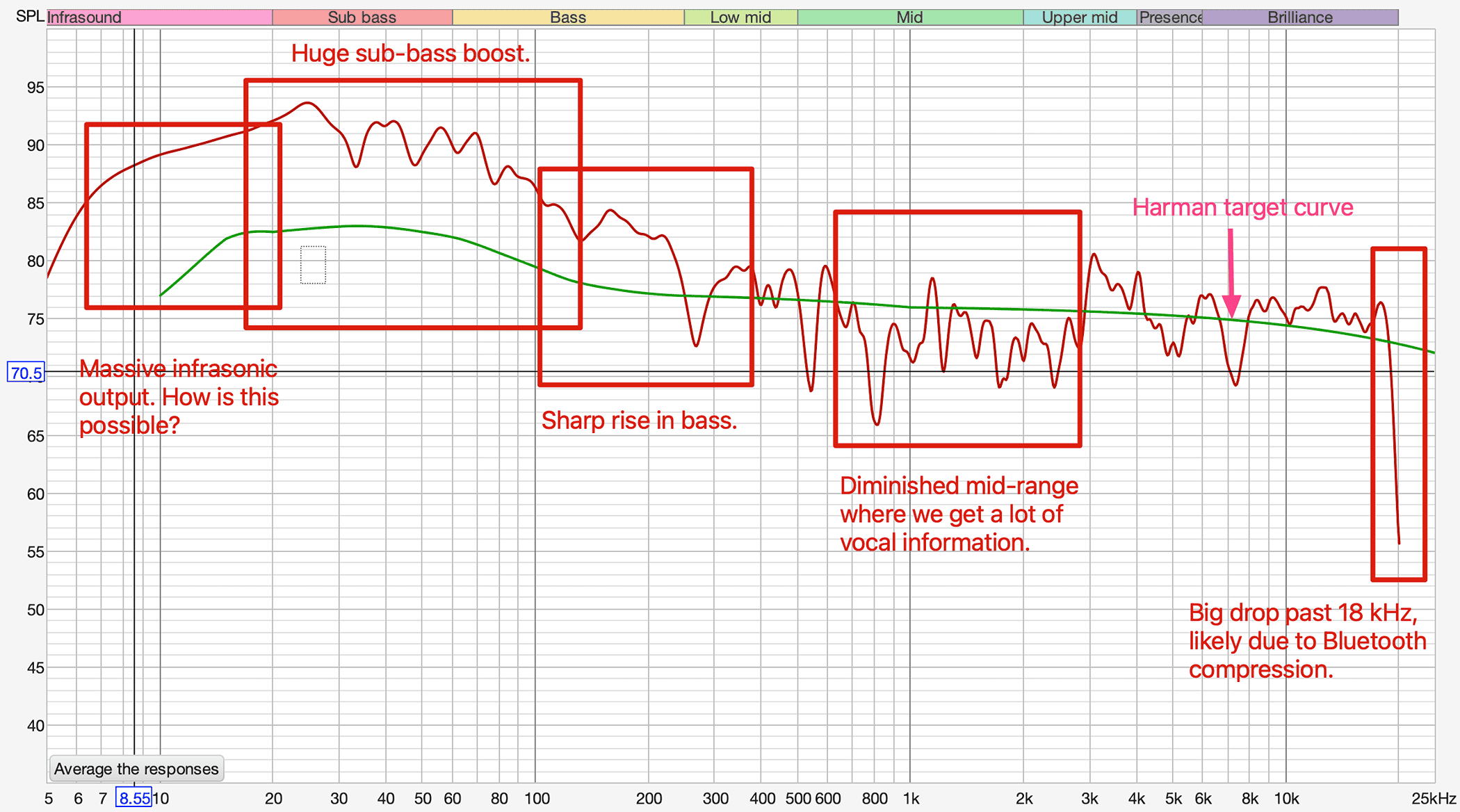
Here is the reference measurement with markup highlighting problem areas.

1711172208312-ey.png


The graph shows frequency (x-axis) plotted against dB or volume (y-axis). In an ideal world, the graph would show a smooth line from 20 Hz to 20 kHz without big bumps and dips. The green line helps us visualize what that “ideal” frequency response might look like. It’s taken from Harman Audio’s research of people’s preferences. The closer a measurement is to a target curve like this one, the more balanced and clear the system will sound.

The target curve isn’t ruler flat (i.e., does not have a zero slope) because people tend to prefer relatively more bass and relatively attenuated high frequencies. This has to do with the fact that human ears have different sensitivity to different frequencies; namely, we have a much harder time hearing bass frequencies than mid-range frequencies, even when they play at the same volume. This phenomenon is known as the equal-loudness contour. We need a lot more bass to perceive it at the same level as 1 kHz so we tend to prefer boosted bass.

As you can see, the R1T Meridian wasn't egregiously far off from the Harman target curve in most areas. However, it had problems.

The R1T Meridian's main problems were:
  • A huge 8-10 dB bump in bass between 20 Hz and 250 Hz that caused rattling and buzzing. I love bass more than the next guy (see the above description of my home system’s bass output) but boosting bass this much masks adjacent frequencies, making music sound muddy and boomy. Low frequencies hang around in the air longer than high frequencies. The more low frequencies are boosted, the longer they hang around until they reach a volume we can’t hear anymore, causing boominess and making nearby frequencies hard to distinguish from the bass. I strongly suspect Rivian boosted bass in this way to give customers an initial impression of sound quality, much like TV manufacturers set their displays to "Vivid" mode in showrooms, which cranks brightness and hyper-saturates colors, to catch your eye. Bass impresses more than other frequency ranges.
  • A sharp 12(!) dB rise in bass between 250 Hz and 150 Hz. Outside of contributing to rattling/buzzing and boominess, the sharpness of the rise masks adjacent frequencies more strongly, making instruments with important information in the 250 - 500 Hz range—such as rhythm guitar and the chestiness of male vocals—difficult to separate from the bass. Think about this as a sharp cliff face that blocks more sunlight from reaching a campsite at its base than a round hill would.
  • Mid-range frequencies between 600 Hz and 3 kHz were attenuated by 3 dB from the target curve and from the frequencies immediately to the left and right of that range, causing noticeably indistinct vocals. Most vocal information lives in the 350 Hz - 4 kHz range. Other than the rattling panels, recessed vocals were the first thing I noticed about the Meridian system.
  • Big drop past 18 kHz. This wasn't a surprise and was likely due to Bluetooth data compression. I had the same result from my R1S Elevation.
According to my measurements, the R1T Meridian system generates infrasonic bass (bass below 20 Hz) at EDM concert-like levels. My home system produces infrasonic bass like that, as do the fair share of EDM concerts I've attended, but the R1T Meridian never vibrated my internal organs or messed with my equilibrium like those systems do. My only hypothesis is that the tiny volume of the R1T's cabin either throws off my measuring equipment and/or REW's interpretation of the data. But I have no idea. To reach the levels of infrasonic bass I measured, the little 6"x9" woofer and mid-range speakers would have to move a foot or more in and out and be powered by tens of thousands of watts of amplification. I don't know what's going on here.

How do we address these issues?

Unfortunately, we can only address them coarsely because the Rivian system doesn’t allow us to change the frequencies we boost and cut. We’re stuck with the frequencies they give us. However, the R1T Meridian system was properly designed (outside of the rattling issue, which we'll get to), so it doesn't require a lot of surgical intervention (unlike the R1S Elevation).

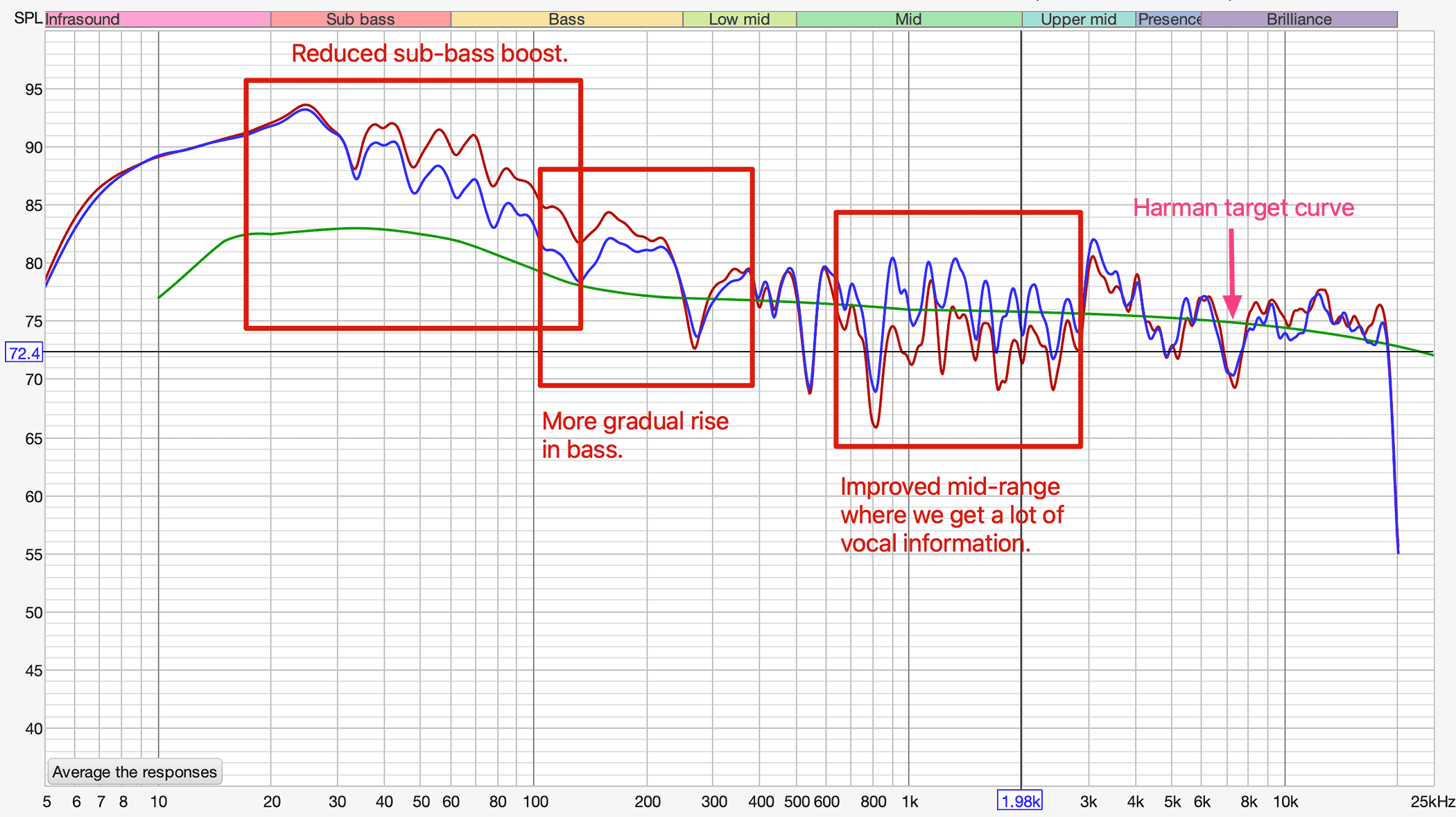
After experimenting with several EQ settings, here’s where I landed:
  • To address the huge 8-10 dB bump in bass between 20 Hz and 250 Hz that caused rattling and buzzing, I cut 63 Hz 3 dB. That largely eliminated the rattling problem from the 6"x9" woofer and door panels, even when we played bass-heavy tracks at meaningful levels. I'd need to do more extensive testing to say whether this change eliminates that rattling under all conditions, but it worked for us. RivianBowerbird was quite pleased with that result. In addition, the majority of muddiness and boominess that RivianBowerbird and I heard disappeared, improving the clarity of bass instruments, like kick drums and bass guitars.
  • To address the sharp 12 dB rise in bass between 250 Hz and 150 Hz, I cut 125 Hz by 3 dB. While 125 Hz isn't within that range, cutting was an effective way to make the rise in bass more gradual. You might wonder why I didn't cut 250 Hz. I experimented with that but decided that it removed too much chestiness from vocals, leaving them sounding hollow. The reason for that is the deep valley at 265 Hz was already 4 dB too low. Cutting it more turned it into an audible problem. This is the one part of the Meridian response curve I wish I could address with a parametric EQ. RivianBowerbird noticed an improvement in vocal and instrument clarity and a reduction of muddiness from the 3 dB cut at 125 Hz immediately.
  • To address the 3 dB attenuation of mid-range frequencies between 600 Hz and 3 kHz, I boosted 1 kHz and 2 kHz by 3 dB each. That lifted the range where the majority of vocal information lives, making a significant improvement to vocal clarity and overall balance across the full sonic spectrum of the music we listened to.
In the end, @RivianBowerbird was pleased with the results. So was I.

NOTE: RivianBowerbird didn't have the highest-quality tier of TIDAL, so we couldn't test the Meridian system's full resolution. However, I suspect the Meridian system may sound better than what I heard using a higher-quality source.

1711176481833-ls.png


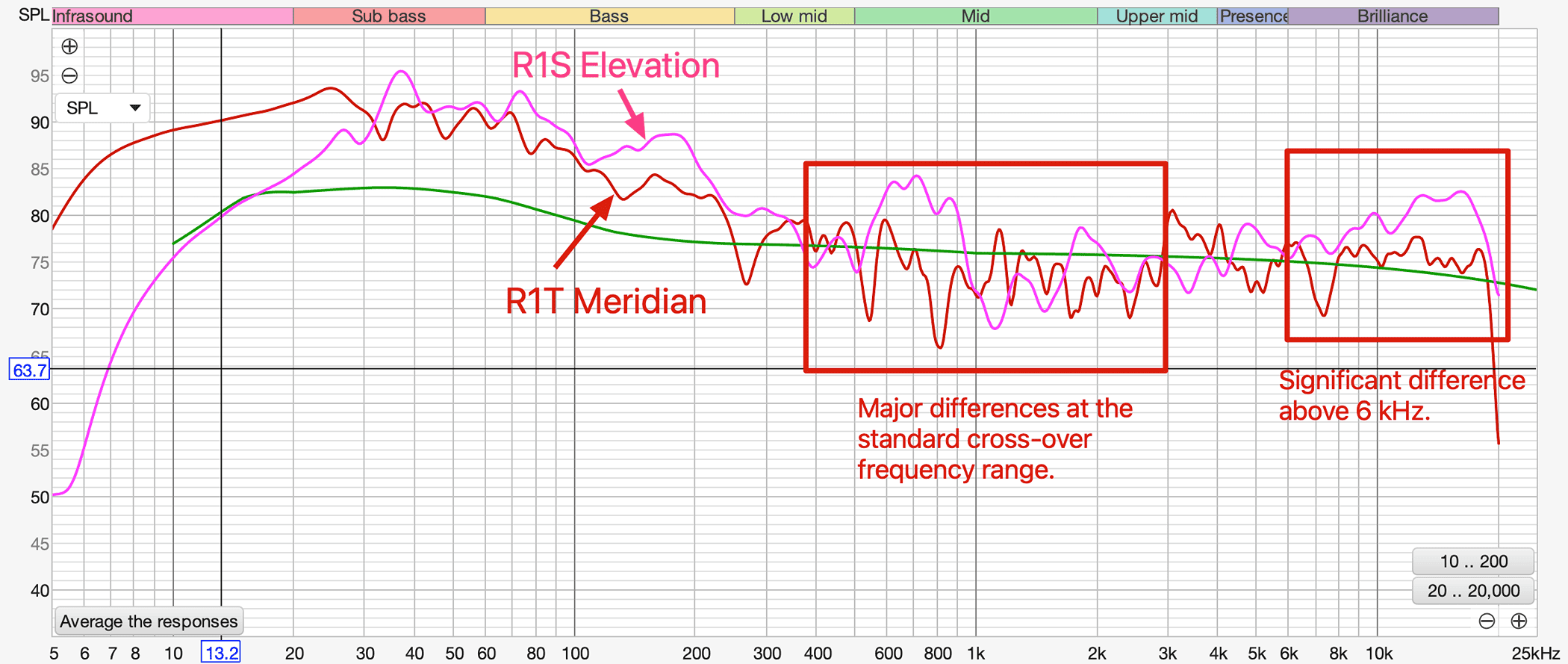
Comparison of R1T Meridian and R1S Elevation Systems

Now that I've made an objective comparison of the R1T Meridian and R1S Elevation systems, I'm more convinced that the Elevation system was misdesigned. My hypothesis was, and remains, that Rivian engineers swapped out the Meridian speakers for Elevation speakers without modifying the cross-over to suit, creating significant response issues at the standard cross-over range around 1 kHz that the Rivian's EQ cannot fix. (See the sister article for details about that.) The difference above 6 kHz is also explainable by a failure to modify the electronics after swapping the speakers.

However, the results are still inconclusive because other differences between the R1T and R1S, like cabin size and the number of speakers, could explain the performance difference between the Meridian and Elevation systems. The most conclusive test would be comparing an R1S Meridian to an R1S Elevation system.

Anyone in or around Austin willing to get their R1S Meridian measured?

1711178363674-v7.png
So should someone with the R1T and Elevation use your settings from the R1S or that too big a stretch?
 

UnsungZero_OldTimeAdMan

Well-Known Member
First Name
Barnum
Joined
Mar 20, 2023
Threads
68
Messages
8,697
Reaction score
11,936
Location
SoCal
Vehicles
'23 GW Quad-Large R1T "Ghost"
Occupation
Advertising Circus
So should someone with the R1T and Elevation use your settings from the R1S or that too big a stretch?
No law saying you couldn't. If that sounds better to you, nothing stopping you. However, those settings are done to optimize/balance listening experience from the driver seat in the larger sound chamber of a R1S, and with slightly different speaker placements than the R1T. So, the real question is, why would you?
 

Sponsored

OP
OP
superfluid

superfluid

Well-Known Member
Joined
Mar 29, 2021
Threads
20
Messages
290
Reaction score
923
Location
Austin, TX
Vehicles
Rivian R1S, Kia Telluride
Occupation
Tech and data
Clubs
 
So should someone with the R1T and Elevation use your settings from the R1S or that too big a stretch?
I'd say it's worth a shot. Then tweak from there.
 

TomServo2112

Well-Known Member
Joined
Aug 13, 2024
Threads
2
Messages
163
Reaction score
214
Location
Southern California
Vehicles
Gen 2 R1S DPM, Large Pack, R2 res holder
How did it work out?
It has definitely been interesting to see how these settings have worked or not worked for different people. What's surprising to me is the range of results. Some love them, some think they're ok, others hate them.

Oh well, I'm glad folks tried them!
I look at it as a starting point. Trying to adjust a system to be as close to the mixing room as possible, and then seasoning to taste. So to me your adjustments could be a great EQ flattener that helps us get as close as possible to how the source was mixed, then if we want to goose a bit here or there, we go for it. I'm on the verge of getting an R1S with Meridian so hopefully these settings port over to it well! I have an Integra processor with Audyssey Pro for my home theater with Klipsch Reference speakers and have never once regretted flattening out all those bass humps!

Thanks for the work!
 

onesoil

Well-Known Member
First Name
Sid
Joined
Jun 16, 2022
Threads
3
Messages
391
Reaction score
560
Location
Montpelier VT
Vehicles
2022 Rivian R1T
Occupation
Director of Operations at Vermont Compost Company
Clubs
 
@superfluid, have you had a chance to test baseline and/or any of your settings since this latest software update? I'm curious if they changed anything about the response curve or crossover points or addressed some of the deficiencies in tuning of the DSP that you measured. All I've noticed is a lot more gain (or volume) at any given setting.

I haven't really tried to listen critically, but it seems like they tweaked something akin to adding more "loudness" (and/or, maybe more goose-necked baseline EQ?), which would probably explain why so many people are reporting an improvement, but I'm curious what the measurements would say. Also, maybe they did more work on the elevation system (I have R1T w/ Meridian)? I have noticed more clarity and depth in the low bass (on tracks like Flight of the Cosmic Hippo and Tin Pan Alley), but that could either be Apple Music or Placebo (wanting to hear the improvement everyone is talking about). It's hard to tell much because I can't AB pre- vs post- update ??‍♂ But that's why its so cool that you've done the response curve analysis you've done!
 

beyond

Well-Known Member
First Name
Brad
Joined
Apr 3, 2023
Threads
3
Messages
156
Reaction score
221
Location
NOVA
Vehicles
R1T, Model Y
Occupation
The Cloud
@superfluid, have you had a chance to test baseline and/or any of your settings since this latest software update? I'm curious if they changed anything about the response curve or crossover points or addressed some of the deficiencies in tuning of the DSP that you measured. All I've noticed is a lot more gain (or volume) at any given setting.

I haven't really tried to listen critically, but it seems like they tweaked something akin to adding more "loudness" (and/or, maybe more goose-necked baseline EQ?), which would probably explain why so many people are reporting an improvement, but I'm curious what the measurements would say. Also, maybe they did more work on the elevation system (I have R1T w/ Meridian)? I have noticed more clarity and depth in the low bass (on tracks like Flight of the Cosmic Hippo and Tin Pan Alley), but that could either be Apple Music or Placebo (wanting to hear the improvement everyone is talking about). It's hard to tell much because I can't AB pre- vs post- update ??‍♂ But that's why its so cool that you've done the response curve analysis you've done!
One thing I also think changed, they're pumping lower frequencies to the door's. I swear those drivers are hitting much harder on this new build.
 

R1Tom

Well-Known Member
First Name
Tom
Joined
May 19, 2022
Threads
37
Messages
3,621
Reaction score
4,862
Location
Wisc
Vehicles
Riv R1T
Occupation
Sales
One thing I also think changed, they're pumping lower frequencies to the door's. I swear those drivers are hitting much harder on this new build.
I agree. I definitely feel they moved some heavy lifting to the door speakers.
Sponsored


Top