
Sponsored


lefkonj
Well-Known Member
- First Name
- Jeff
- Joined
- Feb 6, 2021
- Threads
- 37
- Messages
- 1,452
- Reaction score
- 2,624
- Location
- New Jersey
- Vehicles
- Gen2 R1S Tri, I4-m50
Not my challenge whether or not you believe it that is what happened. I get it takes time but at this point why bother. Apple Maps has been fine for many years, I disagree with your statement. Focus on the driving not the entertainment that has been solved by people who excel at that.Sigh. Apple Maps, Google Maps, Waze, Rivian, etc etc, ALL use the same satellites. Literally. So, I'm having a hard time believing that Rivian didn't know where you were, but Apple did when the location mechanism is 100% the same.
Most likely it was a software glitch that prevented the car UI from updating. Why people keep ignoring that Apple Maps was unusable up until the past year when launching 12 years ago is beyond me. CarPlay was also an unmitigated disaster early on. It takes time, people need to have some patience.
Last edited:
KW_88_SS
Well-Known Member
Statistically, the majority of smartphone users disagree with you. Most Apple users prefer Google Maps. Google Maps has billions of users, while Apple Maps has hundreds of millions and had to reintroduce Google Maps due to backlash after its removal from the App Store. Tim Cook even apologized for Apple Maps and suggested using alternative apps. Despite its attractive UI, Apple Maps has consistently poor directions.Not my challenge whether or not you believe it that is what happened. I get it takes time but at this point why bother. Apple Maps has been fine for many years, I disagree with your statement. Focus on the driving not the entertainment that has been solved by people who excel at that.
I understand you like CarPlay, but liking it doesn't make inferior products good. Do you also think Google Sheets is better than Excel?
CarPlay has its own set of issues. It’s not perfect in every car and can be downright terrible in more complex setups, like in a Porsche. We stopped using CarPlay in our Taycan because it’s so bad. This doesn't even consider that Rivian’s navigation takes your car's configuration into account for route planning. Can Apple or Google do that? No.
Just because CarPlay works well in a 2020 Nissan Sentra from Enterprise doesn’t mean it works well in more complicated setups.
Again, all navigation systems use the same satellite system. Period. Even Tesla uses Google/MapBox hybrid(or they used to). Rivian need's to fix bugs, which takes time. Why this should hinder development to allow CarPlay is beyond me. Rivian's UI and software are far ahead of where CarPlay was in its early years.
lefkonj
Well-Known Member
- First Name
- Jeff
- Joined
- Feb 6, 2021
- Threads
- 37
- Messages
- 1,452
- Reaction score
- 2,624
- Location
- New Jersey
- Vehicles
- Gen2 R1S Tri, I4-m50
To each his own. I have had CarPlay since it came out and my Audi's and more recently BMWs work great with it, using the "complicated" features as well. Never really had issues with it. The beauty is with Carplay/AA users can use whatever maps tool they want, along with dozens of entertainment features.
I love my Rivian it isn't going anywhere but to think that Tesla or Rivian's own system is better than Carplay/AA is just crazy (once again an opinion). I have been in plenty of Tesla's and the infotainment is ok at best but lacking in many other ways. Rivian is behind on this one and adding support for it, notice SUPPORT not give up and let them own it, would be a win for their customers and another piece to the fight the competition.
I love my Rivian it isn't going anywhere but to think that Tesla or Rivian's own system is better than Carplay/AA is just crazy (once again an opinion). I have been in plenty of Tesla's and the infotainment is ok at best but lacking in many other ways. Rivian is behind on this one and adding support for it, notice SUPPORT not give up and let them own it, would be a win for their customers and another piece to the fight the competition.
racekarl
Well-Known Member
Are you really sure you can say that with 100% confidence? I would NOT assume this is true at all. There are at least 5 GNSS constellations and not every device automatically supports them all.Again, all navigation systems use the same satellite system.
Sponsored

Newtonrj
Well-Known Member
- Joined
- Aug 31, 2023
- Threads
- 3
- Messages
- 168
- Reaction score
- 257
- Location
- bloomington, il
- Vehicles
- Porsche Cayenne Plugin Hybrid, BMW 335i, M3, 325i, VW GTI
Be very careful with this statement. I get where you are going but iPhones & Android phones have different GPS receivers than in cars/SUVs/trucks thus can use a multitude of GPS satellite systems (US-GPS, GLOSNASS, Galileo, QZSS, BeiDou & NavalC). Given not all these GPS satellite systems have apps in a phone but they are used for triangulation purposes by the GPS chip. What GPS chips does Rivian use and are they tuned for L1 or then better L5 Precision (ie: dual mode)? Do they use differential correction to get better than 10 meters as the US system provides since 2000? Do they use differential location data sets and post process those other system locations to get down to 1 meter or even centimeter accuracy? If so, how fast? These questions and their answers get accuracy that software can take advantage of post processing. Again, the initial fix can take up to 30 minutes but usually is being constantly updated by newer phones in nReal time with the use of cell tower locations, WIFI hotspot, bluetooth associations and occasional GPS peeking.Again, all navigation systems use the same satellite system
GPS has three main parts, the satellites, the control and the user. You are thinking that user level is exactly the same and it is certainly not. RIvian vehicles use their own GPS receivers separate from cell phone providers. Not sure about you but phones are getting updated every 2-4yrs on average, the autos only get updated generationally (about every 5-7yrs). There are some software fixes that can accelerate GPS processing post chip production but not nearly as effectively as a wholesale replacement of the GPS chip through lifecycle replacement.
KW_88_SS
Well-Known Member
Yes, I literally worked in the GPS space for a decade and now work for a logistics company that relies on Apple/Android apps for pinpoint delivery information. I have real world experience with, "How accurate" a lot of these systems, are, or are not, and what it actually takes to make them better.Are you really sure you can say that with 100% confidence? I would NOT assume this is true at all. There are at least 5 GNSS constellations and not every device automatically supports them all.
GPS is apart of the GNSS constellations. If an Apple device can't find a signal it switches till it finds one. E.g. GPS>Galileo>BeiDou>GLONASS(at least this used to be the order). It is very unlikely that an Apple/Android device or, any car for that matter, would not find find a signal in the United States or Canada at any given time.
And to be even more clear, this is not how cell phones work. They use a combination of towers + GPS + wifi in order to reduce the load. It's also why it's only accurate within a block or so in most cases since there's a lot of external factors.
I literally never claimed that, you're putting words in my mouth. Here's what I said. "Again, all navigation systems use the same satellite system." This is irrefutable.You are thinking that user level is exactly the same and it is certainly not.
This is incorrect. There is not a "multitude of GPS satellite systems", there are a multitude of GNSS systems. GPS is GPS. They are all apart of the 5 Constellations or, individually, they are individual GNSS systems. GPS is Rivian, GNSS is car. You're confusing terms.iPhones & Android phones have different GPS receivers than in cars/SUVs/trucks thus can use a multitude of GPS satellite systems (US-GPS, GLOSNASS, Galileo, QZSS, BeiDou & NavalC)
The hardware currently available today is accurate within 5-10 feet with perfect atmospheric conditions. I doubt Rivian's have a DGPS, so I'm assuming they use the same tech since they have data connectivity within the vehicles.Not sure about you but phones are getting updated every 2-4yrs on average
Ergo my entire point. The hardware differences between cellphones andcar receivers is a moot talking point. It's software, and other external factors(towers, wifi) that add to the perceived "accuracy" of a navigation system. Does Rivian use Wifi+Towers? Do they only have agreements with one cell provider? This matters.
Upgrading your phone to get "more accurate GPS" is akin to upgrading your 2 year old CPU. It's diminishing returns. If the software and external factors are all equal there is going to be almost no difference, at all, with how accurate the systems are.
People need to calm down and allow for more updates to fix bugs, improve latency etc. They are selling more and more vehicles and need to account for that increased load. It's normal.
Last edited:
Newtonrj
Well-Known Member
- Joined
- Aug 31, 2023
- Threads
- 3
- Messages
- 168
- Reaction score
- 257
- Location
- bloomington, il
- Vehicles
- Porsche Cayenne Plugin Hybrid, BMW 335i, M3, 325i, VW GTI
@KW_88_SS,Yes, I literally worked in the GPS space for a decade and now work for a logistics company that relies on Apple/Android apps for pinpoint delivery information. I have real world experience with, "How accurate" a lot of these systems, are, or are not, and what it actually takes to make them better.
GPS is apart of the GNSS constellations. If an Apple device can't find a signal it switches till it finds one. E.g. GPS>Galileo>BeiDou>GLONASS(at least this used to be the order). It is very unlikely that an Apple/Android device or, any car for that matter, would not find find a signal in the United States or Canada at any given time.
And to be even more clear, this is not how cell phones work. They use a combination of towers + GPS + wifi in order to reduce the load. It's also why it's only accurate within a block or so in most cases since there's a lot of external factors.
I literally never claimed that, you're putting words in my mouth. Here's what I said. "Again, all navigation systems use the same satellite system." This is irrefutable.
This is incorrect. There is not a "multitude of GPS satellite systems", there are a multitude of GNSS systems. GPS is GPS. They are all apart of the 5 Constellations or, individually, they are individual GNSS systems. GPS is Rivian, GNSS is car. You're confusing terms.
The hardware currently available today is accurate within 5-10 feet with perfect atmospheric conditions. I doubt Rivian's have a DGPS, so I'm assuming they use the same tech since they have data connectivity within the vehicles.
Ergo my entire point. The hardware differences between cellphones andcar receivers is a moot talking point. It's software, and other external factors(towers, wifi) that add to the perceived "accuracy" of a navigation system. Does Rivian use Wifi+Towers? Do they only have agreements with one cell provider? This matters.
Upgrading your phone to get "more accurate GPS" is akin to upgrading your 2 year old CPU. It's diminishing returns. If the software and external factors are all equal there is going to be almost no difference, at all, with how accurate the systems are.
People need to calm down and allow for more updates to fix bugs, improve latency etc. They are selling more and more vehicles and need to account for that increased load. It's normal.
Thank you for the reply. As a conclusion to this post line, we can agree that smart phones (iOS/Android) use different GPS receiver chips than autos like Rivian. Thus CarPlay and Android Auto use different GPS location fixes, likely more accurate due to using extensive GPS signals and non-GPS signals (WIFI, Bluetooth, Cellular) to generalize and ease loads on the GPS signal acquisition and position fixing.
To the larger post of Android/Carplay in Rivian, I fully admit that RJ Scarage stated nearly complete closure on using these apps within the Rivian OS. That said, I am still hopeful there is a future for CarPlay and Android Auto type apps in some future of Rivian.
I'd personally, enjoy meeting up some day in the future to share info and hope sincerely we can have future productive conversations.
mcclajb
Well-Known Member
- First Name
- Trey
- Joined
- Sep 24, 2021
- Threads
- 0
- Messages
- 105
- Reaction score
- 74
- Location
- Mississippi
- Vehicles
- R1S, Model 3
I'm pretty much a noob when it comes to the technical matters discussed here on the GPS issue. However, I would like to point out one thing and ask a question.Yes, I literally worked in the GPS space for a decade and now work for a logistics company that relies on Apple/Android apps for pinpoint delivery information. I have real world experience with, "How accurate" a lot of these systems, are, or are not, and what it actually takes to make them better.
GPS is apart of the GNSS constellations. If an Apple device can't find a signal it switches till it finds one. E.g. GPS>Galileo>BeiDou>GLONASS(at least this used to be the order). It is very unlikely that an Apple/Android device or, any car for that matter, would not find find a signal in the United States or Canada at any given time.
And to be even more clear, this is not how cell phones work. They use a combination of towers + GPS + wifi in order to reduce the load. It's also why it's only accurate within a block or so in most cases since there's a lot of external factors.
I literally never claimed that, you're putting words in my mouth. Here's what I said. "Again, all navigation systems use the same satellite system." This is irrefutable.
This is incorrect. There is not a "multitude of GPS satellite systems", there are a multitude of GNSS systems. GPS is GPS. They are all apart of the 5 Constellations or, individually, they are individual GNSS systems. GPS is Rivian, GNSS is car. You're confusing terms.
The hardware currently available today is accurate within 5-10 feet with perfect atmospheric conditions. I doubt Rivian's have a DGPS, so I'm assuming they use the same tech since they have data connectivity within the vehicles.
Ergo my entire point. The hardware differences between cellphones andcar receivers is a moot talking point. It's software, and other external factors(towers, wifi) that add to the perceived "accuracy" of a navigation system. Does Rivian use Wifi+Towers? Do they only have agreements with one cell provider? This matters.
Upgrading your phone to get "more accurate GPS" is akin to upgrading your 2 year old CPU. It's diminishing returns. If the software and external factors are all equal there is going to be almost no difference, at all, with how accurate the systems are.
People need to calm down and allow for more updates to fix bugs, improve latency etc. They are selling more and more vehicles and need to account for that increased load. It's normal.
You mentioned to the earlier poster that he could not have experienced a difference between Apple Maps and the Rivian navigation because they (and all other mapping services) use the same satellites. Then, you went on to talk about how Apple Maps was garbage until a year ago. Not disagreeing with you there, especially as I've seen very little reason to use anything other than Google/Waze for years. My question is this. If you say they (Rivian/Mapbox and Apple Maps) couldn't have delivered a different result, how do you also claim Apple Maps is terrible in comparison?
To me, the answer lies in the delivery of the data to the user, not that the data is different or not there. You are essentially acknowledging that there can be issues with the system reporting things differently or more slowly to the user given the critique on Apple Maps. I have had the Rivian navigation "glitch" happen as well, but for only a couple minutes. I chalked it up to what I believed was the universal understanding that Mapbox is one of the worst navigation services in existence, or alternatively, that there was a hardware limitation in the Rivian.
I have never doubted Mapbox has real access to satellites. I just know from my experience that the delivery is extremely poor. They even have street names around my house labeled completely wrong while all other services are consistent in getting that little detail right. While that clearly doesn't affect me locally, it can while traveling. Those street names aren't provided by satellites, so there's one obvious way the map services can differ.
I'm fine with waiting for it to improve, but there hasn't been any indication that work is being done on the map side. There have been no updates to that part of the system, at least to my knowledge, in the couple years that people have been driving Rivians. If people don't demand/request more, then they'll likely find themselves in the same position in another two years. Until Rivian shows more interest in improving maps, we're just hoping for improvements with no real reason to believe much will change.
KW_88_SS
Well-Known Member
Bingo. They all have the same source data. 100%. The ability to track people to pinpoint locations is absolutely something out of 1984. The GPS system knows where you are, it's up to the end user to process that data and do something with it. E.g. show you on a map. If the code is crap, that can impact the ability to show up on the map. I have absolutely no concerns that it's a hardware or source issue.My question is this. If you say they (Rivian/Mapbox and Apple Maps) couldn't have delivered a different result, how do you also claim Apple Maps is terrible in comparison?
To me, the answer lies in the delivery of the data to the user, not that the data is different or not there. You are essentially acknowledging that there can be issues with the system reporting things differently or more slowly to the user given the critique on Apple Maps.
So what does that leave us with? Software, and transmission of data. The lag/glitch, is most likely a transmission issue. I'd be willing to bet(I don't know, just betting) that much of this lagginess goes away with Connect+.
However, work is being done. e.g. look at who Rivian is hiring.
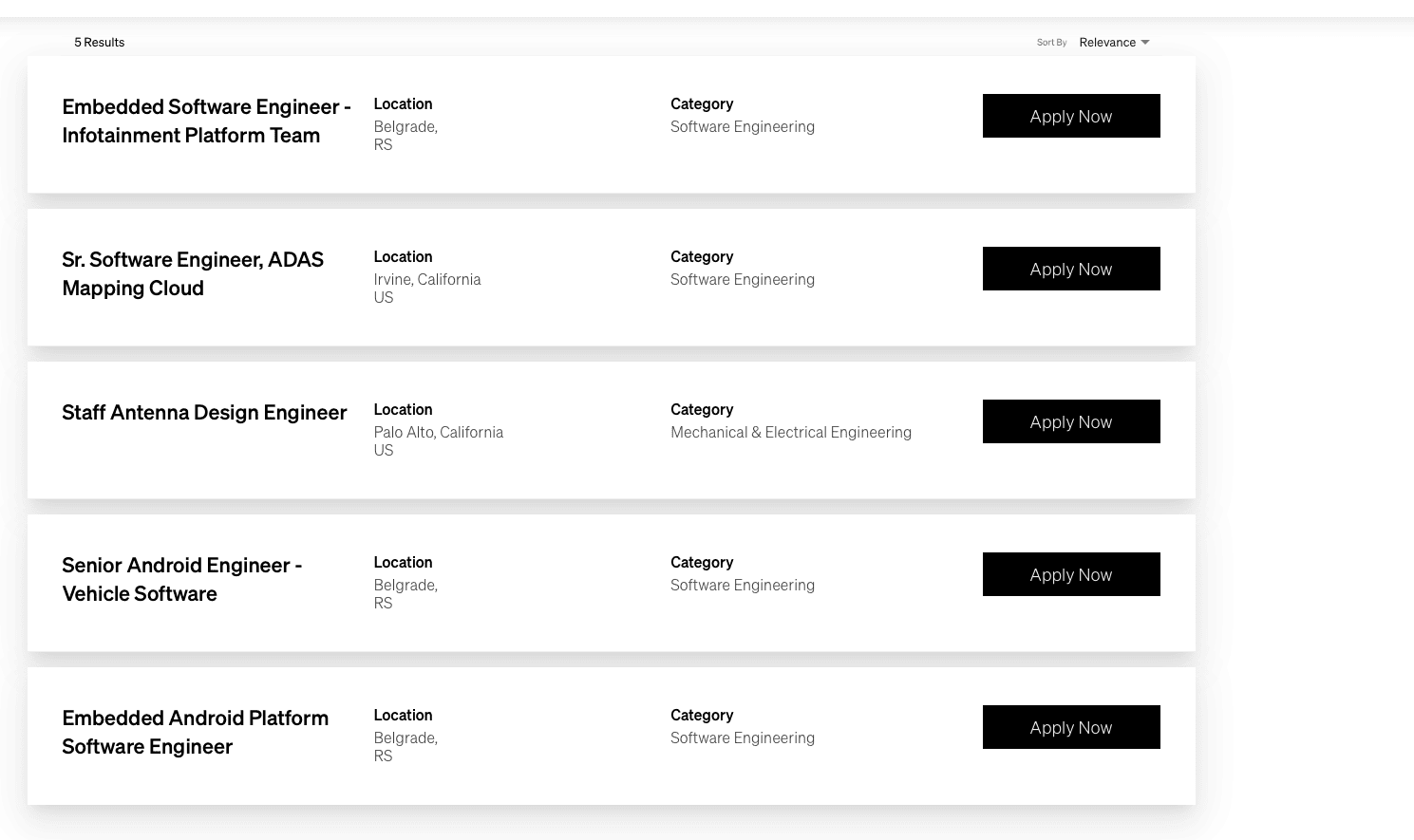
And if you look at some of these job responsibilities.
- Design and develop Rivian Navigation and Infotainment applications on Android OS
- Process geodata from various sources, cleaning and merging it for vehicle consumption.
- Collaborate with the open-source communities (e.g. OpenStreetMap, MapLibre, Overture Maps).
- Work with mapping technologies to visualize and analyze spatial data.
- Collaborate with cross-functional teams to understand data needs.
- Manage large data sets and ensure data integrity and accuracy.
Fun fact, there does not exist a unified complete database of all addresses in the United States. DOT has been trying to fix this, slowly, painfully, for a while now. This is why you see variations between services. Where I live, the variations are massive, it's annoying.Those street names aren't provided by satellites, so there's one obvious way the map services can differ.
https://www.transportation.gov/gis/national-address-database
Sponsored
mcclajb
Well-Known Member
- First Name
- Trey
- Joined
- Sep 24, 2021
- Threads
- 0
- Messages
- 105
- Reaction score
- 74
- Location
- Mississippi
- Vehicles
- R1S, Model 3
Thanks for taking the time to respond. This is excellent info and much appreciated! I feel a lot better about waiting to see how it plays out now.Bingo. They all have the same source data. 100%. The ability to track people to pinpoint locations is absolutely something out of 1984. The GPS system knows where you are, it's up to the end user to process that data and do something with it. E.g. show you on a map. If the code is crap, that can impact the ability to show up on the map. I have absolutely no concerns that it's a hardware or source issue.
So what does that leave us with? Software, and transmission of data. The lag/glitch, is most likely a transmission issue. I'd be willing to bet(I don't know, just betting) that much of this lagginess goes away with Connect+.
However, work is being done. e.g. look at who Rivian is hiring.

And if you look at some of these job responsibilities.
RJ should have mandated US engineers since, not to be a jerk, overseas developers are garbage, but, that's neither here nor there. We're also way more expensive but, I digress. They are actively hiring for these roles clearly for the intention of upgrading the entire map experience. I would wager, 3-6 months out we start seeing some decent improvements if these devs are worth their salt and why I keep saying wait and see.
- Design and develop Rivian Navigation and Infotainment applications on Android OS
- Process geodata from various sources, cleaning and merging it for vehicle consumption.
- Collaborate with the open-source communities (e.g. OpenStreetMap, MapLibre, Overture Maps).
- Work with mapping technologies to visualize and analyze spatial data.
- Collaborate with cross-functional teams to understand data needs.
- Manage large data sets and ensure data integrity and accuracy.
Fun fact, there does not exist a unified complete database of all addresses in the United States. DOT has been trying to fix this, slowly, painfully, for a while now. This is why you see variations between services. Where I live, the variations are massive, it's annoying.
https://www.transportation.gov/gis/national-address-database
KW_88_SS
Well-Known Member
To be clear. This is going to be entirely dependent on the devs. If the devs are not good, we will suffer. They REALLY should have hired US based only. It's a BIG difference in quality and speed. But it's a big cost jump....Thanks for taking the time to respond. This is excellent info and much appreciated! I feel a lot better about waiting to see how it plays out now.
mcclajb
Well-Known Member
- First Name
- Trey
- Joined
- Sep 24, 2021
- Threads
- 0
- Messages
- 105
- Reaction score
- 74
- Location
- Mississippi
- Vehicles
- R1S, Model 3
Understood. I know we're at a stage, being early adopters, where we want so much to happen in a short period of time, but there must be good processes and people in place to pull it off. I like that they're putting the focus on these things. It at least gives us a chance for improvement in the not-so-distant future.To be clear. This is going to be entirely dependent on the devs. If the devs are not good, we will suffer. They REALLY should have hired US based only. It's a BIG difference in quality and speed. But it's a big cost jump....
RivAW
Well-Known Member
its not "news"....they've been saying it for several years now....Interview on The Verge confirming a bit more of the reasoning for not doing full Apple CarPlay integration… but talks about a few features that they are working on….
https://www.theverge.com/2024/7/22/24203609/rivian-apple-carplay-support-rj-scaringe-decoder
Some pertinent quotes…
“We have a great relationship with Apple,” he said. “As much as I love their products, there’s a reason that ironically is very consistent with Apple ethos for us to want to control the ecosystem.” CarPlay isn’t “consistent with how we think about really creating a pure product experience,” Scaringe said.
“We recognize that it’ll take us time to fully capture every feature that’s in CarPlay, and hopefully, customers are seeing that. I think it often gets more noise than it deserves,” Scaringe said in the interview. “The other thing beyond mapping that’s coming is better integration with texting. We know that needs to come, and it’s something that teams are actively working on.”

theirongiant
New Member
- Joined
- Jul 29, 2024
- Threads
- 0
- Messages
- 2
- Reaction score
- 1
- Location
- Los Angeles, CA
- Vehicles
- Volkswagen Beetle
- Occupation
- Systems Engineer
I'm not 100% clear on what the CEO means by not including CarPlay.
There's the first-generation display extension to the car's infotainment system, which we know as "CarPlay" and "Android Auto."
When Apple first introduced CarPlay in 2013, they called it "iOS in the Car." It was finally released and showed off at the Geneva Auto Show in 2014. Most major automakers had adopted it by 2016-2017. Meanwhile, Android Auto was introduced in 2015, and finally made available to the public for 2017.
These two is a general-purpose infotainment replacement that has been around for about 10 years, and here the mobile phone is merely rearranging its own user interface and modifying the user experience to suit the needs of a driver (or comply with common sense safety rules like not allowing YouTube or Zoom calls on the primary infotainment screen).
Then there's "Next Generation" CarPlay aka CarPlay 2.0, which is Apple's vision for a total reskinning of more critical components such as the dashboard and climate controls. They teased this at their worldwide developer conference in 2022, and formally presented it this year:
WWDC 2024: Meet the next generation of CarPlay architecture (Session 10111)
Say hello to the next generation of CarPlay design system (Session 10112)
Many auto makers are hesitant to give Apple this much control over the user interface because they spend a lot of time and money to design their own UI. In most cases, they're tailored for the particular design quirks of the vehicle, or the needs of their customers.
So is Rivian talking about total abandonment of support for traditional CarPlay and Android Auto, in the same way that GM and Tesla have done? Or are they only talking about a rejection of Apple's design proposals for CarPlay 2.0?
There's the first-generation display extension to the car's infotainment system, which we know as "CarPlay" and "Android Auto."
When Apple first introduced CarPlay in 2013, they called it "iOS in the Car." It was finally released and showed off at the Geneva Auto Show in 2014. Most major automakers had adopted it by 2016-2017. Meanwhile, Android Auto was introduced in 2015, and finally made available to the public for 2017.
These two is a general-purpose infotainment replacement that has been around for about 10 years, and here the mobile phone is merely rearranging its own user interface and modifying the user experience to suit the needs of a driver (or comply with common sense safety rules like not allowing YouTube or Zoom calls on the primary infotainment screen).
Then there's "Next Generation" CarPlay aka CarPlay 2.0, which is Apple's vision for a total reskinning of more critical components such as the dashboard and climate controls. They teased this at their worldwide developer conference in 2022, and formally presented it this year:
WWDC 2024: Meet the next generation of CarPlay architecture (Session 10111)
Say hello to the next generation of CarPlay design system (Session 10112)
Many auto makers are hesitant to give Apple this much control over the user interface because they spend a lot of time and money to design their own UI. In most cases, they're tailored for the particular design quirks of the vehicle, or the needs of their customers.
So is Rivian talking about total abandonment of support for traditional CarPlay and Android Auto, in the same way that GM and Tesla have done? Or are they only talking about a rejection of Apple's design proposals for CarPlay 2.0?
Sponsored
Similar threads

- Replies
- 111
- Views
- 10,784

- Replies
- 36
- Views
- 3,111

- Replies
- 4
- Views
- 347

- Replies
- 6
- Views
- 1,011

- Replies
- 67
- Views
- 13,561
