Sponsored

electruck

Well-Known Member
Joined
Oct 6, 2019
Threads
74
Messages
4,187
Reaction score
7,786
Location
Dallas, TX
Vehicles
2023 Rivian R1S
I understand your perspective, but you can always just charge to 90-95% if you're not ready to leave... As someone who did ~15k road trip miles in my R1T in 2024 (with dogs), I find ~15-20 minutes to be the sweet spot if I need to pee and walk the dogs. Except when I sit down to eat I've never needed 30 minutes. But 30 minutes of charging gains about 180mi of range, or more like 120-140mi if you're doing 80mph or in the winter. Not even 2 full hours between stops. I don't need 20 minutes of rest that frequently.
I could "overcharge" maybe once but that won't change when/where my next charging stop will be, it would just end up shifting my charging to the top end of the battery which isn't really desirable for a variety of reasons (ie, charging from my more typical 20-75% to 40-95%; personally, I don't actually charge 10-80%).

Like I said, I expect I am in the minority on this and I don't want this to turn into a debate over personal trip habits (like why you only need 20 mins and my family can't complete a stop in under 30). I was simply calling out that slight improvements in today's charging times can have other consequences such as needing to go unplug and move a vehicle if the charging completes before your other pit stop objectives have been met. Obviously that window of time is going to vary person to person and isn't an issue at all for people who want to stop for 5 mins and are stuck waiting on the charger for the next 20 mins.
Sponsored

 

Jeremy3292

Well-Known Member
First Name
Jeremy
Joined
Apr 27, 2026
Threads
5
Messages
691
Reaction score
1,103
Location
South Carolina
Vehicles
R2
Yeah. I'm extremely disappointed with the R2 battery (both capacity and charging speed), but at the same time it's better than basically every other US market EV at the same or lower price.

I mostly just worry that in 2 years it will feel a bit like a dinosaur when the rest of the market starts moving to actually good batteries.

I just thought that we'd be charging faster than what Tesla and Audi was doing in 2019...
Original E-Tron held 150kW to 80%.
Audit E-Tron is slower 10% to 80% than R2 though.

Other may disagree, but I think it's around 2030 before we see 800v being the standard. Likely R2 Gen2 which won't be til around 2030 either. It's going to take 3-4 years for IONNA, Walmart, and others to really build out their charging networks. Yeah they're going relatively "quick" but that still takes multiple years before they're everywhere like Tesla is. Technology never moves as fast as people think it does, especially one that requires massive infrastructure investments.

We're also only talking what, 5, 7, maybe 10 minutes if we're lucky shaved off the 10 to 80% time? And it'll only be around 5 minutes shaved off the 10 to 70% time. So unless you're a heavy road tripper, it's more a nice to have than needed IMO.
 

Indy avocado

Well-Known Member
First Name
Greg
Joined
Dec 17, 2022
Threads
3
Messages
223
Reaction score
312
Location
Indiana
Vehicles
'22 R1T, '17 Macan S, '11 Mustang GT
I agree with most of what you said but a couple of things. The vast majority of DCFC sites in the US are NOT 800v capable. Just Tesla superchargers alone account for over 50% of DCFC plugs in the USA, and they are not 800v capable. And that doesn't include a bunch of other "legacy" DCFC sites that can't do 800v either. Tesla superchargers can only do 400v, unless they are the very rare V4 "cabinets" superchargers that are rolling out slowly which can do up to 1000v. There's only like 10 of these sites currently. That's why iX3 can only do ~190kW on Tesla superchargers bc the amps are limited to 500 along with voltage.
FYI below may read as argumentative, but it's not meant to be - it's an attempt at discussion/persuasion.

You're mixing sites and stalls.

Yes, the majority of DCFC stalls/ports are Tesla superchargers.
But I personally think sites is a more useful metric, as most stalls/ports sit empty most of the time. I navigate to a site, not a port.

In the US, what "legacy" DCFC sites don't support 800V? I haven't encountered one - they would all be 50kW chargers, and there are so few of those that it's practically in the noise. And I wouldn't call them fast charging in today's world.

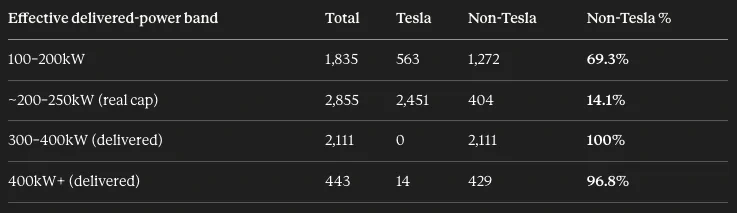
Parsing the AFDC database with Claude, I have the following estimate of 4+ stall sites (after converting "325kW" Tesla stalls to ~250kW):

Rivian R1T R1S R2 10-80% charge test (by State Of Charge) 1783430450928-d9


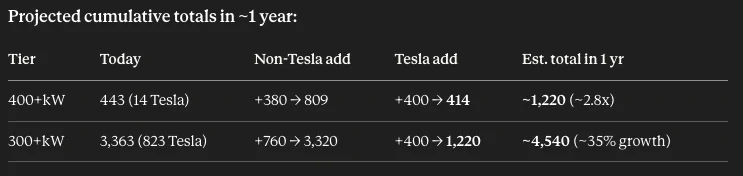
There are 14 V4 sites live, with probably ~90-100/quarter coming online going forward. And there have been ~200 quarterly non-Tesla 300+kW DCFC site additions.

Rivian R1T R1S R2 10-80% charge test (by State Of Charge) 1783430644616-v3


So looking at this, we can assume 4,540 out of ~8,400 sites will be 300+kW, 800V capable by mid 2027. IMO, the meaningful metric would be to ignore <200kW sites.

My estimate: 4,540/6,589 = 69% of sites you care about will be 300+kW, 800V capable in 2027 INCLUDING all V3 supercharger sites.

I could "overcharge" maybe once but that won't change when/where my next charging stop will be
...
Like I said, I expect I am in the minority on this and I don't want this to turn into a debate over personal trip habits
...
I don't think you're in the minority. And I didn't mean to make it a debate about the "right" amount of time.
My view is that faster charging is better, full stop. There is no downside (except upfront costs). Any "excuses" that aren't along the lines of value fall flat to me.

And sure, charging 80-95% is less time efficient than 10-35%, but it's better than nothing! My experience is that I often need to charge to either 65% or 90% to get to my preferred stops in my R1.
 

Jeremy3292

Well-Known Member
First Name
Jeremy
Joined
Apr 27, 2026
Threads
5
Messages
691
Reaction score
1,103
Location
South Carolina
Vehicles
R2
FYI below may read as argumentative, but it's not meant to be - it's an attempt at discussion/persuasion.

You're mixing sites and stalls.

Yes, the majority of DCFC stalls/ports are Tesla superchargers.
But I personally think sites is a more useful metric, as most stalls/ports sit empty most of the time. I navigate to a site, not a port.

In the US, what "legacy" DCFC sites don't support 800V? I haven't encountered one - they would all be 50kW chargers, and there are so few of those that it's practically in the noise. And I wouldn't call them fast charging in today's world.

Parsing the AFDC database with Claude, I have the following estimate of 4+ stall sites (after converting "325kW" Tesla stalls to ~250kW):

1783430450928-d9.webp


There are 14 V4 sites live, with probably ~90-100/quarter coming online going forward. And there have been ~200 quarterly non-Tesla 300+kW DCFC site additions.

1783430644616-v3.webp


So looking at this, we can assume 4,540 out of ~8,400 sites will be 300+kW, 800V capable by mid 2027. IMO, the meaningful metric would be to ignore <200kW sites.

My estimate: 4,540/6,589 = 69% of sites you care about will be 300+kW, 800V capable in 2027 INCLUDING all V3 supercharger sites.


I don't think you're in the minority. And I didn't mean to make it a debate about the "right" amount of time.
My view is that faster charging is better, full stop. There is no downside (except upfront costs). Any "excuses" that aren't along the lines of value fall flat to me.

And sure, charging 80-95% is less time efficient than 10-35%, but it's better than nothing! My experience is that I often need to charge to either 65% or 90% to get to my preferred stops in my R1.
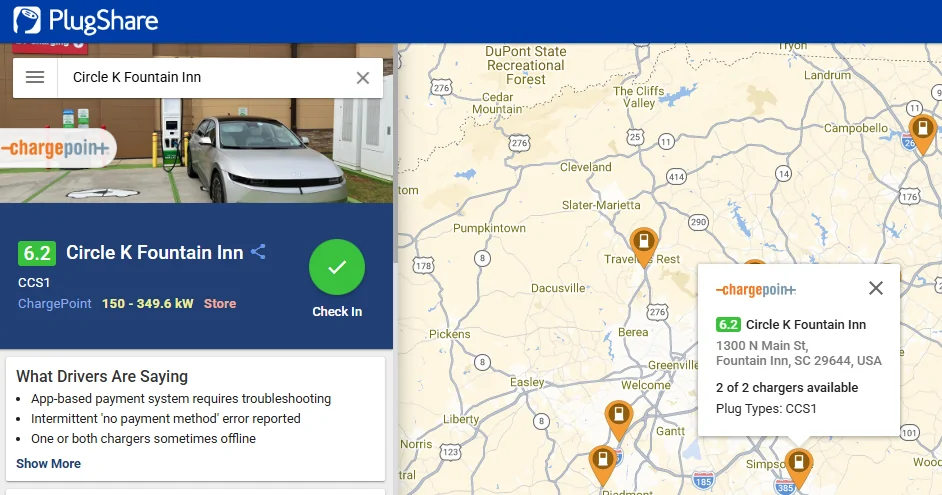
I gotcha. I would also like to point out I think there is some "dirty data" at least in the southeast regarding 800v or 300-400kW chargers. There are A TON of newly installed POS chargers that are only 200 amp capable, but purport to be 350kW chargers. For example, below near me. This thing isn't pulling over 150kW and that's if you are 800v car. It doesn't get above 80kW on 400v and they installed these things everywhere.

So I hesitate to say there's a lot of 800v capable 300kW+ charges around, bc I think the data on it is muddy. People (not saying you) love to show PlugShare and say "you're wrong look at all these in the Carolinas" when in reality those of us who live here know they're few and far in between.

Rivian R1T R1S R2 10-80% charge test (by State Of Charge) 1783432141466-l4


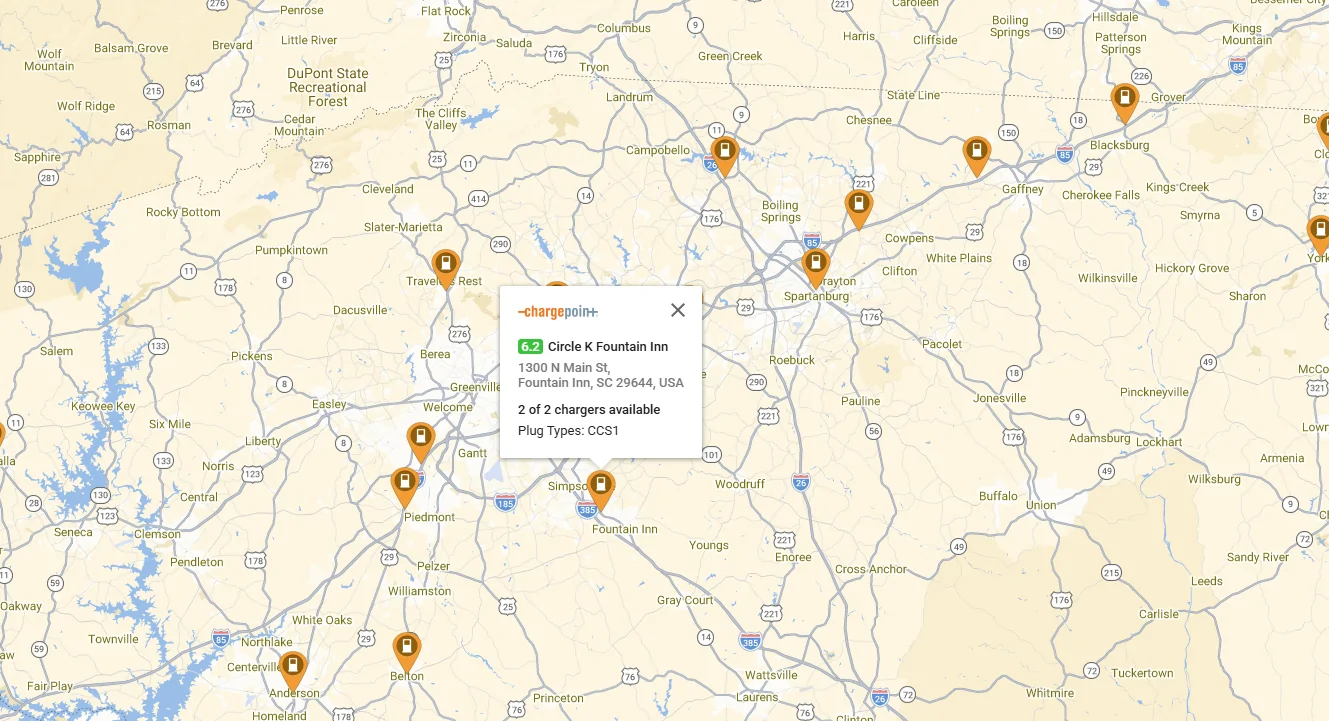
There's at least 5 sites in the picture below that are the same 200 amp crap charger, even though I filtered by only 300kW+ sites on PlugShare. So as you can see there's only a few 800v 300kW+ chargers to use if you want that fast charging time. Pilot, EVGO, EA, IONNA, and Rivian have one each. And this is along I-85 between ATL and CLT, a major interstate. So it's just not that ubiquitous to me.

Rivian R1T R1S R2 10-80% charge test (by State Of Charge) 1783432487110-73
.
 
Last edited:

Indy avocado

Well-Known Member
First Name
Greg
Joined
Dec 17, 2022
Threads
3
Messages
223
Reaction score
312
Location
Indiana
Vehicles
'22 R1T, '17 Macan S, '11 Mustang GT
Also we have to stop using miles as a metric :CWL: SoC or kWh added is all that matters. Miles added is meaningless IMO bc it's a metric that changes greatly depending on conditions.

I used to completely agree, but I've been converted. I can't drive percent!
When we have vehicles of wildly different efficiency, miles matters more than energy.
However, when towing, energy is the only thing that matters.

Miles should scale approximately equally across vehicles depending on speeds and efficiency.


Audit E-Tron is slower 10% to 80% than R2 though.
You sure about that!? ~26 minutes per EVKX (I forget, but I remember the Etron being sub 30min).
https://evkx.net/models/audi/e-tron/e-tron_55/chargingcurve/
(The Etron had a way over-built [Expensive] battery, so it's not entirely fair).

Other may disagree, but I think it's around 2030 before we see 800v being the standard. Likely R2 Gen2 which won't be til around 2030 either. It's going to take 3-4 years for IONNA, Walmart, and others to really build out their charging networks.
For big battery vehicles, 800V is the standard already IMO. For sedans and cheaper CUVs, 400V will remain for a long time, agreed.

We're also only talking what, 5, 7, maybe 10 minutes if we're lucky shaved off the 10 to 80% time? And it'll only be around 5 minutes shaved off the 10 to 70% time. So unless you're a heavy road tripper, it's more a nice to have than needed IMO.
You've got this backwards. The time savings are all before 50%. so you save 5-10 minutes from 10-50%, and 0 minutes from 50 to 80%.

I'm biased because I regularly drive 500-700miles in a day at 75-80mph, meaning typically 3-5 stops. Driving EV is already adding 1-2 hours to these excessively long trips.

I also did a lot of towing, so I was stuck with a pattern of ~90 minutes of driving, ~30-40 minutes of charging when I had the camper behind. Taking 10 minutes off of that is pretty meaningful.

As I've been building out my tool (evbench.pluginpath.com) it's converted me a bit. There's not a huge difference in total trip time between 25 and 35 minute stops. But adding range is the killer feature - it provides flexibility in planning, fewer overhead, and more initial road time (from 100%) where charging speed isn't a factor.

I gotcha. I would also like to point out I think there is some "dirty data" at least in the southeast regarding 800v or 300-400kW chargers. There are A TON of newly installed POS chargers that are only 200 amp capable, but purport to be 350kW chargers.
For sure - the data is imperfect. Luckily, my search would have excluded these specific ones since they only have 2 stalls.
 

Sponsored

Jeremy3292

Well-Known Member
First Name
Jeremy
Joined
Apr 27, 2026
Threads
5
Messages
691
Reaction score
1,103
Location
South Carolina
Vehicles
R2
For big battery vehicles, 800V is the standard already IMO. For sedans and cheaper CUVs, 400V will remain for a long time, agreed.


You've got this backwards. The time savings are all before 50%. so you save 5-10 minutes from 10-50%, and 0 minutes from 50 to 80%.

I'm biased because I regularly drive 500-700miles in a day at 75-80mph, meaning typically 3-5 stops. Driving EV is already adding 1-2 hours to these excessively long trips.

I also did a lot of towing, so I was stuck with a pattern of ~90 minutes of driving, ~30-40 minutes of charging when I had the camper behind. Taking 10 minutes off of that is pretty meaningful.

As I've been building out my tool (evbench.pluginpath.com) it's converted me a bit. There's not a huge difference in total trip time between 25 and 35 minute stops. But adding range is the killer feature - it provides flexibility in planning, fewer overhead, and more initial road time (from 100%) where charging speed isn't a factor.


For sure - the data is imperfect. Luckily, my search would have excluded these specific ones since they only have 2 stalls.
What I meant was 800v being the standard in basically all new vehicles that are made, including Tesla and Rivian, which I don't think will happen til 2030 or so. If you road trip a lot like you said, then I can see wanting that extra 10 minutes charging savings, but for most of America it doesn't really matter. I'll be splashing and dashing from 10% to 70% in 20 min or less in the R2 and hitting the road again. Saving 5 minutes isn't a big deal IMO.
 

mkennedy009

Well-Known Member
First Name
Michael
Joined
Mar 11, 2026
Threads
1
Messages
60
Reaction score
86
Location
Scappoose, OR
Vehicles
2012 Triumph Bonneville T100 110th Anniversary
Occupation
Database developer
Do we realize 2030 is 3.5 years away? Most people who choose to lease will be returning the R2 then.
It is tough to be on the cutting edge of technology. So many Sony products sit in a box at my house.
China has a 5 minute charging battery today (even at freezing). That technology is here.

Why is 80% not the new 100%? We could have 80=100 and then have a 'road trip' mode that will charge to the real 100%, Once. I am constantly doing math in my head to reduce the EPA numbers to 70% (10-80). This gets me the 'real' advantage of the EV.

To be fair I drive a EX90 Plug-in with 32 miles of range. It gets 32 miles, every time. Regen can add a few more. I expect when the range is stated it is not actually 70% of that number for normal driving.
 

electruck

Well-Known Member
Joined
Oct 6, 2019
Threads
74
Messages
4,187
Reaction score
7,786
Location
Dallas, TX
Vehicles
2023 Rivian R1S
My view is that faster charging is better, full stop. There is no downside (except upfront costs). Any "excuses" that aren't along the lines of value fall flat to me.
For the EV market as a whole, I agree. right now, EV adoption (especially in the US), is critically linked to how fast vehicles can be charged (among other things). And I absolutely would not suggest that manufacturers shouldn't continue to make incremental reductions in charge times. I was just pointing out that for folks like me, those incremental improvements can actually introduce some additional pit stop hassle that doesn't exist today (and that hassle will be very real for some of us), so I disagree with your statement of "no downside".

As for value, that's highly subjective. For example, when traveling, I value simplicity over everything else. So I will pay extra for the convenience of plug and charge at Tesla because I value simplicity over the additional cost. Others value cost and don't mind managing a little extra complexity. And in the context of my original statement here, I don't mind if charging takes a little longer if it means I don't have to babysit the charging session (and I fully admit we don't set any records for fastest pit stops on road trips).

but back on topic, I think we understand each other on this matter.
 

Indy avocado

Well-Known Member
First Name
Greg
Joined
Dec 17, 2022
Threads
3
Messages
223
Reaction score
312
Location
Indiana
Vehicles
'22 R1T, '17 Macan S, '11 Mustang GT
Do we realize 2030 is 3.5 years away? Most people who choose to lease will be returning the R2 then.
It is tough to be on the cutting edge of technology. So many Sony products sit in a box at my house.
China has a 5 minute charging battery today (even at freezing). That technology is here.

Why is 80% not the new 100%? We could have 80=100 and then have a 'road trip' mode that will charge to the real 100%, Once. I am constantly doing math in my head to reduce the EPA numbers to 70% (10-80). This gets me the 'real' advantage of the EV.

To be fair I drive a EX90 Plug-in with 32 miles of range. It gets 32 miles, every time. Regen can add a few more. I expect when the range is stated it is not actually 70% of that number for normal driving.
I have been trying to workshop the '80% is labeled 100%' thing for the past year.

And then actually using full 100% capacity is "extended range" 125% mode

It simplifies the logic for non-nerds for both DCFC and overnight charging.
 

jnc007

Well-Known Member
First Name
Josh
Joined
Jun 9, 2022
Threads
13
Messages
103
Reaction score
139
Location
South Portland maine
Vehicles
‘13 tacoma
Occupation
Firefighter/ paramedic
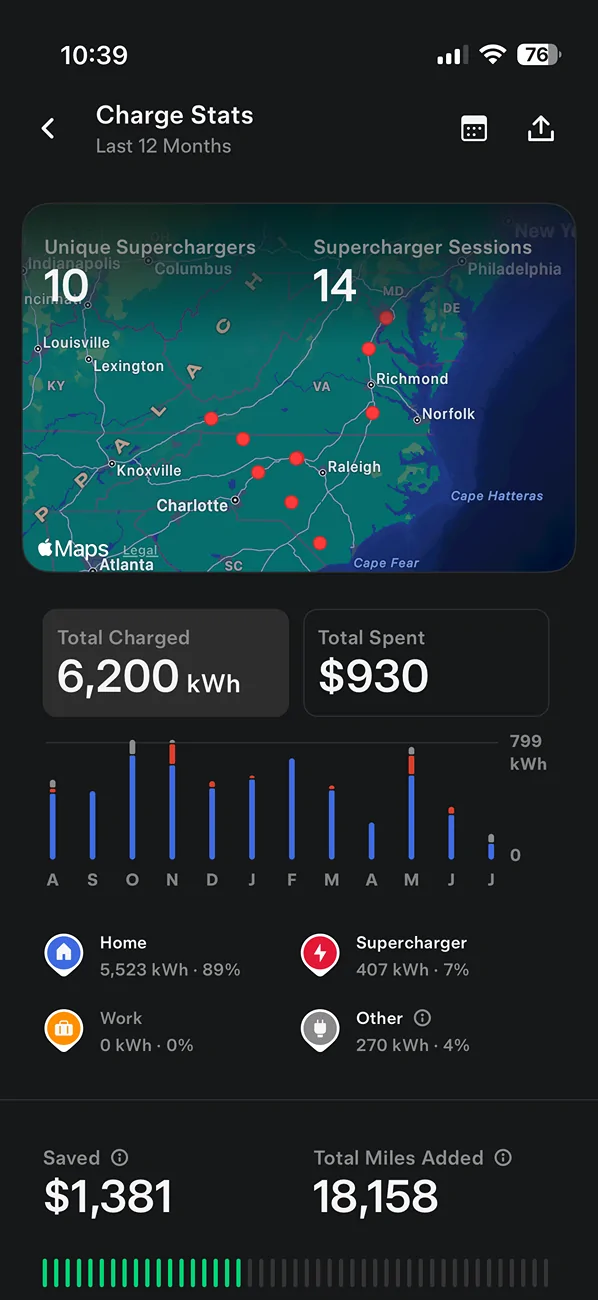
I'd like faster charging just as much as the next guy, but after looking at my stats over the past year, my usage nearly mirrors what RJ expected for fast-charging sessions. 89% of my time is spent charging at home, 4% at my MiL's beach house, and the other 7% is Supercharging. And this is from someone who drives ~20,000 miles/year.

I think I'll do just fine with the R2's charging curve :D

IMG_1385.webp
What is this done through?
 

Sponsored

Jeremy3292

Well-Known Member
First Name
Jeremy
Joined
Apr 27, 2026
Threads
5
Messages
691
Reaction score
1,103
Location
South Carolina
Vehicles
R2
For the EV market as a whole, I agree. right now, EV adoption (especially in the US), is critically linked to how fast vehicles can be charged (among other things). And I absolutely would not suggest that manufacturers shouldn't continue to make incremental reductions in charge times. I was just pointing out that for folks like me, those incremental improvements can actually introduce some additional pit stop hassle that doesn't exist today (and that hassle will be very real for some of us), so I disagree with your statement of "no downside".

As for value, that's highly subjective. For example, when traveling, I value simplicity over everything else. So I will pay extra for the convenience of plug and charge at Tesla because I value simplicity over the additional cost. Others value cost and don't mind managing a little extra complexity. And in the context of my original statement here, I don't mind if charging takes a little longer if it means I don't have to babysit the charging session (and I fully admit we don't set any records for fastest pit stops on road trips).

but back on topic, I think we understand each other on this matter.
Exactly, I agree. The simplicity and ease of using Tesla superchargers cannot be overstated enough. I know where they are along the routes I've taken for years and they just work. I am somewhat of a charging nerd so if I had an 800v car I'd likely search for the 800v chargers but they aren't everywhere like Tesla is and the vast majority of Americans won't be searching for them. They'll just look around and see a supercharger and plugin and wonder why it's taking longer than 15 min 10% to 80%.

I'd also have to be able to find an 800v charger that is on my route at the exact time I'm going to be around 10% SoC, which isn't easy nor possible a lot of times. With Tesla superchargers I can very easily just stop at a supercharger when I'm around 10% SoC bc they're everywhere. Not to mention reliability of these third party networks...I'd only use IONNA or Rivian personally. VERY excited about IONNA though - hope they keep scaling quickly.

So for me yeah in 2030 or so when 800v chargers are everywhere and I can plugin whenever I feel like and not have to think "is this charger 800v capable" it will be great. But today it's more of a headache than anything to try and save 5, maybe 10 minutes.
 

Indy avocado

Well-Known Member
First Name
Greg
Joined
Dec 17, 2022
Threads
3
Messages
223
Reaction score
312
Location
Indiana
Vehicles
'22 R1T, '17 Macan S, '11 Mustang GT
For the EV market as a whole, I agree. right now, EV adoption (especially in the US), is critically linked to how fast vehicles can be charged (among other things). And I absolutely would not suggest that manufacturers shouldn't continue to make incremental reductions in charge times. I was just pointing out that for folks like me, those incremental improvements can actually introduce some additional pit stop hassle that doesn't exist today (and that hassle will be very real for some of us), so I disagree with your statement of "no downside".

As for value, that's highly subjective. For example, when traveling, I value simplicity over everything else. So I will pay extra for the convenience of plug and charge at Tesla because I value simplicity over the additional cost. Others value cost and don't mind managing a little extra complexity. And in the context of my original statement here, I don't mind if charging takes a little longer if it means I don't have to babysit the charging session (and I fully admit we don't set any records for fastest pit stops on road trips).

but back on topic, I think we understand each other on this matter.
If the infrastructure was sufficient where everyone can spend 60 minutes at a charger, then what does it matter if the vehicle is done charging?

In fact, if every vehicle charges faster, site throughput can be higher and make it less of a problem if one or two stalls are occupied for an hour.

I've seen people complaining about these megawatt chargers from China that only have two ports... But if the vehicle charges in 5 minutes, it will have the same throughput as an 8 stall supercharger.
 

Indy avocado

Well-Known Member
First Name
Greg
Joined
Dec 17, 2022
Threads
3
Messages
223
Reaction score
312
Location
Indiana
Vehicles
'22 R1T, '17 Macan S, '11 Mustang GT
There's at least 5 sites in the picture below that are the same 200 amp crap charger
It just hit me that the R2 would charge at twice the speed (~150kW vs ~75kW) for almost the entire charging session on these crappy cable limited chargers if it was 800V ;)
 

electruck

Well-Known Member
Joined
Oct 6, 2019
Threads
74
Messages
4,187
Reaction score
7,786
Location
Dallas, TX
Vehicles
2023 Rivian R1S
If the infrastructure was sufficient where everyone can spend 60 minutes at a charger, then what does it matter if the vehicle is done charging?
"if" is the keyword since that is generally not a reality (although I have encountered Tesla superchargers at Buccees where that actually is the case). but in that hypothetical, it wouldn't matter because you wouldn't be blocking anyone else from charging and, hypothetically, there would be no need for idle fees.

I've seen people complaining about these megawatt chargers from China that only have two ports... But if the vehicle charges in 5 minutes, it will have the same throughput as an 8 stall supercharger.
gas vehicles fill their tanks in just a few minutes so perhaps you should explain to Buccees that they have waaay too many gas pumps. 🤣
Sponsored


Top