

B_Wagon136
Well-Known Member
- Thread starter
- #1
Just had a big overnight charge session from 10% to 80%.
I have a Gen 1 Dual Max Performance. Yes it is winter but I live in SoCal and that is not a factor at these temps.
The vehicle consumed 85 kWh to gain 70% charge (from 10 to 80%). If 85 kWh constitutes 70% of my battery capacity that meant that 100% capacity is only 121 kWh, not the stated 141 kWh for Gen 1 Max. (Rivian roamer currently shows 143.9 usable kWh in my battery pack).
The mileage range also increased from 40mi at 10% to 325mi at 80%. That’s 285 miles of range for 85 kWh, equating to 3.35 mi/kWh. Ain’t nobody getting that kind of efficiency.
So, uh, what gives?
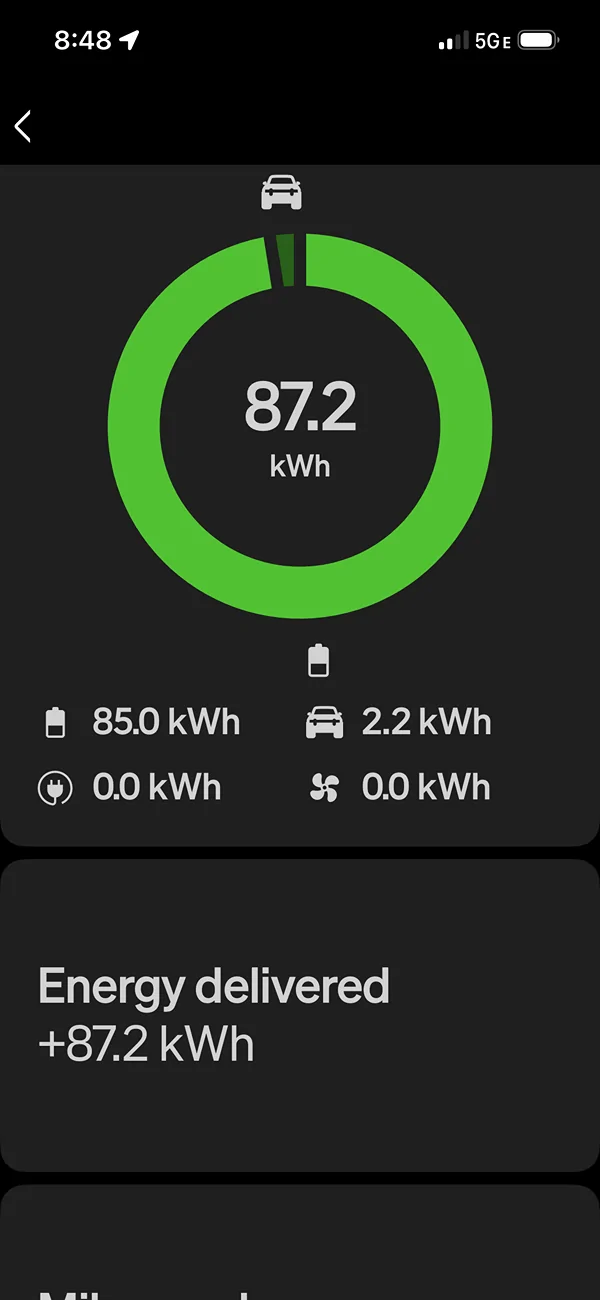
And for the sake of clarity, the 85 kWh consumption im referencing is what was received by the battery itself, not the extraneous amounts that went to other systems (pic attached)

I have a Gen 1 Dual Max Performance. Yes it is winter but I live in SoCal and that is not a factor at these temps.
The vehicle consumed 85 kWh to gain 70% charge (from 10 to 80%). If 85 kWh constitutes 70% of my battery capacity that meant that 100% capacity is only 121 kWh, not the stated 141 kWh for Gen 1 Max. (Rivian roamer currently shows 143.9 usable kWh in my battery pack).
The mileage range also increased from 40mi at 10% to 325mi at 80%. That’s 285 miles of range for 85 kWh, equating to 3.35 mi/kWh. Ain’t nobody getting that kind of efficiency.
So, uh, what gives?
And for the sake of clarity, the 85 kWh consumption im referencing is what was received by the battery itself, not the extraneous amounts that went to other systems (pic attached)
Sponsored
Last edited:


