Sponsored

ta2

Member
Joined
May 21, 2024
Threads
1
Messages
10
Reaction score
0
Location
Vancouver
Vehicles
22 R1S LE & 22 Model Y
Have you heard about any issues with the ceiling speakers? When the initial update dropped, my ceiling speakers worked, but since the "corrected" Apple Music update I've heard nothing.
Ceiling speakers were non functional for me in 2024.31, but are better in 2024.35. They should probably still be a little louder though.
Sponsored


KW_88_SS

Well-Known Member
First Name
Kyle
Joined
Jul 26, 2024
Threads
3
Messages
106
Reaction score
77
Location
Tampa
Vehicles
R1T Launch Edition Quad / Taycan Turbo GT
Occupation
Software Engineer
Ceiling speakers were non functional for me in 2024.31, but are better in 2024.35. They should probably still be a little louder though.
Ya know, it's weird. Turn on "Latch" by Sam Smith. The ceiling speakers completely rip.

I'm not an audiophile by any means but, it feels very song dependant? I thought "Atmos is Atmos", is that possibly not true?
 

ta2

Member
Joined
May 21, 2024
Threads
1
Messages
10
Reaction score
0
Location
Vancouver
Vehicles
22 R1S LE & 22 Model Y
Ya know, it's weird. Turn on "Latch" by Sam Smith. The ceiling speakers completely rip.

I'm not an audiophile by any means but, it feels very song dependant? I thought "Atmos is Atmos", is that possibly not true?
Most of the audio is just 2.0 stereo and the way they map it to 14 speakers or whatever is completely proprietary. It depends on the frequency response and signal to noise ratio of the individual speakers.

In 2024.31 they messed something up big time. But in 2024.35 and others it seems they have not got the perfect setup still.
 
OP
OP
superfluid

superfluid

Well-Known Member
Joined
Mar 29, 2021
Threads
20
Messages
290
Reaction score
923
Location
Austin, TX
Vehicles
Rivian R1S, Kia Telluride
Occupation
Tech and data
Clubs
 
Ya know, it's weird. Turn on "Latch" by Sam Smith. The ceiling speakers completely rip.

I'm not an audiophile by any means but, it feels very song dependant? I thought "Atmos is Atmos", is that possibly not true?
It’s extremely song-dependent because it’s extremely artist and engineer dependent. The music industry is just starting to learn how to use immersive audio to improve music. I’d say most mixing engineers haven’t gotten it down yet, but they’re working through it.

A good analogy is the use of 3D in movies. Early producers of 3D movies leaned heavily on showing off the technology, which turned into lots of springs and arrows popping out of the screen at you, doing more to distract you from the movie’s storyline than advance it. Producers wanted to show what they could do with 3D so they drew our attention to the 3D—which is not what we really care about in a movie. A primary example of an early 3D movie going too far with the tech is Journey to the Center of the Earth (2008) with Brendan Fraser whose 3D effects were just silly. Many scenes were storyboarded to show off the 3D instead of build tension, develop characters, or advance the plot, imo. Even earlier than that were first-generation 3D theme park rides that splashed water and puffed air at you when something came out of the screen. I think the Terminator ride at Universal did something like that. We can tolerate that kind of stuff for 15 minutes but not 2.5 hours because its usage was immature and took away from the movie instead of added to it. Imagine watching Seven Samurai or a classic like that in 3D. I’m not sure the film would improve.

It took many generations of filmmakers to experiment with and learn how to use 3D to increase the effectiveness of the storytelling. Avatar 1 and 2 are good examples of films that tried to understand the inherent value of 3D (immersion) and use it to tell a better story. As producers learned, 3D effects became more subtle, measured, and deliberate. We all learned that most visual content doesn’t benefit enough from 3D to make the added complexity of producing and delivering it worth it—to the point where very few display manufacturers offer 3D displays anymore, even though nearly all of them touted their 3D features 3-4 generations of displays ago. Remember the active vs. passive 3D glasses war? Exactly =)

The same kind of journey is happening in the immersive audio world. A ton of mixing engineers and recording artists got their hands on a new generation of immersive audio tech (object-based immersive encoding like Atmos) because content distributors and device makers are selling the tech’s benefits to consumers. Musicians and engineers are now playing catch-up and learning how to use immersive audio to produce better music. It’ll take them time. The most likely thing to happen is we realize that not all music sounds better when the snare drum comes from behind us. But some music does. Learning what mixing decisions benefit from immersive audio and what doesn’t is a journey that will take a few generations of engineers and record labels to parse out. I think the jury is still out as to whether music benefits enough from immersive mixes to make its production and delivery worth it to most people.

Here’s my current—unsolicited—opinion on this: Well-mixed immersive audio sounds great in a car because a car is such a spatially compromised environment already. We don't sit between the left and right channels so real stereo imaging is impossible without significant signal processing which can only do so much. Immersive mixes can improve our ability to localize sound and hear a better spatial image in car. However, I don't think immersive music sounds better in a well-calibrated media room like mine. I A/B'd some well-mixed immersive songs (see Billie Eilish's Bad Guy in Atmos and stereo) with their stereo counterparts on my home system. While neat, the Atmos versions aren't good enough to make me switch from my regular stereo playlists.

On the other hand, I think live musical performances recorded in immersive audio can sound glorious on a home system. I can go into more depth about why another time, but well-engineered live performances record spatial cues from the churches, symphony halls, and jazz clubs they're performed in, which a properly calibrated Atmos system can capitalize on and use to transport you out of your home and into those venues. John William's live performance of Imperial March from his Wiener Philharmonic in Vienna disc in Atmos is a fantastic example.

For now, we have the results of the music industry’s experimentation in immersive audio and they have our feedback. It’ll be hit or miss as we learn what tends to work and what doesn’t.
 
Last edited:

SamDoe1

Well-Known Member
Joined
Nov 22, 2022
Threads
2
Messages
253
Reaction score
280
Location
Minnesota
Vehicles
Rivian R1T, BMW M2 Comp
Clubs
 
^ This. There are some songs on Apple Music encoded in Atmos that sound absolutely phenomenal (try Love by Lorde or The Door by Teddy Swims) and others that are just labelled Atmos for fun and not specifically recorded/encoded in the right way with all of the specific channels mapped to the correct speaker.
 

Sponsored

OP
OP
superfluid

superfluid

Well-Known Member
Joined
Mar 29, 2021
Threads
20
Messages
290
Reaction score
923
Location
Austin, TX
Vehicles
Rivian R1S, Kia Telluride
Occupation
Tech and data
Clubs
 
Measured @RivianBowerbird 's Gen 1 R1T Meridian 2024.39.01 today. We learned several interesting things, including that Rivian engineers paid attention to this one. The Gen 1 R1T Meridian sounds great. Full analysis—and recommendations—to come.
 
  • Like
Reactions: ta2

Alanca3

New Member
First Name
Andy
Joined
Apr 28, 2026
Threads
0
Messages
3
Reaction score
3
Location
Louisiana
Vehicles
Porsche Macan, F-150
Occupation
Sales
Super cool to see others taking in-situ measurements of their audio systems. I actually made an account just to reply to this thread with some tips regarding your measurement methodology. I came across these posts as I'm considering buying a pre-owned Rivian, and audio quality is very important to me.


This might be a bit long winded, but here is my experience as an audio engineer.

REW uses a standard swept sine stimulus and performs an FFT to derive the magnitude and phase response of your device under test. The output sweep of your laptop is compared to the input of your microphone, and the difference between the two is the response of your loudspeaker. The problem with a single point measurement is that the computer can't tell which parts of the impulse response are direct and which are reflected. As such, you'll see many peaks and valleys unless you apply smoothing or gating, since the various reflections destructively interfere at the measurement position. To make things worse, vehicles are comparatively small and have many hard surfaces. This has the effect of raising the transition frequency. This is the frequency at which the room stops behaving modally and starts behaving specularly; in other words, when reflections take over the response. If you apply smoothing, you're simply hiding parts of the measurement. If we apply frequency dependent gating, you separate the direct vs indirect components of the response at the expense of frequency resolution. It's also not how human's hear. The best option is to take many measurements and perform a spatial average. You can do this by either running many sweeps at different mic positions, or by running a continuously averaging RTA measurement whilst slowly moving the mic around (MMM; moving mic method). Continued below
 

Alanca3

New Member
First Name
Andy
Joined
Apr 28, 2026
Threads
0
Messages
3
Reaction score
3
Location
Louisiana
Vehicles
Porsche Macan, F-150
Occupation
Sales
To create a spatially averaged sweep, you must perform at least 6 (preferably more) measurements in a sloping rectangular pattern around the driver position. In REW, you then cross-correlate align the impulse responses, and then perform "RMS + Phase" average of the responses. What you're doing is aligning the measurements in time, averaging the magnitude response (without regard to phase aka scalar averaging), and averaging the phase response (time information). This will yield an accurate frequency response which correlates more closely to what you actually hear in the vehicle. Below I’ve attached some pictures of the proper mic placement, as well as the measurements of my base model 2022 F-150. The alternative method is easier, and is called the moving mic method. I can’t come up with a better write-up than the folks over at AudioScienceReview, so I’ll drop a link to that guide here.


Speaking of measurement methodology, we need to ditch the bluetooth. Bluetooth has compression baked in, meaning parts of the spectrum are selectively chopped off to save data. This invalidates the data, and also makes timing information impossible. There is any easy way around this; exporting stimulus files. In REW, you can export a file containing the sweep information. You can then add this file to your iPhone, USB stick, whatever you choose. You play the stimulus while recording the input from your mic in a separate app. This way you’re playing an uncompressed, bit perfect copy of the stimulus file. Make sure to set the export to 32bit wave / 48Khz sampling rate to match the UMIK sampling rate, and use your phone plugged in (or CarPlay, if Rivian has that).


So in summary, to get the best data, you have to take many measurements and provide an uncompressed stimulus file. By carefully averaging the measurements, you can get actionable data. A single point measurement is deceptive and doesn’t really tell you the whole story. Our perception of tonality and timbre depends heavily on the relative timing of acoustic signals, so single point just doesn’t cut it.


Rivian R1T R1S How to Improve a Gen 1 Rivian R1S’s Meridian Sound System After Update 2024.27.01/35.00 With Simple EQ Changes Avg vs Ra

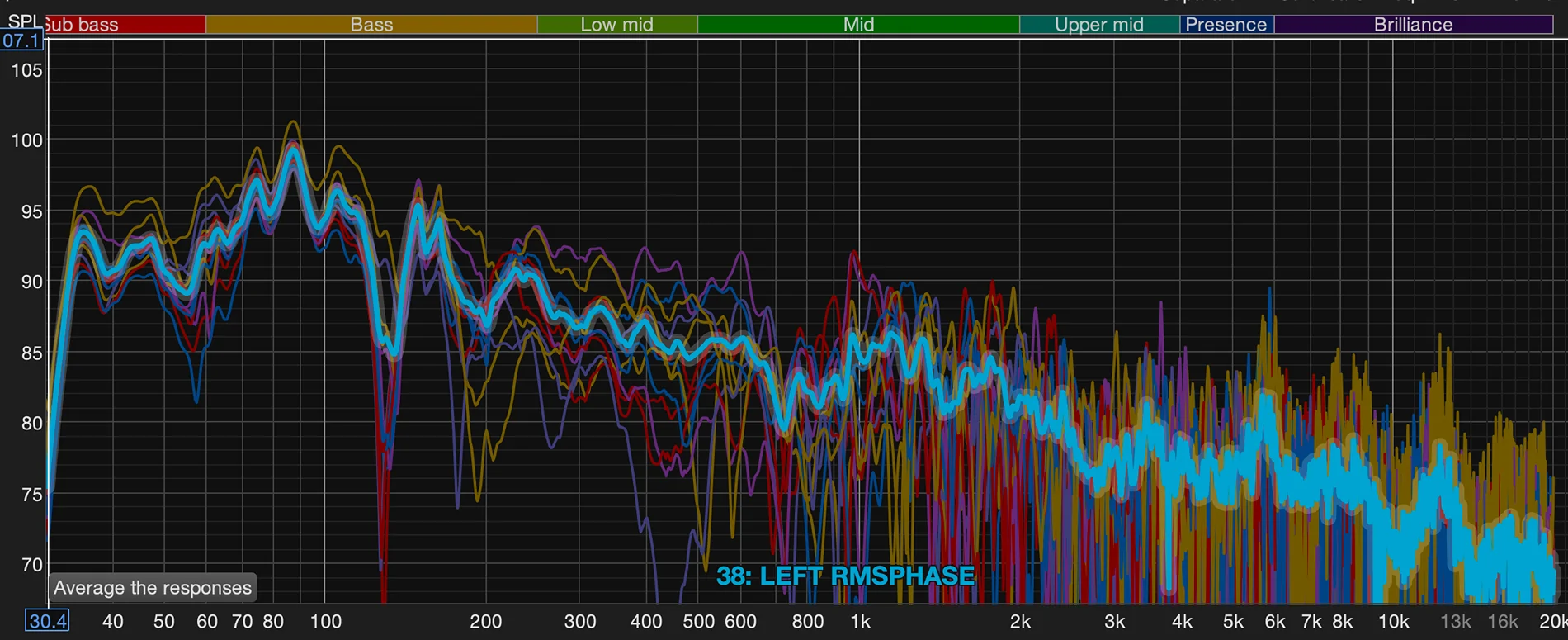
F150 Measurement of left channel. Blue is the average, the rest are the individual measurements. No smoothing applied at all. Note the scale of the Y axis as well. This is the industry standard scaling and provides an intuitive understanding of how the graph might sound (each division being 1db, and major divisions every 5 db). Different scaling can vastly change how we interpret the data.


Rivian R1T R1S How to Improve a Gen 1 Rivian R1S’s Meridian Sound System After Update 2024.27.01/35.00 With Simple EQ Changes Screenshot 2026-04-28 at 2.02.42 PM

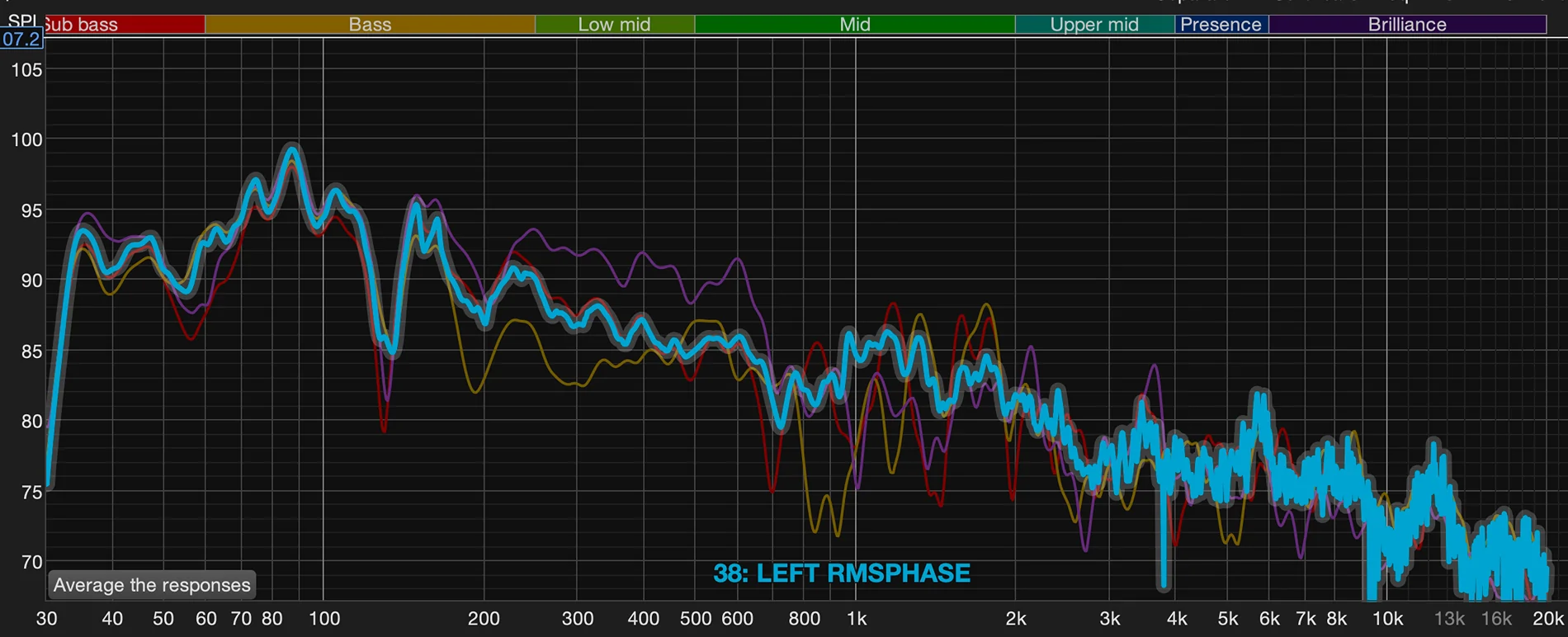
Three closely spaced measurements (with 1/12 octave smoothing), compared to the non-smoothed average (blue). Notice the vast difference in response across an area of maybe 4-8 inches. Red is the center, main position. Good agreement at lower frequencies below the transition frequency, then variable agreement above it (approx 800hz).


Rivian R1T R1S How to Improve a Gen 1 Rivian R1S’s Meridian Sound System After Update 2024.27.01/35.00 With Simple EQ Changes csm_GR22FA_1_11abc1ec39

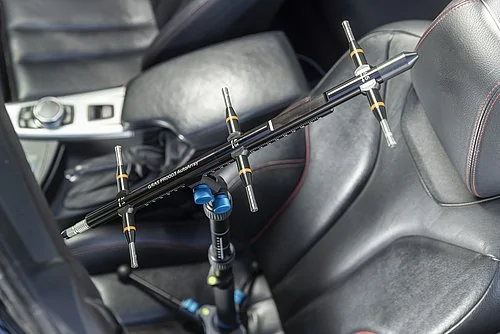
The latest accepted automotive measurement rig as laid on by the AES. These are very expensive, you can emulate it by taking 6 separate measurements.
 
Last edited:

Alanca3

New Member
First Name
Andy
Joined
Apr 28, 2026
Threads
0
Messages
3
Reaction score
3
Location
Louisiana
Vehicles
Porsche Macan, F-150
Occupation
Sales
Hopefully this was a helpful write-up. I think your measurements are really cool, so I just wanted to share some of my experience from the pro-audio world. AudioScienceReview has a bunch of great resources as well, as does the AES library.
 
OP
OP
superfluid

superfluid

Well-Known Member
Joined
Mar 29, 2021
Threads
20
Messages
290
Reaction score
923
Location
Austin, TX
Vehicles
Rivian R1S, Kia Telluride
Occupation
Tech and data
Clubs
 
@Alanca3 Thanks for this excellent rundown of proper methodology from a pro! I ported my home acoustics-based methodology to the car to diagnose a glaring performance issue. It helped me identify the central issue (a massive SPL swing centered at 1 kHz), but I quickly understood it wasn't particularly accurate about anything else. As I researched car audio measurement methodology more, I realized I needed more equipment and more knowledge. By that time, I got my Rivian sounding good enough for my tastes and let it be =)

In REW, you then cross-correlate align the impulse responses, and then perform "RMS + Phase" average of the responses. What you're doing is aligning the measurements in time, averaging the magnitude response (without regard to phase aka scalar averaging), and averaging the phase response (time information). This will yield an accurate frequency response which correlates more closely to what you actually hear in the vehicle.
I did not know this. I wonder why we don't do this in home acoustics. My guess is that home spaces are so much bigger than a car's so the transition frequency is often around 300-500 Hz, below which is where the most damaging modal problems show up. I guess we don't need to phase-align measurements in the 20-500 Hz range to see those issues (minimum phase?).
Speaking of measurement methodology, we need to ditch the bluetooth. Bluetooth has compression baked in, meaning parts of the spectrum are selectively chopped off to save data. This invalidates the data, and also makes timing information impossible.
Agree!
A single point measurement is deceptive and doesn’t really tell you the whole story. Our perception of tonality and timbre depends heavily on the relative timing of acoustic signals, so single point just doesn’t cut it.
You're right. I tried RTA and got wacky results. It was definitely user-error but the interior of the car was already getting too hot (had to turn off the air to reduce the noise floor) so I switched back to sweeps. If I do measurements again, I'll go back to trying RTA. RTA works fine in my media room.

Re: Rivian's audio performance, the quality between generations of vehicle and trim levels is stark. I'd definitely spend time auditioning the audio in any vehicle you consider. You might want to budget for a subwoofer upgrade, regardless of generation or trip. So far, I've decided against upgrading mine because I invested that money in acoustically treating my listening room at home.
Sponsored


Top