
ksurfier
Well-Known Member
- Thread starter
- #1
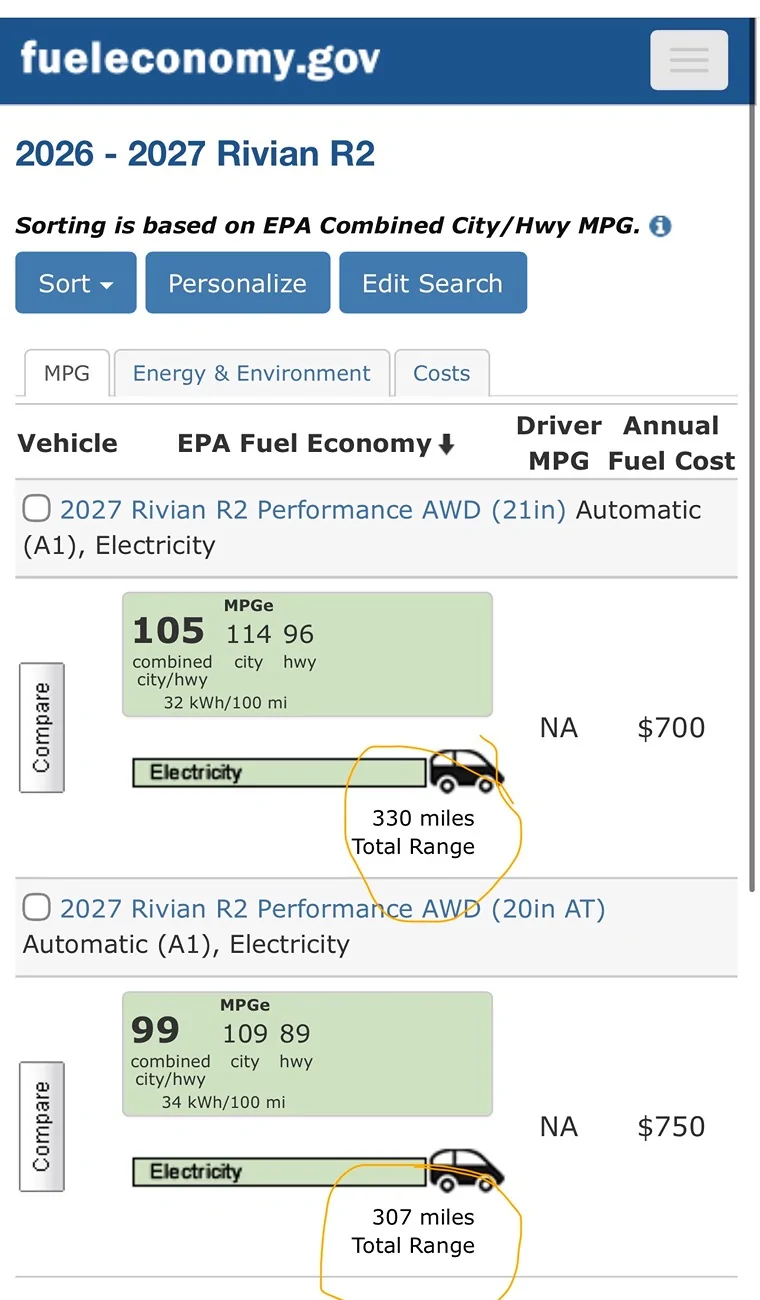
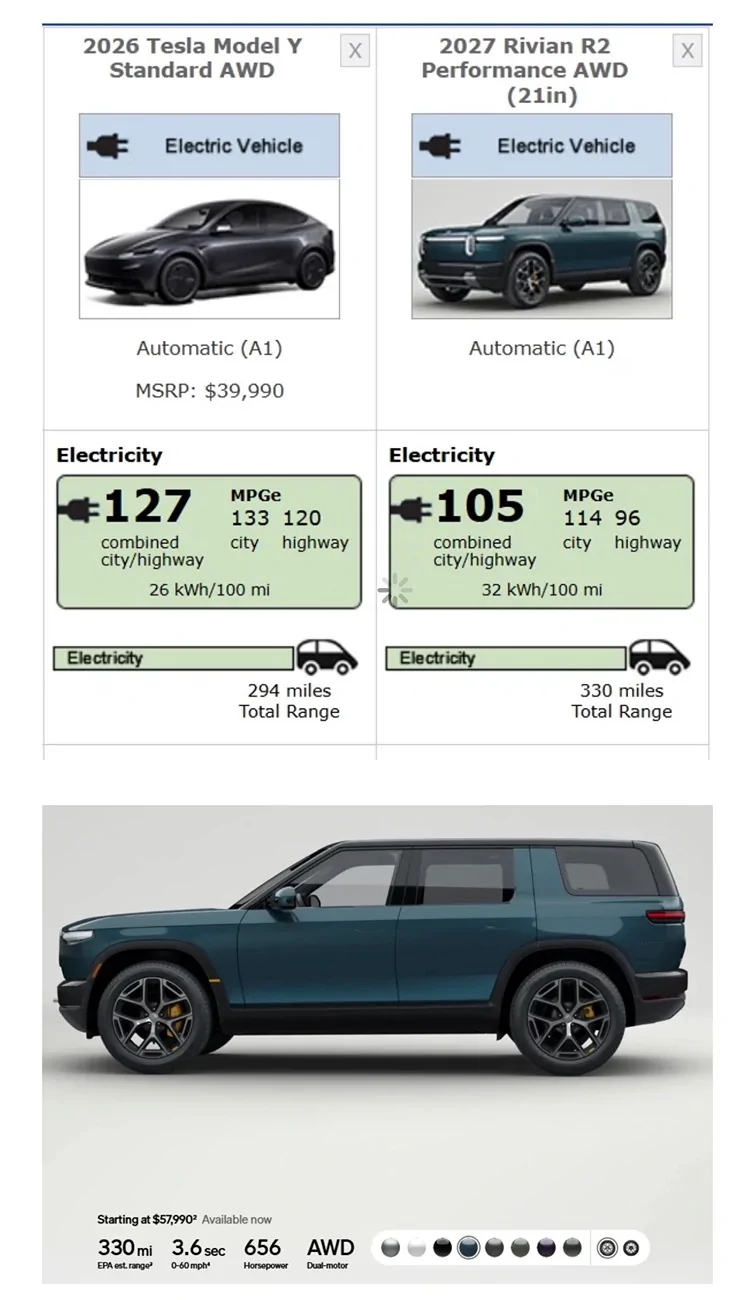
For anyone expecting the R2 to deliver 330 miles in everyday driving, here’s the bigger picture.
The issue isn’t that the R2 is inefficient. It’s that EPA range ratings have changed significantly over the last few years, and those changes tend to favor vehicles whose efficiency drops rapidly at higher highway speeds—exactly what happens with taller, boxier SUVs like the R1 and R2.
The first-generation R1 used a much more conservative EPA certification approach that historically tracked real-world highway driving fairly well. Beginning with the refreshed Gen 2 R1, Rivian adopted a newer EPA methodology that produces substantially higher EPA numbers while doing little to change what owners actually experience at 70–80 mph.
The Numbers Tell the Story
What’s Changed?
On paper, Rivian appears to have improved efficiency dramatically:
Yet real-world highway testing simply doesn’t support anything close to that magnitude of improvement.
The original R1 generally returns around 2.2–2.3 mi/kWh at 70 mph.
The refreshed Gen 2 R1 is…also around 2.2–2.3 mi/kWh.
The R2 appears somewhat better—roughly 2.65–2.85 mi/kWh based on early testing—but nowhere near the 3.75 mi/kWh implied by its EPA rating.
The Underlying Issue
The newer EPA certification approach places much greater emphasis on lower-speed driving and comparatively little emphasis on sustained freeway speeds above roughly 50–55 mph.
That matters because aerodynamic drag increases with the square of speed, while the power required to overcome it rises approximately with the cube of speed.
For vehicles with a relatively tall, upright profile—like the R1 and R2—energy consumption climbs rapidly once cruising speeds reach 65–80 mph.
As a result:
The Bottom Line
The R2 is likely to be an outstanding vehicle.
But buyers expecting 330 miles at normal interstate speeds may be disappointed.
Based on the available highway testing, a more realistic expectation appears to be:
It’s that the EPA rating system has evolved in a way that can overstate real-world highway range for aerodynamic SUVs, and the R2 appears to be the clearest example yet of that growing disconnect.


The issue isn’t that the R2 is inefficient. It’s that EPA range ratings have changed significantly over the last few years, and those changes tend to favor vehicles whose efficiency drops rapidly at higher highway speeds—exactly what happens with taller, boxier SUVs like the R1 and R2.
The first-generation R1 used a much more conservative EPA certification approach that historically tracked real-world highway driving fairly well. Beginning with the refreshed Gen 2 R1, Rivian adopted a newer EPA methodology that produces substantially higher EPA numbers while doing little to change what owners actually experience at 70–80 mph.
The Numbers Tell the Story
| Model | Usable Battery (kWh) | EPA Range (mi) | EPA Efficiency (mi/kWh) | Typical 70 mph Efficiency (mi/kWh) | Approx. 70 mph Highway Range |
| 2022-2023 R1S Quad (Gen 1) | ~128 | 316 | 2.47 | ~2.2-2.3 | 280-295 mi |
| 2025-2026 R1S (Gen 2) | ~109 | ~315-320 | ~2.9 | ~2.2-2.3 | 240-255 mi |
| 2027 R2 Dual Motor | ~88 | 330 | 3.75 | ~2.65-2.85 | 235-250 mi |
What’s Changed?
On paper, Rivian appears to have improved efficiency dramatically:
- Gen 1 R1: ~2.47 EPA mi/kWh
- Gen 2 R1: ~2.9 EPA mi/kWh
- R2: 3.75 EPA mi/kWh
Yet real-world highway testing simply doesn’t support anything close to that magnitude of improvement.
The original R1 generally returns around 2.2–2.3 mi/kWh at 70 mph.
The refreshed Gen 2 R1 is…also around 2.2–2.3 mi/kWh.
The R2 appears somewhat better—roughly 2.65–2.85 mi/kWh based on early testing—but nowhere near the 3.75 mi/kWh implied by its EPA rating.
The Underlying Issue
The newer EPA certification approach places much greater emphasis on lower-speed driving and comparatively little emphasis on sustained freeway speeds above roughly 50–55 mph.
That matters because aerodynamic drag increases with the square of speed, while the power required to overcome it rises approximately with the cube of speed.
For vehicles with a relatively tall, upright profile—like the R1 and R2—energy consumption climbs rapidly once cruising speeds reach 65–80 mph.
As a result:
- Around town, the EPA numbers can be quite representative.
- On long interstate trips, those same vehicles lose efficiency much faster than the EPA rating suggests.
The Bottom Line
The R2 is likely to be an outstanding vehicle.
But buyers expecting 330 miles at normal interstate speeds may be disappointed.
Based on the available highway testing, a more realistic expectation appears to be:
- ~235–250 miles at a steady 70 mph
- More at slower speeds.
- Less at 75–80 mph, in cold weather, or with headwinds and elevation gain.
It’s that the EPA rating system has evolved in a way that can overstate real-world highway range for aerodynamic SUVs, and the R2 appears to be the clearest example yet of that growing disconnect.
Sponsored
Last edited: